
The MD Anderson Cancer Center, part of the University of Texas and located in Houston, is a giant hub of huge cancer research money, even for US standards. They also do a lot of science there, which only purpose seems to be publishing in big journals in order to generate even more money. If there is any genuine interest to help cancer patients with actual research: this stands in a stark contrast with MD Anderson’s evident attitude to research reproducibility and data integrity. A number of their star researchers who published in most respectable journals papers, had their data flagged on the whistleblowing platform PubPeer as highly problematic. Yet MD Anderson apparently cannot care less. Their star cancer researcher and businessman Raghu Kalluri was never investigated for many problems in his publications, either in those with or those without his misconduct-tainted Portuguese co-author and ex-MD Anderson employee Sonia Melo. When nobody ever investigates your research practices (e.g., because your research institution is blinded by the investor money you brought in), you will per definition never be found guilty of any misconduct. This is probably exactly why the elite journal Nature recently accepted a new paper from the Kalluri lab (Kamerkar et al 2017), on the same topic of exosomes as cancer biomarkers as his irreproducible earlier masterpiece with Melo (Melo et al, Nature 2015). The new Nature paper even again features the same disgraced co-author, who lost a Nature Genetics paper (Melo et al, 2009) and her EMBO Young Investigator funding due to data manipulation.
There is more evidence for research misconduct at MD Anderson. Its former president Ronald DePinho resigned from his position in March 2017, in the wake of enormous financial losses of almost half a billion dollar, but unlike his almost 800 colleagues there, he did not lose his job. DePinho’s own PubPeer record of questionable data is very impressive, but not as impressive as his past salary as president of MD Anderson of $2 Million a year (he now earns “only” $800k).
Bharat Aggarwal left MD Anderson in December 2015 after nine retractions, which certainly restricted his capacity for impactful publishing and funding acquisition in the US, which might have in turn also diminished Aggarwal’s practical use for the Texan elite cancer research center. The pharmacologist retired honourably and kept all his pension and benefits. His PubPeer record can be admired here. Aggarwal’s data manipulations in around 65 papers were originally flagged by pseudonymous Juuichi Jigen, afterwards whole 85 Aggarwal papers were reported (with little consequences) to the US Office of Research Integrity (ORI) by the mitochondria researcher and data integrity detective Paul Brookes, who used to operate a website science-fraud.org, until he was forced to shut down his site after legal attacks. Brookes also flagged the data integrity deficits in papers of others former MD Anderson researchers, namely Dina Chelouche Lev (PubPeer record here) and Ratna Vadlamudi (PubPeer record here). PubPeer also lists numerous concerns for the papers by the MD Anderson leukaemia researchers Michael Andreeff and Marina Konopleva.
A reader of my site forwarded me now a dossier about the works Anil Sood, which I present below. Sood is professor of Gynecologic Oncology and Reproductive Medicine and co-director of Center for RNA Interference and Non-Coding RNAs at MD Anderson, his many grants are listed here. Sood is paid $455k annually by MD Anderson, even slightly more than Kalluri. Unlike Kalluri (PubPeer record here), Sood never had to correct a paper for data integrity problems, despite his impressive list of PubPeer evidence of questionable data. What follows below is an extra. Will MD Anderson care?
Not likely. Their research integrity Ombudsman William Plunkett did not reply to my first email request where I asked if he is interested to see the Sood dossier. My reminder two days later was answered with an auto-reply: “I am out of my office and will reply to your email when I return”. No date was specified: in which year or century Prof Plunkett will be back to deal with my inquiries, I suppose I was expected to wait.
Here is the full file of the Anil Sood dossier. Following is some select evidence, and even more is on PubPeer.
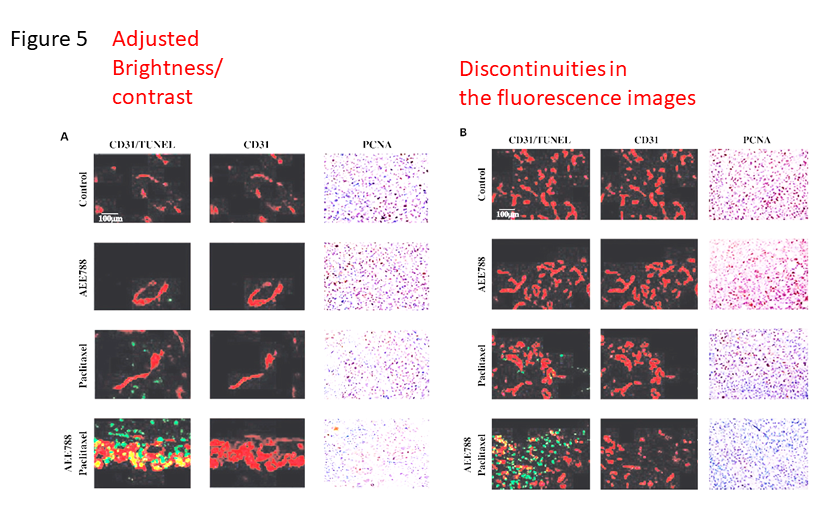
Thaker PH, Yazici S, Nilsson MB, Yokoi K, Tsan RZ, He J, Kim SJ, Fidler IJ, Sood AK. Antivascular therapy for orthotopic human ovarian carcinoma through blockade of the vascular endothelial growth factor and epidermal growth factor receptors. Clin Cancer Res. 2005 Jul 1;11(13):4923-33.
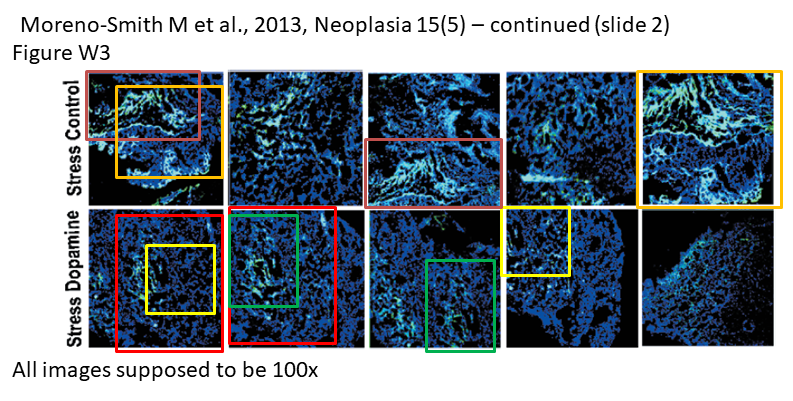
Moreno-Smith M, Lee SJ, Lu C, Nagaraja AS, He G, Rupaimoole R, Han HD, Jennings NB, Roh JW, Nishimura M, Kang Y, Allen JK, Armaiz GN, Matsuo K, Shahzad MM, Bottsford-Miller J, Langley RR, Cole SW, Lutgendorf SK, Siddik ZH, Sood AK. Biologic effects of dopamine on tumor vasculature in ovarian carcinoma. Neoplasia. 2013 May;15(5):502-10.
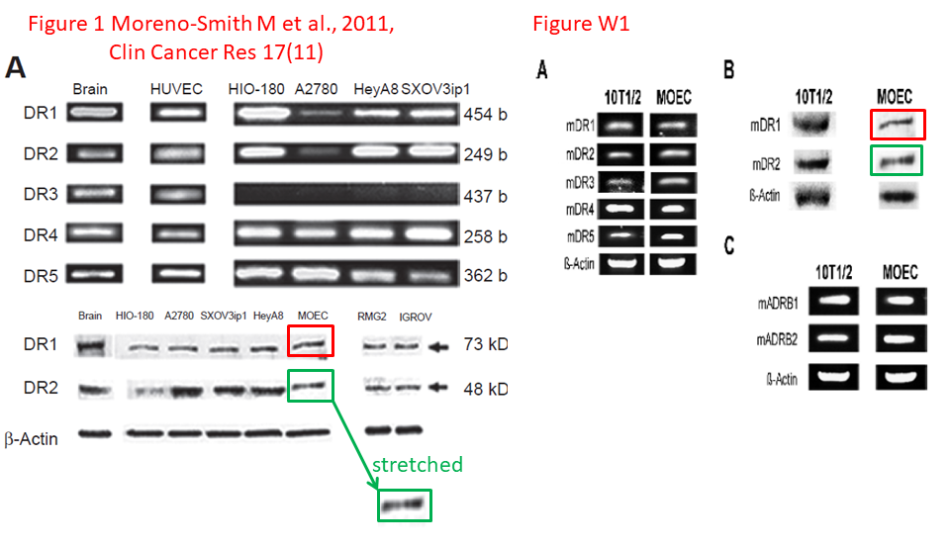
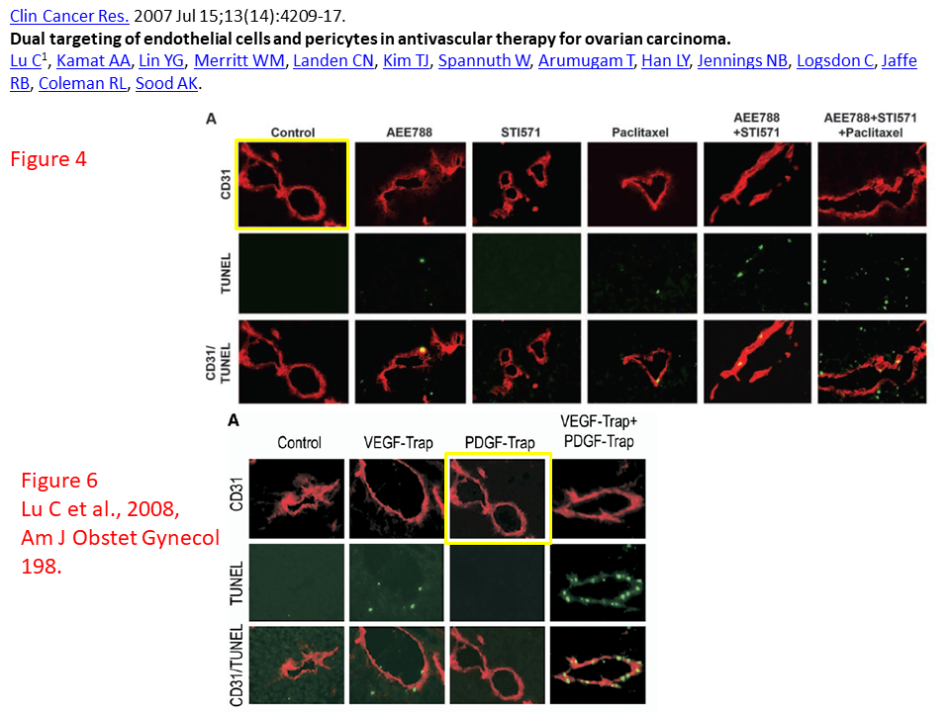
Lu C, Kamat AA, Lin YG, Merritt WM, Landen CN, Kim TJ, Spannuth W, Arumugam T, Han LY, Jennings NB, Logsdon C, Jaffe RB, Coleman RL, Sood AK. Dual targeting of endothelial cells and pericytes in antivascular therapy for ovarian carcinoma. Clin Cancer Res. 2007 Jul 15;13(14):4209-17.
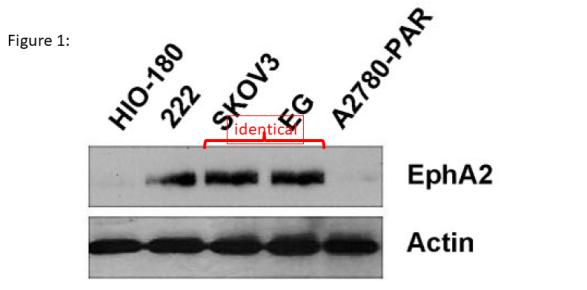
Thaker PH, Deavers M, Celestino J, Thornton A, Fletcher MS, Landen CN, Kinch MS, Kiener PA, Sood AK. EphA2 expression is associated with aggressive features in ovarian carcinoma. Clin Cancer Res. 2004 Aug 1;10(15):5145-50.
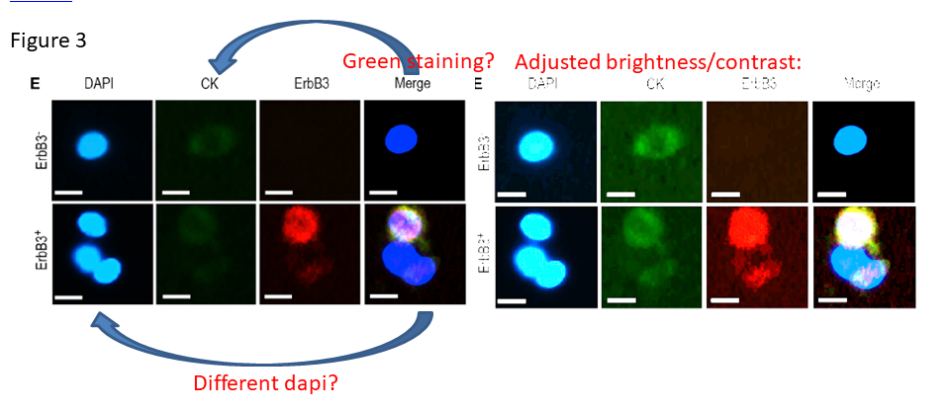
Pradeep S, Kim SW, Wu SY1, Nishimura M, Chaluvally-Raghavan P, Miyake T, Pecot CV, Kim SJ, Choi HJ, Bischoff FZ, Mayer JA, Huang L, Nick AM, Hall CS, Rodriguez-Aguayo C, Zand B, Dalton HJ, Arumugam T, Lee HJ, Han HD, Cho MS, Rupaimoole R, Mangala LS, Sehgal V, Oh SC, Liu J, Lee JS, Coleman RL, Ram P, Lopez-Berestein G, Fidler IJ, Sood AK13. Hematogenous metastasis of ovarian cancer: rethinking mode of spread. Cancer Cell. 2014 Jul 14;26(1):77-91. doi: 10.1016/j.ccr.2014.05.002.
Donate!
If you are interested to support my work, you can leave here a small tip of $5. Or several of small tips, just increase the amount as you like (2x=€10; 5x=€25). Your generous patronage of my journalism will be most appreciated!
€5.00

 For Better Science
Pingback: Xiongbin Lu nanobombs cancer with fluorescent nude mouse recycling – For Better Science
Pingback: Croce begat Calin, and Calin begat Girnita… – For Better Science
Pingback: Prof Elizalde’s Magic Cancer Research at CONICET – For Better Science
28 December 2023 Expression of Concern
https://onlinelibrary.wiley.com/doi/10.1111/his.15124
Abstract
Marques-Piubelli, M.L., Kim, D.H., Medeiros, L.J., Lu, W., Khan, K., Gomez-Bolanos, L.I., Rodriguez, S., Parra, E.R., Ok, C.Y., Aradhya, A., Solis, L.M., Nieto, Y.L., Steiner, R., Ahmed, S. and Vega, F. (2023), CD30 expression is frequently decreased in relapsed classic Hodgkin lymphoma after anti-CD30 CAR T-cell therapy. Histopathology, 83: 143–148. https://doi.org/10.1111/his.14910
This Expression of Concern is for the above article, published online on 30 March 2023 in Wiley Online Library (wileyonlinelibrary.com), and has been published by agreement between the journal Editor-in-Chief, Daniel Berney and John Wiley & Sons Ltd. The Expression of Concern has been agreed due to concerns raised by a third party regarding duplicated sections within some of the panels of Figure 1. The authors admitted to these image alterations which were performed to enhance the visual appearance of the images (correcting folded areas or filling in blank spaces). The authors were able to provide the original, unmodified images and stated that they did not want to misrepresent the critical data or to compromise the scientific integrity of the manuscript. However, the modification of the images to change the appearance is clearly against the ethical policy of Histopathology and Wiley’s Best Practice Guidelines on Research Integrity and Publishing Ethics. Therefore, the journal has decided to issue an Expression of Concern to inform and alert the readers.
Original article.
Histopathology
. 2023 Jul;83(1):143-148. doi: 10.1111/his.14910. Epub 2023 Mar 30.
CD30 expression is frequently decreased in relapsed classic Hodgkin lymphoma after anti-CD30 CAR T-cell therapy
Mario L Marques-Piubelli 1, Do Hwan Kim 2, L Jeffrey Medeiros 2, Wei Lu 1, Khaja Khan 1, Lorena Isabel Gomez-Bolanos 1, Saxon Rodriguez 1, Edwin R Parra 1, Chi Young Ok 2, Akanksha Aradhya 2, Luisa M Solis 1, Yago L Nieto 3, Raphael Steiner 4, Sairah Ahmed 3 4, Francisco Vega 2
Affiliations collapse
Affiliations
1Department of Translational Molecular Pathology, The University of Texas MD Anderson Cancer Center, Houston, TX, USA.
2Department of Hematopathology, The University of Texas MD Anderson Cancer Center, Houston, TX, USA.
3Department of Stem Cell Transplantation and Cellular Therapy, The University of Texas MD Anderson Cancer Center, Houston, TX, USA.
4Department of Lymphoma & Myeloma, The University of Texas MD Anderson Cancer Center, Houston, TX, USA.
PMID: 36994939 DOI: 10.1111/his.14910
LikeLike