
One dishonest scientist sacked, another one is welcomed. At least this is what it looks like at the Spanish National Centre for Cardiovascular Research, CNIC, which seems to be recruiting their principal investigators through the whistleblower platform PubPeer, as the scientist who alerted me to this development quipped half-jokingly. The new recruitment at the Madrid institute is the regenerative medicine researcher Pura Muñoz-Cánoves, whose papers contain evidence of data manipulation in form of band and lane duplications in western blots and gels.
CNIC only recently sacked the ERC-funded heart regeneration researcher Susana Gonzalez. Their investigative report is confidential and not available to public, though one can safely assume misconduct was in play. Gonzalez quickly found another job, at a different Madrid research institute, her €2 Million ERC funding is not terminated, but suspended while ERC investigates (see my brief report here). Gonzalez’ research specialization is cardiac muscle ageing and regeneration (or the data manipulation therein), that of Muñoz-Cánoves is just the same, but for the skeletal muscle. The latter is therefore a suitable replacement for the former in every respect.
The concerned scientist who contacted me about CNIC’s new principal investigator provided some additional information:
“The funding as far as I know is CNIC, meaning national budget is directly injected in the labs. I honestly don’t get it. Pura will keep her joint affiliation at UPF [Universitat Pompeu Fabra, in the Catalonian city Barcelona, -LS], and establish a second lab in Madrid. So she will get the money in Madrid to still keep doing her ‘research’. The truth is that she has little money in Catalonia”.
The Catalonian muscle stem cell researcher Muñoz-Cánoves was elected as member of the prestigious European research organization EMBO in May 2015, just some months later first evidence of data irregularities in her papers appeared on PubPeer.

I contacted CNIC trying to clarify their rationale for such a controversial personnel decision. Vicente Andrés, head of basic research at CNIC, told me the following:
“Dr. Pura Muñoz joined the CNC in January 2016. Shortly after this, Dr. Muñoz became aware of Pubpeer notes regarding several publications from her laboratory and she immediately informed the CNIC Direction. At her own initiative, she contacted the editors of each of the five journals involved in the Pubpeer accusations and provided explanations and primary data for each of them. While one editor has not yet replied, editors from four other journals appreciated the initiative of Dr. Muñoz and were fully satisfied with the explanations provided”
Slightly confused, I asked Andrés if more detailed information on these journal interactions can be provided, as well as the original data Muñoz-Cánoves allegedly submitted there to achieve such response. My CNIC interlocutor first told me that this was “confidential information we cannot provide at the present time”, then specified:
“Although we are aware of the process that Dr. Muñoz initiated to clarify the situation with all papers cited in Pubpeer because she informed us, the CNIC did not participate in any of them. We do not have the original data, which belong to Dr. Muñoz, the co-authors and their institutions. That’s way I mentioned ‘confidentiality’.
Likewise, we do not have detailed information regarding the communication of Dr. Muñoz with all journals, except that she informed us that all but one of the editors have already replied and are satisfied with her clarifications. We are confident she will provide detailed information when the process is finished with all journals”.
Therefore, CNIC accepted Muñoz-Cánoves’ claim that her research data integrity was validated by four journals, with one nonresponsive. But: at least in one case she was not telling the truth. This is what Bernd Pulverer, chief editor of EMBO Journal, declared to me:
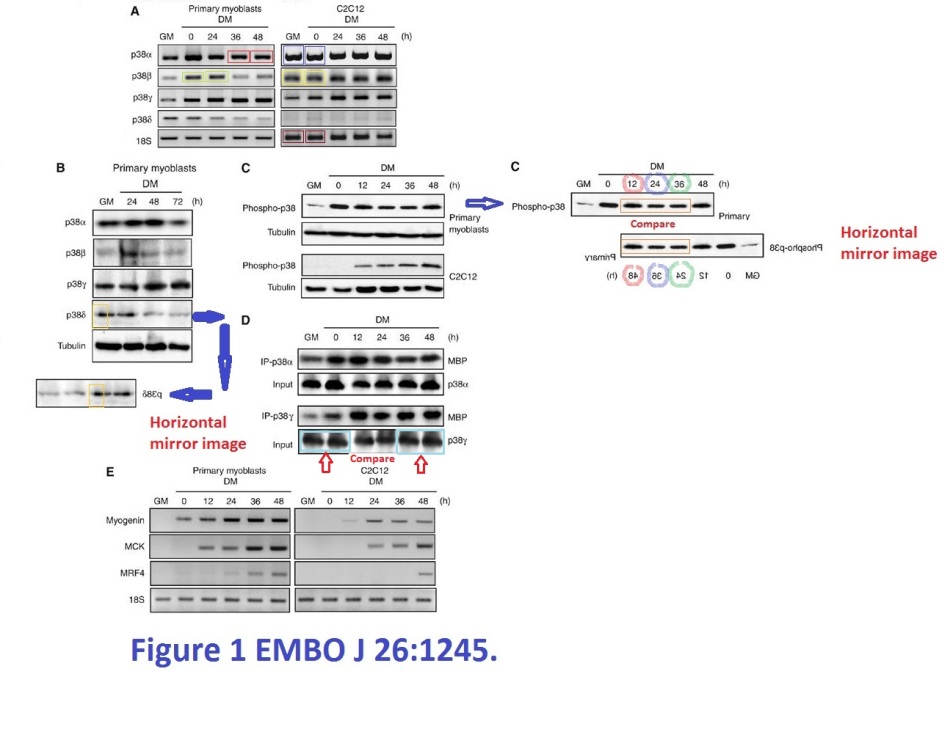
“We have indeed been aware of the PubPeer comments on the two papers authored by Pura Muñoz-Cánoves’s for a few months (see also the note I posted on PubPeer to this effect earlier this year [link here, LS]). We are in fact engaged in a constructive exchange with the relevant parties and we hope to be able to move forward in this matter shortly”.
A journal which can’t care less
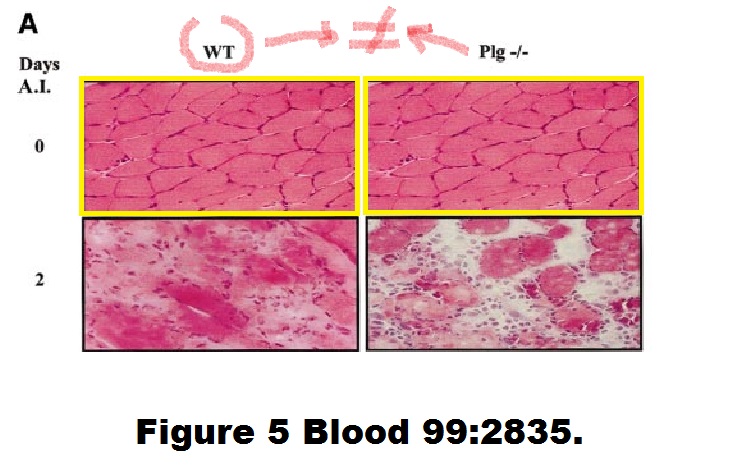
Yet, if the other four journals (Blood, FEBS Journal, Cell Metabolism and Molecular Biology of the Cell) really have reacted as Muñoz-Cánoves claims they did, this would be indeed some worrisome editorial stance. From a previous investigation, I learned that the journal Blood (where another two papers by Muñoz-Cánoves were flagged) has a very peculiar laissez-faire attitude to research integrity. When almost a year ago I provided this journal’s editors with detailed evidence of deliberate data manipulations in the Saumet et al 2008 paper of the French CNRS researcher Charles-Henri Lecellier (whom Olivier Voinnet allegedly banished from his lab for misconduct, sic!), Blood simply buried the issue (see my detailed report here). Hence, I fully trust this journal (published by the American Society of Hematology) not to mind the deceptive lane splicing or image duplications like in this Muñoz-Cánoves paper from 2002:
Pixely evidence
Noteworthy, some anonymous PubPeer commenters jumped to dismiss the data integrity concerns in Muñoz-Cánoves papers by declaring the striking similarities between bands to be coincidental, since very tiny pixel differences were still visible. Is Muñoz-Cánoves a hapless victim of a libel campaign by her envious colleagues?
Here an example for Serrano et al, 2008, where peers even created a forensic analysis to show virtually identical shape pattern of two gel bands, which somebody still found unconvincing as evidence of duplication.


I invited the Turin-based data integrity expert Enrico Bucci to contribute an analysis (disclaimer: I am external consultant at his start-up Resis). Bucci explains the technicalities:
“I used a variance analysis (2 pixel), to produce a map of the band and noise contours. This is a 8-bit map which put a gray-value in each pixel; this value corresponds to the variance in gray levels between the original pixel and the average of the surrounding 2 in every direction. Briefly, you obtain an image which represents the contours of bands and tiny noisy features in the gel. In a true gel experiment, both types of contours are chaotic (much more than the general shape of the bands); in the case under analysis, more than 95% of the pixels included in the contours of one variance map perfectly overlap (in position and intensity) with those in the other variance map. This is physically impossible, because thermal and other sources of noise forbid even a small portion of the contours of two features on a gel to be identical (image artifacts such jpeg compression are irrelevant when comparing contours on a variance map)”.
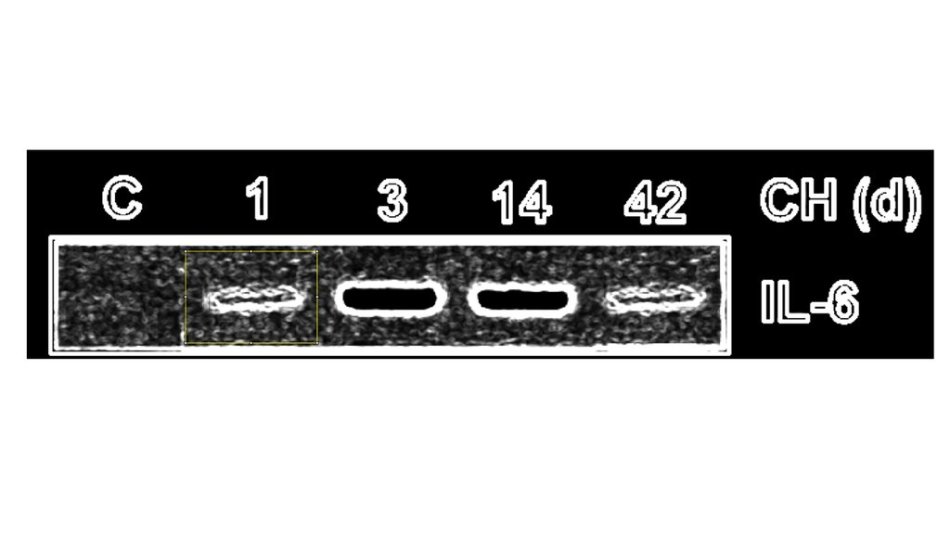
To sum up: bands 1 and 42 in the Muñoz-Cánoves paper in the Cell Press journal Cell Metabolism are according to all evidence the same. One even clearly sees the splicing edges around band 1, demonstrating willful and deliberate image manipulation, with the likely purpose to deceive. Questions remaining here: which author was responsible and, rather rhetorically, how trustworthy are such scientists and their publications.
Another fine scientist vindicated in Spain
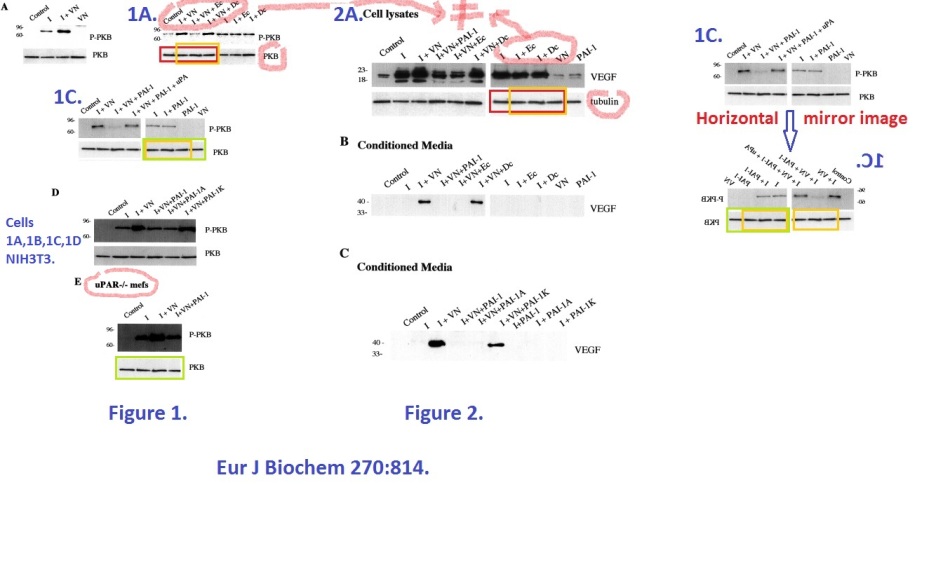
A similar circular debate about band duplications and their denial was led for Perdiguero et al, 2007 and Baeza-Raja and Pura Muñoz-Cánoves, 2004. All these papers were published between 2002 and 2008, when Muñoz-Cánoves used to lead a laboratory at the Centre for Genomic Regulation (CRG) in Barcelona. In this regard, what makes the above described line of defense particularly remarkable is that a different CRG scientist, Maria Pia Cosma was exonerated in May 2015 of similar accusations of band duplications with the exactly same arguments (see the PubPeer thread here). Her CRG colleagues based their decision (which they made final and closed the case) on the “absence of primary data” (sic!) and a questionable forensic report from a local IT expert they commissioned. I obtained copies of these forensic analyses from one senior CRG researcher in charge, Juan Valcárcel Juárez, and had to promise him not to disseminate it (Valcárcel however in turn promised to hand out these to anyone requesting it from him). The “expert” compares western blot bands in Cosma publications which were flagged as suspiciously too similar, and takes every single non-overlapping pixel as evidence of the blot bands’ separate and independent origin.
Specialists quickly demonstrated that the CRG understanding of data integrity is actually false: digital image compression during figure processing is the most likely source introducing such miniscule pixel differences. At the same time, as Bucci explained above, a certain degree of overlap between two allegedly unrelated bands serves as sufficient evidence for digital band duplication. You could do the same with your own face photograph and claim to have met your long-lost twin, evidenced by the picture of you both next to each other. Bottom line: no two physically separate gel bands, even those made from same samples under same experimental conditions and acquired with same methods can ever be that similar. It is simply statistically utterly improbable. This is why some devious scientists sometimes re-use physically different image acquisitions of the same bands in order to hide their common origin. Hence, if you splice two consecutively snapped photographs of yourself, instead of copy-pasting same photo, your case for having found your long-lost twin will look much more convincing (though you still would be cheating).
In any case, one year ago CRG happily decided not to question the forensic report which showed exactly what they (and certainly Cosma herself) wanted to see. Now, exactly same defence strategy is being used to protect from scrutiny the CRG papers by Muñoz-Cánoves, which of course may be just a coincidence. What counts is: the information provided to me by her new CNIC colleague Andrés makes no mention of any investigations whatsoever into Muñoz-Cánoves work either at CRG or at the Universitat Pompeu Fabra.
Apparently, all three research institutions are prepared to accept whatever Muñoz-Cánoves negotiates with the journals herself, unquestioned. Which makes it a Spanish tradition: Muñoz-Cánoves’ Catalonian collaborator Manel Esteller was also tasked by the institute IDIBELL with investigating himself (details here). Thus, congratulation to CNIC on gaining an EMBO member as new PI!
List of Muñoz-Cánoves papers, flagged on PubPeer:
Serrano et al, Cell Metabolism (2008)
Perdiguero et al, EMBO J (2007)
Baeza-Raja and Pura Muñoz-Cánoves, Mol. Biol. Cell (2004)
López-Alemany et al, Eur. J. Biochem, now FEBS Journal (2003)
Donate!
If you are interested to support my work, you can leave here a small tip of $5. Or several of small tips, just increase the amount as you like (2x=€10; 5x=€25). Your generous patronage of my journalism will be most appreciated!
€5.00

 For Better Science
The new recruitment at the Madrid institute is the regenerative medicine researcher Pura Muñoz-Cánoves, whose papers contain evidence of data manipulation in form of band and lane duplications in western blots and gels.
A lot more comes to light.
List: PubPeer – Search publications and join the conversation.
Recent selection:-
PubPeer – Genetic analysis of p38 MAP kinases in myogenesis: fundament…
Something went wrong in the transporter
PubPeer – Chromatin-wide and transcriptome profiling integration uncov…
PubPeer – Role of HuR in skeletal myogenesis through coordinate regula…
J Cell Biol, a quality journal.
PubPeer – PAI-1-regulated miR-21 defines a novel age-associated fibrog…
Mol Biol Cell, safe as houses
PubPeer – p38 MAPK-induced nuclear factor-kappaB activity is required…
PubPeer – p38 MAPK-induced nuclear factor-kappaB activity is required…
The old ones are the best.
PubPeer – Plasmin activity is required for myogenesis in vitro and ske…
PubPeer – Plasmin activity is required for myogenesis in vitro and ske…
Last century
PubPeer – Differential regulation of urokinase-type plasminogen activa…
LikeLike
A beautiful example by Pura Muñoz-Cánoves:
PubPeer – FoxO maintains a genuine muscle stem-cell quiescent state un…
LikeLike