Schneider Shorts 10.10.2025 – A forum for finding irrelevant ‘issues’ that pillory young scientists
Schneider Shorts 10.10.2025 - - how Nobel Magic works, a German Nobelist investigates again, a Polish professor out of the job, a wise fellow in Sweden, a cunning move from Denmark, with various retractions in Heliyon, Wiley behaving funny, and finally, with a scamference heir suing Canadian university.
Schneider Shorts of 10 October 2025 – how Nobel Magic works, a German Nobelist investigates again, a Polish professor out of the job, a wise fellow in Sweden, a cunning move from Denmark, with various retractions in Heliyon, Wiley behaving funny, and finally, with a scamference heir suing Canadian university.
On 8 October 2025, the Nobel Prize for Chemistry was announced:
“The Nobel Prize in Chemistry 2025 was awarded jointly to Susumu Kitagawa, Richard Robson and Omar M. Yaghi “for the development of metal–organic frameworks””
The MOF “inventor” Omar Yaghi is professor and co-director of the Bakar Institute of Digital Materials at University of California Berkeley in USA. I wrote about him before, here:
As one Nobelist retracted her Science paper, another Nobelist has stealthily corrected his. The correction opens new dimensions of probabilities and is indeed best kept hidden.
It was about a paper with Yaghi as last, back then the celebrity author was the Nobel Prize laureate Fraser Stoddart, who died last December aged 82, apparently his anti-aging products didn’t help(read my obituary in January 2025 Shorts). The Science paper was flagged in 2019 for a clearly duplicated (and recoloured) figure:
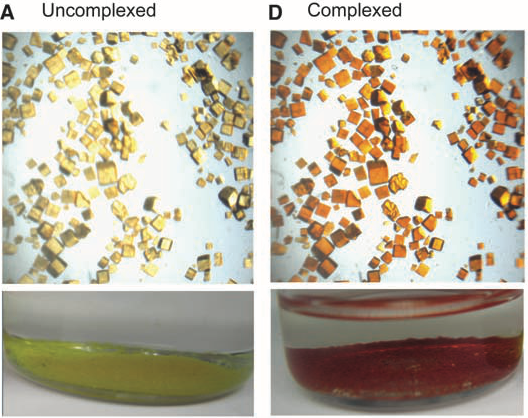
Gravesia guttata: “Figures 4A and D show MOF-1001 before and after docking of PQT2+, a single crystal–to–single crystal transformation. The process from A to D is described as “MOF-1001 crystals were introduced into a saturated solution of PQT·2PF6 in acetone”. The supplementary video also shows that shaking is involved. The bottom part of Figure 4A and D shows that the crystals have moved. I thus wonder how the crystals can be unaffected by the washing process, as they do not move at all between the two pictures.”
Clearly this is the same picture, recoloured. Normally, one would blame a student, replace the figure with a correction, and declare the conclusions unaffected. But not Yaghi.
Back in 2019, a reader notified the journal, to which Science editor Jake Yeston retorted: “This paper was published too long ago for us to pursue a formal data request.” Eventually, Science issued a stealth correction. It has no DOI, it is not available as separate article and it couldn’t not be searched for or even accessed freely. It was hidden in the Supplemental Online Material:
“Correction (5 November 2019): After the publication of this Report, the authors have provided a supplementary addendum to incorporate further technical details on the experiment monitoring the paraquat inclusion process in MOF-1001 without disturbing the crystals in Section S1. Figure S0 and accompanying paragraphs explain the experimental setup.
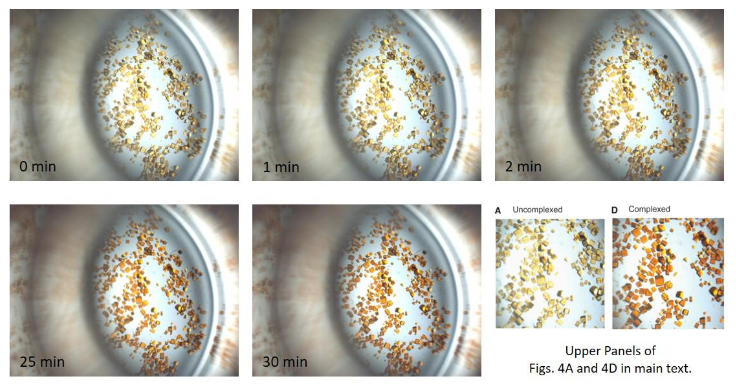
To find the new addendum, you must download the updated supplement file and proceed to page 20. There, you will find a new section, and now we see it was not just a small spot where the crystals did not move, no, it was the entire bottom of the flask. A large field of crystals there remained perfectly immobile after a large volume of fluid was gently added, as if they were all glued. Except that they were not, they stayed in place by Nobel Magic(TM):
“Monitoring paraquat Inclusion without Disturbing Crystals:
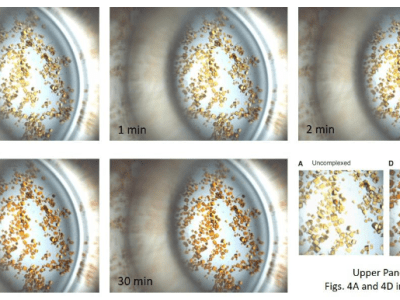
To prove that the MOF pseudorotaxanes were obtained in a single-crystal to single-crystal transformation, rather than the dissolution and recrystallization manner, several MOF-1001 single crystals were placed at the bottom of a 20-mL vial in 5 mL acetone solvent, and drops of paraquat solution were added gently using pipet without disturbing the crystals. The whole process was monitored under optical microscope, and snapshots were taken at 0, 1, 2, 25, and 30 mins after adding paraquat. Partial pictures of the crystals at 0 and 30 mins were presented in the upper panels of Figs. 4A and 4D in the main text.”
“Fig. S0. Snapshots of crystals in vials taken at 0, 1, 2, 25, and 30 mins after adding paraquat, while keeping the single crystals undisturbed.” Figure S0
Yes, ridiculous, and pathetic. But this is the kind of science and science ethics which earns you the Nobel Prize and makes you both rich and a role model for everyone.
Other papers by Yaghi were criticised on PubPeer, those were are scientific disagreements with his claims.
In any case, Nobel Prizes have two purposes. The first one – to sanctify some old man and his ego – is not even the main purpose. The Nobels are a huge exercise in lobbyism, the research field which honoured with a Nobel Prize will be flooded with research funding and industry investments. Everyone in this field profits, not just the Nobel awardees.
And MOFs are already popular with the papermills, read below. Heck, some say this is why the field was deemed so important by the Nobel committee.
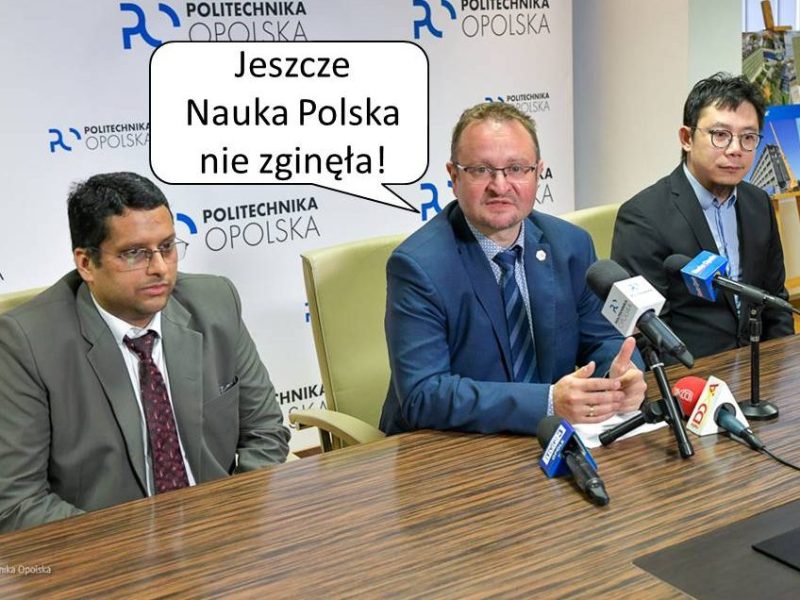
Poor Grzegorz Krolczyk, this Polish scholar suffered so much, one can almost call him Christ Among the Scientists. He lost his positions as chair of the governmental board for higher education, as Vice-Rector for Research at his own Opole University of Technology, and he continues losing papers. Worse: the professor now lost his university job.
“Prof. Grzegorz Królczyk, Vice-Rector for Science and Development of the Opole University of Technology, was elected President of the Council for Innovation in Higher Education and Science.”
It is not clear why, but Opole Polytechnic’s rector Marcin Lorenc forced Krolczyk and his wife, fellow professor, and coauthor of some papermill fabrications Jolanta Krolczyk to leave this university. Having heard these rumours, I decided to check for Krolczyk’s institutional profiles at Opole Polytechnic. They are gone, Google search suggests they were deleted just recently.
And then, the local newspaper Opolskareported on 9 October 2025 that Krolczyk was indeed fired (Google-translated):
“According to our findings, Rector Lorenc met on Tuesday with the employees of the mechanical engineering faculty where the Królczyks were employed and announced that they were both leaving the university with immediate effect, which is said to be related to the audit carried out at the polytechnic. What exactly was the audit and what were the allegations against professors – the rector did not reveal.
Unofficially, we hear that they also received a more “gracious” offer to leave the university by mutual consent, but we have no official confirmation of the final procedure in which the employment relationship with both of them was terminated.”
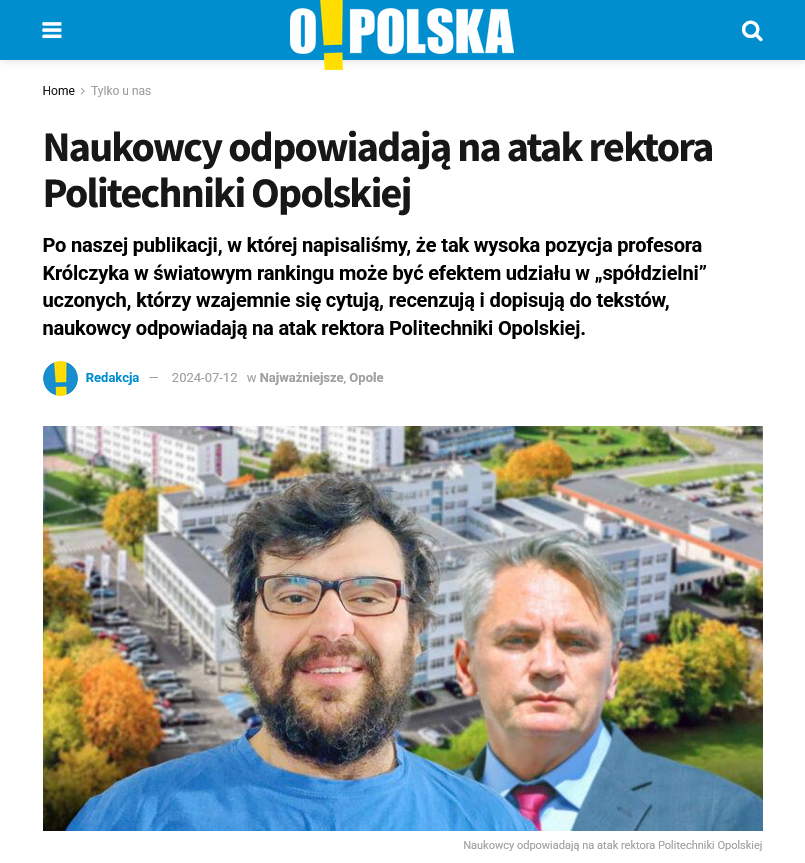
The irony is that Lorenc used to defend Krolczyk, he smeared and slandered his Vice-Rector’s critics, and had his university sue Opolska(in vain). But Krolczyk’s personal defamation lawsuit against Opolska is ongoing, do you think the papermill rabbit has any chance to win now?
To add insult to injury, the retractions continue: now at Elsevier’s Heliyon, and neither of the two papers was flagged on PubPeer before.
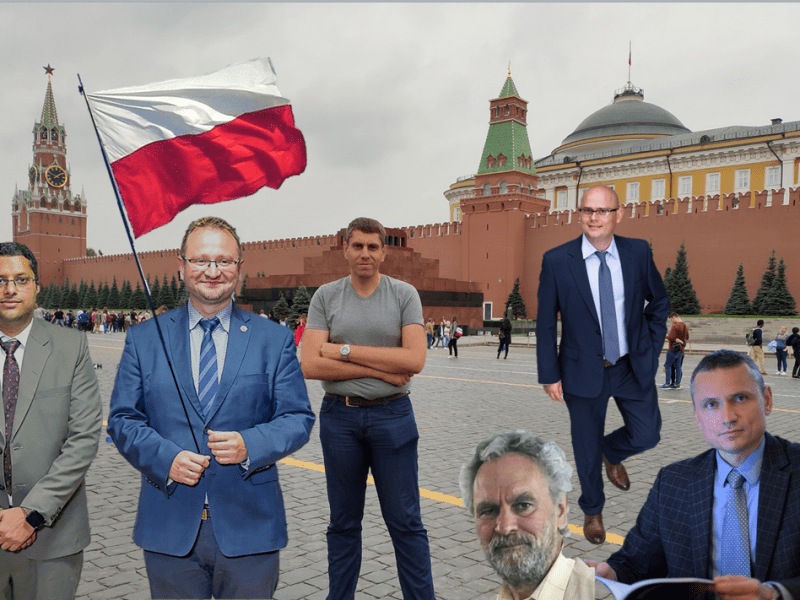
We see Krolczyk with some celebrities of papermilling: Shubham Sharma (who already caused him some retractions, read September 2025 Shorts), Sayed M Tag El Din (who uses all possible varieties of his name so he can peer review himself), and the legendary citations champion Changhe Li:
“Post-publication, an investigation conducted by Elsevier’s Research Integrity & Publishing Ethics team on behalf of the journal identified references that are irrelevant to the article. The authors were asked to comment upon the presence of these references in their work but were unable to satisfactorily address the reason for the references. Consequently, the editor no longer has confidence in the integrity and the findings of the article and has decided to retract it. The scientific community takes a very strong view on this matter and apologies are offered to readers of the journal that this was not detected during the submission process.
The corresponding author alleges that the references were added by author Elsayed Mohamed Tag Eldin without the approval or knowledge of the other authors. Furthermore, when the authors attempted to contact him post publication, he did not respond.
The authors disagree with the retraction and dispute the grounds for it.”
Krolczyk’s coauthor Szymon Wojciechowski, professor at from Poznan University of Technology, featured prominently in this article, for his close collaboration with the rascist fraudster Danil Pimenov, a fanboy of putin and kadyrov:
“An investigation conducted on behalf of the journal by Elsevier’s Research Integrity & Publishing Ethics team found that 20 citations were added to this paper at the accept stage, without the approval of the Editor. The Editor has lost confidence in the findings of the article and has determined that it should be retracted.
The authors disagree with the retraction and dispute the grounds for it. Additionally, several of the authors have stated they have no knowledge of the added references.”
For some reason, Krolczyk didn’t reply to my email about his departure from Opole Polytechnic.
Wise Fellow
“Meet the WISE Fellows – Sadia Ilyas“- this is how the Wallenberg Initiative Materials Science for Sustainability (WISE), part of the famous Swedish Wallenberg Foundation, introduced their awardee in September 2024.
Sadia Ilyas from Pakistan is associate professor for process metallurgy at Luleå University of Technology. I once wrote about that university in the very far north of Sweden here:
Lulea University of Technology is a dark and violent place, according to these victim accounts. Bullying, blackmail, sexual nepotism, robbery and even threats of physical violence and suicide are not unheard of. LTU leadership seems to be part of the problem, and money plays a role.
Ilyas is also associate editor at several journals (including in microbiology!), and Editor-in-Chief of the Taylor & Francis journal Toxicological & Environmental Chemistry. Her research ticks all the right boxes: “to significantly reduce carbon emissions, minimize energy consumption“, “circular economy”, “sustainable solution“, It is however unclear how all this can be achieved by data forgery or maybe by feeing money to Pakistani papermills.
A sleuth studied Ilyas’s achievements, the result is on PubPeer, currently 12 papers with clearly forged data. Heavy metals removed easily:
Thallarcha lechrioleuca: “Fig.6 All XRD patterns with identical noise, but only reflections of Cu and Au (40 to 55 degrees range) change in intensity from the bottom (a) to the top.(e)”
Thallarcha lechrioleuca: “Fig.4 Some parts of these spectra are too similar and some parts look like something was connected or drawn by hand”
The Davis-Joseph principle
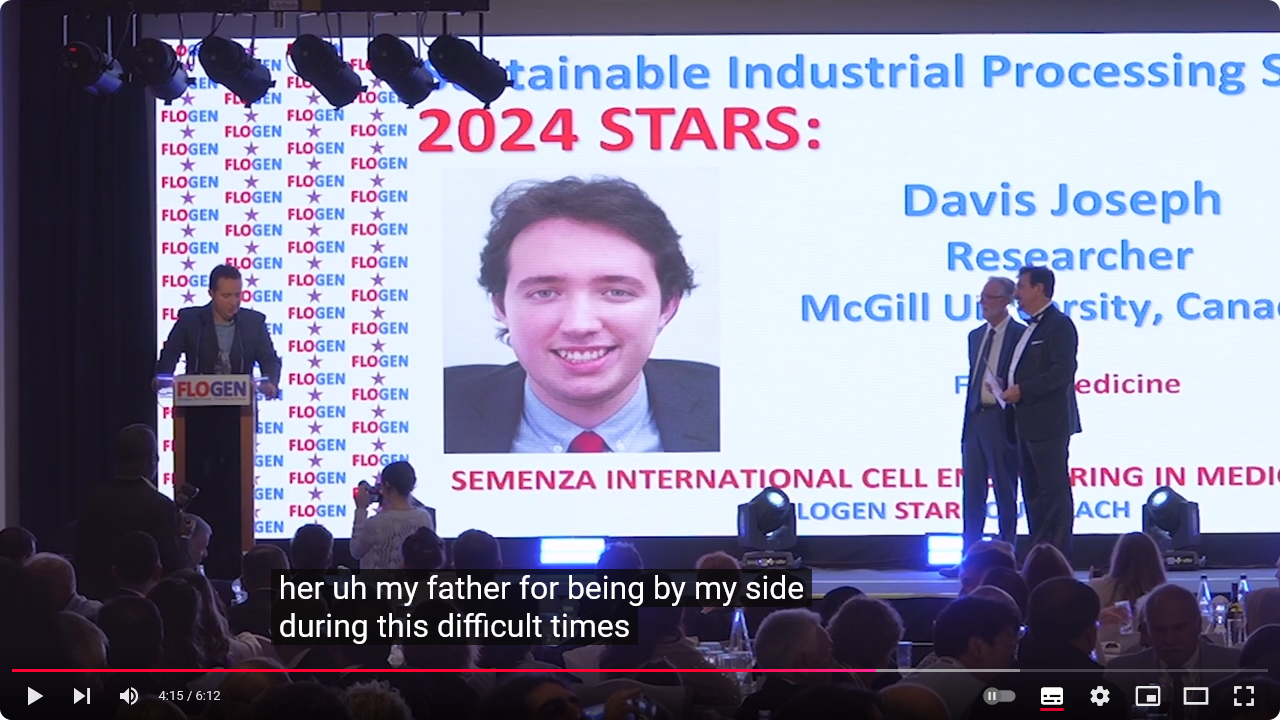
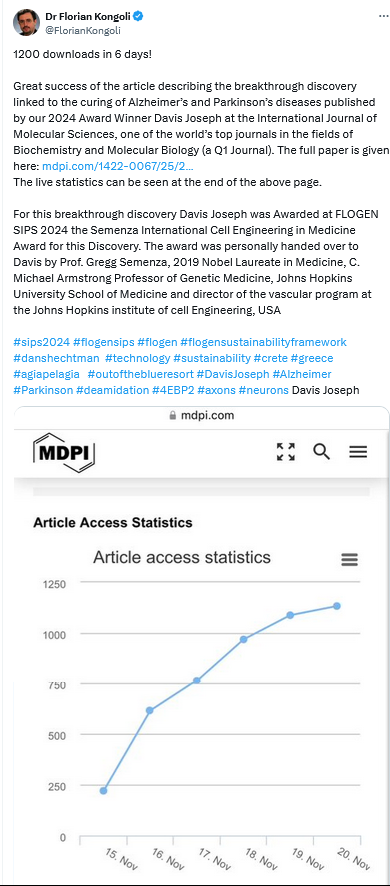
Pepjn van Erp once uncovered the FLOGEN scamferences by Florian Kongoli, which various Nobel Prize laureates love to visit, also to name worthless awards after themselves. Last year, the retractions-plagued Nobelist Gregg Semenza awarded Kongoli’s son Davis Joseph with the “Semenza International Cell Engineering in Medicine Award” at the 2024 FLOGEN SIPS scamference in Crete, Greece (read November 2024 Shorts).
“Davis Joseph, the winner of FLOGEN 2024 Semenza International Cell Engineering in Medicine Award” YouTube
Now Joseph is suing the McGill University in Canada for half a BILLION dollar. Pepjin blogged about it referencing Canadian media. Specifically, La Pressereported on 6 October 2025 that Joseph sues McGill University, plus “seven of his professors and the Langlois law firm for misfire, fraud and harassment” (Google translated):
“In court documents consulted by La Presse, Davis Joseph claims to have been “denied access” to the department’s laboratories in September 2024.
His laboratory supervisor, Dr Nahum Sonnenberg, reportedly told him that his discovery has “no scientific basis” but nevertheless tried to steal his intellectual property with complicit colleagues, alleges Davis Joseph.
A document indicates that he was fired from his research work because he “requested to publish results without a scientific basis [by] constantly mentioning a Nobel Prize.””
“”Dr. Nahum Sonenberg and trainee Davis Joseph attended a seminar from Nobel prize winner Dr. Paul Nurse.”: X:
We are also told that Joseph present himself as Dr Joseph, a holder of a PhD degree, although he doesn’t have one. He also posts on social media photos of himself with Canada’s Prime Minister Mark Carney and other cabinet members. This is why Joseph sues McGill, as per La Presse:
“In two scientific articles he published in the International Journal of Molecular Sciences in November 2024 and April 2025 – as a researcher at McGill University’s Faculty of Medicine – Davis Joseph claims that he achieved a whole feat: “Over a two-week period,” when he was only 23 years old, he put on a solo theory that “revolutionizes the way humanity understands the production of proteins””
These are the two papers, in the same MDPI journal:
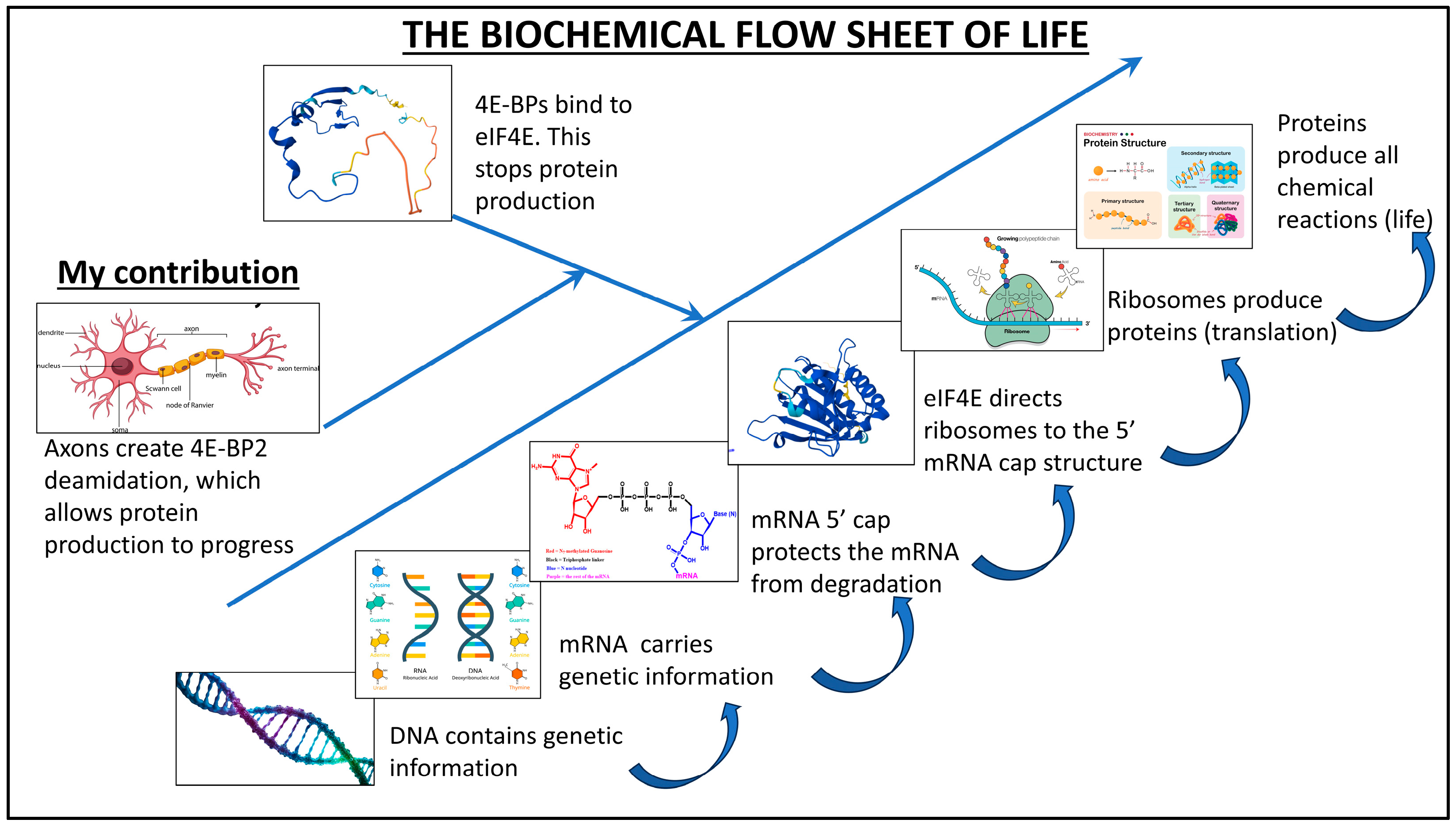
“My finding revolutionizes humanity’s understanding of protein production in the human body. Figure 5 shows a flow sheet describing protein production in mammalian organisms”
The second paper was the extension of the first one, Joseph modestly presented “My Unified Theory of neurodegeneration pathogenesis,” and announced the arrival of the “Davis-Joseph principle“:
To sum up: the two papers are deranged rubbish, one could also say it took Joseph’s daddy a bribe of three FLOGEN awards (plus dinner, lodging, etc) to three Japanese men to get this rubbish published even in such a trashbin as MDPI.
La Press got this from Kongoli:
“In a formal notice submitted before the publication of this article, Flogen accuses La Presse of participating in a “coordinated campaign of defamation, harassment and economic sabotage” with McGill to discredit the work of Davis Joseph, Florian Kongoli and Flogen. The discovery of the young researcher, supports the formal notice, is “worthy of a Nobel” and has a potential value “of more than 1 billion US dollars”.
The newspaper interviewed a Canadian FLOGEN awardee, Louise Otis, former judge of the Quebec Court of Appeal and President of the Administrative Tribunal of the OECD. At that 2024 scamference in Greece, Otis posthumously awarded Kongoli’s wife and Joseph’s mother, the late Migen Dibra, which was perfectly fine as Otis explained to the newspaper: “That night, everyone was winning a prize”.
Imagine how much money Kongoli makes with his scamferences so that he can sponsor his son’s frivolous lawsuits.
If interested, here a brainrot FLOGEN press release from May 2025:
“The 21st edition of Sustainability Through Science and Technology Summit 2025 (SIPS 2025), dedicated to Prof. Aaron Ciechanover, Nobel Laureate in Chemistry, to be held in Cebu, Philippines, from 17-20 November 2025, has confirmed the participation of Davis Joseph as an invited summit plenary lecturer for his recent ground-breaking discovery of the common master switch for numerous brain-related diseases.”
Man & Chicken
The Aarhus University in Denmark tries everything to get this article deleted:
As I wrote in September 2025 Shorts, I was recently contacted by Aarhus University’s Chief Legal Advisor Gry Bagger seeking to defend the honour of their papermilling professor Christian Sonne:
“Please be advised that:
The use of Professor Sonnes’s image constitutes a violation of his personal rights and data protection laws (including GDPR).
Such use is not covered by any “fair use” or citation exception, as a portrait photograph does not fall within the scope of scholarly citation.
Continued publication of the image without authorization exposes you to liability, including but not limited to:
Formal complaints to data protection authorities,
Civil claims for damages and injunctive relief,
Possible reputational consequences within the academic publishing community.
We therefore demand that you immediately remove Professor Sonnes’s photograph from all online platforms and any printed versions.
In addition, please note that we are currently reviewing our position with regard to the manner in which Professor Sonne has otherwise been cited and subjected to what we consider to be intimidatory treatment on your site. We reserve all rights in this respect.”
Since I failed to comply, the Aarhus University went to the Danish production company which made the 2015 film Men & Chicken“. It was a horror comedy so unhinged and sick it befitted to illustarate that university, that I used a movie still as a cover image for my article. But then, clearly prompted by Aarhus University lawyers, a representative of M&M Productions wrote to me on 2 October 2025:
“I´m contacting you because we have discovered that photos from our film is used in a article on your website. You have no permission to use the photos and could you please remove them asap.”
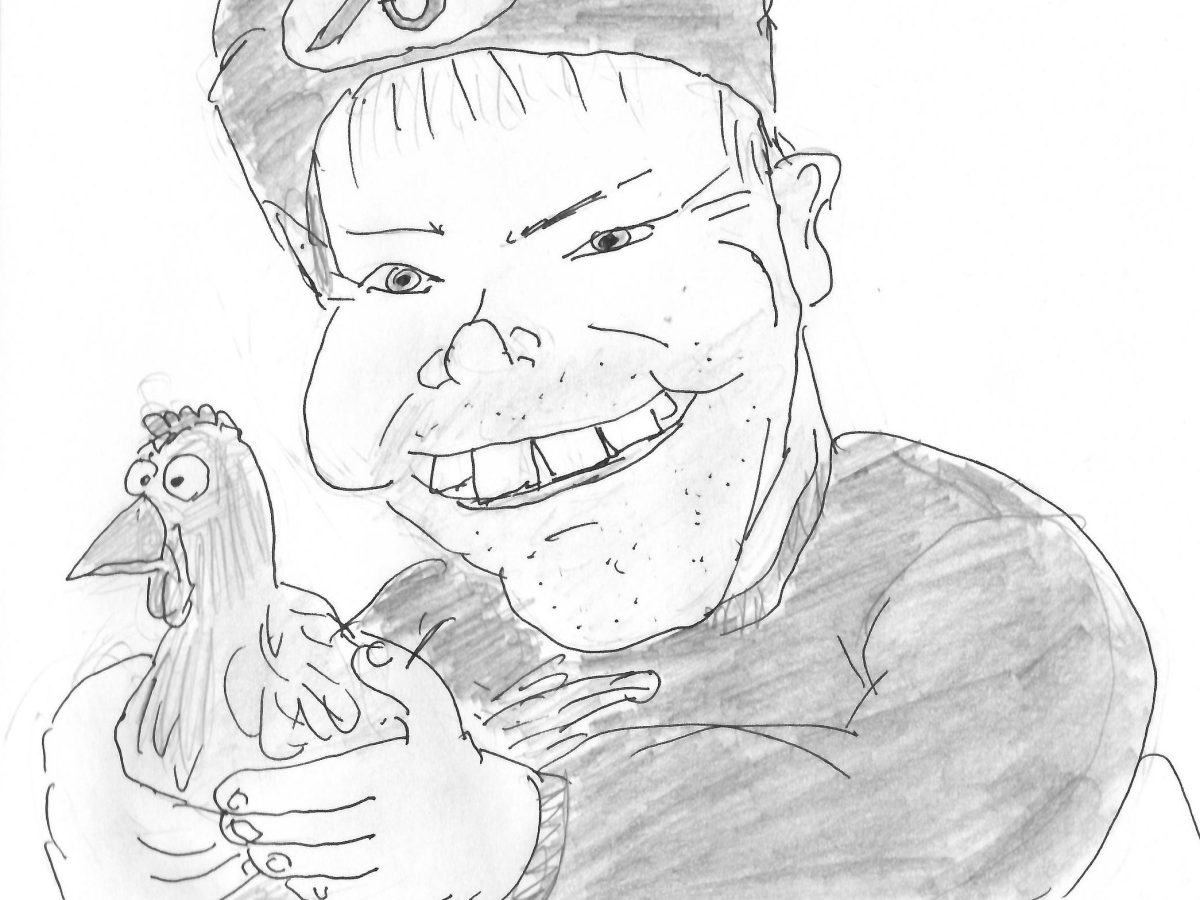
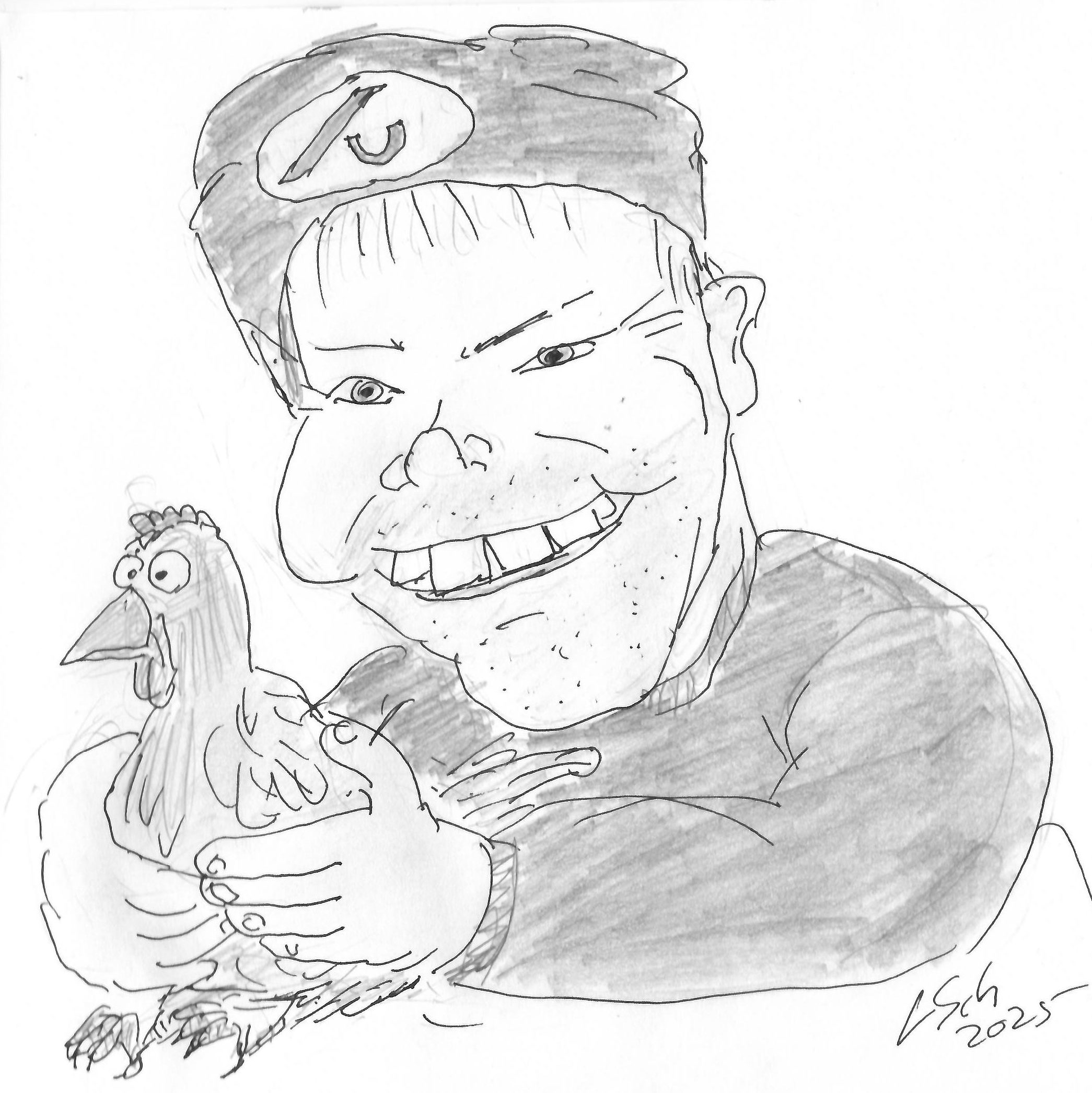
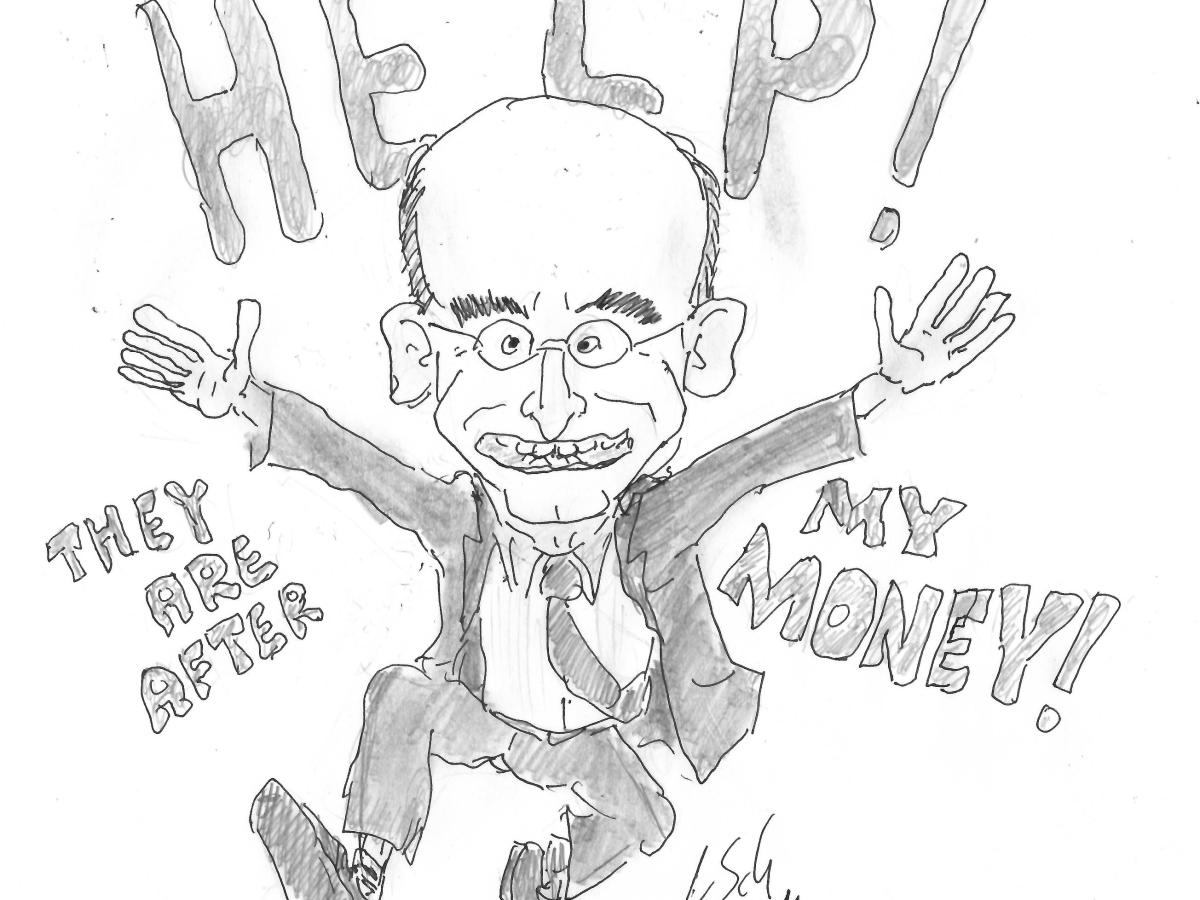
This time, I eagerly complied and make a cartoon, of some random Danish man with a chicken. This is the new cover image:
Man & Chicken
I hope Aarhus University and Professor Sonne enjoy their success in making me replace that movie still.
Scholarly Publishing
A forum for finding irrelevant ‘issues’ that pillory young scientists
The Nobel Prize laureate and Stanford professor of neuroscience Thomas Südhof mulls retracting a third paper. It has the same lead authors as the two retracted ones: Pei-Yi Lin of the PNAS paper Lin et al 2023, and Lulu Chen, of Chen et al 2017 in Neuron (read about its retraction in February 2025 Shorts). Südhof now goes around complaining about these retractions to anyone who listens (read July 2025 Shorts).
“The professional bloggers are now trying to turn this into a question of research integrity which is deeply misleading, and claim that they are doing this not for financial gain. Judge for yourself!” – Thomas Südhof, Nobel Prize laureate
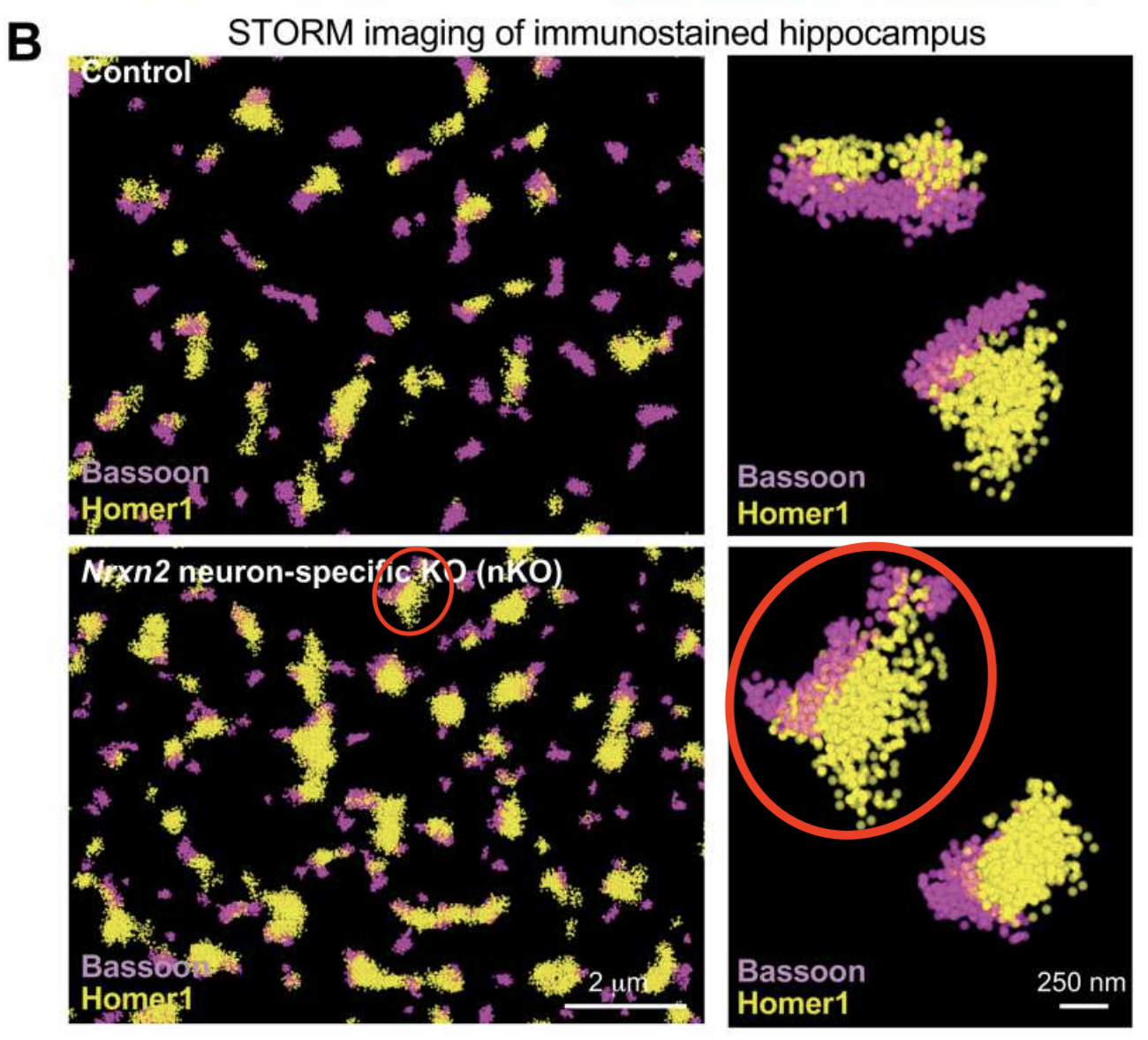
Elisabeth Bik on Figure 4B: “The two enlarged clusters in the top right photo appear to be both missing from the image shown on the left[…]. Only the cluster shown in the red box can be seen in the enlarged image on the right, but its partner in that image is not present in the image on the left. So the right photo contains two different clusters that were not adjacent to each other in the left photo. It seems apparent that the right photo was ‘stitched’ or spliced.”
On PubPeer, Südhof became furious about “Dr. Bik’s relentless accusations on PubPeer and ‘X’ (Twitter)“:
“Dr. Bik’s passionate eagerness to find fault with our work leads her to accusations that are simply incorrect. The paper clearly states that the right images are representative enlargements of two synaptic junctions and never stipulates that the two synapse images are adjacent to each other in a lower magnification image or even that they are found in the left images – they are just beautiful examples of synapses that we like. Stitching implies the accusation that we are trying to hide something which we don’t,”
Not true what Südhof says: in his paper, he described the composite image as “Representative” of “direct stochastic optical reconstruction microscopy (dSTORM)“, i.e. as original unedited microscopy data. Whatever their reasons, the authors were indeed trying to hide something.
Animation by Orchestes quercus
Later on, Südhof blamed the digital editing on our not living “in a perfect world without size limits on figure legends“, and adding:
“I think this is another example of what PubPeer has become: a forum for discovering minor mistakes and finding irrelevant ‘issues’ that pillory young scientists, accompanied by social media posts with advertisements.”
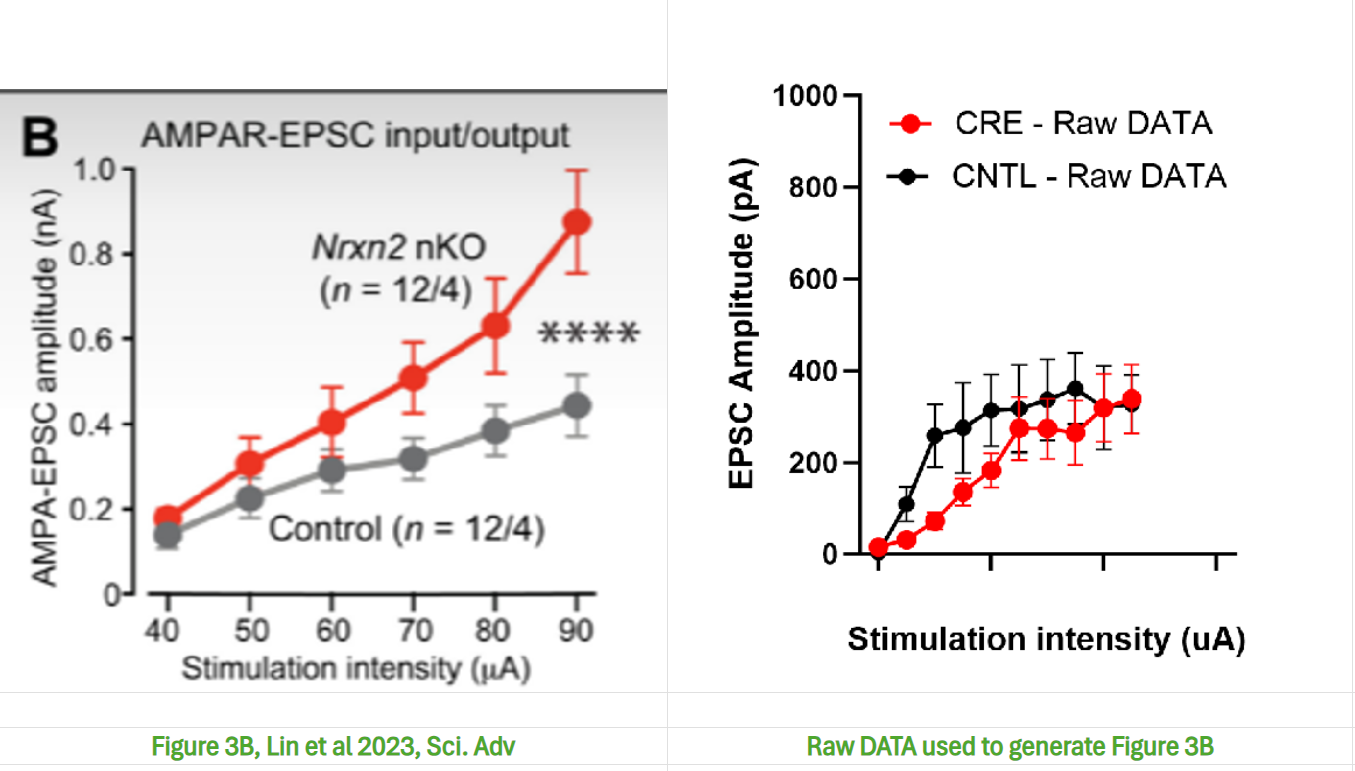
Other sleuths found more. Since Südhof and his coauthors kindly deposited the raw data for this study, some PubPeer users reanalyised it and found discrepancies to the published Figure 3, for example:
Zeuxine oblonga:: “I analyzed a piece of the data to regenerate Figure 3B, AMPA EPSCs. I included all the recordings reported in the lapbook notes […] There is no significant difference in AMPA EPSC measurement between CNTL and ncKO based on the raw data.”
This however became a problem. An Editorial Expression of Concern was issued by the Edior-in-Chief Holden Thorp on 1 October 2025:
“On 6 January 2023, Science Advances published the Research Article “Neurexin-2: An inhibitory neurexin that restricts excitatory synapse formation in the hippocampus” by P.-Y. Lin et al. (1). Comments on PubPeer noted concerns with Fig. 3, including that the n’s reported in Fig. 3B were not consistent with the n’s in the raw data in the Stanford Digital Repository (SDR). We are notifying readers that concerns exist while the authors determine whether reliable recordings exist to support the data in Fig. 3.”
To translate: the authors admit that Figure 3 is fraudulent. But there’s no reason to jumpt to retraction: the authors and editors wish to check see what the measurements really say because maybe the unpublished real results will coincidentally match the published fake ones.
Thomas Südhof, victim of racist and sexist persecution, announced to retract a second paper, “even though the quantitative analyses and conclusions are correct”.
Wiley once again proves to be United2Act against papermills.
The sleuth Fabian Wittmers reported to Wiley this papermill fabrication by a certain Mohammed Monier, professor at Mansoura University in Egypt, who currently has over 70 fake papers on PubPeer.
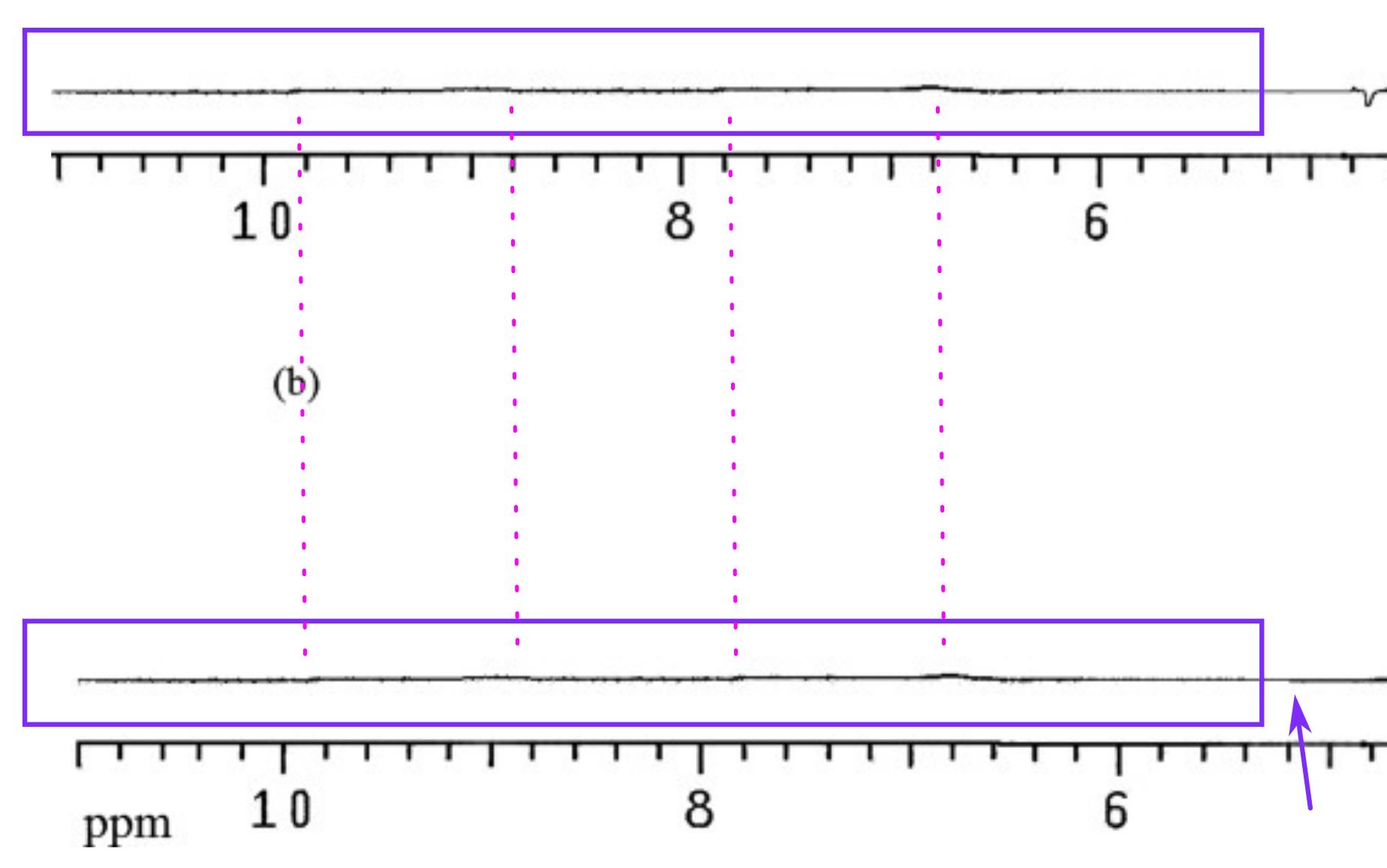
Archasia belfragei: “Figure 3 XRD patterns contain some repetitive sections of noise that would be expected to be random”
On 3 October 2025, the sleuth received this reply from Wiley’s Integrity Assurance & Case Resolution team:
“The concerns have been investigated by independent members of Wiley’s IACR-team in accordance with COPE guidelines. We have asked the authors to provide a detailed explanation and supporting data to address the concerns. The authors were able to do so to our satisfaction, hence we consider the matter resolved. Thank you for contacting us.”
As you saw, the spectra are most obviously fake. Then the sleuth found this:
Archasia belfragei: “Please note unexpected similarities in the noise signature presented here and another paper by the same group:”
Archasia belfragei: “Figure 3: some noise sections seem repetitive across and within spectra”
“Figure 6: some sections of “random” noise appear repetitively in the XRD patterns”
Mu Yang, who posted much of the Munier evidence on PubPeer, also tried to change Wiley’s verdict, by providing to the publisher “some of my favorite M. Monier cases that I use when giving talks about image manipulation — these cases usually convince my audience that anyone can identify salient fraud, using nothing but a pair of eyes, and the most basic knowledge in chemistry and physics.” Here they are:
Dysdera arabisenen: “Fig 3: a,b,c traces contain sections that are more similar than expected, sometimes facing opposite directions. left-and right facing arrows are used to indicate directionality of the sections. Not an exhaustive marking. Dotted line is used to indicate partial duplication (as compared to sections marked with solid lines of the same color).”
Dysdera arabisenen: “Both Fig 5 contain sections that are highly similar within traces (light blue and purple), across traces (green and yellow), and across studies (red and navy). Double-sided arrows point to identical traces. Dotted lines indicate partial similarity. “
Here another figure from the first of these two papers:
Dysdera arabisenen: “Fig 3: a and b baselines contain sections that are more similar than expected.”
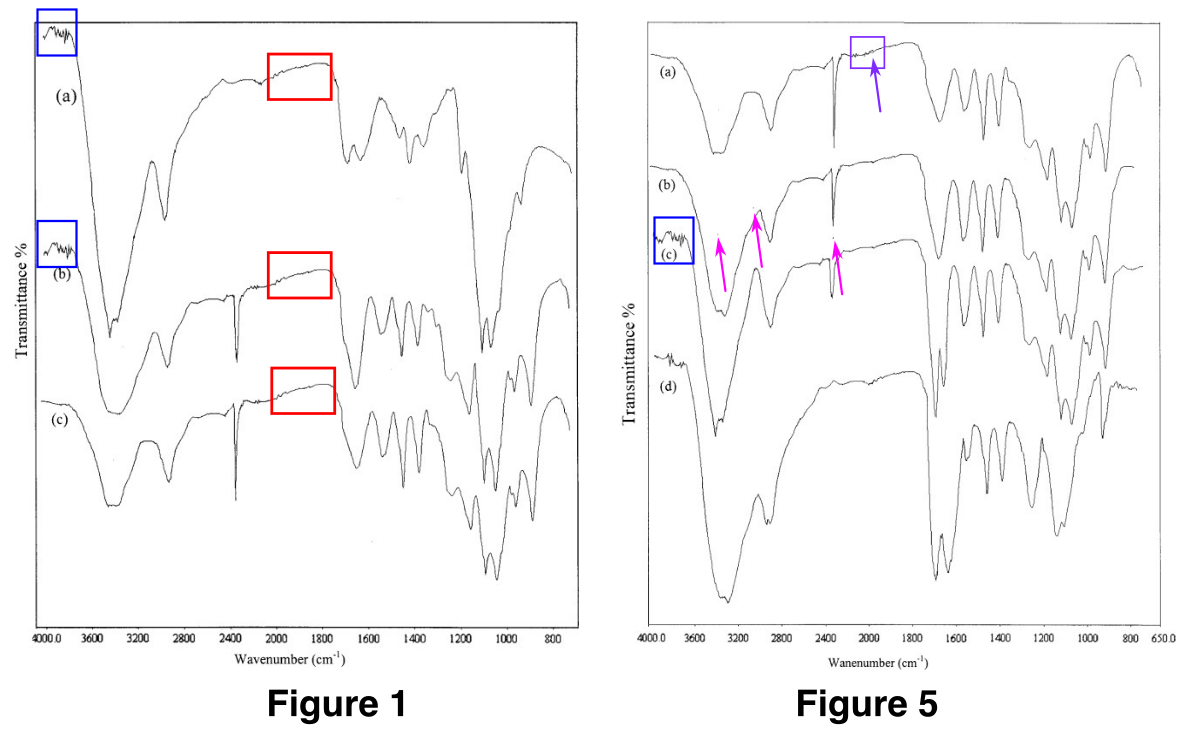
Also Valentin Rodionov, who is not only a sleuth but as associate professor of polymer chemistry at Case Western Reserve University in USA also very much an expert in this exact field, wrote to Wiley. He found even more fraud in Sarhan et al 2010, adding that “Even disregarding these fabrications, the spectra are chemically nonsensical” and that “The central claim is chemically indefensible“.
Valentin Rodionov: “Fig. 1a, 1b, and 5c share noise patterns that are more similar than expected between ~3750–4000 cm⁻¹. Fig. 1a, 1b, and 1c share noise patterns that are more similar than expected in the silent region between ~1800–2100 cm⁻¹. Fig. 5a shows a doubled trace at ~2000 cm⁻¹. There are dark spots on the spectrum background, which should not appear there if the spectra were plotted by instrument software or a package like Excel or Origin.”
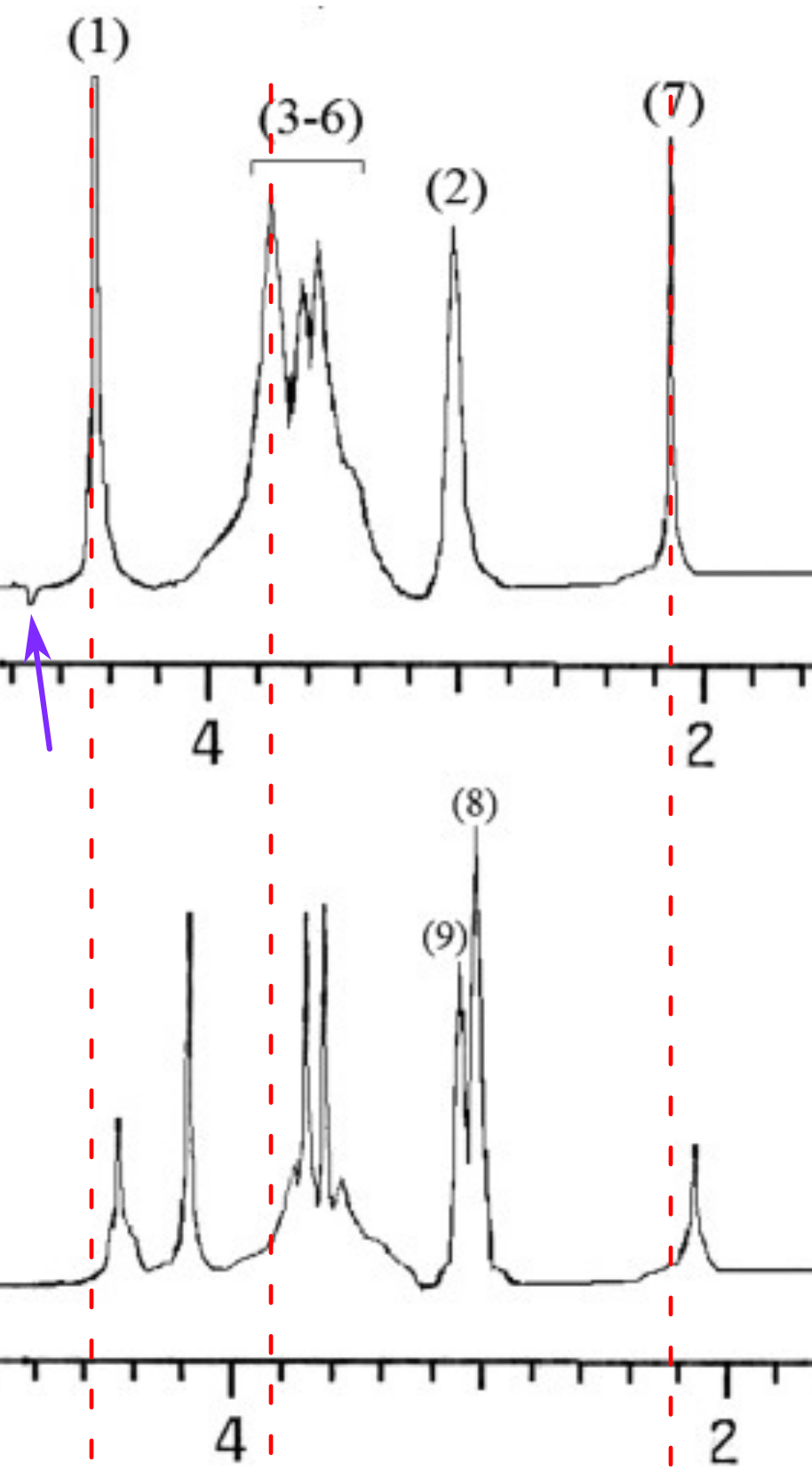
Valentin Rodionov: “Fig. 2a and 2b share noise patterns above ~5 ppm that are more similar than expected. These patterns are slightly shifted along the chemical shift axis, which precludes any possibility this is an instrument artifact […] The below-baseline “dip” at 4.7 ppm in Fig. 2a is inconsistent with being an artifact of NMR acquisition or phasing.”.”
Rodionov ended his message to Wiley with:
“This paper is riddled with fabrication and fundamental chemical errors. I urge Wiley to retract it promptly and to investigate other manuscripts that may have passed through the same reviewers. No competent polymer chemist could have endorsed this work after even a cursory look.“
Wiley however decided that it was the three sleuths who were full of shit. On 8 October 2025, the publisher announced to Fabian their final decision:
“We would like to confirm that the case was carefully investigated by our team in accordance with Committee on Publication Ethics (COPE) guidelines. Our assessment focused solely on the scientific content of the article in question. Other publications by the author group were not considered in our evaluation, as they fall outside the scope of this specific inquiry.
The authors provided a detailed and satisfactory response, including supporting data that was sufficient to validate the findings presented in the article. Please note that the response and accompanying data are confidential and cannot be shared with third parties.
Based on the evidence reviewed, we are confident that the conclusions of the article remain valid.
Thank you again for bringing this matter to our attention; we appreciate your commitment to upholding the integrity of the scholarly record. “
Archasia belfragei: “Figure 3: two XRD patterns appear identical in noise. Some vertical stretch might distinguish them. There also seems to be some backtraces present, which seem physically impossible.”
Should some publisher (not Wiley obviously) ever press for retractions, Monier will surely blame his coauthors. Good luck here:
Archasia belfragei: “Figure 2: There seem to be multiple repetitive patterns present in the SEM image”
“Figure 3: EDX noise seems to contain repetitive elements”
The other 70 fake papers by Monier on PubPeer show similar type of forgeries, presumably his entire body of research is a fabrication, and I don’t mean in the way nanotechnologists usually use this word.
“the original figure 4a and 4b: multiple spheres seem to be more similar than expected”
Archasia belfragei: “Figure 3: various sections of noise seem repetitive and not random as they should be”“Figure 5: repetitive elements in the XRD noise signatures which should be random and not repeat”
The authors regret that [Fig. 4] in the original paper may have been erroneous SEM images due to an error in assembling the figures. The SEM samples were processed along with other materials with similar surface morphology, and while assembling the images and adding labels on them, confusion was probably made so that the likelihood of including images from other unrelated but surface-similar samples existed.
In order to correct this and ensure scientific transparency, new SEM images were recorded from the concerned samples under improved imaging conditions. The corrected Fig. 4 is as given below. Authors confirm that the correction does not change the experimental results, interpretation of the data, or overall conclusions of the original article.
The authors apologize for the oversight and any inconvenience it may have caused.”
Let me close with a Monier paper in the same Wiley journal where everything looks to the publisher’s satisfaction:
Archasia belfragei: “Figure 1c: there seems to be at least one repetitive region in the SEM image”
“Figure 3: some XRD pattern noise seem repetitive between and within samples”
By the way, Monier did postdoc at Drexel University in USA. Imagine what he must have left behind there.
Do the needful
More of Wiley’s United2Act professionalism!
The pseudonymous Claire Francis reported this perfectly clear case of data theft or, if one prefers, plagiarism. It is the usual “non-coding RNA as cancer therapy target” rubbish popular with Chinese papermills, and the authors (or rather papermill customers) are from Chongqing Three Gorges Central Hospital in China:
Now, the study Koo et al 2017 was published by a team of researchers in London, UK, 3 years before Deng et al 2020, and it has of course no common authors with the Chinese product. It is perfectly clear who stole from whom.
Moreover, the 2017 study was published in an AACR journal, the copyright belongs to the American Association for Cancer Research, while the 2020 Wiley paper attributes the copyright to the Chinese authors. Thus it is not only an issue of research fraud, but also of copyright infringement.
But here is how Wiley addressed it.
Claire Francis contacted Wiley 0n 2 October 2025. On 5 October, the journal’s editorial assistant forwarded the email to the Production Editor Charulatha Nagarajan, asking her to “do the needful.” Nagarajan first asked the sleuth to “please clarify your query in detail as we have published the paper JCLA“, but eventually agreed to assess the issue. She wrote back on 7 October:
“Dear Claire,
I can understand your concern from the below screenshot of the figure files. I believe that the description of the figures are varied between these 2 articles. […] By comparing these 2 figures, the below highlighted section/describtion is different from each other.
I hope you have mentioned the above changes in figure files from these 2 articles which were published in 2 different journals. For JCLA, i would like to confirm that we were preocessed the figure files as same as the author’s manuscript without any changes in figure describtion and attached the manuscript file for your reference.”
Indeed, the original manuscript was attached. It says on every page “This article is protected by copyright. All rights reserved“. I wrote to Nagarajan, who replied to me:
“As I can understand that the reused data in the journal JCLA is different from the older journal MCT, I ensure to escalate this issue to our production manager.“
Was it the papermill’s only mistake to relabel the images then? The Wiley professional answered:
“…we can’t make any changes in the published version without the editor’s approval.”
Are they really that inept or is “do the needful” a Wiley code for: play stupid so these complainers give up and go away? Do they at Wiley sack everyone who cares and shows competence?
Nobody say papermillers have no sense of humour. They now started to use in-jokes about the papermill sleuth Alexander Magazinov, their nemesis! The authors of this nanotechnology study display affiliations in China, Iraq, Iran, Malaysia, Turkey, Azerbaijan and Saudi Arabia:
“Magazinov’s research on the topological and geometric characteristics of high-dimensional spaces had the potential to shed light on the behavior of atomic defects in nanoscale structures [42,43]. Magazinov’s findings had the potential to provide a novel viewpoint on the potential effect of structural imperfections in CNTs on the overall mechanical and thermal properties of a material.”
[42] P.V. Blagojevic, R. Karasev, A. Magazinov, A CENTER TRANSVERSAL THEOREM FOR THE SUPER-RADO DEPTH (2016), arXiv preprint arXiv:1606.08225 [43] A. Magazinov, P. Soberón, Positive-fraction intersection results and variations of weak epsilon-nets, Monatsh. Math., 183 (1) (2017), pp. 165-176
Magazinov protested on PubPeer:
“As it happens, I am the Magazinov who co-authored the above papers. And I can reassure the authors that neither of the cited works is even remotely related to “nanoscale structures,” “carbon nanotubes,” or whatever other nonsense they come up with. In other words, this is a blatant miscitation, consistent with very probable paper mill origin of this work. (The following PubPeer query – authors:”soheil salahshour” – provides quite enough context for a reader familiar with the basics of the “paper mill” concept.)”
However, it may be not Soheil Salahshour (an associate of Davood Toghraie and Krolczyk’s friend Zhixiong Li) who added this text and references, but the papermill he frequents. Another friend of Salahshour is Massimiliano Ferrara, professor at University Mediterranea of Reggio Calabria in Italy, a local star who regularly features with his non-achievements in local news. I wrote about that and his papermilling(including with Salahshour) in December 2023 Shorts.
Salahshour’s PubPeer record shows many cases of nonsense references, presumably whoever assembled the papermill product above decided to honour their worthy adversary Magazinov, the scourge of papermills. Or maybe the plan is actually to discredit Magazinov as an alleged papermill customer, by adding references to his papers as we saw above?
Retraction Watchdogging
Remarkable health benefits
When a meat industry shill advocates for fresh fruit, you must get suspicious. Indeed, José Manuel Lorenzo has been papermilling again, but at least this time, he was slapped with a retraction.
Lorenzo is Head of Research at the Meat Technology Centre of Galicia in Spain and was in fact publicly exposed as a massive papermiller who “publishes a study every other day” by El Pais in June 2023. He is an associate of Abjijit Dey, has a PubPeer record, and briefly featured in this article:
The retraction arrived already on 26 February 2025:
“Post-publication, an investigation conducted on behalf of the journal by Elsevier’s Research Integrity & Publishing Ethics team discovered substantial changes in authorship during the submission process of this paper. During revision, Mohamed Mekhemar, Sunil Kumar, T. Anitha, and V. Balamurugan were added to the author list, and 3 authors were removed, without adequate explanation. The Editor does not have confidence that all of the stated authors of the article qualify for authorship and has therefore lost confidence in the validity/integrity of the article and made the decision to retract.
The authors disagree with the retraction and dispute the grounds for it.”
Lorenzo publishes on any topic a papermill offers. It all passes peer reveiw because the papermillers organise it. Look at this travesty:
Mycosphaerella arachidis: “The same image of nanoparticles has been used to represent three different types of nanoparticles, sourced from four different suppliers, the first publication (in 2019) has a different scale bar to all the rest.” (Karami et al 2023, Almanaa et al 2022, Zadehi et al 2020, Shahrajabian & Sadeghian 2019)
Here another paper by the polymath Lorenzo and the above coauthor Christophe Hano, associate professor at the University of Orleans in France:
Conidens laticephalus: “The SEM equipment is misreported. The manufacturer (TESCAN) is correct, yet the model is not. The correct model, according to the auto-generated legend, is MIRA3.”
In 2023, I exchanged some emails with Hano, because he coauthored the problematic paper Khalili et al 2022, also with Gholamreza Gohari. Hano assured me that his Iranian colleague is “a serious, expert and honest researcher” and that “this work is original” and “in no way related to the papermill.”
Hano also told me he was “committed to integrity”, and “I sincerely appreciate the utility of your (and some of your colleagues) work, I use your work as part of my teaching of scientific methodology“. In his follow-up emails, Hano became less friendly (maybe because he works “more than 70 hours per week“?), he started accusing me of having vested interests, and presentign hismelf as a research integrity whistleblower.
Hano has almost 20 papers on PubPeer, flagged for fake data and nonsense content, coauthored not just with Lorenzo but also with oher major papermillers: William C. Cho, Abhijit Dey and Javad Sharifi-Rad.
Solanine derivatives as treatment for Alzheimer’s
Another Heliyon retraction. A Hungarian scholar named István Gábor Gyurika, professor of engineering at University of Pannonia, decided to proclaim that potatoes cure Alzheimer’s, a culinary discovery he made with the help of some Iraqi papermill.
The retraction from 20 March 2025 went (highlights mine):
“Post-publication, an investigation conducted on behalf of the journal by Elsevier’s Research Integrity & Publishing Ethics team discovered suspicious changes in authorship between the original submission and the revised version of this paper. During revision, the authors Saja Mohsen Alardhi and Malik M. Mohammed were added to the revised paper without explanation and without exceptional approval by the journal editor, which is contrary to the journal policy on changes to authorship. The Editor reached out to the authors for an explanation, but they failed to provide a satisfactory explanation to these changes. The Editor has determined that the authorship and the findings of the article cannot be relied upon, and has decided to retract the article.
The authors disagree with the retraction and dispute the grounds for it.”
Also the corresponding preprint at SSRN (without Saja Mohsen Alardhi and Malik M. Mohammed) was retracted, with the notice: “This paper was withdrawn as the corresponding journal article has been retracted“.
Gyurika was obviously invited to this travesty by his Iraqi PhD student, Osamah Ihsan Ali. They have many common papers.
Whether or not ethical approval was given
We continue with Heliyon retractions. This clincial study was retracted for lacking an ethics approval. Not, it is not from India. It’s from University of Missouri in Kansas City, USA, the last author is their professor Rajiv Chhabra, the only coauthor not from Kansas City is Christopher Koh, Clinical Director at the Division of Intramural Research at NIH in Bethesda, USA.
“A post-publication investigation conducted by the Elsevier’s Research Integrity & Publishing Ethics team on behalf of the journal could not confirm whether or not ethical approval was given for the research presented in this publication in line with the journal’s policy. As it cannot be established whether the article complies with the journal’s policies on ethical approval, the Editor has decided to retract the article.
The authors disagree with retraction and dispute the grounds for it.”
The main was completely removed by Elsevier and replaced with that retraction notice. But PubMed still has a copy. Its states that 79 patients who received a left ventricular assist device (LVAD) between 2010 and 2015, were retrospectively studied for their survival and clincial history for a year, the trial took place at Saint Luke’s Mid America Heart Institute, where Chhabra works.
Yes, also retrospective clinical studies need an ethics approval.
I apologize, but I need more context or information to provide an academic rewrite
Another funny retraction, again in Elsevier’s Heliyon:
Nerita vitiensis: “The phrase “I apologize, but I need more context or information to provide an academic rewrite” is a typical response produced by the AI chatbot ChatGPT when generating text according to a user’s question/prompt”
The retraction arrived on 4 October 2025 (highlight mine):
“There are concerns that a Generative AI source has been used in the writing process of the paper without disclosure, which is a breach of journal policy. The authors informed the journal that a third-party editing service violated its written agreementlimiting assistance to language polishing, resulting in non-original content, and requested the retraction of the article.
The editor has lost confidence in the integrity and findings of the article and has determined that it should be retracted.”
Yes, blame the papermill.
Donate!
If you are interested to support my work, you can leave here a small tip of $5. Or several of small tips, just increase the amount as you like (2x=€10; 5x=€25). Your generous patronage of my journalism will be most appreciated!
Abhijit Dey, Javad Sharifi-Rad, William C. Cho? Here is a network I discovered with Argos in more than 20 Polish Universities. I will not disclose Polish researchers publishing with them, because this investigation is still ongoing. There are hundreds of them. Compared to many of them Krolczyk is a pawn. This is mostly in life and medical sciences. Mechanical engineering constitutes a separate set. Only a few names overlap. As you can see, Changhe Li is not on this list, but Sezai Ercisli and Abhijit Dey, for example, are on both.
Every year, as the leaves fall and twinkling lights go up in the cities of Europe, an odd kind of holiday spirit settles over the academic world: Nobel Season. It’s like Christmas, but instead of gifts wrapped in shiny paper, the parcels are papers wrapped in questionable data. Instead of elves in workshops, there are grad students in labs at 3 a.m., pipetting with trembling hands.
The fraudsters gather, giddy as children by a tree, whispering and giggling as they nominate each other. “Oh, Klaus, your completely unreplicable study on anti-gravity yogurt was brilliant! You deserve this year’s prize!” To which Klaus replies, eyes twinkling, “Haz lulz, my friend—your Photoshopped microscope images of teleporting mitochondria are surely Nobel-worthy too!”
Committees convene in hushed secrecy, like carolers rehearsing in the cold. Instead of hymns, they sing statistics, p-values strung together like holiday lights that don’t quite match but still glow warmly when you squint. A fraudulent forest of citations shines in Google Scholar like ornaments on the great tree of Science.
When the prizes are finally awarded, the joy is palpable. Fraudsters embrace, tears streaming, champagne flowing. It is a season of giving: giving medals, giving speeches, giving thanks to Photoshop, to creative Excel work, and to the reviewers who never looked too closely.
And the world watches, claps politely, and posts on Twitter (sorry, X) with knowing smirks: “Haz lulz. Nobel Season again.”
Because, like Christmas, it comes every year. And like Christmas, the spectacle is dazzling—whether you believe in it or not.
Wrt Südhof :“I think this is another example of what PubPeer has become: a forum for discovering minor mistakes and finding irrelevant ‘issues’ that pillory young scientists, accompanied by social media posts with advertisements.”
Funny, I see only the old fart whining about those ‘irrelevant issues,’ as if the often-cited ‘young scientists’ don’t even care. Or am I mistaken, and is he referring to his wife ChingChong?
And there is truth in this. Here are the examples:
1- Fullerenes (C60 Buckyballs) – Nobel Prize in Chemistry, 1996, the first wonder carbon material, was supposed to Frevolutionise electronics and medicine, but never lived up to most of the hype, despite its fascinating chemistry.
2. Conducting Polymers – Nobel Prize in Chemistry, 2000, it wsa argued that CPs will changes the face of electronic for ever, but here were are after half a century after their discovery, still having high-cost low-performance materials! This was even awarded to the wrong people (back to lobbying)!
3. Graphene – Nobel Prize in Physics, 2010. Graphene was hailed as a world-changing supermaterial. Applications so far (graphene and any other 2D material out there); none! despite EU wasting 1 billion Euros on it! Still no “miracle” for which it was marketed.
4. Quasicrystals – Nobel Prize in Chemistry, 2011, beautiful materials but with few practical uses (for example in non-stick coatings).
Probably number 5 on the list should go to MOFs, beautiful chemistry, fancy science, but limited applications!
The paper is from a journal that ceased publishing sometime in 2024. The most recent “papers” are retraction notes dated 18 September 2024.
The authors seem to be involved in a larger network based in Ethiopia wih several people now affiliated with Gdansk University of Technology in Poland.
Regarding Philopedon plagiatum’s comment, that kind of “anomalous pattern” happen when you have a high contrast image with fine lines and horizontal or vertical fragments saved as JPEG. The compression algorithm divides the space into 8×8 pixel blocks and if the line in the image is parallel to the line of blocks, there’s noticeably less compression error.
It looks like the trace contained a small fragment of constant transmittance over a range of wavenumbers, which can easily result from detector saturation.
Prof. Tobiszewski has been on my radar for quite some time. Scopus allows citation analysis by author, affiliation, country etc. Unfortunately I cannot post files of graphs here, so just a few leading examples from this analysis of his impressive number of citations (9662), except for that Lancet paper, which gives 1/3 of this number and has a different distribution. Of course, he is on the list of Top 2% Most Cited Researchers. Galal Magdy, Kafrelsheikh University, Egypt Faiyaz Shakeel, College of Pharmacy, Riyadh, Saudi Arabia Sultan Mohammed Alshehri, College of Pharmacy, Riyadh, Saudi Arabia Alam Prawez, Prince Sattam Bin Abdulaziz University, Al Kharj, Saudi Arabia Fathalla F. Belal, Mansoura University, Mansoura, Egypt And here are his citations by country: Egypt (about 40%) Saudi Arabia India China Brazil Turkey I know these countries have become scientific powerhouses in the past 10 years, so I’m not suggesting any wrongdoing.






















 For Better Science
Abhijit Dey, Javad Sharifi-Rad, William C. Cho? Here is a network I discovered with Argos in more than 20 Polish Universities. I will not disclose Polish researchers publishing with them, because this investigation is still ongoing. There are hundreds of them. Compared to many of them Krolczyk is a pawn. This is mostly in life and medical sciences. Mechanical engineering constitutes a separate set. Only a few names overlap. As you can see, Changhe Li is not on this list, but Sezai Ercisli and Abhijit Dey, for example, are on both.
Abhijit Dey (Presidency University)
Javad Sharifi-Rad (Zabol University of Medical Sciences)
Manoj Kumar (Central Institute for Research on Cotton Technology)
Miquel Martorell (University of Concepción)
Daniela Calina (University of Medicine and Pharmacy of Craiova)
Cristina Quispe (Arturo Prat University)
William C. Cho (Queen Elizabeth Hospital)
Shaker A. Mousa (Albany College of Pharmacy and Health Sciences)
Shafaqat Ali (Government College University, Faisalabad, China Medical University)
Riaz Ullah (King Saud University)
Tapan Behl (Chitkara University)
Ammara Saleem (Government College University, Faisalabad) – 5 retrakcji
Simona Bungau (University of Oradea)
Hesham R. El-Seedi (Uppsala University, Menoufia University, Jiangsu University)
Fahadul Islam (Daffodil International University)
Sezai Ercisli (Atatürk University)
Aayush Sehgal (Chitkara University)
Muhammad Rizwan (Government College University, Faisalabad
Mohamed M. Abdel‐Daim (King Saud University)
Manzer H. Siddiqui (King Saud University)
Hayssam M. Ali (King Saud University)
Saqer S. Alotaibi (Taif University)
Talha Javed (Fujian Agriculture and Forestry University)
Adnan Noor Shah (Khwaja Fareed University of Engineering and Information Technology)
Mohammed A. A. Ahmed (Alexandria University)
LikeLiked by 3 people
Nobel Season
Every year, as the leaves fall and twinkling lights go up in the cities of Europe, an odd kind of holiday spirit settles over the academic world: Nobel Season. It’s like Christmas, but instead of gifts wrapped in shiny paper, the parcels are papers wrapped in questionable data. Instead of elves in workshops, there are grad students in labs at 3 a.m., pipetting with trembling hands.
The fraudsters gather, giddy as children by a tree, whispering and giggling as they nominate each other. “Oh, Klaus, your completely unreplicable study on anti-gravity yogurt was brilliant! You deserve this year’s prize!” To which Klaus replies, eyes twinkling, “Haz lulz, my friend—your Photoshopped microscope images of teleporting mitochondria are surely Nobel-worthy too!”
Committees convene in hushed secrecy, like carolers rehearsing in the cold. Instead of hymns, they sing statistics, p-values strung together like holiday lights that don’t quite match but still glow warmly when you squint. A fraudulent forest of citations shines in Google Scholar like ornaments on the great tree of Science.
When the prizes are finally awarded, the joy is palpable. Fraudsters embrace, tears streaming, champagne flowing. It is a season of giving: giving medals, giving speeches, giving thanks to Photoshop, to creative Excel work, and to the reviewers who never looked too closely.
And the world watches, claps politely, and posts on Twitter (sorry, X) with knowing smirks: “Haz lulz. Nobel Season again.”
Because, like Christmas, it comes every year. And like Christmas, the spectacle is dazzling—whether you believe in it or not.
LikeLiked by 2 people
Wrt Südhof :“I think this is another example of what PubPeer has become: a forum for discovering minor mistakes and finding irrelevant ‘issues’ that pillory young scientists, accompanied by social media posts with advertisements.”
Funny, I see only the old fart whining about those ‘irrelevant issues,’ as if the often-cited ‘young scientists’ don’t even care. Or am I mistaken, and is he referring to his wife ChingChong?
LikeLiked by 1 person
Hano has published 18 papers in 2019, 24 in 2020, 48 in 2021, 41 in 2022, 25 in 2023, but only 6 in 2024 and 1 in 2025. A gradual repentance?
LikeLike
A wise colleague once said; when a Nobel prize is given to a material, that material is ought to be useless!
LikeLike
And there is truth in this. Here are the examples:
1- Fullerenes (C60 Buckyballs) – Nobel Prize in Chemistry, 1996, the first wonder carbon material, was supposed to Frevolutionise electronics and medicine, but never lived up to most of the hype, despite its fascinating chemistry.
2. Conducting Polymers – Nobel Prize in Chemistry, 2000, it wsa argued that CPs will changes the face of electronic for ever, but here were are after half a century after their discovery, still having high-cost low-performance materials! This was even awarded to the wrong people (back to lobbying)!
3. Graphene – Nobel Prize in Physics, 2010. Graphene was hailed as a world-changing supermaterial. Applications so far (graphene and any other 2D material out there); none! despite EU wasting 1 billion Euros on it! Still no “miracle” for which it was marketed.
4. Quasicrystals – Nobel Prize in Chemistry, 2011, beautiful materials but with few practical uses (for example in non-stick coatings).
Probably number 5 on the list should go to MOFs, beautiful chemistry, fancy science, but limited applications!
LikeLike
Quasicrystals! Back then even Linus Pauling mocked Shechtman: “There are no quasicrystals, only quasi-scientists”.
Good times…
Helium Superfluids probably should make the list.
LikeLike
Shechtman is the best buddy of the scamferencer Florian Kongoli, hanging out at his FLOGEN events all the time. Sorry to rob you of yet another hero.
LikeLike
Oh, well… “False is the tale; a Hero never dies.”
LikeLike
I’ve a somewhat out-of-topic question: who should I contact to report this case: https://pubpeer.com/publications/8983B9519A4C22776A48F6F37FF4B5#
The paper is from a journal that ceased publishing sometime in 2024. The most recent “papers” are retraction notes dated 18 September 2024.
The authors seem to be involved in a larger network based in Ethiopia wih several people now affiliated with Gdansk University of Technology in Poland.
LikeLike
https://chem.pg.edu.pl/kipitch/pracownicy-i-doktoranci/doktoranci
https://mostwiedzy.pl/pl/abreham-bayu-ass-prof,1504462-1
https://mostwiedzy.pl/pl/worku-firomsa-kabeta,1380242-1
LikeLike
and here is the head:
https://pubpeer.com/search?q=gebicki
LikeLike
Nice work, Philopedon plagiatum!

https://pubpeer.com/publications/1F40EEC90DE99705A486B95763A838
LikeLike
@Leonid Schneider
Regarding Philopedon plagiatum’s comment, that kind of “anomalous pattern” happen when you have a high contrast image with fine lines and horizontal or vertical fragments saved as JPEG. The compression algorithm divides the space into 8×8 pixel blocks and if the line in the image is parallel to the line of blocks, there’s noticeably less compression error.
It looks like the trace contained a small fragment of constant transmittance over a range of wavenumbers, which can easily result from detector saturation.
LikeLike
Write to Wiley Research Integrity team: researchintegrity@wiley.com
LikeLiked by 1 person
Friday test – find at least 3 similarities (files can be downloaded from the links):
https://mostwiedzy.pl/en/publication/application-of-chromogenic-dye-in-biogenic-amines-determination-using-spectrophotometry,156053-1
https://mostwiedzy.pl/en/publication/green-simple-analytical-method-for-total-biogenic-amines-content-determination-in-wine-using-spectro,158974-1
LikeLike
Prof. Tobiszewski has been on my radar for quite some time. Scopus allows citation analysis by author, affiliation, country etc. Unfortunately I cannot post files of graphs here, so just a few leading examples from this analysis of his impressive number of citations (9662), except for that Lancet paper, which gives 1/3 of this number and has a different distribution. Of course, he is on the list of Top 2% Most Cited Researchers.
Galal Magdy, Kafrelsheikh University, Egypt
Faiyaz Shakeel, College of Pharmacy, Riyadh, Saudi Arabia
Sultan Mohammed Alshehri, College of Pharmacy, Riyadh, Saudi Arabia
Alam Prawez, Prince Sattam Bin Abdulaziz University, Al Kharj, Saudi Arabia
Fathalla F. Belal, Mansoura University, Mansoura, Egypt
And here are his citations by country:
Egypt (about 40%)
Saudi Arabia
India
China
Brazil
Turkey
I know these countries have become scientific powerhouses in the past 10 years, so I’m not suggesting any wrongdoing.
LikeLiked by 1 person