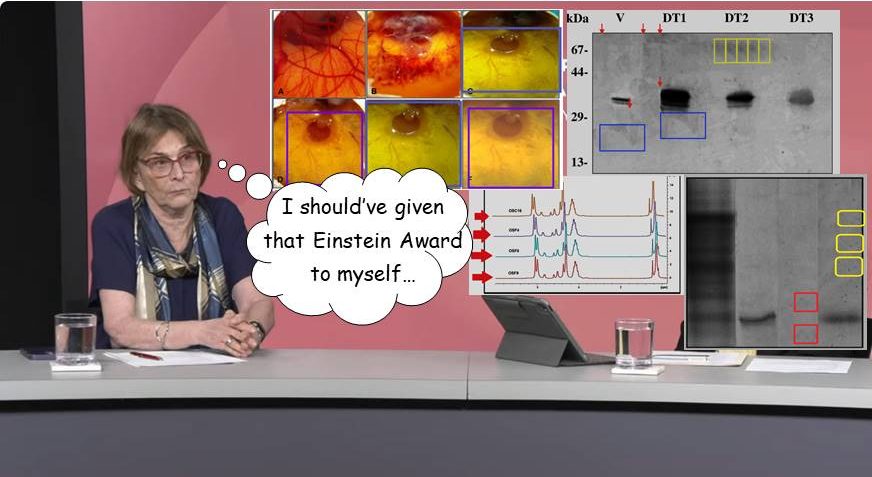

The biochemist Helena Bonciani Nader is Professor Emeritus at Federal University of São Paulo (Unifesp), currently serving as President of the Brazilian Academy of Sciences and other academic organisations. Nader is also member of the Jury of the Einstein Foundation in Berlin, Germany, which in November 2024 awarded the sleuth Elisabeth Bik and PubPeer with €200k each. It is a bit ironic.
On 25 September 2025, in her capacity as Academy President, Nader gave testimony before the Brazilian Senate against the bill which proposed to treat research misconduct as a crime. Which is also a bit ironic.
Most Nader’s papers were flagged on PubPeer after the jury’s decision to award Bik and PubPeer was already set. Thus, it sure was not a conspiracy, but coincidence – the posters likely didn’t even know she was a jury member. Still, eventually even Elisabeth Bik chimed in with more concerns of data forgery, only to be accused by Nader’s colleague of cyberstalking, harassment and misogyny.
When Nader was invited to speak before the Brazilian Senate, the forgeries in her own papers and her utterly inappropriate attitude of denial and dismissal of the PubPeer concerns were already known, including to Brazilian audience (e.g. here and here). No wonder Nader objected to the criminalisation of science fraud and declared the tools already in place to be perfectly sufficient. Instead, she suggested as the solution to make “training in scientific integrity mandatory at all levels of education, from high school to undergraduate and graduate studies“.

I wrote about the problems with Nader’s papers in March 2025 Shorts, feel free to charge me with plagiarism for reusing that material. Only one of these bad studies by Nader was corrected so far, probably because the editors insisted. Other promised corrections never materialised, and we shouldn’t expect any retractions, neither Nader’s not her coauthors’ universities will ever asked for them.
The oldest Nader paper was posted on PubPeer 10 years ago. Its coauthor is Carl Peter von Dietrich, Brazilian academician, Commander and Great Officer National Order of Scientific Merit, and Unifesp professor, who used to be Nader’s mentor. He died in 2005 aged 68, 4 years before this study was published, but he became its author nevertheless:
Célia R.C. Franco , Edvaldo S. Trindade , Hugo A.O. Rocha , Rafael Bertoni Da Silveira , Katia Sabrina Paludo , Roger Chammas , Silvio S. Veiga , Helena B. Nader , Carl P. Dietrich Glycosaminoglycan chains from α5β1integrin are involved in fibronectin-dependent cell migration Biochemistry and cell biology = Biochimie et biologie cellulaire (2009) doi: 10.1139/o09-047

Similar bands but different conditions.
Undeclared splicing in panels B and C”

Nader’s then-PhD student Edvaldo da Silva Trindade (now professor at Federal University of Paraná), replied on PubPeer in April 2025:
“In response to the criticism regarding Figure 1, […] we would like to clarify that there was never any intention of deceit in the experiments. Although some errors may have occurred in creating the composite figure, the image in question is merely illustrative of the appearance of the cells, […]
It is worth noting that the other criticisms were duly addressed at the time (back in 2014)”
It is not clear what Trindade meant with “addressed”, because no corrections were published, not in 2014 nor later. But another sleuth found more issues in that paper:

This is that other Nader study from 2006, flagged in March 2025. Dietrich was already dead when it was published:
C.C. Lopes , L. Toma, M.A.S. Pinhal , M.A. Porcionatto, M.C. Sogayar, C.P. Dietrich , H.B. Nader EJ-ras oncogene transfection of endothelial cells upregulates the expression of syndecan-4 and downregulates heparan sulfate sulfotransferases and epimerase Biochimie (2006) doi: 10.1016/j.biochi.2006.04.009

Nader replied on PubPeer to explain how the Northern blot technology works, and insisted that “the images are indeed distinct”. Her evidence was not really convincing though:

depicted in the highlighted regions.”
The overall similarity is unlikely to have happened by chance, while the tiny pixel differences are most likely compression artefacts of the low resolution images.
Other papers by Nader were flagged on PubPeer in March 2025, including this one with Von Dietrich, published when he was still alive:
F I Staquicini, C R Moreira , F D Nascimento , I LS Tersariol , H B Nader , C P Dietrich , J D Lopes Enzyme and integrin expression by high and low metastatic melanoma cell lines Melanoma Research (2003) doi: 10.1097/00008390-200302000-00003

Again a clearly falsified gel, coauthored by Von Dietrich, again after his death:
Olga Meiri Chaim, Youssef Bacila Sade , Rafael Bertoni Da Silveira, Leny Toma, Evanguedes Kalapothakis, Carlos Chávez-Olórtegui, Oldemir Carlos Mangili , Waldemiro Gremski, Carl Peter Von Dietrich , Helena B. Nader, Silvio Sanches Veiga Brown spider dermonecrotic toxin directly induces nephrotoxicity Toxicology and Applied Pharmacology (2006) doi: 10.1016/j.taap.2005.05.015

Nader’s collaborator Olga Meiri Chaim, professor at the Federal University of Paraná, replied to explain how western blot works:
“All these western blots were obtained and performed with huge amount of rigor and dedication using nitrocellulose paper, BCIP and NBT for revealing method, no fluorescent or chemoluminescence method to detection. There is typical precipitation of milk and substrate particles that had created background, […] These areas pointed are not equal at all. Your detection system is reflecting biased and “similar” as standards not realistic to measures of Western Blots done with membranes captured by scanning.”

Julius Caesar & Daria – Brazilian Tango in Stanford
The published research by Daria Mochly-Rosen and her mentee Julio CB Ferreira supports the theory that maybe Stanford is a bad place for science.

Chaim also chimed in here, on another paper by Nader and Von Dietrich (who died two years before publication):
Rafael Bertoni Da Silveira, Olga Meiri Chaim, Oldemir Carlos Mangili , Waldemiro Gremski, Carl Peter Dietrich , Helena B. Nader , Silvio Sanches Veiga Hyaluronidases in Loxosceles intermedia (Brown spider) venom are endo-beta-N-acetyl-d-hexosaminidases hydrolases Toxicon (2007) doi: 10.1016/j.toxicon.2006.11.024

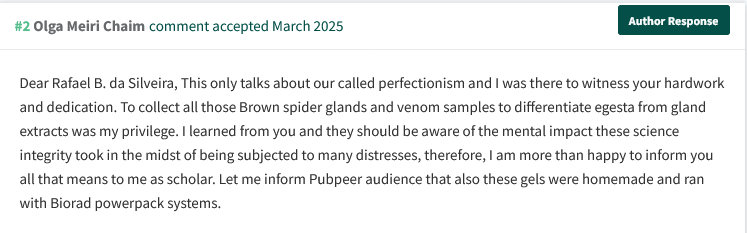
First, Chaim mistakenly posted her email exchange with the first author Rafael Bertoni Da Silveira as reply on PubPeer:
“Dear Rafael B. da Silveira, This only talks about our called perfectionism and I was there to witness your hardwork and dedication. To collect all those Brown spider glands and venom samples to differentiate egesta from gland extracts was my privilege. I learned from you and they should be aware of the mental impact these science integrity took in the midst of being subjected to many distresses, therefore, I am more than happy to inform you all that means to me as scholar. Let me inform Pubpeer audience that also these gels were homemade and ran with Biorad powerpack systems.“
Then, Silvio Sanches Veiga, professor at Federal University of Paraná, chimed in:
“As scientists, we value constructive evaluations that contribute to rigorous and truthful research. When we published the referenced article, our goal was to identify the presence of hyaluronidases in the venom of the brown spider Loxosceles intermedia. At no point did we intend to falsify results or act in bad faith.
A testament to the validity of our findings is that, following the initial publication in 2007, we published two additional articles on these hyaluronidases. […]
Therefore, there was never any intent to fabricate results. […]
The body of literature and independent researchers have corroborated our findings. Science relies on verification, and our data stand as evidence of rigorous, reproducible research.“
Sure sure, but what about those clearly identical gels?
Mario Saad and the return of the wandering western blot
“A clinical trial of fake news, by Mario Saad”
Also, why didn’t Veiga list this paper of his (with Nader, Chaim, Da Silviera and the already deceased Von Dietrich), also on brown spider toxins, it surely corroborates whatever they wanted to see corroborated:
Rafael Bertoni Da Silveira , Romine Bachmann Pigozzo , Olga Meiri Chaim, Marcia Helena Appel, Juliana Luporini Dreyfuss , Leny Toma , Oldemir Carlos Mangili , Waldemiro Gremski , Carl Peter Dietrich , Helena B. Nader, Silvio Sanches Veiga Molecular cloning and functional characterization of two isoforms of dermonecrotic toxin from Loxosceles intermedia (Brown spider) venom gland Biochimie (2006) doi: 10.1016/j.biochi.2006.02.008

Several areas appear to look repetitive, and sharp vertical transitions suggest that the blot was not run as presented.”
Nobody replied there, but what indeed can be said. We can however safely assume Nader now regrets giving that Einstein Award to Bik and PubPeer.
When in a hole, stop digging. In this simple and in principle excusable case of two pixel-identical images, these authors refused to admit an error:
Marcia Helena Appel, Rafael Bertoni Da Silveira , Olga Meiri Chaim, Kátia Sabrina Paludo , Dilza Trevisan Silva , Daniele M. Chaves , Paulo Henrique Da Silva , Oldemir C. Mangili , Andrea Senff-Ribeiro, Waldemiro Gremski , Helena B. Nader , Silvio Sanches Veiga Identification, cloning and functional characterization of a novel dermonecrotic toxin (phospholipase D) from brown spider (Loxosceles intermedia) venom Biochimica et Biophysica Acta (2008) doi: 10.1016/j.bbagen.2007.11.007

Chaim explained: “Dear Pubpeer, It is the same rabbit area for the period of time 6h up to 24h after the experimentally performed envenomation of the rabbit reported“. She was joined by Veiga, who reiterated the same, and insisted:
“We affirm that there has never been any attempt on our part to falsify or publish adulterated results. We are committed to rigorous and serious scientific research.“
Bik found more envenomated rabbit ears:

Cyan boxes highlight regions in the middle panel that appear to be identical, albeit 180 degrees rotated.”
Chaim then returned to PubPeer to give the sleuth a long lecture about the joys of having “animals subjected to a massive inflammation and pain driven by simultaneous injection of venom or recombinant isoforms“. I repeat here only the beginning and the end of that insane post, which Bik aptly summed up as “the gish-gallop of factoids“:
“Dear Elisabeth,
I hope individuals concerned with data herein have further looked to references to learn from many PLD aspects. […]
Curious individuals sometimes behave like trolls for personal goals in laboratories with no due respect for foreigner investments by being raised in attitude in areas that should be more respectful to all, working here as an exercise of collegiality and reciprocity. Thanks for sharing.”
Followed by:
“...you have being perceived as a toxic cyberbully mistaken as a science educator many times. Many are discouraged to interact with women in Science and we are misrepresented. […] I don’t have personal interest in judging anyone, while being targeted like you by toxic bots online to suppress our work.”
Chaim, the victim of Bik’s misogyny, then took care to prophylactically place all responsibility for data integrity with another woman, the first author Marcia Helena Appel, now associate professor at Universidade Estadual de Ponta Grossa.
I think these people need to see a psychiatrist.
Boys from Brazil
“We can always make mistakes in our publications but never acting intensionally. Regarding Prof. Eder works, I know him well and I don’t believe he has anything wrong” – Glaydson S. Dos Reis
The new PubPeer threads actually began in December 2024, with this paper (also flagged by Claire Francis):
Bruna Ribeiro Carneiro , Paulo Castanho A. Pernambuco Filho, Ana Paula De Sousa Mesquita , Douglas Santos Da Silva , Maria Aparecida S. Pinhal, Helena B. Nader, Carla Cristina Lopes Acquisition of anoikis resistance up-regulates syndecan-4 expression in endothelial cells PLOS One (2014) doi: 10.1371/journal.pone.0116001

Sicyonia mixta: “Figure 5: More similar than expected”
Nader replied on PubPeer with a total lack of understanding, quote:
“You can notice that the figure shows differences with respect to the intensity of the bands. Also, it is hard for us to understand the question, since they are stating that the red and blue rectangles drawn in the figure by them show “more similarity than expected”. We have no idea of what they mean by this statement.“
Later on, Nader and her FAPESP colleague Carla Cristina Lopes de Azevedo admitted the similarity, declared original data to be unavailable, and warned:
“…we want to once more emphasize that this does not interfere with the results presented in the paper.”
A correction was not even considered. Another one by Nader and Lopes, with duplicated cell cultures:
Jessica Oyie Sousa Onyeisi , Paulo Castanho De Almeida Pernambuco Filho , Silvana De Araujo Lopes , Helena Bonciani Nader , Carla Cristina Lopes Heparan sulfate proteoglycans as trastuzumab targets in anoikis-resistant endothelial cells Journal of Cellular Biochemistry (2019) doi: 10.1002/jcb.28656

Archasia belfragei: “Unexpected similarities in two panels of Figure 3”

Red boxes: In the EC row, the Tmab 12h and 20h panels look unexpectedly similar”
At least here, Nader and Lopes announced to publish a correction, even though they insisted that “this error does not compromise the integrity of the data nor affects the overall conclusions of the study.” The Correction, appeared on 17 July 2025, the editors allowed the authors to credit themselves:
“Following the publication of this article, the authors identified errors in Figures 2A and 3A. Specifically, in each figure, one panel was inadvertently duplicated, replacing another panel that should have been included. These duplications occurred due to a technical error during the final stages of image assembly and were unfortunately not detected before publication.
Upon discovering the issue, the authors conducted a thorough review of the original image data and have provided the corrected versions of Figures 2A and 3A below. The corrected figures accurately reflect the intended experimental conditions.
The authors confirm that these errors do not compromise the integrity of the underlying data, nor do they affect the results or conclusions of the study.
We sincerely regret any confusion or inconvenience this may have caused and reaffirm our commitment to upholding the highest standards of scientific accuracy and transparency. We appreciate the editorial team’s attention to this matter and remain available to provide any further clarification or supporting documentation as needed.”
The next paper is a clinical study with 10 female patients:
Ricardo Santos Simões , José Maria Soares-Jr, Manuel J. Simões , Helena B. Nader , Maria Cândida P. Baracat , Gustavo Arantes R. Maciel , Paulo C. Serafini , Ricardo Azziz , Edmund C. Baracat Small leucine-rich proteoglycans (SLRPs) in the endometrium of polycystic ovary syndrome women: a pilot study Journal of Ovarian Research (2017) doi: 10.1186/s13048-017-0349-9


On PubPeer, Nader and her mentee José Maria Soares Jr apologised for the error and announced an erratum. But then they must have decided against it, since no Erratum appeared as of today.
In March 2025, I contacted Nader about her PubPeer record, and she told me that there was a death in her family. Yet she promised to contact other senior authors and be “getting back to the lab to properly answer all comments.“
There will be a lot to address, currently over 20 papers. This was also flagged by Claire Francis, Nader is corresponding author:
Rodrigo I. Bouças , Thais R. Jarrouge-Bouças , Marcelo A. Lima , Edvaldo S. Trindade, Fabio A. Moraes , Renan P. Cavalheiro , Ivarne L.S. Tersariol, Debra Hoppenstead , Jawed Fareed, Helena B. Nader Glycosaminoglycan backbone is not required for the modulation of hemostasis: effect of different heparin derivatives and non-glycosaminoglycan analogs Matrix biology (2012) doi: 10.1016/j.matbio.2012.03.001

Nader replied with records from “the PhD of Dr Rodrigo I Bouças“. She stated: “The images are original. They have not been manipulated or altered“. That is only partially correct, I made a comparison:

Nader then replied to me on PubPeer (highlights mine):
“The composite image was created from various gels (unfortunately, there isn’t a large enough gel to run all the tested samples), and the nature of the compounds investigated in the manuscript was assessed using enzymatic digestion, besides other characterizations which are described in the paper. […] Clearly, nothing is concealed, and the interpretation of the results from this data is clear-cut. Lastly, this data is 15 years old, a time when creating composite images lacked advanced tools such as those available today and gel imaging systems (especially for these homemade, bespoke carbohydrate gels) weren’t available; perhaps mistakes in image creation were made (possible, but I wouldn’t be able to say); nonetheless, it is clear there was no malicious act to hide anything back then“
To avoid confusion about those “advanced tools”: her paper is from 2012, not from 1912. Maybe Nader thinks I am 17 years old and think the world was black-and-white before my birth. It’s not nice to dirty play tricks with raw data.
Another denial by Nader:
Maria B R Piva , Eloah R Suarez , Carina M Melo, Renan P Cavalheiro , Helena B Nader, Maria A S Pinhal Glycosaminoglycans affect heparanase location in CHO cell lines Glycobiology (2015) doi: 10.1093/glycob/cwv035
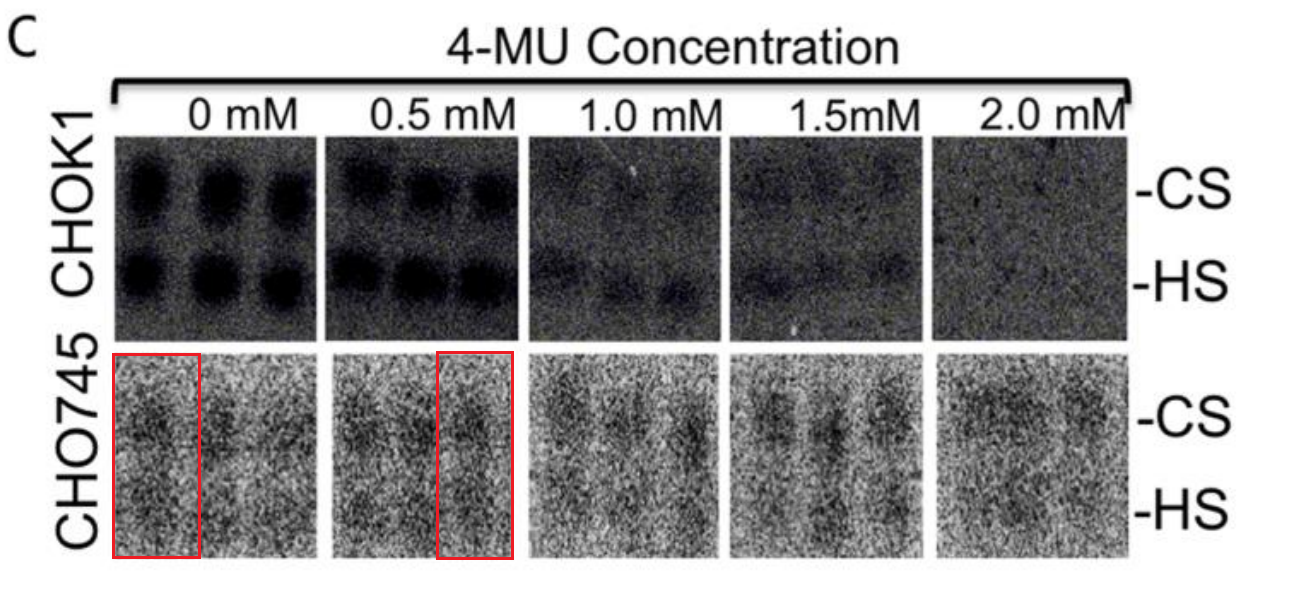
Nader explained on PubPeer:
“We would like to emphasize that the image is reflecting the actual data collected. No manipulation was performed […] Neverthess, we want to let it clear that the highlighted observation does not affect the results or conclusions […] Furthermore, we affirm that all experiments were conducted under rigorous scientific standards.”
Bik replied with more duplications:

The only problem is the lane overlap in the left two panels. Such overlaps do affect one’s conclusions about the rigor with which experiments have been performed.”
More dodgy gels, which were supposed to be corrected:
Sueli M P S Torres , Helena B Nader, Ricardo S Simões , Edmund C Baracat , Manuel De J Simões , Luiz F P Fuchs , José Maria Soares , Regina Célia T Gomes Concentration of sulfated glycosaminoglycans in the mammary tissue of female rats with the aging and about hormonal influence Gynecological endocrinology (2018) doi: 10.1080/09513590.2017.1336218

The Unifesp professor Regina Célia Teixeira Gomes protested:
“On behalf of all the authors of this article, I would like to emphasize that we are a reputable research group and we are available to provide any necessary clarifications. We represent an internationally renowned University and with great pride. […]
I would like to clarify that the image provided by you has been darkened and does not correspond to the original image of the paper. […] looking at the marked bands one gets the impression that they are duplicates, but I do not agree, I looked at the original images and they are not duplicates.“
Then Elisabeth Bik found more issues:
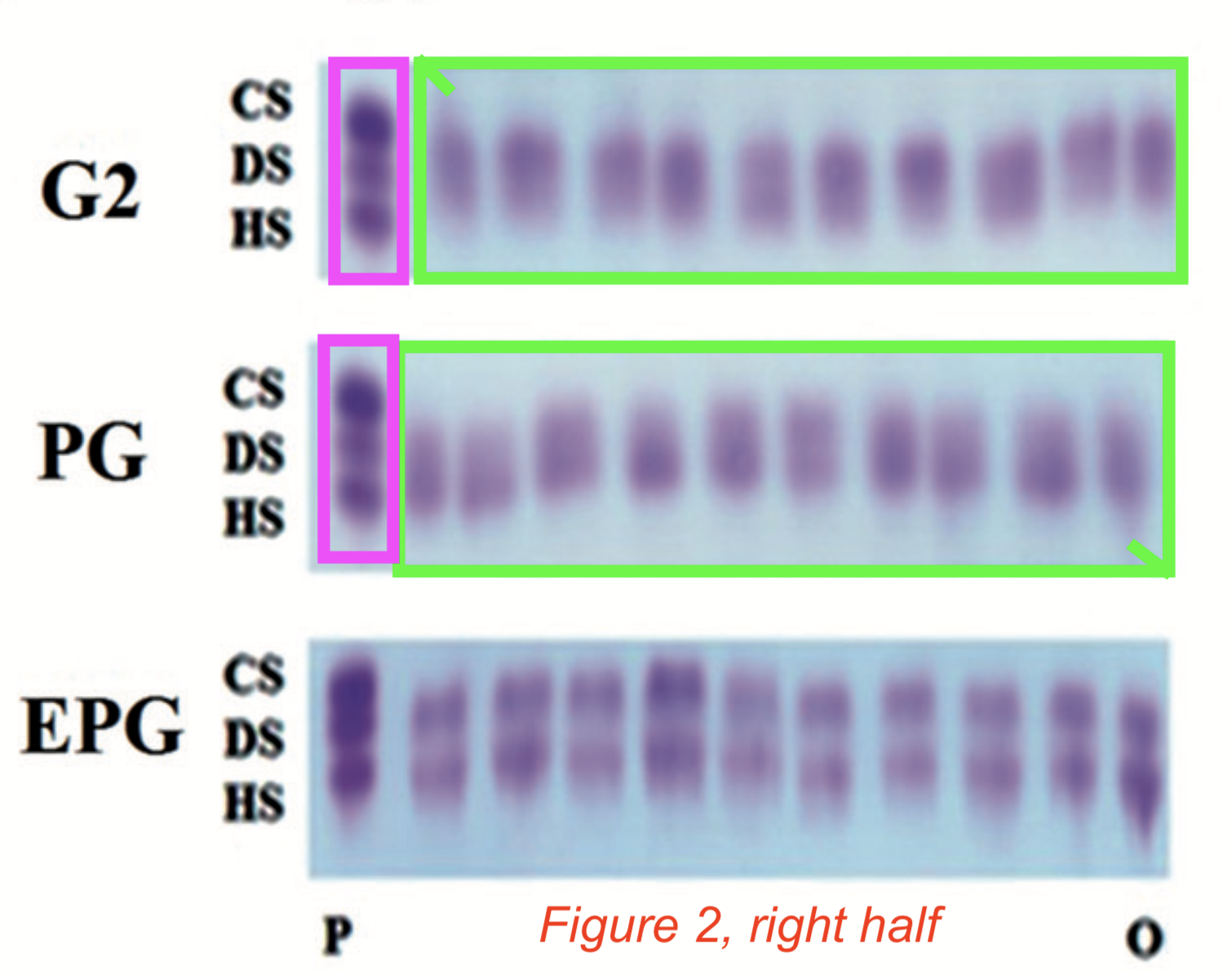
Elisabeth Bik: “additional concerns about the right half of Figure 2 […]:
Green boxes: The sample lanes in the G2 and PG gels look remarkably similar, albeit 180 degrees rotated (new finding).
Pink boxes: The marker lanes in the G2 and PG gels look remarkably similar, as noted above
Gomes then shared some raw data which she and her colleagues “found in our files (chests)“, which, unsurprisingly, proved not to match the published figure:
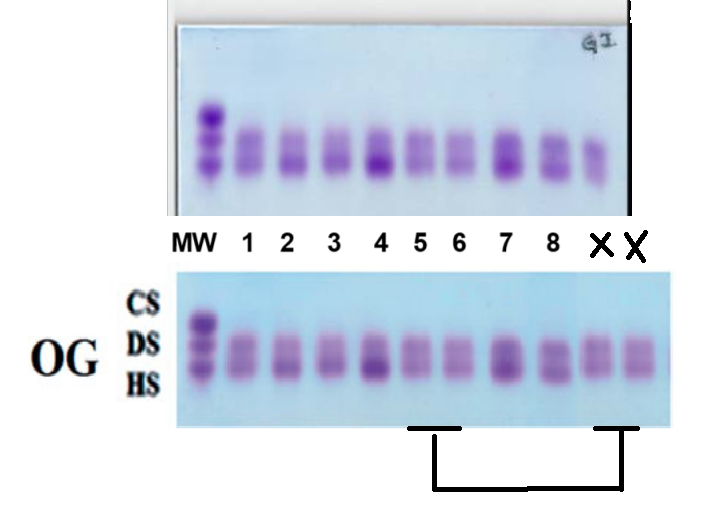
By April 2025, Gomes admitted not to be able to find the real raw data in her chests. She announced to “perform the appropriate processing and remake the agarose gel“, and “statistically quantify the value again and send it to the journal as an erratum“, and at the end she even admitted to image forgery or, as she calls it, “silly mistakes“:
“Dear PubPeer, We affirm that there has never been any attempt on our part to falsify or publish adulterated results. We are committed to rigorous and serious scientific research. For that reason, I would like to believe that there really were such silly mistakes in the figure in question. The fact is that there are errors and we will correct them and submit a new figure with all the uncropped gels to the Journal Gynecological Endocrinology and to PubPeer.”
Half a year passed with no Erratum since.
Some PubPeer threads never received any replies, neither from Nader nor her coauthors. It’s a pity, I wish they would explain how 2 out of 4 gel bands get to become identical:
Carolina M. Vicente, Marcelo A. Lima, Edwin A. Yates, Helena B. Nader, Leny Toma Enhanced Tumorigenic Potential of Colorectal Cancer Cells by Extracellular Sulfatases Molecular cancer research (2015) doi: 10.1158/1541-7786.mcr-14-0372


Nobody ever replied to issues of this paper from Unifesp, and it is merely 5 years old:
T. A. Russo , A. M. M. Banuth , H. B. Nader, J. L. Dreyfuss Altered shear stress on endothelial cells leads to remodeling of extracellular matrix and induction of angiogenesis PLOS One (2020) doi: 10.1371/journal.pone.0241040

No reply also here, where some gel bands ad some images of cells were cloned:
Carolina M Vicente, Marcelo A Lima, Helena B Nader, Leny Toma SULF2 overexpression positively regulates tumorigenicity of human prostate cancer cells Journal of experimental & clinical cancer research (2015) doi: 10.1186/s13046-015-0141-x


Elisabeth M Bik: “the 0h DU-145 panels in Figure 4 appear to overlap. These should be two independent scratches.”
In case you are tired of cloned gel bands, here some cloned NMR spectra, and Nader is corresponding author:
Aline Mendes , Maria C Z Meneghetti, Marcelly Valle Palladino , Giselle Zenker Justo, Guilherme L Sassaki , Jawed Fareed, Marcelo A Lima, Helena B Nader Crude Heparin Preparations Unveil the Presence of Structurally Diverse Oversulfated Contaminants Molecules (2019) doi: 10.3390/molecules24162988

Nader saw no issue at all, and protested on PubPeer that her critics would meddle with her attempt to save countless human lives:
“As a matter of fact, the similarity among spectra […] was fully acknowledged by us (text in bold above) and even expected […] these samples were the ones associated with the heparin contamination crisis that led to deaths…“
A suggestion of mine: when not saving lives, Nader should run the same sample through NMR analysis 4 times and see if she’ll get 4 perfectly identical curves even then. Anyway, here a fake gel in that same paper:

Dark blue boxes, added by me, highlight repetitive areas in the left part of the photo.
Image made darker to bring out details”
Now, how about some cloned immunohistochemistry?
Luiz Antonio De Souza Merli, Valquíria Pereira De Medeiros, Leny Toma, Rejane Daniele Reginato, Eduardo Katchburian , Helena B. Nader, Flavio Faloppa The Low Level Laser Therapy Effect on the Remodeling of Bone Extracellular Matrix Photochemistry and Photobiology (2012) doi: 10.1111/j.1751-1097.2012.01172.x

Psorospermum corymbiferum: “Figure 2: More similar than expected”
Nader replied on PubPeer in April 2025 (brackets hers):
“[We were] able to find 2 new images, regarding the 14 days experiment (control and after laser therapy). The images again clearly show that the advantage of the laser therapy is to diminish the period of new bone formation. Thus, when looking at 14 days, without and with laser therapy the effect is the same. [We] could not found the image you are requesting, nevertheless [we were] able to find 2 independent experiments from the same protocol, where the whole area of bone formation is depicted.“
The four new images she provided look rather random chosen, of varying colouration and apparently even magnification:


A similar case, no replacement pictures offered here though:
David J Cohen , André V Oliveira , Théresè R Theodoro , Giuliana Petri , Carina M Melo , Renan P Cavalheiro , Helena B Nader , Ana M Mader , Maria A S Pinhal , Sidney Glina Extracellular matrix alterations after blood instillation in tunica albuginea of rats International Journal of Impotence Research (2018) doi: 10.1038/s41443-017-0015-1

Fig 2
In March 2025, Nader admitted on PubPeer that the images was “inadvertently duplicated due to an unnoticed error” and announced to be “contacting the journal […] to ask for an erratum“. Half a year later, still no erratum was published.
Now, how about a chicken egg, cloned four times after stretching?
Celina Maria P. Guerra Dore , Monique Gabriela C. Faustino Alves , Nednaldo D. Santos , Ana Katarina M. Cruz , Rafael Barros G. Câmara , Allisson Jonathan G. Castro , Luciana Guimarães Alves , Helena B. Nader, Edda Lisboa Lisboa Leite Antiangiogenic activity and direct antitumor effect from a sulfated polysaccharide isolated from seaweed Microvascular Research (2013) doi: 10.1016/j.mvr.2013.03.001

Or maybe those eggs are from the same chicken, thus expected to be identical? I am neither professor nor an academician, and neither do I sit on no research integrity juries or testify before any parliaments, so what do I know.
Now you probably understand why the Senate invited Nader as expert witness to give testimony on the legislative Bill 330/2022, which proposed to make scientific misconduct a crime. If you speak Portuguese (I don’t), you can watch the video testimony here, Nader speaks remotely (starting at around 6:30):
I downloaded Nader’s written testimony from Senate’s website, here it is:
At the beginning, Nader refers to the proxalutamide fraud committed during the pandemic by Flavio Cadegiani and his associates in Brazil in USA, which left many COVID-19 patients in Brazil dead. I first wrote about this case here:
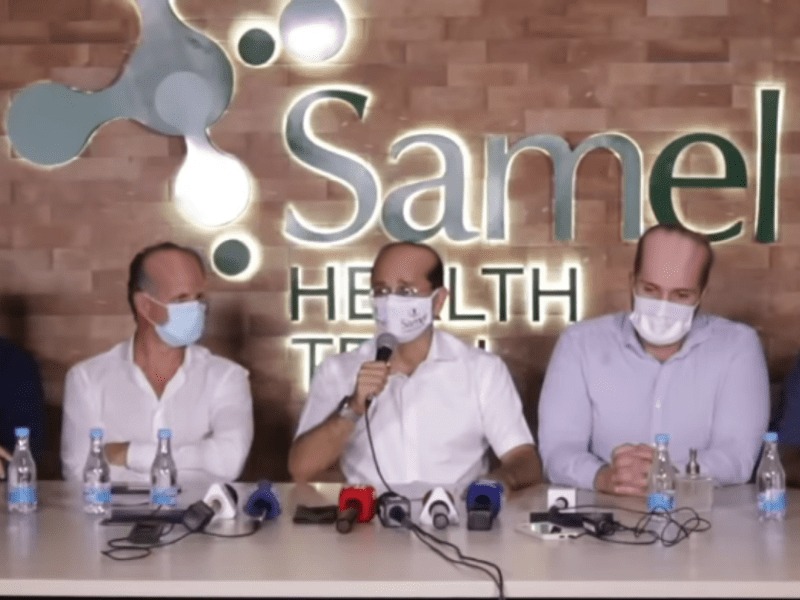
Why not chemical castration (to escape COVID-19)?
Male boldness causes COVID-19 death, go figure. This ridiculous quackery from Brazil is based on fudged clinical trials, sponsored by an obscure Californian hair loss business, and even Torello Lotti is on board!
Here is Nader’s written testimony translated with DeepL:
“Mr. President, Senators, colleagues,
I would like to express my concern regarding Bill No. 330/2022, which proposes to criminalize scientific misconduct, establishing a prison sentence of 3 to 5 years and a fine for researchers who violate protocols, manipulate data, or selectively present results.
The motivation behind the bill is legitimate: serious incidents such as that involving proxalutamide in Amazonas revealed serious flaws in compliance with research protocols and impacted the lives of hundreds of people. These cases do indeed require rigorous investigation and accountability. However, the solution presented by Bill No. 330 is neither the most appropriate nor the most effective.
First, because science is an activity based on uncertainty. Hypotheses are tested, results may diverge, statistical analyses can be interpreted in different ways. Methodological errors or disagreements between groups cannot be treated as crimes. The risk is criminalizing scientific practice itself, inhibiting innovation and creativity.
Second, because Brazil already has robust mechanisms for oversight and punishment. The National Research Ethics Commission (CONEP), linked to the National Health Council (CNS), is the body responsible for evaluating the ethical aspects of research involving human subjects in Brazil. Formed by specialists from different areas, including users, CONEP develops and updates standards for the protection of research participants and coordinates the CEP/CONEP System, which brings together local committees, researchers, educational institutions, and research centers across the country. In the system, the Research Ethics Committees (CEP) analyze studies of low and medium complexity, serving as a gateway for any project involving human subjects. CONEP, on the other hand, examines more complex research or research in sensitive areas, such as genetics, human reproduction, indigenous peoples and international cooperation, as well as projects from the Ministry of Health. Protocols that require this evaluation are forwarded by the CEP to the national authority. To be considered ethical, research must respect the dignity and autonomy of participants, recognizing their vulnerability; balance risks and benefits, prioritizing the minimization of harm; prevent foreseeable harm; and demonstrate social relevance, ensuring that the knowledge produced has human and collective value.
The Arouca Law refers to Law No. 11,794, of October 8, 2008, which regulates the scientific use of animals in teaching and research activities in Brazil, establishing the National Council for the Control of Animal Experimentation (CONCEA) and the Ethics Committees on the Use of Animals (CEUAs), which oversee the application of ethical standards and animal welfare, in addition to promoting the use of alternative methods whenever possible. The system establishes standards for the breeding, maintenance, and use of animals in laboratories, requires the adoption of the 3Rs principles (reduce, refine, and replace), and accredits the Animal Use Ethics Committees (CEUAs), responsible for evaluating and approving projects at the institutional level. In this way, it seeks to balance the advancement of science and innovation with the protection of animal welfare, promoting more responsible practices that are transparent and aligned with international standards.
Thus, the CEP/CONEP, CEUA/CONCEA systems, research ethics committees, funding agencies, universities, hospitals, and other ICTs apply sanctions ranging from warnings to the revocation of funding and dismissal of researchers.
These administrative instruments are more proportionate and effective. Creating criminal penalties creates overlap, legal uncertainty, and the risk of arbitrary punishment.
Third, it is important to remember that the Federal Constitution protects academic freedom.
Article 207 guarantees university autonomy, and Article 218 gives priority to scientific research, with the text of EC 86/2016, which specifies that the State must promote and encourage scientific development, research, technological training, and innovation. It prioritizes basic scientific research for the public good, technological research focused on Brazilian problems and the development of the productive system, in addition to supporting the training of human resources in these areas.
Criminalizing scientific conduct threatens these principles and may lead to self-censorship, drive away young researchers, and hinder international collaborations.
The bill also violates the principle of proportionality. Practices such as “inappropriately using statistical data” or “selectively presenting results” may stem from bad faith, but also from technical errors or divergent interpretations. Turning them into a crime punishable by imprisonment is an excess that is not seen even in countries with a tradition of strict control of scientific integrity.
What we need is not imprisonment for scientists, but rather institutional strengthening. I propose that we move forward with measures such as:
- expanding the capacity and resources of CONEP and ethics committees;
- making training in scientific integrity mandatory at all levels of education, from high school to undergraduate and graduate studies;
- creating national data repositories to increase transparency;
- encouraging good practices with integrity programs and regular audits.
Honorable Senators, this is not about downplaying the seriousness of scientific misconduct, but about finding the right way to combat it. Criminal law should be reserved for extreme situations of proven intent and damage. For other cases, existing mechanisms are sufficient, provided they are strengthened.
Brazilian science is at a crucial juncture: it needs to recover investments, attract young talent, and increase its international presence. Passing a bill that criminalizes research will mean moving in the opposite direction, instilling fear and mistrust within the scientific community itself.
Therefore, I express my opposition to Bill 330/2022 and recommend that this House seek alternatives that preserve integrity without compromising academic freedom and the advancement of science in Brazil.
Thank you very much.
Helena B. Nader
President”
Well, those existing “robust mechanisms for oversight and punishment” against research fraud are working excellently in Brazil. The mega-cheater Mario Saad was not only whitewashed and defended, he almost became rector of his university.
“Criaremos na Unicamp um escritório permanente de integridade em pesquisa para proteger a sociedade e o pesquisador”, afirma Mario Saad
Mario “Fakenews” Saad is entering a run-off election to become rector of his Brazilian university. The man responsible for massive research fraud and 18 retractions plays the victim of a “Cancel Culture”. Saad also announces to create an “Office for Research Integrity”, to legalise misconduct and to punish the whistleblowers.
The papermill fraudster Eder Lima also has nothing to fear from his Brazilian university. He even started to disperse his papermilling acolytes into European universities. And Julio CB Ferreira even enjoys protection not just at home in Brazil, but also from the mighty Stanford University in USA.
Maybe Brazil needs some radical new legislation after all. You saw how Brazli’s top scientist Helena Nader reacts when people find fraud in her own papers.
Donate!
If you are interested to support my work, you can leave here a small tip of $5. Or several of small tips, just increase the amount as you like (2x=€10; 5x=€25). Your generous patronage of my journalism will be most appreciated!
€5.00

 For Better Science
As soon as the first indications of her ‘problematic papers’ came out, the Einstein Foundation was made aware. I don’t know the timeline of events within the Foundation, but if you click on the link in the article, you can see that currently she is not on the Jury anymore.
LikeLike
Indeed! Nader is now “former member”. https://award.einsteinfoundation.de/jury/former-members-of-the-jury
LikeLiked by 1 person
Is it possible that university, instead of the author herself, asks for retraction?
LikeLike
Often universities ask for retraction, but sometimes they get ignored by the publishers. That’s why universities twist their scientists’ arms to get them to ask for retraction themselves.
As it happened here:
LikeLike
BMJ, the publisher of BMJ Public Health, refuses for already >15 months to fulfill a formal request by all authors of Mostert et al. (2024) to retract this horrible antivax study.
https://pubpeer.com/publications/BD524B3E696274C2F24DFFC8CCA546
LikeLike
Universities and research institutes occupy a peculiar place in society. They are publicly funded to a large degree—through taxes, state appropriations, and government grants—yet they often resist being bound by the same rules that apply to the general public or to private enterprises. Instead, academia cultivates its own governance structures, codes of conduct, and ethical standards, which can appear insulated and self-referential.
This resembles the historical phenomenon of church law (canon law), in which religious institutions developed their own systems of justice and accountability that operated separately from, and sometimes in tension with, the legal framework of the state. The medieval church insisted that clerics should be judged under canon law, not civil law, thereby maintaining an internal jurisdiction that gave it special privileges. To outsiders, this looked like an exemption from the rules everyone else was required to follow.
LikeLike
Historically, universities were founded and operated as church institutions. People tend to forget this.
LikeLike
Yes, different gods, same masters — the cult has been rebranded, not dismantled.
LikeLike
“Brazil already has robust mechanisms for oversight and punishment.” Ha ha, best joke of the year. Mario Saad had over 80 papers flagged on PubPeer for the worst image irregularities for years…..Ha ha ha ha!!!
LikeLike