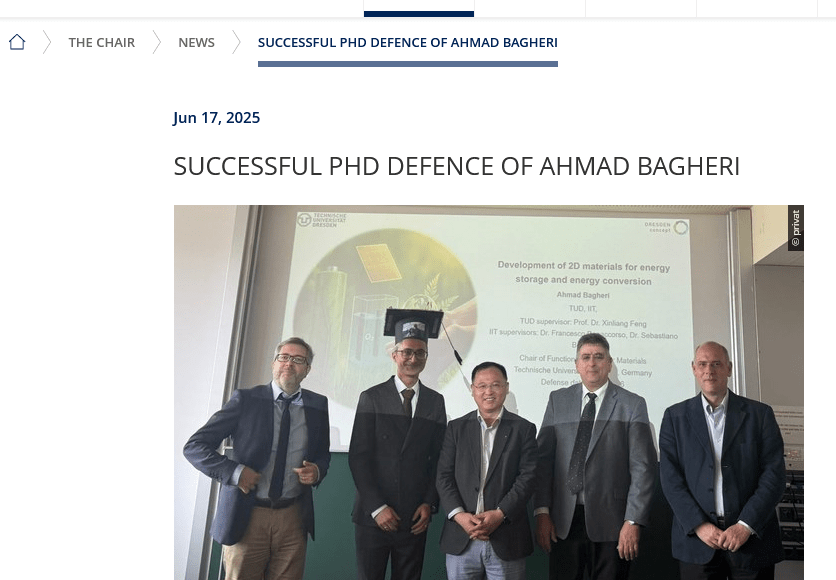

On 17 June 2025, the Technical University (TU) Dresden proudly announced:
“Successful PhD defence of Ahmad Bagheri
Ahmad Bagheri successfully defended his PhD thesis on “Development of 2D materials for energy storage and energy conversion” on June 16, 2025. Congratulations to Ahmad!”

The man in the middle, to the right of Doctor-hatted-Bagheri, is his PhD mentor Xinliang Feng, Chair of Molecular Functional Materials at TU Dresden and Director of Max Planck Institute of Microstructure Physics.
This PhD defence shows that German science is most certainly not as great, clean and shiny as the Germans firmly believe.
TU Dresden previously featured on this website, in the context of the affair of Bernhard Hommel and his wife Lorenza Colzato, as well as TU Dresden’s own rector, Ursula Staudinger:
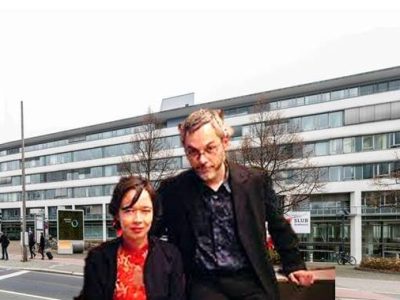
Bad Choices in Dresden III
Lorenza Colzato was a rising star of psychology and a role model for Women in STEM. All Dutch media and even some local German newspapers talk about her now. But I want to talk about her husband Bernhard Hommel instead.

During his PhD at TU Dresden, Bagheri got delegated to work with a collaborator of Feng’s at the Istituto Italiano di Tecnologia (IIT) in Genoa, Italy – Francesco Bonaccorso (who is Deputy Head of Innovation there). Specifically, Bagheri started to work at IIT’s spin-off company BeDimensional, which was founded in 2018 by Bonaccorso and his IIT colleague Vittorio Pellegrini, and which markets graphene technology. There, Bagheri worked next to another Iranian: Hossein Beydaghi . Both Bagheri’s and Beydaghi’s LinkedIn accounts show that they both presently work at Bedimentional.
Let me show you what Bagheri and Beydaghi published before they arrived to Europe:
Hossein Beydaghi , Mehran Javanbakht, Ahmad Bagheri , Parisa Salarizadeh , Hossein Ghafarian- Zahmatkesh , Sepideh Kashefi , Elaheh Kowsari Novel nanocomposite membranes based on blended sulfonated poly(ether ether ketone)/poly(vinyl alcohol) containing sulfonated graphene oxide/Fe3O4 nanosheets for DMFC applications RSC Advances (2015) doi: 10.1039/c5ra12941a

The last author Elaheh Kowsari is an associate of the papermill professional Seeram Ramakrishna (see for example Teymoorian et al 2021 and Akbarian et al 2022, which were both stricken by The Vickers Curse.
The Vickers Curse: secret revealed!
How did an editorial about insect pheromone communication get to receive 1200 irrelevant citations, almost all from papermills? Alexander Magazinov reveals The Secret of The Vickers Curse!

The coauthor Parisa Salarizadeh has around 20 papermill fabrications on PubPeer, her coauthors include the infamous Fatih Sen (e.g Askari et al 2021) and funnily, another Italian, Antonio Di Bartolomeo, who is a physics professor at the University of Salerno and lover of Iranian papermills.
Here a paper by Bagheri, Beydaghi and Salarizadeh:
Parisa Salarizadeh, Ahmad Bagheri , Hossein Beydaghi , Khadijeh Hooshyari Enhanced properties of SPEEK with incorporating of PFSA and barium strontium titanate nanoparticles for application in DMFCs International Journal of Energy Research (2019) doi: 10.1002/er.4635

This is the second paper, published by Beydaghi slightly later:
Khadijeh Hooshyari, Samira Heydari , Mehran Javanbakht , Hossein Beydaghi , Morteza Enhessari Fabrication and performance evaluation of new nanocomposite membranes based on sulfonated poly(phthalazinone ether ketone) for PEM fuel cells RSC Advances (2020) doi: 10.1039/c9ra08893h

Another one by Beydaghi and Salarizadeh:
Khadijeh Hooshyari , Sima Nazari Khanamiri , Parisa Salarizadeh , Hossein Beydaghi Nanocomposite Membranes with High Fuel Cell Performance Based on Sulfonated Poly (1,4-phenylene ether ether sulfone) and Ytterbium/Yttrium Doped-Perovskite Nanoparticles Journal of The Electrochemical Society (2019) doi: 10.1149/2.1521912jes


This is however the best ever by Beydaghi:
- Hossein Beydaghi , Mehran Javanbakht , Hossein Salar Amoli , Alireza Badiei , Yeganeh Khaniani , Mohammad Reza Ganjali , Parviz Norouzi , Majid Abdouss Synthesis and characterization of new proton conducting hybrid membranes for PEM fuel cells based on poly(vinyl alcohol) and nanoporous silica containing phenyl sulfonic acid International Journal of Hydrogen Energy (2011) doi: 10.1016/j.ijhydene.2010.08.085
- Hossein Beydaghi , Mehran Javanbakht , Alireza Badiei Cross-linked poly(vinyl alcohol)/sulfonated nanoporous silica hybrid membranes for proton exchange membrane fuel cell Journal of Nanostructure in Chemistry (2014) doi: 10.1007/s40097-014-0097-y
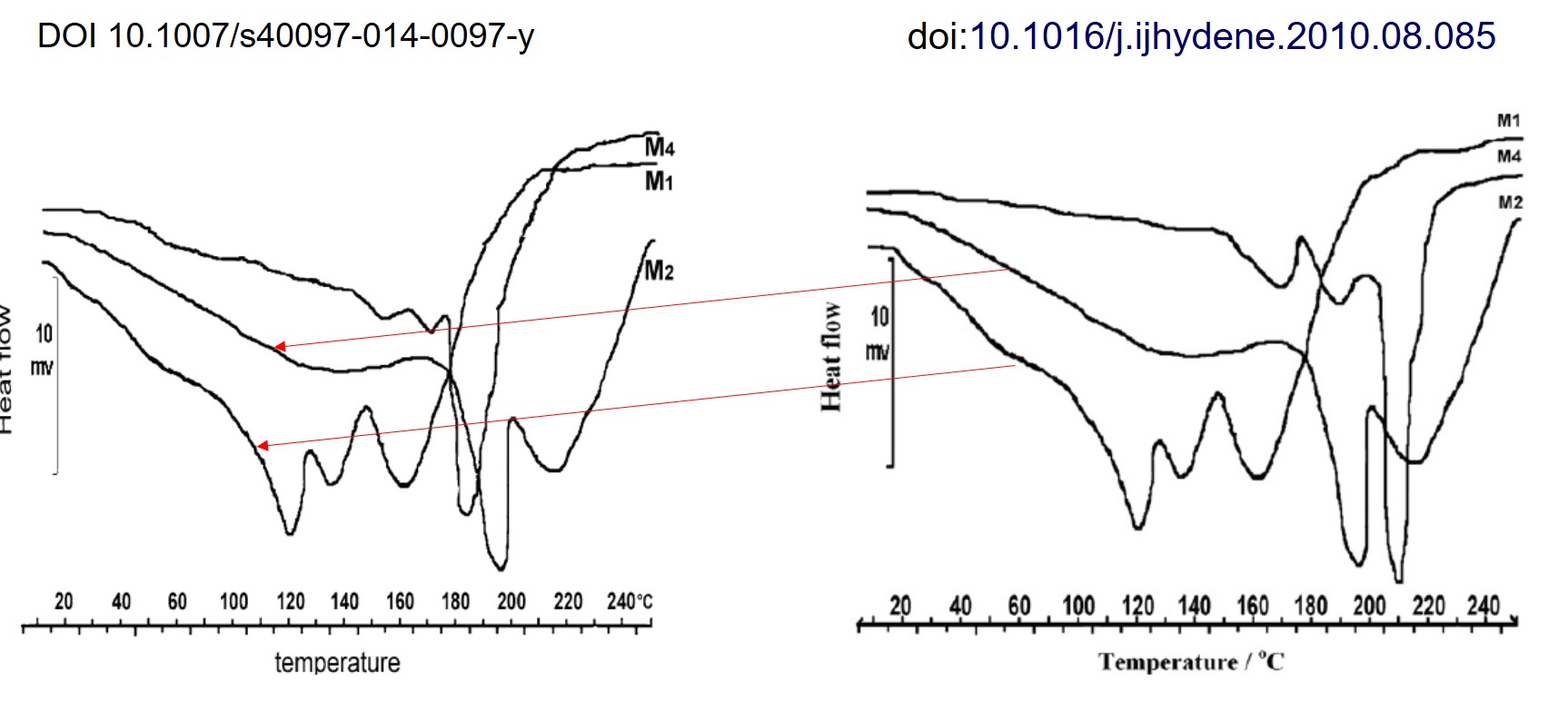
Never mind the duplication. The spectra are most obviously hand-drawn. Badly so. And these are the skills which Bonaccorso so values in his employees, that he will sue everyone who disapproves.
The men in Italy and Germany play with huge amounts of public money. Bonaccorso used to be “responsible for defining the ten years scientific and technological roadmap for the European Graphene Flagship” and “Deputy of the work-package Innovation of the Flagship.” Also Feng had a high position at the Graphene Flagship, which the European Union funded for a decade with a billion of Euros to produce very little of value when it ended in 2024.
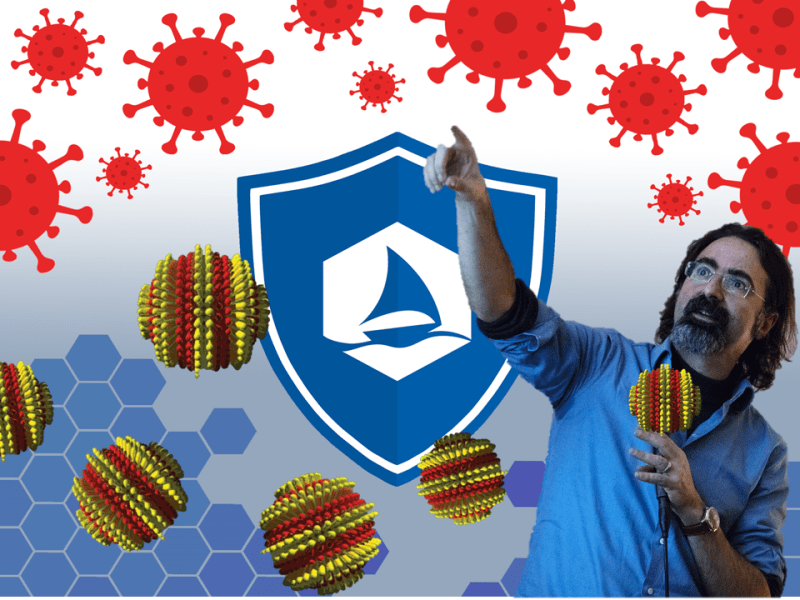
Graphene Flagship deploys Stripy Stellacci to fight the Coronavirus
How can EU Flagships help with coronavirus pandemic? Human Brain Project offers IT power and cigarettes, while Graphene Flagship established a COVID-19 Task Force. With Francesco “Stripy” Stellacci as virology expert!
Now, here is a paper by Bagheri, Beydaghi, Feng, Bonaccorso and Pellegrini. As you see, it shares data with two other papers by a similar team (without Feng but with Salarizadeh):
- Ahmad Bagheri , Sebastiano Bellani , Hossein Beydaghi , Matilde Eredia , Leyla Najafi , Gabriele Bianca , Marilena Isabella Zappia , Milad Safarpour , Maedeh Najafi , Elisa Mantero , Zdenek Sofer , Guorong Hou , Vittorio Pellegrini , Xinliang Feng , Francesco Bonaccorso Functionalized Metallic 2D Transition Metal Dichalcogenide-Based Solid-State Electrolyte for Flexible All-Solid-State Supercapacitors ACS Nano (2022) doi: 10.1021/acsnano.2c05640
- Hossein Beydaghi , Sebastiano Bellani , Leyla Najafi , Reinier Oropesa-Nuñez , Gabriele Bianca , Ahmad Bagheri , Irene Conticello , Beatriz Martín-García , Sepideh Kashefi , Michele Serri , Liping Liao , Zdeněk Sofer , Vittorio Pellegrini , Francesco Bonaccorso Sulfonated NbS2-based proton-exchange membranes for vanadium redox flow batteries Nanoscale (2022) doi: 10.1039/d1nr07872k
- Hossein Beydaghi , Leyla Najafi , Sebastiano Bellani , Ahmad Bagheri , Beatriz Martín-García , Parisa Salarizadeh , Khadijeh Hooshyari , Sara Naderizadeh , Michele Serri , Lea Pasquale , Bing Wu , Reinier Oropesa-Nuñez , Zdeněk Sofer , Vittorio Pellegrini , Francesco Bonaccorso Functionalized metallic transition metal dichalcogenide (TaS2) for nanocomposite membranes in direct methanol fuel cells Journal of Materials Chemistry A (2021) doi: 10.1039/d0ta11137f


By the way, there is a tragic figure in this: Zdeněk Sofer, co-author of the two papers above, and professor of chemistry in Prague, Czechia. Number one, Sofer is a coauthor of Radek Zboril‘s on the paper Tucek et al Nature Comms 2016, which was retracted due to fraud by Zboril’s and his University of Olomouc colleagues.

Whitewashed by ACS and Elsevier, Zboril sues Olomouc Dean for “bullying”
“I should remind you that the editorial offices that investigated your allegations did not found any evidence of scientific misconduct or data fabrication. In my opinion, your allegation may bear the elements of defamation and false accusation” – Prof Radek Zboril
But Sofer was also the author of this masterpiece of satire and sarcasm, where the authors proved that graphene can just as well be successfully doped with actual chicken shit:
Lu Wang , Zdenek Sofer , Martin Pumera Will Any Crap We Put into Graphene Increase Its Electrocatalytic Effect? ACS Nano (2020) doi: 10.1021/acsnano.9b00184
Sofer replied to me in March 2023:
“Regarding IIT paper I asked coauthor to check and provide all raw data. I suppose to be clarified ASAP.
From my lab originated 2D materials same like many other groups using them. […]
I suppose this issue on two papers where I’m coauthor will be clarified ASAP.”
The issue was never clarified. I wrote to Bonaccorso and Pellegrini, after a reminder Bonaccorso sent me this reply:
“Do not permit to write again.
Your accusation of falsified data is unacceptable.
If you write another email, we will act legally against you.
Francesco Bonaccorso“
I did write again, to Bonaccorso and in March 2023 Shorts and in May 2023 Shorts, but the tough guy remained silent instead of acting against me, either legally or illegally.
IIT’s Scientific Director Giorgio Metta eventually replied to me on 18 April 2023 and suggested I contact the IIT ombudsman with a formal report. I suggested he contacts the unnamed Ombudsman himself, and I never heard from Metta again. He certainly did not apologise for his colleague’s legal threats. No paper was ever even corrected.
Since both Bagheri and Beydaghi work at Bedimentional, a company partially sponsored by EU money, I contacted the EU Commission also with concerns of Bonaccorso’s attitude and whether his two Iranian employees should receive EU funds in any form. A EU Commission Spokesperson announced to me in March 2023 to “analyse the matter“. Nobody ever replied again.
The situation was no better in Germany. In May 2023, I contacted Feng because he was installed his PhD student Bagheri, plus Beydaghi, as speakers at the chem2Dmat conference in Bologna, which Feng himself organised.
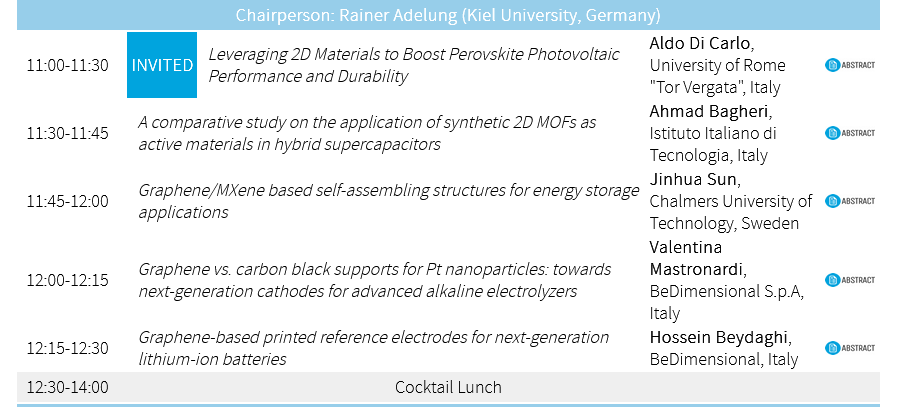
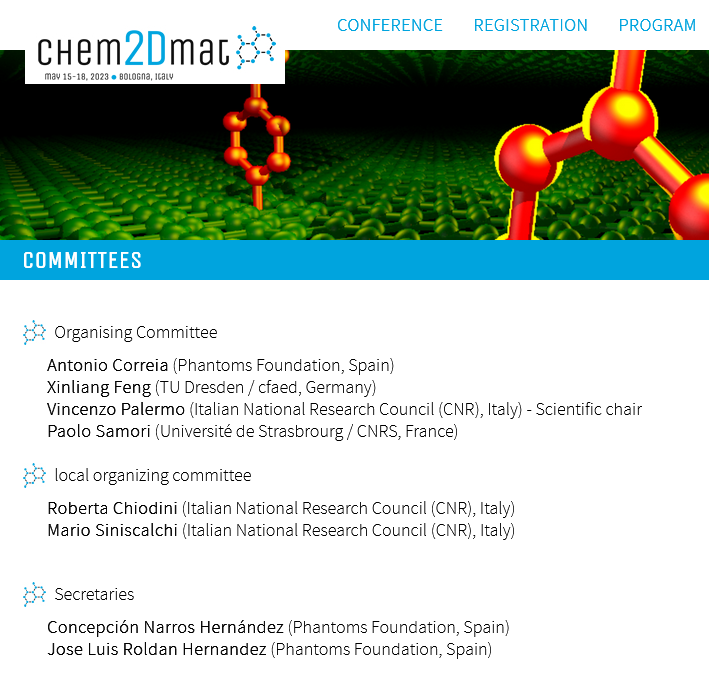
Neither Feng nor his co-organisers ever replied. I then wrote to Stefan Kaskel, Dean of the Faculty of Chemistry and Food Chemistry at TU Dresden, asking him to alert Feng to the problems with the papers by Bagheri and Beydaghi. Also Kaskel never replied, despite reminders. The dean is responsible for PhD graduations.
In January 2022, a problematic paper by Feng was flagged on PubPeer, and he was notified.
Yang Hou , Ming Qiu , Tao Zhang , Xiaodong Zhuang , Chang‐Soo Kim , Chris Yuan , Xinliang Feng Ternary Porous Cobalt Phosphoselenide Nanosheets: An Efficient Electrocatalyst for Electrocatalytic and Photoelectrochemical Water Splitting Advanced Materials (2017) doi: 10.1002/adma.201701589

Triplophyllum dicksonioides: “In Figure S6, the background noise patterns in the red marked regions are almost the same for the three different samples, while the informative region at low wavenumber is different.”
Here is another problematic Feng paper, again no Iranian students to blame:
Sheng Han , Yanru Zhao , Yanping Tang , Fengzhi Tan , Yanshan Huang , Xinliang Feng , Dongqing Wu Ternary MoS2/SiO2/graphene hybrids for high-performance lithium storage Carbon (2015) doi: 10.1016/j.carbon.2014.09.050

Thallarcha lechrioleuca: “Fig 4a. two identical XRD patterns for different samples”
In February 2025, I wrote to Feng again, and asked what he intends to do about the above two papers and the one he coauthored with Bagheri and Bonaccorso. I added the responsible Ombudsoffice of TU Dresden in cc. Nobody ever replied.
And a few days ago, Bagheri successfully graduated with PhD and everyone at TU Dresden is very proud.
Let me just say this: even if they at TU Dresden decided to forgive Bagheri’s sins of youth and give this fine Iranian lad a second chance, they would have made him correct or retract his fraudulent papers first. And of course same applies to Beydaghi at IIT Genoa. This of course was never even considered, in his message to me Bonaccorso simply spoke out what everyone thought.
Bad Choices in Jena
It is even worse at the University of Jena, like Dresden also located in Eastern Germany.
They just allowed Mohammad Taheri to (very quietly) defend his PhD. By all standards, his cosplaying as a humble PhD student is more than unusual and in fact very suspicious. Read about Taheri here:

Look What the Cat Dragged In
Meet Mohammad Taheri, PhD, a humble PhD student in Jena, Germany, and his equally unremarkable Iranian associate Dr Soudeh Ghafouri-Fard.
Thing is, Taheri actually had a PhD degree already, from Iran, but no rules ever applied to this papermiller. Taheri also claims to run his own clinical research lab in Iran and authored more than 660 papers, many of them before he even started his PhD in Jena. NINETY of these papers have been flagged on PubPeer.
Taheri’s closest collaborator is a certain Soudeh Ghafouri-Fard, who in turn is married to one of Iranian regime’s top officials, Mehdi Akhavan Behabadi, Secretary of Supreme Council of Cyberspace, head of National Center of Cyberspace, and former government deputy minister.
Taheri’s and Ghafouri-Fard’s clinical studies from Iran, on human patients, contain made-up data and lack ethics approvals. Which was apparently not deemed as an ethical problem, neither by University of Jena leadership nor by academic journal editors, because a) in Iran you can do to people whatever you want, and b) those clinical studies were made up anyway. You can see this attitude in a recent correction for Taheri et al 2024 (read June 2025 Shorts).
Nobody in Jena wondered why the humble PhD student Taheri published much, much more that his Doktorvater in Germany and fellow Persian, Prof. Dr. rer. nat. Aria Baniahmad, deputy chair of the Institute for Human Genetics of the University Clinic Jena. Baniahmad, with whom Taheri authored several very problematic papers, remains the Ombudsman for research integrity in Jena. We can safely assume it was Ombudsahmad who was in charge of investigating himself and his successful PhD student.
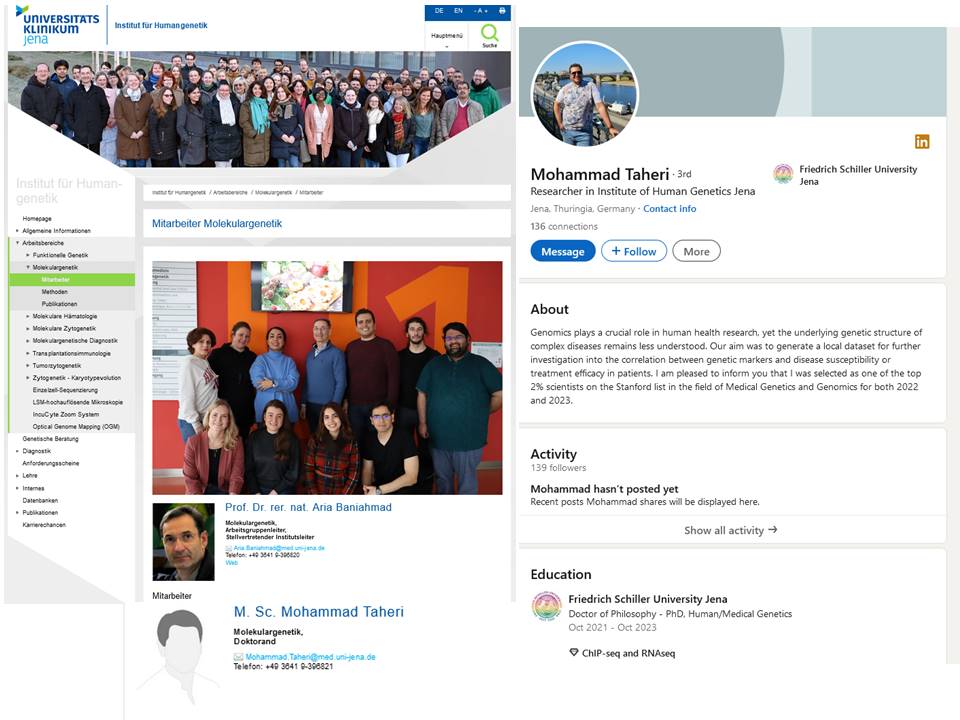
Taheri runs worldwide networks, enlisting many important academics as his coauthors, which is the best insurance against retractions. In Australia, it was Marcel Dinger, Dean of Science at the University of Sydney, who soon came to regret that collaboration (read May 2024 Shorts and later reporting by Retraction Watch). At the University of Basel in Switzerland, Taheri supplied Serge Brand and Annette Brühl (deputy director at the university’s psychiatric clinic) with authorships (read another issue of May 2024 Shorts).
In early 2024, Alexander Magazinov and myself notified the University of Jena of the fraud in Taheri’s research, and his connections to the Iranian leadership, which is clearly a national security issue. Georg Pohnert, interim President of the University of Jena, wrote to us on 8 February 2024:
“we have initiated an investigation into the allegations. We confirm that we take full account of conflict of interest.
Thank you for your emails, which we take very seriously.“
Also the scientific director and dean of the University Clinic Jena, Thomas Kamradt, wrote to us on 16.02.2024:
“Thank you for your information about the possible secret service activity of an employee of the University Hospital, which I take very seriously. I have forwarded your report to the internal reporting office set up at Jena University Hospital in accordance with the law for better protection of whistleblowers…”
But soon, the university leaders must have understood that the real threat to German science and national security came from evil monsters like Magazinov and myself. All our follow-up emails remained unanswered. Taheri’s papermiling happily continued with his German university’s full endorsement. Baniahmad remained Ombudsman for research integrity. Behind the scenes, University of Jena proceeded with saving Taheri and their Ombudsahmad. Where need arose, corrections were negotiated, like here:
Mohammad Taheri , Zeinab Shirvani-Farsani , Atefeh Harsij , Mohadeseh Fathi , Sheyda Khalilian , Soudeh Ghafouri-Fard, Aria Baniahmad A review on the role of KCNQ1OT1 lncRNA in human disorders Pathology – Research and Practice (2024) doi: 10.1016/j.prp.2024.155188
“The authors regret to inform that three papers cited in this review have been retracted. Specifically, the following references have been retracted: in the Introduction, the citation reporting that LncRNAs act as oncogenic or tumor suppressive transcripts (Ref. [10]); the accuracy of this statement is supported by Ref. [11]. In the section discussing the interaction between lncRNAs and miRNAs mediated by the RNA-induced silencing complex and regulation of gene expression (Ref. [16]), this statement is supported by Ref. [18]. Additionally, in the summary of studies reporting the upregulation of KCNQ1OT1 in glioma, including its prognostic roles (Ref. [62] in Tables 2 and 3).
The authors apologize for any inconvenience caused. Importantly, none of the retracted citations affect the conclusions drawn in this review.”
Corrigendum 19 November 2024
Magazinov then noticed that two more references were retracted, [19] already in 2021 and [58] in August 2024. The sleuth then wondered: “How many more of them are needed to put the conclusions into doubt (if there are conclusions, that is)?“
Unlike with Bagheri and TU Dresden, the University of Jena never announced Taheri’s recent PhD graduation, which took place in April 2025. Some weeks ago, Taheri changed his LinkedIn profile picture to this:
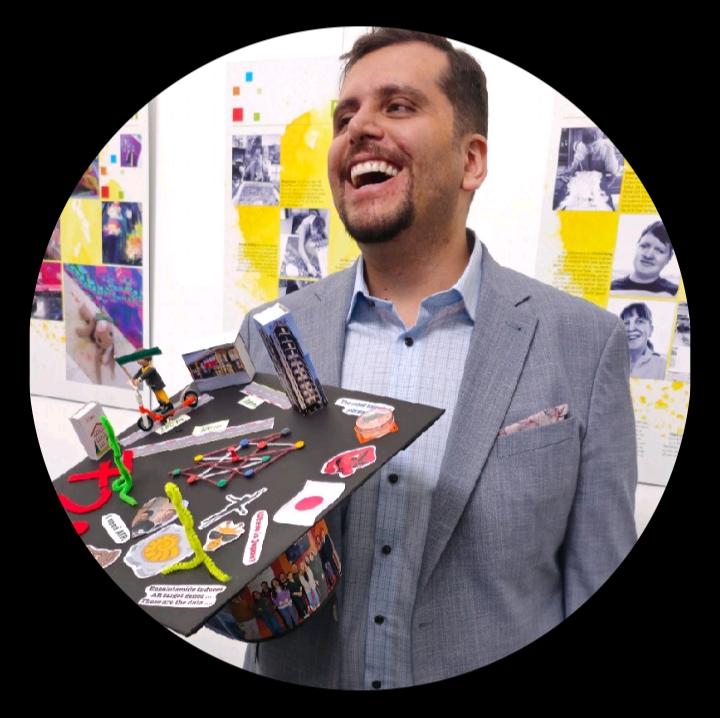
It shows a happy Taheri holding the traditional German “Doktorhut“, a hand-made present given by lab colleagues to a successful new PhD graduate on the day of their thesis defence. Right after I found that photo and wrote to University of Jena about his graduation, Taheri deleted his LinkedIn profile completely.
Yet just before Taheri’s secret PhD defence in Jena, one of his papers was retracted (read March 2025 Shorts). That idiotic autism study cited retracted studies, the peer reviewer Amin Safa previously collaborated with Taheri and Ghafouri-Fard:
Mohammadarian Akbari , Reyhane Eghtedarian , Bashdar Mahmud Hussen , Solat Eslami , Mohammad Taheri, Seyedeh Morvarid Neishabouri , Soudeh Ghafouri-Fard Assessment of Expression of Regulatory T Cell Differentiation Genes in Autism Spectrum Disorder Frontiers in Molecular Neuroscience (2022) doi: 10.3389/fnmol.2022.939224
“Following publication, concerns regarding potential undisclosed conflicts of interest were raised by a reader. An investigation was conducted in accordance with Frontiers’ policies, after which Frontiers found substantial evidence of undisclosed conflicts of interest that undermined the integrity of the peer review process. Additionally, following the Chief Editor’s assessment, it was determined that the validity of the content was significantly compromised by the inclusion of retracted references. […]
The authors do not agree to this retraction. Frontiers would like to thank Alexander Magazinov for contacting the journal regarding the published article.”
Retraction 4 March 2025
German Authorities on Papermills and Whistleblowing
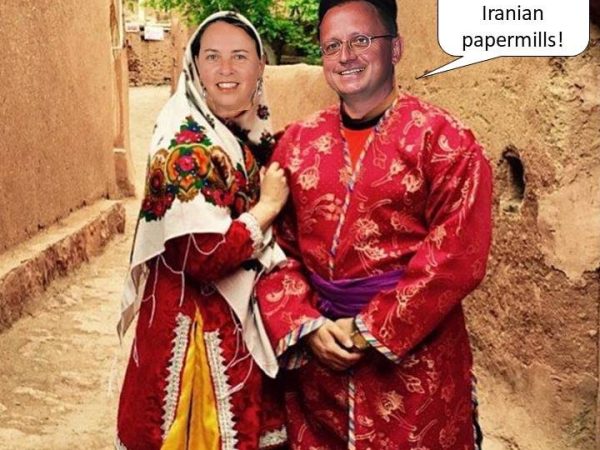
“I am not familiar with Iranian papermills!” – Prof Dr med Henning Madry, Saarland University.
Update 31 July 2025. I had to submit a Freedom of Information inquiry intil the University of Jena finally deigned to admit that Taheri indeed graduated with PhD. The thesis defence took place on 1 April 2025, the committee consisted of Jena professors of medicine Baniahmad, Ferdinand von Eggeling and Sussanne Füssel.
The dissertation is titled “Analysis of long-non coding RNAs in androgen receptor signaling of prostate cancer” and can be downloaded here. It is a so-called “cumulative” one, which means Taheri didn’t have to write a proper thesis, he just assembled a list of his papers with Baniahmad and Ghafouri-Fard (those not yet flagged on PubPeer!), framed by a short introduction and discussion. These are the papers:
- Mohammad Taheri , Arash Safarzadeh , Bashdar Mahmud Hussen , Soudeh Ghafouri-Fard , Aria Baniahmad LncRNA/miRNA/mRNA Network Introduces Novel Biomarkers in Prostate Cancer Cells (2022) doi: 10.3390/cells11233776
- Mohammad Taheri, Arash Safarzadeh, Soudeh Ghafouri-Fard, Aria Baniahmad An in-silico Approach for Recognition of Long non-coding RNA-Associated Competing Endogenous RNA Axes in Prostate Cancer Urology journal (2024) doi: 10.22037/uj.v20i.7650
- Mohammad Taheri , Tayyebeh Khoshbakht , Elena Jamali , Julia Kallenbach , Soudeh Ghafouri-Fard , Aria Baniahmad Interaction between Non-Coding RNAs and Androgen Receptor with an Especial Focus on Prostate Cancer Cells (2021) doi: 10.3390/cells10113198
- Mohammad Taheri , Arash Safarzadeh , Aria Baniahmad Unveiling four axes ADAMTS9-AS2|MEG3/hsa-miR-150/PRKCA|MMP14 within prostate cancer through establishment of the ceRNA network Pathology – Research and Practice (2024) doi: 10.1016/j.prp.2024.155604 (originally “submitted for publication in International Journal Of Surgery“
- Mohammad Taheri , Katrin Schindler , Aria Baniahmad The lncRNAs PART1 and ADAMTS9-AS2 act in an antithetic manner on AR signaling and induction of cellular senescence in prostate cancer cells International journal of surgery (2025) doi: 10.1097/js9.0000000000002334 (according to thesis, “submitted for publication in International Journal Of Biological Macromolecules“)
The last paper in the list is discussed in July 2025 Shorts, where I also inform that just after his PhD graduation the University of Jena found Taheri guilty of research misconduct, for “failure to consider retractions in at least three cases” and “splitting results into inappropriately small publications“, while “Baniahmad’s conduct was at the borderline of scientific misconduct, but did not cross it“.
Bad Choices in Helsinki
As it happens, Taheri’s close collaborator and coauthor on the above retraction, Reyhane Eghtedarian (PubPeer record) will soon defend her PhD at the University of Helsinki (read June 2024 Shorts), supervised by assistant professor Helena Kilpinen. The Finnish university acknowledged in their official letter to Alexander Magazinov that Eghtedarian’s papers with Taheri and Ghafouri-Fard “are either of low quality or may be produced by entities generating falsified research to sell authorship positions (papermills)“, but insisted that:
“Eghtedarian has not had the role of principal investigator in the research behind the publications. Nor had she been the main author of the publications. According to her response, she has, for example, conducted experimental research, conducted laboratory experiments and prepared summarizing tables. Eghtedarian has, thus, not been responsible on the design of the publications or on the ethical permits of the research projects.”
Magazinov’s notification was rejected as “unfounded”. The university also didn’t mind that Eghtedarian peer-reviewed Taheri’s papers, because “her action as a peer reviewer took place only after the collaboration has ended“. That wasn’t true, but since when do facts matter when Iranian geniuses are under attack.
In December 2024, the Finnish National Board on Research Integrity (TENK) supported the decision of University of Helsinki:
“TENK agrees with the assessment of the course of events issued by the chancellor of the University of Helsinki and the decision that neither Reyhane Eghtedarian nor Helena Kilpinen had committed RI violations.”
Coda: The Bad Bilals
The Gdansk University of Technology recently divested from two Pakistani papermillers, both have very similar names. One is called Muhammad Bilal and the other is Muhammad Bilal Hafeez.
The former Bilal is more senior that the other and used to be a so-called Nobelium Fellow, but he was kicked out after my reporting:
Nobelium Bilalski, a Gdansk papermiller
“To date, he has authored over 700 peer-reviewed articles, 150 book chapters, 25 edited books, and 10 editorial-type scientific articles in various areas of Science and Engineering. Dr. Bilal has a h-index of 94 with 34 000 citations (Google Scholar).”
Bilal now even removed his past employment as professor in Gdansk from his ORCID profile, because he started as a humble postdoc at the Department of Biochemical and Chemical Engineering of University of Antwerp in Belgium. I wrote to Bilal’s new bosses in Antwerp, and was told he works in the lab of the associate professor Iris Cornet.
But we focus on PhD students here, especially those in Germany, so let me tell you about the other Bilal, Muhammad Bilal Hafeez. Be aware that PubPeer records include another Pakistani papermill customer of the exact same name, but that other one publishes on agronomy topics and is affiliated with University of Agriculture Faisalabad. Our Bilal Hafeez is into engineering, and was doing PhD in Poland. In January 2025 Shorts, I discussed a retraction of his:
Muhammad Bilal Hafeez, Marek Krawczuk, Hasan Shahzad , Amjad Ali Pasha , Mohammad Adil Simulation of hybridized nanofluids flowing and heat transfer enhancement via 3-D vertical heated plate using finite element technique Scientific Reports (2022) doi: 10.1038/s41598-022-15560-5

Of note: refs. [68, 69, 72, 73] have nothing to do with the Galerkin method. Refs. [76, 77] have been retracted.
Of another note: the same exact batch has been spotted elsewhere.”
That other paper was authored by notorious papermillers El Sayed M. Tag El Din, Wasim Jamshed and Mohamed R. Eid, the only common author was Amjad Ali Pasha.
“After publication of this Article concerns were raised over relevance of some of the references to the content they were cited to support. Editors requested that, in addition to clarification about these concerns, the Authors provide the underlying code for the simulations. An expert post-publication peer review of the provided code showed that it is not suited to reproduce the reported results. Therefore, the Editors lost confidence in the results and conclusions of the Article.
Marek Krawczuk and Amjad Ali Pasha do not agree with the retraction.”
Retraction 15 April 2024
This Marek Krawczuk is professor at Gdansk Polytechnic, and the former host of Bilal Hafeez, together they have many joint papers with Pasha, Jamshed, Eid and Tag El Din. They obviously originate from papermills, like Shahzad et al 2022, Darwesh et al 2022, Bilal Hafeez et al 2022, Bilal Hafeez et al 2023, Kaneez et al 2023, Majeed et al 2023, or this one:
Umar Nazir , Muhammad Sohail , Muhammad Bilal Hafeez , Marek Krawczuk , Sameh Askar , Sammar Wasif An inclination in Thermal Energy Using Nanoparticles with Casson Liquid Past an Expanding Porous Surface Energies (2021) doi: 10.3390/en14217328
As Guillaume Cabanac noted, that paper contained “tortured phrases” like “slanted attractive field” and “warm conductivity“, which arise when stolen text is chased through machine translation to hide the plagiarism. Krawczuk replied on PubPeer:
“I agree that used phrases are inappropriate. All phrases should be change by the way as proposed Guillaume Cabanac. I am wondering that those phrases has not been improved before publication.”
A Correction was issued on 19 April 2024:
“Some phrases in the original publication were not appropriate [1]. The authors would like to change “limit layer” to “boundary layer”, “attractive field” to “magnetic field”, “stream” to “fluid flow”, “strand” to “extrusion”, “warmth transport” to “heat transport”, “warmth” to “heat transfer”, “prerequisite” to “researcher”, “warming as refrigerator” to “heating and cooling”, “warm” to thermal”, “transformation of heat” to “heat transfer”, “raised warmth stream” to “increase the heat flow”, “warm conductibility” to “thermal conductivity”, “trademark” to “significant”, “consistent” to “steady”, “soaked” to “saturated”, “volume portion” to “volume fraction”, “cloth” to “material”.
Corrections have been made to 1. Introduction, 2. Mathematical Formulation, 4. Outcomes and Discussion, and 5. Conclusions.
The authors state that the scientific conclusions are unaffected. This correction was approved by the Academic Editor. The original publication has also been updated.”
They haven’t corrected everything, as Nick Wise found more tortured phrases in need of update, including:
“There is also hydromantic which means ‘pertaining to hydromancy‘, divination by water or other liquid. I assume the authors (or their software) meant hydrodynamic.”
I wrote about the Editor-in-Chief of this MDPI journal, Enrico Sciubba, here:
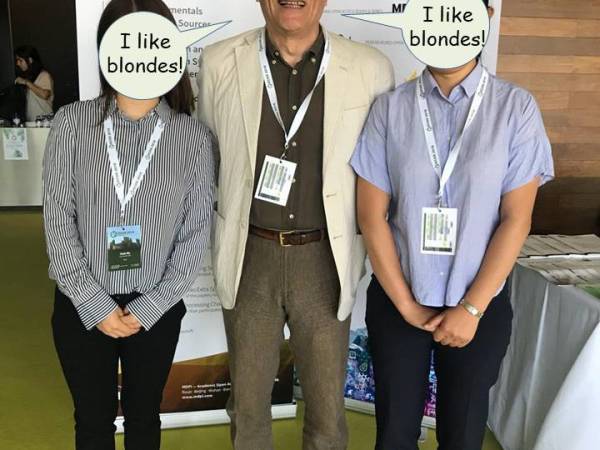
The perfect MDPI editor
“I know you cannot understand such matters, since you appear to have strong mother-related problems that most likely have denied you of a satisfactory sexual life”, _ Enrico Sciubba, Editor-in-Chief
Here are Bilal Hafeez and Krawczuk peddling citations:
Farrah Ashraf , Tehsina Javeed , Romana Ashraf , Amina Rana , Ali Akgül , Shahram Rezapour, Muhammad Bilal Hafeez , Marek Krawczuk Some new soliton solutions to the higher dimensional Burger–Huxley and Shallow water waves equation with couple of integration architectonic Results in Physics (2022) doi: 10.1016/j.rinp.2022.106048

Alexander Magazinov: “Supporting a garbled definition (“remarkably” is not a formal notion, thus has no mathematical meaning) of a soliton with 8 citations to a certain STR Rizwi is unexpected. “
Krawczuk had to save himself, especially since Gdansk papermilling became the subject of national debate, so Bilal Hafeez had to go. In fact, Krawczuk even managed to have his cake and eat it: while all the other common papermill fabrications by Krawczuk and Bilal Hafeez remain standing today, the Gdansk professor used the above SciReps retraction to charge Bilal Hafeez with fraud and have him kicked out, as he wrote in one letter (translated):
“I informed the authorities of Gdańsk Tech, in the following order: the Dean of the Faculty of Mathematics and Engineering (Prof. A. Seweryn), the Chairman of the RDN (Prof. M. Wasilczuk), the Director of the Doctoral School (Prof. M. Mrozowski) and the Vice-Rector for Science (Prof. A. Milewski).
As a result, Mr. Hafeez was deprived of all scholarships, and a request to be removed from the list of students was also sent.“
In January 2025, Gdansk Polytechnic announced (translated):
“Muhammad Bilal Hafeez was a former doctoral student of the Faculty of Mechanical Engineering and Shipbuilding. He completed his studies within the Doctoral School and was removed from the list of doctoral students at Gdańsk University of Technology for failing to submit his doctoral dissertation on time.”
After the Gdansk Polytechnic divested of both Bilals in late 2024, Bilal Hafeez started working as PhD student at the University of Paderborn in Germany:

Bilal Hafeez’s new boss is Julia Riese, who arrived to Paderborn in October 2023 as full professor for fluid process engineering. I contacted Riese in January 2025, she replied with (translated):
“We will carefully check the facts with the help of the established university internal processes and then draw appropriate consequences. Please note that this can take some time.“
Half a year passed. In June 2025, I tried contacting Riese again. She chose not to comment on Bilal Hafeez’s papermilling. He remains a member of Riese’s team.

I guess in a few years, we can congratulate Bilal Hafeez on a successfully defended PhD in Paderborn?
Notes:
- The article was updated on 30.06.2025 to include additional infromation about Bilal Hafeez.
- The article was updated on 31 July 2025 to include information about Taheri’s successful PhD defence which was followed by research misconduct findings.
- This article contains material previously published in Friday Shorts. This proves that Schneider himself is a plagiarist and a research fraudster, who slanders young foreign scholars in racist and sexist manner.
Donate!
If you are interested to support my work, you can leave here a small tip of $5. Or several of small tips, just increase the amount as you like (2x=€10; 5x=€25). Your generous patronage of my journalism will be most appreciated!
€5.00

 For Better Science
Yay! Gdansk Tech featured again! I’m sure the spokesperson will present it as “growing recognition of GUT”!
But seriously, my Alma Mater appears to be the National hub for fraudsters 😦
The Nobelium program really made an impact
LikeLike
Kowsari & Ramakrishna mentioned in the beginning of the post also have connections to Gdansk papermilling: https://link.springer.com/rwe/10.1007/978-981-97-4618-7_44
LikeLike
Greg Boczkaj definitely needs a big fat promotion for this achievement alone.
LikeLike
Parisa Salarizadeh also “collaborates” with Gdansk Tech:
https://mostwiedzy.pl/pl/search?s=Parisa+Salarizadeh
LikeLike
That’s because of Dr Mohammad Taghi Tourchi Moghadam, Adiunkt at Katedra Inżynierii Materiałów Funkcjonalnych WETI, Assistant Professor at Gdansk University of Technology.
Here he is with Parisa:

https://pubpeer.com/publications/B01C219425D833E4262024D35554D6
And here he is with Rajender Varma!!!
http://dx.doi.org/10.1016/j.jpcs.2022.111176
Congratulations!
LikeLiked by 1 person
Rajender Varma retired with great honour! A professor from Belgium even wrote a nice tribute paper honoring Varma his work! It’s crazy how these people get away with it.
LikeLike
Here’s also Varma and Mohammad Reza Saeb (while he was still at Gdansk Tech):
https://pubpeer.com/publications/CA072A86348196C927C7C848EC5FC4
LikeLiked by 1 person
“The Nobelium program really made an impact”
Of course, it did – 4.5 mln PLN for Saeb, 2 mln for Bilal, 2 mln for Castro-Munoz. And this is only what I know of.
LikeLike
https://pg.edu.pl/badawcza/centra/naukowe/cmp/laureaci-nobelium
at least 2 more laureates have sizable PubPeer record: Yazdi and Shahsavarifar
LikeLike
https://pubpeer.com/search?q=%22Samaneh+Shahsavarifar%22
https://pubpeer.com/search?q=%22Mohsen+Khodadadi+Yazdi%22
LikeLike
Oh, the graphene guy threatened you. Laughing fact, not only these articles but also in solar cells (perovskites) they published many articles with Iranian paper millers. Neither of them were expert on topic or required laboratory available for such article. One can guess, the quality of work, another mining ready to dig. just check. Hot topics are easy target for paper millers, specially when you have co-authors available to be part of pie.
LikeLike
Gdansk Tech Graduate (unfortunately I cannot respond to your comment): “Yazdi and Shahsavarifar”
Yep, prominent co-authors: Mehdi Rahimi-Nasrabadi, Mohammad Reza Ganjali, Mohammad Reza Saeb, Mehdi Baghayeri. Anybody knows if Mahdiyeh-Sadat Hosseini is related or somehow connected to Seyed Hossein Hosseini (featuring prominetly in other Polish technical universities)?
This one is particularly interesting, since it features Justyna Kucinska-Lipka, the vice-rector for development.
PubPeer – Biopolymer-based composites for tissue engineering applicati…
LikeLike
Oh dear.

Vice Rector Justyna Kucinska-Lipka with her beloved Mohammad Reza Saeb, plus f*cking Navid Rabiee!
Plus Mahmood Barani !
And citing Saeeb ad nauseam.
Vice-Rector’s two most recent papers, you will recognise her esteemed coauthors Pooyan Makvandi and Milad Ashrafizadeh
Beyrami, H., Nazarzadeh Zare, E., Golshan, M., Kucińska-Lipka, J., Zare, I., Kang, N., Saeb, M. R., Salami-Kalajahi, M., Kang, H., & Makvandi, P. (2025). Engineered intrinsically conducting polymer/MXene smart platforms: Fabrication, clinical translatability, and biomedical applications. COORDINATION CHEMISTRY REVIEWS, 540, 216802. https://doi.org/10.1016/j.ccr.2025.216802
Gnatowski, P., Ansariaghmiuni, M., Piłat, E., Poostchi, M., Kucińska-Lipka, J., Khodadadiyazdi, M., Ryl, J., Ashrafizadeh, M., Mottaghitalab, F., Farokhi, M., Saeb, M., Baczek, T., Chen, C., & Luo, Q. (2025). Hydrogel membranes in organ-on-a-chip devices: A review. COLLOIDS AND SURFACES B-BIOINTERFACES, 251, 114591. https://doi.org/10.1016/j.colsurfb.2025.114591
LikeLike
I feel like this is actually a viable strategy to keep the fraud going: either openly recruit rectors, deans and other “heads” into papermill or “by courtesy” propose them a spot on your paper (note in Poland researchers are expected to fill the 3 publication “slots”, no matter how busy they are with teaching or administrative duties – such an opportunity of having a “slot” filled with little to no own input might be tempting) and then when sh*t hits the fan these rectors/deans will defend the fraudster by all means because they are in the same boat. This is essentially the science version of communist secret service producing kompromat.
LikeLiked by 1 person
I suspect this is exactly why Iranian regime invests so much into papermills. First, it gives their agents a superhuman CV to get every job in the west, and second, it creates Kompromat on their elite western coauthors, who by this become Iranian assets to be exploited.
Basically, University of Jena is now run from Iran.
LikeLike
Unfortunately, COORDINATION CHEMISTRY REVIEWS and COLLOIDS AND SURFACES B-BIOINTERFACES are also papermill dens. The latter published e.g. the paper by Bilal and Jesionowski, which was the first I commented on 9 months ago.
PubPeer – Enzyme mimic nanomaterials as nanozymes with catalytic attri…
It contained almost 50 tortured phrases and errors such as “degradation of O2 to oxygen” or “oxygen breakdown, delivering water (H2O), hydrogen oxide or hydrogen peroxide (H2O2)”. I submitted my letter of concern on Oct. 4th, 2024. Nobody cares.
Actually, it is hard to find a reliable journal at Elsevier nowadays. Also ACS and RSC publish a lot of crap – RSC Advances, ACS Omega, even ACS Nano. Doing research and publishing honestly stopped making sense.
LikeLike
Talking about Navid Rabiee. I think that most people in Poland don’t know his story at Murdoch University
Chemist under scrutiny resigns from Australian university
and his “achievements” with Green Biomaterials, a journal he created last year, which was closed by Taylor&Francis before ever publishing a paper.
‘Bad actors’ dominate new chemistry journal’s editorial board, critics allege
New chemistry journal folds after outcry over editor appointments
LikeLike
Indeed, Hubert, most people don’t know Rabiee’s story.
That’s because the author of the first article you shared, Dalmeet Singh Chawla once again erased all credit or reference to people who worked to get Rabiee sacked.
Especially Alexander Magazinov.
https://forbetterscience.com/tag/navid-rabiee/
In Dalshit’s second article you posted Dalshit even ridicules Magazinov by using his tweet while assigning credit to a French researcher.
The third Dalshit article you link is a story stolen straight from FBS, just days after I wrote about it:
Dalshit’s real expertise is to grab a hot story from For Better Science and to de-Schneiderize everything, ideally by misattributing the credit to respectable people. That’s why he is so successful, there is much demand for this service.
LikeLike
Rabiee, the impostor, shows up at Tsinghua University after Australia. As someone whose name has been implicated in academic fraud, his chances of finding a job at Tsinghua were very low; in fact, we could say that it would have been easier for him to find a job in Europe. If one of China’s most prestigious universities is willing to hire this impostor even after corruption allegations have surfaced, considering Rabiee’s past at Sharif University and his likely current connections, it becomes clear that this story is not merely academic but also political. What kind of activities did Rabiee engage in during the years he spent in Australia under the guise of being a victim and an innocent person? We will never know. It is likely that Australian security authorities aren’t concerned about this either.
LikeLike
I am actually genuinely scared that Gdansk Tech has essentially unwillingly established an outpost of Iranian secret service/IRGC in Poland. Note how many Iranian ‘scholars’ have been recruited and how interconnected are they. Eg. Shahsavarifar published a paper with russia-affiliated NCN expert Luque and IRGC’s university-afiliated Nasrabadi: https://pubpeer.com/publications/409DF39D4A141F62C9F432EFB29291 with another co-author, Jesionowski, being connected to the Bilal case
LikeLike
And let us not forget Nasrabadi’s German friend Hermann Ehrlich now at AMU in Poznan, who seems to be absolutely unwelcome back at his old German university.
LikeLike
Wow, do you think this one was also taken from FBS?
Russia honors chemist who was suspended in Spain
Or maybe from Forum Akademickie? It appeared 1 week after Mariusz Karwowski published his article…
Współpraca z Rosją, sztuczne cytowania, podejrzenia o paper mills… Zajrzeliśmy na listę ekspertów NCN
So, who can be trusted these days? Not even ACS and Nature?
LikeLike
Yes, it was also taken by Dalshit from FBS. And I got the news from Magazinov. I treated Luque as as a secondary story though, because I wrote many times about his russian activities already.
LikeLike
Gdańsk University of Technology (PG) is launching a new postgraduate degree program: “Financial crime prevention” 🤣🤣🤣🤣
Gdańsk/ Nowy kierunek na PG – przeciwdziałanie przestępczości finansowej | Nauka w Polsce
LikeLike
Perfect! The next one should be degree in publication integrity.
I’m sure you’ll also like this one: https://pg.edu.pl/centrum-analiz/2024-03/mit-oxford-cambridge-politechnika-gdanska-goni-swiatowa-czolowke
LikeLike
Yes, of course, but they would have to take Mohammad Reza Saeb back as a key lecturer.
“He also teaches three self-designed courses at Elementary, Intermediate, and Advanced levels entitled »Writing a Scientific Paper«.”
Loop | Mohammad Reza Saeb
And talking about the Oxford-Cambridge stuff. Nothing new. Opole University of Technology is already better than Oxford at mechanical engineering.
LikeLike
Maybe not a degree program in research integrity but for a good start a conference: “Ethics in science – how to strengthen research integrity and responsibility?”
Forum Akademickie – portal środowiska akademickiego i naukowego Etyka w nauce – Forum Akademickie – portal środowiska akademickiego i naukowego
LikeLike
This one is also amazing. And even without co-authors from Asia with comments long before the Bilal’s affair broke out.
PubPeer – Antibacterial polyurethanes, modified with cinnamaldehyde, a…
And Prof. Kucinska-Lipka was also on the Editorial Board of Green Biomaterials.
PubPeer – <i>Green Biomaterials</i> : fundamental principles
LikeLike
Oh my god. No Iranians to blame!
I suspect this paper was Saeb’s present to his new boss. I reported Justyna for suspected research misconduct now.
LikeLike
Did you submit the report here?
https://pg.edu.pl/rzecznik-akademicki/biuro-rzecznika
LikeLike
Meanwhile in Poznan: https://forumakademickie.pl/rektor-politechniki-poznanskiej-nowym-prezesem-akademii-inzynierskiej-w-polsce/
LikeLike
We should send some flowers to congratulate Prof Teofil Jesionowski! You see, papermilling is rewarded at least in Poland!
LikeLike
Yes, Poland is an amazing country – 300 distinguished scientists made this selection. But Polish engineers are also able to recognize other accomplished scientists. Rafael Luque has been invited to InterNanoPoland – “the leading scientific and business conference in Poland dedicated exclusively to nanotechnology and advanced materials. It’s an international meeting point for scientists, entrepreneurs, investors, students, and innovation leaders shaping the future of nanotech.”
Prof. Rafael Luque – InterNanoPoland
https://internanopoland.com/speaker/prof-rafael-luque/
LikeLike
Very peculiar, they don’t actually let you see any of their speakers via the Internanopoland website.
Even the program doesn’t say who is giving the talks. As if it they would steal public money to privately feed some known fraudsters!
LikeLike
Well, still 3 months to go. I hope they will disclose all speakers at least a couple of days before the conference commences. I found Rafael by chance searching for him with Polish affiliation after his role as a panel chairman in the National Science Center was discovered in April and then described in Forum Akademickie in May.
Współpraca z Rosją, sztuczne cytowania, podejrzenia o paper mills… Zajrzeliśmy na listę ekspertów NCN
I am sure we will be able to find some other accomplished scientists on this list. Maybe Hamid Reza Karimi, Chander Prakash, Seyed Hosseini or even Grzegorz Królczyk – frequent co-authors of several members of the scientific committee.
LikeLike
As expected, Rafa is smart enough not to show his RUDN affiliation in his Inter-Nano-Porno CV. Ditto his recent award.
LikeLike
I am sure the organizers of this conference took care of this.
LikeLike
Regarding
Umar Nazir , Muhammad Sohail , Muhammad Bilal Hafeez , Marek Krawczuk , Sameh Askar , Sammar Wasif An inclination in Thermal Energy Using Nanoparticles with Casson Liquid Past an Expanding Porous Surface Energies (2021) doi: 10.3390/en14217328
This work is mathematically erroneous, disproven here https://pubpeer.com/publications/FAFC82AD88A15A0183A92B278DBD6F#5
LikeLike