
Learn from the charming Italian pensioner Enrico Sciubba how to successfully run an MDPI journal, and how to make papermills happy and whistleblowers cry.
In July 2024, a reader contacted the 75 year old Enrico Sciubba, emeritus professor at the Sapienza University of Rome in Italy, and for the last 15 years Editor-in-Chief of the MDPI journal Energies, with concerns about two papers in this journal. The problem was that the handling editor Siamak Hoseinzadeh published a joint study (Gilani et al 2021) with the corresponding author of these two manuscripts, Hirou Karimi. In fact, Karimi’s Google Scholar profile lists Hoseinzadeh as one of her top coauthors.
- Mohammad Adibhesami , Hirou Karimi, Ayyoob Sharifi , Borhan Sepehri , Hassan Bazazzadeh, Umberto Berardi Optimization of Urban-Scale Sustainable Energy Strategies to Improve Citizens’ Health Energies (2022) doi: 10.3390/en16010119
- Hirou Karimi, Mohammad Anvar Adibhesami , Hassan Bazazzadeh, Sahar Movafagh Green Buildings: Human-Centered and Energy Efficiency Optimization Strategies Energies (2023) doi: 10.3390/en16093681

Before I proceed to Sciubba’s emails, you must know who some of the people involved are.
One coauthor is a certain Canada-based Italian gentleman called Umberto Berardi, who just happens to be Section Editor-in-Chief of Energies, presumably poised to inherit Sciubba’s throne when he retires.
But the most important character is the handling editor of these two papers, Siamak Hoseinzadeh. First, he is employed as research fellow at Sciubba’s Sapienza University of Rome, specifically at the the Department of Planning, Design and Technology of Architecture, where he is funded by an ERC grant.
Second, Hoseinzadeh is a papermiller, and member of the Arash Karimipour gang, as you can read in detail in the relevant “Siamak Hoseinzadeh” chapter here:

Karimipour Saga III: All roads lead to Rome
“The academic career of D’Orazio is tightly coupled to that of Karimipour since she hosted him at Sapienza. Of the 57 papers she declared authorship for, 25 (44%) are published together with Karimipour.” – Maarten van Kmapen

After that article was published, Hoseinzadeh sent me a couple of emails begging me to remove his name, with a poem:
"Why are you playing with my academic life?
I am not corresponding author
Why are you happy to playing with my life?
I tried hard for my academia
You ruined my future job
Are you happy now?
Please remove my name"
Obviously Hoseinzadeh’s career didn’t suffer, he is still employed at Sapienza, just like all other papermillers there (especially Annunziata d’Orazio and Filippo Berto, see the article above).
“I don’t even believe you are in good faith”
Now, there are normally two ways for an editor to react to a reader’s notification of a compromised peer review. One, the honest way, is to thank the reader and to investigate the affair. Second, the lazy and dishonest way, is to just ignore it, because who cares.
And then there is the Sciubba way, which is to insult and threaten the whistleblower. His first reply was relatively measured, and requested “relevant additional material“, to which the reader then replied with 3 points:
- “One of the articles contains substantial (AI) writing. Based on Turnitin, it is about 52 %. There is no statement about using AI. For four authors, what exactly are the Authors’ Contributions to this article?
- Unrelated citations to the guest editor articles.
- It seems that the acceptances of these articles were based upon the positive advice of reviewer reports from reviewers who were closely linked to the Guest Editor, Dr. Siamak Hoseinzadeh who has publication with the author Hirou Karimi.”
Sciubba then demanded to know where the whistleblower works, whether they were “in some way associated with any of the authors“, and their “real motives to contact this Journal“. The message anded with:
“…we cannot proceed any further without ascertaining your identity, your possible personal motives and the reason for your interest in this “case”.“
The whistleblower then politely informed Sciubba that Hoseinzadeh already earned 2 expressions of concern in the Elsevier journal Engineering Analysis with Boundary Elements (which were likely caused by past For Better Science reporting).

Karimipour Saga I: Setting Boundaries
“The business of selling authorships and citations needs a steady supply of paper-shaped vehicles. It is most efficient to produce these in assembly lines that focus on a narrow topic.” – Maarten van Kampen
These were the two concerned (pun intended) papers:
- Ali Sohani , Mohsen Dehbashi , Fatemeh Delfani , Siamak Hoseinzadeh Optimal techno-economic and thermo-electrical design for a phase change material enhanced renewable energy driven polygeneration unit using a machine learning assisted lattice Boltzmann method Engineering Analysis with Boundary Elements (2023) doi: 10.1016/j.enganabound.2023.04.027 (Expression of Concern Sept 2024)
- Shahin Rashidian, Mohammadreza Omidkhah Nasrin, Mona Zamani Pedram, Siamak Hoseinzadeh Study of the physicochemical and transport performance of neat Matrimid 5218 membrane with nanoparticles: A molecular dynamics simulation Engineering Analysis with Boundary Elements (2023) doi: 10.1016/j.enganabound.2023.01.036 (Expression of Concern Sept 2024)
The Expressions of Concern from September 2024 named “potentially compromised or manipulated peer-review of the article“, “potential citation manipulation within the article” and even “changes to the authorship of the article prior to publication” as reasons. The whistleblower explained that they are worried about protecting their identity and that the publisher would “leak info outside” and added that “maybe this behavior is normal in MDPI since I saw some stories on “Retraction Watch” about MDPI.“”
This is where Sciubba went berserk. He opened his email with “I shall no longer correspond with you, for the reasons stated below“, which were him being “quite satisfied” with MDPI workflow, and not caring about what Hoseinzadeh did at Elsevier. He also explained that he must know if “the claimant is a doctoral student whose work has been published by one of her/his advisors” but no worries, “we are neither in North Korea nor in Russia: we offer the utmost confidentiality“. And this:
““potential citation manipulation within the article” […] are you kidding? Have you ever published a series of papers on the same topic? Please double check at random 50 review papers published in ANY journal of ANY publisher on ANY topic in ANY field: you will find out with 75% probability that 45% of the citations involve either the main author directly or his coworkers, present and past.“
Yeah right. MDPI is known to allow citation extortion to take place, read here:
The Extortionists, by M. Angeles Oviedo-Garcia
“The preference of Thippa Reddy Gadekallu et al. (Abdul Rehman Javed, Celestine O. Iwendi, Sharnil Nitin Pandya and Gaurav Jay Dhiman) for coercive citation and copy-pasting their review comments” – Maria de los Ángeles Oviedo García

Oh, and this, from Sciubba:
“To believe what Retraction Watch writes, nat least on MDPI, is almost at the same level of believing that the 1989 Tien-an-Men massacre was just a peaceful confrontation and/or that Alexei Navalny committed suicide because he was getting bored in his Siberian quarters…“
In this regard it is important that the whistleblower has a Chinese name, which is probably why Sciubba invoked the Tiananmen Square massacre from 1989. Also, in a later email to me Sciubba portrayed himself as a staunch supporter of Ukraine.
In this regard, it is important to know that MDPI is owned by a Chinese owner, Shu-Kun Lin, who once outed himself as a Trump supporter and apparently also as a racist, read here:

MDPI and racism
In 2019, MDPI published a Special Issue “Beyond Thirty Years of Research on Race Differences in Cognitive Ability”, one year later its owner Shu-Kun Lin expressed admiration for Trump and said “Black Lives Matter. White Lives Matter. All Lives Matter.”
MDPI’s main seat is in Switzerland, with additional seats abroad, including in Romania, where an employee died at her desk from overworking (see October 2024 Shorts). Yet as sources informed me, in reality this “Swiss” publisher is ruled from China, where all decisions are made.
Also, MDPI clearly supports russia. This publisher allows their editors to ban Ukrainian authors (see February 2024 Shorts) while eagerly publishing masses of papermill fraud from russia:

Russkiy Mir at Elsevier and MDPI
Alexander Magazinov presents you two russian professors whom Elsevier and MDPI consider respectable: a Lt Colonel of putin’s mass-murdering army, and a machine-gun totting rascist. Both buy from papermills.

Back to Sciubba’s email. There, he also told the whistleblower: “I don’t even believe you are in good faith”, and hinted that he and MDPI have “specialists in ethical, publishing and legal issues” do deal with “what you call “your whistleblower efforts”“. A legal threat? I myself was previously contacted by an MDPI lawyer who demanded the removal of certain reporting affecting their research integrity manager Jesus Garcia-Cano (see November 2023 Shorts).
The whistleblower replied that they tried contacting the managing editor before escalating to Sciubba, but received no reply, and announced to be “forwarding this to “Retraction Watch” and “For Better Science” for a story“. Sciubba’s last message on 14 June 2024 warned that the whistleblower “exceeded the limits of my patience” and ended with: “This is all from me. If necessary, MDPI will follow suit.“
Replacement Editor who “has no conflict of interest”
But even MDPI understands that sometimes some things need to be done to maintain the pretence of editorial ethics. So they fixed at least one of the two papers, Adibhesami et al 2022, with a Correction from 22 January 2025 (highlights mine):
“Following publication [1], concerns were raised to the editorial office relating to a potential conflict of interest between an author and the Academic Editor that supervised the peer review of this article. Adhering to our complaints policy, an investigation was completed by the Editorial Office, which confirmed a recent collaboration between an author and the Academic Editor that could be perceived as a conflict of interest and was judged as not aligning with MDPI’s conflict of interest policy relating to the handling of Special Issue submissions (https://www.mdpi.com/special_issues_guidelines).
Consequently, the Editorial office and Editorial Board conducted a post-publication review of this review article. This included inviting an Editorial Board member to review the entire editorial process that had been carried out as per standard MDPI policy (https://www.mdpi.com/editorial_process), assessing the quality of the peer review and considering the appropriateness of the final decision made on this publication. Here, the Editorial Board member confirmed all elements of the editorial process and concluded the acceptance and publication of this publication.
As a result of this process, the Editorial Office, Editorial Board and authors agreed to replace the existing Academic Editor listed on this publication with the Editorial Board member who conducted this post-publication review. The Academic Editor who was invited to confirm the final decision and has no conflict of interest with the authors: Abdul-Ghani Olabi. The original publication has now been updated accordingly.”
This new replacement editor with “no conflict of interest“, Abdul-Ghani Olabi, is another papermiller from the same circle of Arash Karimipour. His PubPeer record suggests peer review manipulation and includes coauthorships with papermill crooks Nader Karimi and Omid Mahian showcases the bizarre joke of his appointment.
In fact, four papers by Olabi, published in the special issue “Recent Advances in Battery Thermal Management” (edited by the papermillers Karimi, Mohammad Arjmand and Masoud Afrand) of Elsevier’s Journal of Energy Storage, received Expressions of Concern, following this investigation by Alexander Magazinov:
Maybe stop accepting submissions, Herr Prof Dr Sauer?
Who needs science if you can have a 75 paper strong special edition by Afrand and Karimi? A guest post by Alexander Magazinov.
These are the four “concerned” Olabi papers:
- Hegazy Rezk , Enas Taha Sayed , Hussein M. Maghrabie , Mohammad Ali Abdelkareem, Rania M. Ghoniem , A.G. Olabi Fuzzy modelling and metaheuristic to minimize the temperature of lithium-ion battery for the application in electric vehicles Journal of Energy Storage (2022) doi: 10.1016/j.est.2022.104552 (Expression of Concern Aug 2024)
- Mohammad Ali Abdelkareem, Hussein M. Maghrabie, Ahmed G. Abo-Khalil , Ohood Hameed Kadhim Adhari , Enas Taha Sayed , Ali Radwan , Khaled Elsaid, Tabbi Wilberforce, A.G. Olabi Battery thermal management systems based on nanofluids for electric vehicles Journal of Energy Storage (2022) doi: 10.1016/j.est.2022.104385 (Expression of Concern Aug 2024)
- Mohammad Ali Abdelkareem, Hussein M. Maghrabie, Ahmed G. Abo-Khalil, Ohood Hameed Kadhim Adhari , Enas Taha Sayed, Ali Radwan, Hegazy Rezk, Hussam Jouhara, A.G. Olabi Thermal management systems based on heat pipes for batteries in EVs/HEVs Journal of Energy Storage (2022) doi: 10.1016/j.est.2022.104384 (Expression of Concern Aug 2024)
- Abdul Hai Alami, Hussein M. Maghrabie, Mohammad Ali Abdelkareem, Enas Taha Sayed , Zena Yasser , Tareq Salameh, S.M.A. Rahman , Hegazy Rezk , A.G. Olabi Potential applications of phase change materials for batteries’ thermal management systems in electric vehicles Journal of Energy Storage (2022) doi: 10.1016/j.est.2022.105204 (Expression of Concern Aug 2024)
From the August 2024 Expression of Concern on the penultimate paper in the list:
“The acceptance of this article was based upon the positive advice of reviewer reports from reviewers who were closely linked to the Guest Editor, Nader Karimi.
Furthermore, the Editors noticed a significant increase of self-citations of some of the authors between the original submission and the revised version.
Papers by Abdul Ghani Olabi were cited 7 times in the original version of the paper. This increased to 27 in the revised version.”
The other 3 notices were similar. I agree with Sciubba and MDPI: Olabi is the most qualified editor to judge on papermill fraud.
“white-supremacist pseudo-journalist”
So basically, the whistleblower was completely right about compromised peer review, and even MDPI had to admit it, even if in their own twisted and rotten way. Sciubba’s tirades were completely out of order. I wrote to him and invited him to apologise to the notifier. Because I announced to publish his exchange with the whistleblower, Sciubba replied by playing the victim of my “obviously blackmailish undertones“.
After I reminder this champion of democracy who he works for and about all that Chinese, Iranian and russian papermill fraud MDPI publishes, Sciubba went into a full attack mode. He expressed his “disgust for you & your likes” and accused me of writing “AI-aided lines tedious, dull & monotonous” emails and of being a “racist” and a “white-supremacist pseudo-journalist“.
He also invited MDPI to set their lawyers on me:
“The reason for which I am copying my mails (and yours) to my Editorial Office is for them to evaluate whether your AI-assisted pamphletting may have infringed some laws of our civilised Europe”
But because of his “Roman benevolence” he won’t sue me himself, instead Sciubba ordered me “to see a behavioural psychologist“. he also called me “a frustrated former academician turned fanatic” and “a non-english native speaker who uses AI to purge his texts of any trace of germanism“.
“A satisfactory sexual life”
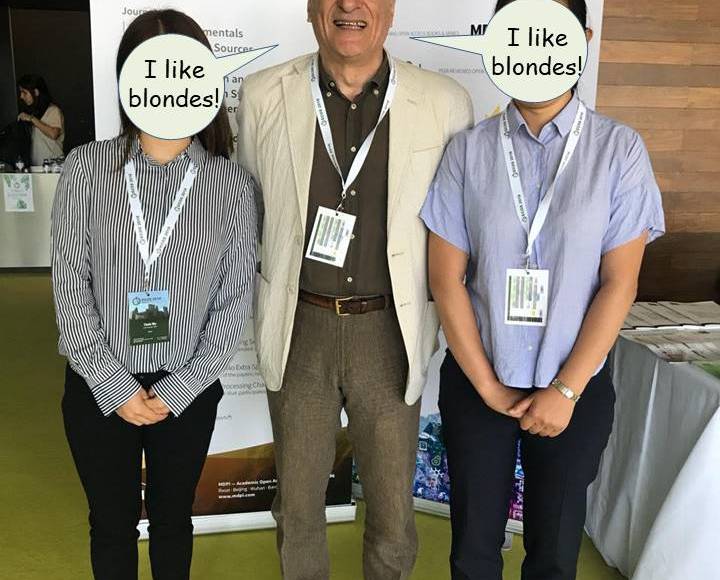
It’s only then that I googled Sciubba, and found this tweet by MDPI from 2018 (I covered the faces of the two Chinese women):

I sent this photo and asked this dirty old man where his hands were.
This was his reply, sent in cc to MDPI editorial office:
“I apologize for revealing a personal detail to you that you will perhaps find inappropriate, since you are not good with women: I like blondes! I know you cannot understand such matters, since you appear to have strong mother-related problems that most likely have denied you of a satisfactory sexual life… but, as the saying goes, to each his own…
If you were not the obvious psychotic you are, I would ask you to apologise to the two ladies… but I don’t think you ever will (probably because you are scared to interact with any woman, except of course your beloved and oppressive mother), so I’ll quit it here.
Wish you live a long life, continuously oppressed by your Oedipus complex and your academic frustration about the papers you were never able to write. Always remember: you are a blogger, not a journalist! and much the less a scientist…”
It was followed by further insults combined with Sciubba’s boasting what an influential alpha male he is. This dirty old Italian man seemed to openly boasts of power abuse and sexual predation (if not worse), in a matter we so unfondly remember from his late ruler, Silvio Berlusconi.
I invited MDPI to distance themselves from Sciubba’s tirades, especially towards subordinate women. The publisher indicated by their silence to to stand by all of it.
Now that you heard how Sciubba the Lover of Blondes imagines me and my life, let me show you whom he considers to be his fellow alpha males of science, knowledge and sexual prowess.
Carbon emanations
We start with the papermill owner and journal hijacker Kittisak Jermsittiparsert, about whose ridiculously excessive fraud you can read here:
We don’t need no education, We don’t need no thought control
“Of course the sentient rubber-stamps guest-editing Special Issues on behalf of papermills would have accepted anything – they don’t give two tugs on a dead dingo’s dick about content ” – Smut Clyde

In June 2024, Sciubba corrected two ridiculously fraudulent papers by Kitty Sack, both contained silly phrases and blocks of nonsense citations.
Hafezali Iqbal Hussain, Muhammad Haseeb , Manuela Tvaronavičienė , Leonardus W. W. Mihardjo , Kittisak Jermsittiparsert The Causal Connection of Natural Resources and Globalization with Energy Consumption in Top Asian Countries: Evidence from a Nonparametric Causality-in-Quantile Approach Energies (2020) doi: 10.3390/en13092273
“To allow the original publication to be better understood [1], the authors would like to make the following updates.
In the text, the following updates have been made:
- “Carbon emanations” has been replaced with “carbon emissions”;
- “Trade barricades” has been replaced with “trade barriers”;
- “Atmospheric downfall” has been replaced with “climate disaster”;
- “Antecedents of energy usage” has been replaced with “determinants of energy consumption”;
- “Carbon discharge” has been replaced with “carbon emissions”;
- “Prospering countries” has been replaced with “developing countries”.
In the References section, the following updates have been made:
[9 references replaced] […]
The authors state that the scientific conclusions are unaffected. This correction was approved by the Academic Editor. The original publication has also been updated.”
Correction 14 June 2024
Muhammad Haseeb, Sebastian Kot, Hafezali Iqbal Hussain, Kittisak Jermsittiparsert Impact of Economic Growth, Environmental Pollution, and Energy Consumption on Health Expenditure and R&D Expenditure of ASEAN Countries Energies (2019) doi: 10.3390/en12193598
“To allow the original publication to be better understood [1], the authors would like to make the following updates.
In the text, the following updates have been made:
- “Carbon dioxide emanations” has been replaced with “carbon dioxide emissions”;
- “Greenhouse emanations” has been replaced with “greenhouse gas emissions”;
- “CO2 emanations” has been replaced with “CO2 emissions”;
- “carbon emanation” has been replaced with “carbon emission”.
In the References section, the following update has been made:
Reference [27] was wrongly cited.[…] Reference for Figure 1 was incomplete. Reference [29] has been added. With this correction, the order of some of the references has been adjusted accordingly. […]
The authors state that the scientific conclusions are unaffected. This correction was approved by the Academic Editor. The original publication has also been updated.”
Correction 12 June 2024
Raised warmth stream
Here a ridiculously fraudulent, plagiarised papermill product, with authors from Pakistan, Saudi Arabia and Poland, probably led by the Pakistani papermiller Muhammad Bilal Hafeez (PubPeer record here)
Umar Nazir , Muhammad Sohail , Muhammad Bilal Hafeez , Marek Krawczuk , Sameh Askar , Sammar Wasif An inclination in Thermal Energy Using Nanoparticles with Casson Liquid Past an Expanding Porous Surface Energies (2021) doi: 10.3390/en14217328
As Guillaume Cabanac noted, this paper contained “tortured phrases” like “slanted attractive field” and “warm conductivity“, which arise when stolen text is chased through machine translation to hide the plagiarism. The polish co-author Marek Krawczuk replied on PubPeer:
“I agree that used phrases are inappropriate. All phrases should be change by the way as proposed Guillaume Cabanac. I am wondering that those phrases has not been improved before publication.”
A Correction issued by Sciubba on 19 April 2024 stated:
“Some phrases in the original publication were not appropriate [1]. The authors would like to change “limit layer” to “boundary layer”, “attractive field” to “magnetic field”, “stream” to “fluid flow”, “strand” to “extrusion”, “warmth transport” to “heat transport”, “warmth” to “heat transfer”, “prerequisite” to “researcher”, “warming as refrigerator” to “heating and cooling”, “warm” to thermal”, “transformation of heat” to “heat transfer”, “raised warmth stream” to “increase the heat flow”, “warm conductibility” to “thermal conductivity”, “trademark” to “significant”, “consistent” to “steady”, “soaked” to “saturated”, “volume portion” to “volume fraction”, “cloth” to “material”.
Corrections have been made to 1. Introduction, 2. Mathematical Formulation, 4. Outcomes and Discussion, and 5. Conclusions.
The authors state that the scientific conclusions are unaffected. This correction was approved by the Academic Editor. The original publication has also been updated.”
They haven’t corrected everything, as Nick Wise found more tortured phrases in need of update, including:
“There is also hydromantic which means ‘pertaining to hydromancy‘, divination by water or other liquid. I assume the authors (or their software) meant hydrodynamic.”
But our hydromantic Sciubba decided not to issue a second correction. Here some more fun corrections Sciubba eagerly approved, again with tortured phrases.
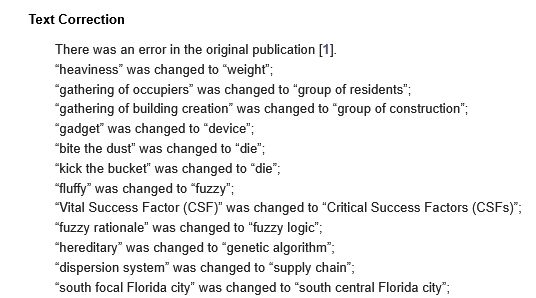
Stay away from south focal Florida city or you might bite the dust and kick the bucket:
Ghada Elshafei, Dušan Katunský, Martina Zeleňáková, Abdelazim Negm Opportunities for Using Analytical Hierarchy Process in Green Building Optimization Energies (2022) doi: 10.3390/en15124490
Power vitality is something Sciubba can surely relate to, right? It is indeed not kidding sort of issue of various electric organizations:
Rehan Akram , Nasir Ayub , Imran Khan , Fahad R. Albogamy , Gul Rukh , Sheraz Khan , Muhammad Shiraz , Kashif Rizwan Towards Big Data Electricity Theft Detection Based on Improved RUSBoost Classifiers in Smart Grid Energies (2021) doi: 10.3390/en14238029

This Earth-wide temperate boost is totally benign in comparison to the above:
Rosaliya Kurian , Kishor Sitaram Kulkarni , Prasanna Venkatesan Ramani , Chandan Swaroop Meena , Ashok Kumar , Raffaello Cozzolino Estimation of Carbon Footprint of Residential Building in Warm Humid Climate of India through BIM Energies (2021) doi: 10.3390/en14144237

And some fluffy enrollment capacities:
Alireza Pourdaryaei , Mohammad Mohammadi , Mazaher Karimi , Hazlie Mokhlis , Hazlee A. Illias , Seyed Hamidreza Aghay Kaboli , Shameem Ahmad Recent Development in Electricity Price Forecasting Based on Computational Intelligence Techniques in Deregulated Power Market Energies (2021) doi: 10.3390/en14196104

The scientific conclusions are unaffected
And here are more of Sciubba’s fellow virile scholars – the Iranian papermill fraudster Afshin Davarpanah, his Indonesian customer Mahyuddin Nasution (PubPeer record here) and the Polish papermill addict Marek Jaszczur, about whom you can read here:

Anyone can start a papermill!
“There are no capital requirements or significant technological barriers, anyone can create papers by rewriting already published works, either themselves or with the assistance of ChatGPT or other software. With a Telegram channel or WhatsApp group the papermiller can easily organise the sale of authorship” – Nick Wise

Their learned treatise in Energies is full of huge blocks of irrelevant citations and actually a copycat of another simultaneously published papermill fabrication by Davarpanah in another MDPI journal, Syah et al Coatings 2021, which was retracted in July 2024 due to “irregularities within the presented findings and […] presence of a high number of citations that lacked sufficient relevance“:
Rahmad Syah, Safoura Faghri , Mahyuddin KM Nasution, Afshin Davarpanah, Marek Jaszczur Modeling and Optimization of Wind Turbines in Wind Farms for Solving Multi-Objective Reactive Power Dispatch Using a New Hybrid Scheme Energies (2021) doi: 10.3390/en14185919


Nick Wise: “On the 7th of September 2021 an advert was placed on a Telegram channel that offers citations. This is the only paper with keywords matching the advert according to Web of Science. This was the 1st paper on the channel and they appear to have gone slightly overboard with cramming the paper with references.”
But you heard Sciubba above, masses of irrelevant references are actually a sign of quality when these go to important and deserving men. Given that MDPI retracted one copy of that paper in Coatings, it is reasonable to assume that they considered to retract the Energies copy also. But Sciubba probably put his foot down.
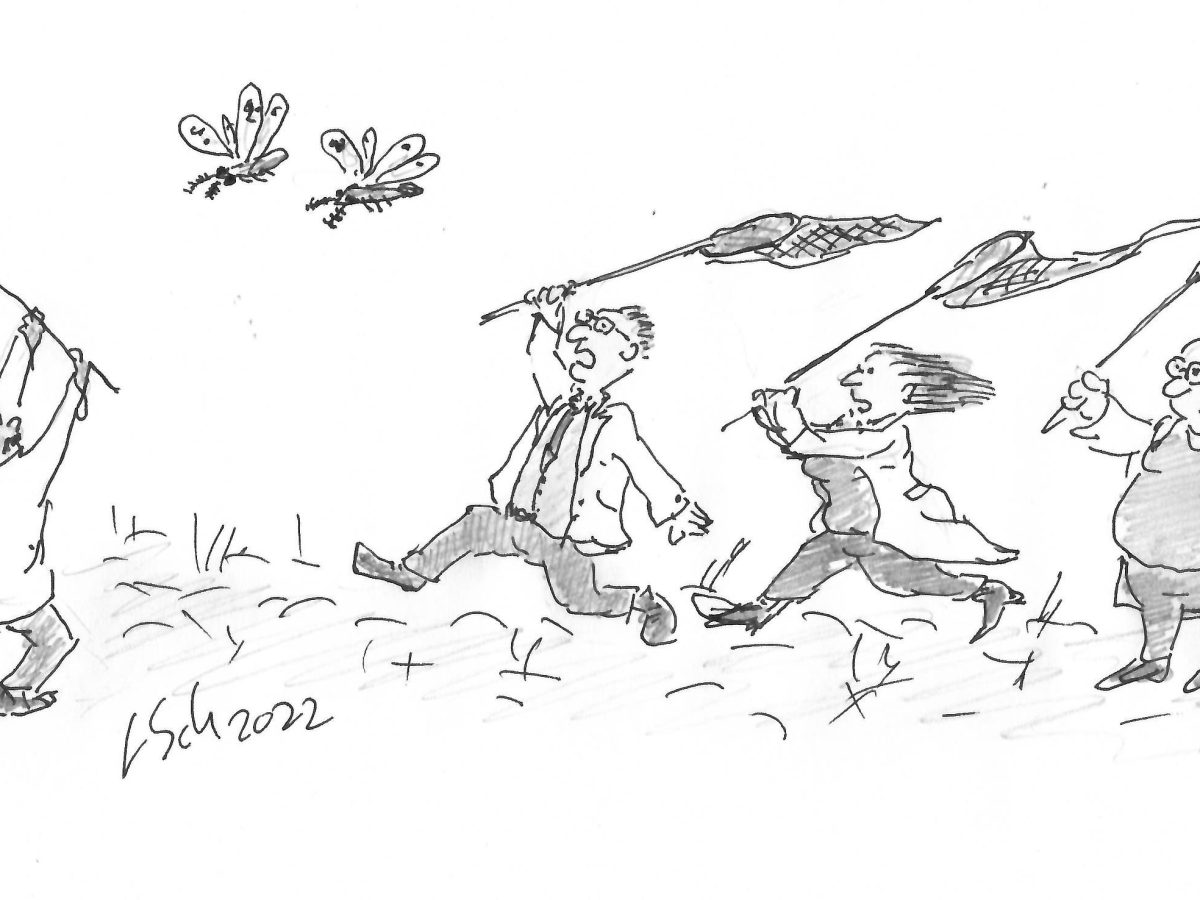
The Vickers Curse: secret revealed!
How did an editorial about insect pheromone communication get to receive 1200 irrelevant citations, almost all from papermills? Alexander Magazinov reveals The Secret of The Vickers Curse!
Of course, Sciubba also extended a helping hand to fellow Italians in trouble. This paper became victim of The Vickers Curse, where a certain moth pheromone editorial got cited instead of whatever paper the papermill wanted to cite (read the article above):
Wang Lu , Pietro Bartocci, Alberto Abad , Aldo Bischi , Haiping Yang , Arturo Cabello , Margarita De Las Obras Loscertales , Mauro Zampilli , Francesco Fantozzi Dimensioning Air Reactor and Fuel Reactor of a Pressurized CLC Plant to Be Coupled to a Gas Turbine: Part 2, the Fuel Reactor Energies (2023) doi: 10.3390/en16093850
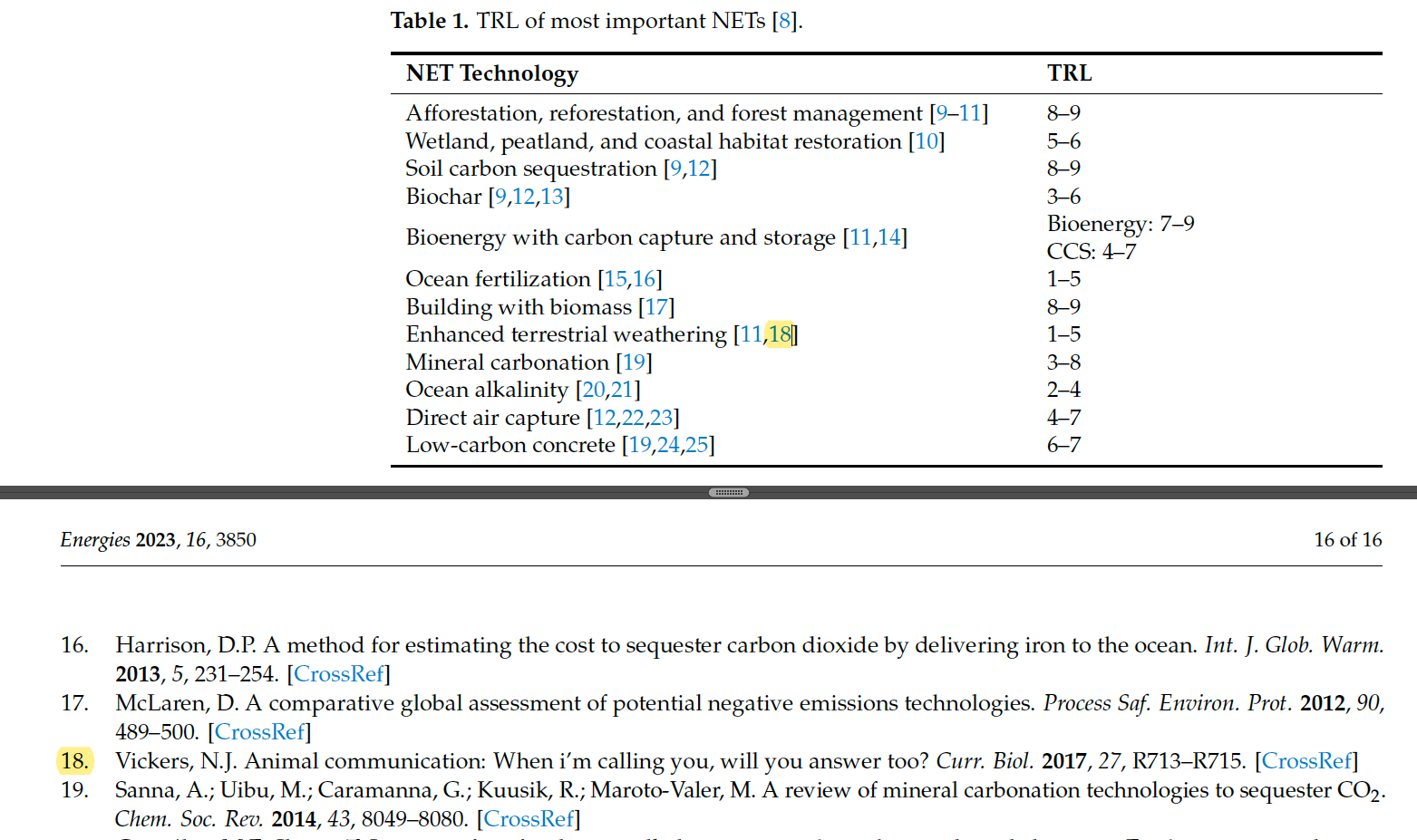
The second author Pietro Bartocci explained on PubPeer:
“Thanks for signaling this the citation in 18 has to be substituted with: “Smith P, Davis SJ, Creutzig F, Fuss S, Minx J, Gabrielle B, et al. Biophysical and economic limits to negative CO2 emissions. Nature Climate Change. 2015 Dec 7;6(1):42–50. Available from: http://dx.doi.org/10.1038/nclimate2870“. I will communicate this to the editor of the journal.“
Thing is, Bartocci lied: there is no way this Nature Portfolio paper was the one he and his international colleagues originally wanted to cite. The Vickers Curse only struck Elsevier papers, resolving a doi starting with “10.1016/j” followed by a space into the Vickers editorial about moths. Never mind, Sciubba fixed it with a correction in July 2024, and now even Bartocci’s alternative reference became irrelevant:
“In the original publication [1], the reference [18] was mistakenly cited, which has been deleted. With this correction, the order of some references has been adjusted accordingly.
The authors state that the scientific conclusions are unaffected. This correction was approved by the Academic Editor. The original publication has also been updated.”
You will be paid US $500-800 for each paper
“Or The author can also put your name to the article to increase your academic popularity, such as adding your name to the second or third author.”
You probably would like to see some fake spectra now? Never corrected, maybe because the German coauthor Falko Mahlendorf of University Duisburg-Essen is blonde, and we know Sciubba likes them:
Laksanaporn Poolnapol, Wathanyu Kao-ian , Anongnat Somwangthanaroj , Falko Mahlendorf , Mai Thanh Nguyen, Tetsu Yonezawa, Soorathep Kheawhom Silver Decorated Reduced Graphene Oxide as Electrocatalyst for Zinc–Air Batteries Energies (2020) doi: 10.3390/en13020462

Suspicious collaboration patterns
Finally, Anna Abalkina, Germany-based expert in Russian paper mills, published in 2022 a preprint (later as a peer reviewed paper Abalkina 2023) about the Russian paper mill called International publisher LLC. Quote:
“…some of the offers on the 123mi.ru website mentioned straightforwardly that one coauthorship slot of the paper was reserved for the editor of the journal or editor of the journal from this particular country. This coauthorship pattern in MDPI journals served as a good predictor of other dishonest papers.
Four MPDI journals (Sustainability (Switzerland), Journal of Theoretical and Applied Electronic Commerce Research, Energies, Mathematics) were involved in such suspicious collaboration patterns””
Here is one such russian papermill product Abalkina reported, authored by the notorious papermiller Alexey Mikhaylov:
Alexei Yumashev , Beata Ślusarczyk , Sergey Kondrashev , Alexey Mikhaylov Global Indicators of Sustainable Development: Evaluation of the Influence of the Human Development Index on Consumption and Quality of Energy Energies (2020) doi: 10.3390/en13112768

This paper is a part of a special issue ” Special Issue Management and Technology for Energy Efficiency Development” edited by three guest editors, among whom Beata Ślusarczyk is included. She is also a co-author of this paper. The offer stated that the 2nd place is reserved for an editor.”
We can now safely assume that at least some Energies editors take bribes from papermills for smuggling in their products. Remember in this regard the corrected paper Adibhesami et al 2022, the last author of which is the Energies Section Editor-in-Chief Umberto Berardi, the only Italian in a team of internationally-dispersed Iranians. I think we all understand what went on there.
Sciubba’s role in all this papermill scam is not clear, but it seems in the very best case that he never noticed or cared in his 15 years of rule over this MDPI journal. Except to insult and threaten the occasional whistleblowers.
As I understand, Sciubba only retracts when MDPI issues orders or when authors ask for it. As it happened in one completely bizarre case, described in this article:
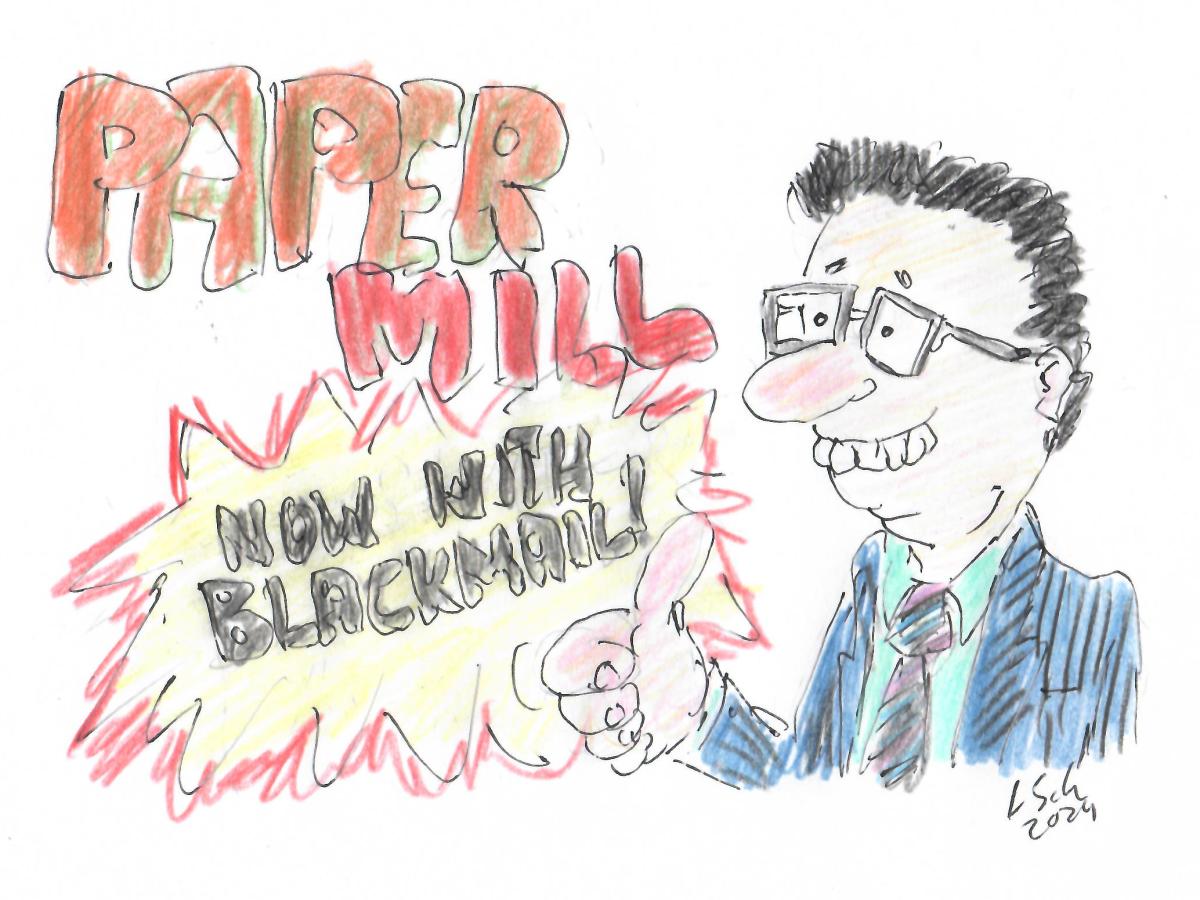
Retraction blackmail – new service by Iranian papermills
“I was asked to pay in bitcoin to avoid retraction”. – Zbigniew Leonowicz
The paper was this one, it was a plagiarised copy from a study by unrelated Iranian authors.
Abeer Anazi , Luis Barboza-Arenas , Rosario Romero-Parra , Ramaswamy Sivaraman , Maytham Qasim , Sara Al-Khafaji , Maher Gatea , Reza Alayi , Waqas Farooq , Michał Jasiński , Zbigniew Leonowicz , Filip Novak , Radomir Gono Investigation and Evaluation of the Hybrid System of Energy Storage for Renewable Energies Energies (2023) doi: 10.3390/en16052337
“Following publication, concerns were brought to the attention of the publisher regarding overlap with a previously published manuscript [2] with a different authorship group and published in another language. Adhering to our complaint procedure, an investigation was conducted by the Editorial Office, members of the Editorial Board, and the Editor-in-Chief that confirmed a significant overlap. This article [1] is therefore retracted.
This retraction was approved by the Editor-in-Chief of Energies.”
From the retraction notice 19 July 2024
The papermill ringleader was, according to the Polish coauthor Zbigniew Leonowicz, a certain Iranian fellow named Reza Alayi, who then decided to extort his customers after publication by demanding “a “ransom” in bitcoins for withdrawing the article”. Since his customers didn’t pay, Alayi contacted the journal, admitted the fraud and requested a retraction. Leonowicz told me:
“Then the fraudster reported himself to MDPI and started blackmailing me, then even demanded about PLN 5,900 for “deleting” the article.
The case was not clear, so the retraction lasted as long as 15 months. […]
The attitude of MDPI is also strange to me, they refused to conduct a fair procedure, it was written falsely that I was against retraction (and I was the first to demand it in May 2023!) then it was written that a committee had made a decision, and then it turned out that there was no “ethics committee” at all, and the decision was made only by prof. Sciubba.“
Alayi published another paper in Energies, Alghamdi, et al 2023. Presumably, its authors paid the ransom and Alayi didn’t have to ask Sciubba to retract that one.
Let me close with a long list of fraudulent papers in MDPI Energies.
Donate!
If you are interested to support my work, you can leave here a small tip of $5. Or several of small tips, just increase the amount as you like (2x=€10; 5x=€25). Your generous patronage of my journalism will be most appreciated!
€5.00

 For Better Science
What a buffoon! MDPI should be proud to have editors like him. 🙂
LikeLike
They are proud in fact!
LikeLike
For some reason my country, Poland is gradually becoming a papermill haven 😦 And there’re no signs of counteraction from the government
LikeLiked by 1 person
Competent engineers have jobs as engineers, which are much more rewarding than academic positions occupied by half-assed technicians in third-rate institutions who churn out fake, lame and impactless publications to support of the illusion of relevance. In a way, MDPI is doing a service by precisely identifying the occupants and institutions of this “wannabee world”, and it’s a shame that funding agencies do not avail of this useful information to curtail their activities.
LikeLike
Two remarks. First, while MDPI is always seen as a publisher that only publishes junk, they actually also publish decent/good studies. Secondly and more worrisome, MDPI is always seen as the rotten apple and so on, yet the same people who ‘hate’ on MDPI are the same that ‘love’ Elsevier for being such an outstanding publisher. No, Elsevier is just as bad or even worse. Yes, I agree, MDPI has huge issues, but Elsevier (or others) also have these but for some reason there people some to either ingore it or not realize it while they publish shit as well that is ironically ‘whitewashed’ because ‘it must be good, it’s Elsevier and not MDPI’. This worries me actually more.
LikeLike
Elsevier is evil, but they are professionals. Their boss would never say racist stuff in public, they wouldn’t drive employees in poorer countries to death (literally, as it happened in Romania), and Elsevier most certainly would not tolerate such public performance from their EiC as Sciubba delivered.
LikeLiked by 2 people
No need to draw distinctions between Elsevier and MDPI. MDPI is a testing ground, “can we adopt this predatory practice and go unpunished?” Elsevier is where such practices are implemented at full scale if they are found successful at MDPI.
LikeLiked by 2 people
The difference between MDPI and Elsevier feels a bit like the difference between being eaten by a bare-handed cannibal vs. by one using a knife and fork.
LikeLiked by 1 person
Emails of great shame… It’s not because of amateurism but because of endless arrogance.
Judging by the tone, the patronizing tone and the cynicism in the emails, it’s not hard to see that this guy is a classic European pseudo-intellectual. Unfortunately, there are a lot of pseudo-intellectuals in his age group.
Men like this don’t need to think when they speak or type because they think they can see and know everything. They are mostly on the extreme left, very few on the extreme right. The far left can be considered the ancestors of today’s woke generation.
And this man, in an email to which he should have responded properly, mentions Tiananmen, while at the same time supporting Iranians at his university and in his journal, while at the same time supporting Ukraine. Such men think they are doing everything right. Such men have unbreakable beams inside their heads.
Probably because in his mind he sees the Iranians as the persecuted elements of a glorious tribe, he feels it is his vital duty to protect the Iranians who are involved in the papermill business in his country and in his journal, so he shamelessly tries to put sleuth in a fire. Nauseous!
I was really surprised to hear that Hoseinzadeh was funded by ERC funding. ERC was expected to be one of the most prestigious funds. This means that ERC, like other EU funds and national funds in Europe, has been put at the service of Iranian papermills. What a shame.
I guess I can’t track citation abuses on Energies for a long time. It’s not so much because of the shameful emails of the chief editor, but because every time I see the name Energies, I will laugh at Leonid’s email –I sent this photo and asked this dirty old man where his hands were.– The old man was probably punching the keyboard in anger in his email cc’ing MDPI.
LikeLike
I don’t think Sciubba cares about Ukraine, or russian and Chinese dictatorship, or Iranian women (certainly not for their freedom), it’s all just virtue signalling of a man who thinks he is a red left while sharing all the power greed, corruption and misogyny of the patriarchal right. Quite common among communists historically.
That’s why Sciubba feels attracted to Iranian papermillers: these dudes are phonies just like him.
LikeLiked by 1 person
When I saw the photo of ECOS 2018, I immediately remembered and checked. I think ECOS is a huge annual conference. It looks like it will be held in Paris this year.
Click on the About tab and you will see ECOS Intrnational Society, Inc. This companyish thing is probably the formation of the group that organizes this annual conference. Sciubba’s name appears as the ECOS secretary. So he may have posed at ECOS 2018 not only as the chief editor of Energies but also as the owner of the conference.
My recall of ECOS is closely tied to two publications on Pubpeer. Once the first paper is published at the ECOS 2023 conference, the same text was published without any changes in the journal Entropie : thermodynamique – énergie – environnement – économie as an original research paper. Here is the Pubpeer link of the copy work. What appears to be two works, but is only one, is owned by a well-known Danish papermill group led by Arabkoohsar.
The editor of the journal is chair of this year’s ECOS conference in Paris. I must admit, they are well organized.
LikeLike
To me the difference between Elsevier and MDPI feels a bit like the difference between research and researchers being eaten by a bad lab in elite institutions vs by a bad lab in bad institutions. Former is always kinder and more professional, there is no doubt. But the (negative) impact of the former is also higher as people rely on them.
LikeLike
Joris van Rossum, an ID creationist and a former PhD student of Ronald Meester, is an employee of Elsevier. Apparently, it was no problem for Elsevier that Joris van Rossum could be interviewed by Tom Zwitser https://deblauwetijger.com/video/ronald-meester-en-joris-van-rossum-over-de-religie-van-wetenschap/ [in Dutch].
LikeLike
Ai detectors like Turnitin are garbage and shouldn’t be used. Tortured phrases, however, are a smoking gun.
LikeLike
Which was just sufficient to qualify Jermsittiparsert for editorship in Sciubba’s journal.
https://doi.org/10.3390/en18030738
Although a certain PoS called “professor Marc A Rosen” agrees that Jermsittiparsert is a good pick for editorship. Hence, in Su(ck)stainability:
https://doi.org/10.3390/su17030900
https://doi.org/10.3390/su17062613
Well, those actually are from MDPI’s “Topics,” whatever this BS means. Everyone is welcome to try untangle this heap of junk.
LikeLiked by 2 people
Hey why don’t you write to Sciubba about his respected colleague Kitty Sack, let’s see what Sciubba throws at you then.
LikeLiked by 1 person
It is funny that Siamak changed his surname from Hoseinzadeh to Hosseinzadeh (double s) as well in all his pages, even though his articles now are all in Hoseinzadeh format. I suppose it is a way to hide and get rid of all articles about him.
Here is the archive Google Scholar page of him:
https://web.archive.org/web/20240502074838/https://scholar.google.com/citations?user=dxITgAEAAAAJ&hl=en
LikeLiked by 1 person
Lol. Siamak also changed his profile photo to look even more like a mafia don impersonator.
Yet the offers he made me were all refused.
LikeLiked by 2 people