
Nick Wise wrote about some bottom-feeding papermillers and their bottom-feeding Iraqi papermill which sells plagiarised papers. The customers are not only Iraqis and other Arabs, but also Poles, Hungarians, and russians, the authorships are sold on Telegram and WhatsApp. The extra bit of irony: those from whom the cheap Iraqi papermill steals, may have obtained their papers from a higher quality Iranian papermill.
Nick’s article contains additional text provided by me.
Incidentally, the main protagonist of the story, the Iraqi papermill fraudster Qusay Hassan, wrote to me just before this very article was published, to complain about reader comments from May 2024:
“I am writing to urgently request the removal of a comment posted on your platform that targets me and my co-authors in a defamatory and unfounded manner. […] it does not adhere to the principles of fair and evidence-based academic discussion. It is important to maintain the integrity of your platform and ensure that it is not used as a tool for personal vendettas or defamation.”
I think the word “vendetta” must be copyrighted as an exclusively academic term. The other protagonist of this story and Hassan’s coauthor and PhD mentor, the Polish professor Marek Jaszczur, did not reply when asked to comment.

Anyone can start a papermill!
By Nick Wise (and LS)
In June 2024, Sasan Sadrizadeh, professor at KTH Royal Institute of Technology in Stockholm in Sweden, posted on LinkedIn about a paper that had recently been published and then retracted in Elsevier’s Energy & Buildings:
Qusay Hassan, Nadia Sarhan , Emad Mahrous Awwad , Tariq J. Al-Musawi , Nouby M. Ghazaly , Patrik Viktor, Monika Fodor, Amjad Iqbal , Sergey Zhiltsov , Azamat Makhmudov , Ali Khudhair Al-Jiboory , Ihssan Alrekabi , Sameer Algburi , Marek Jaszczur , Aws Zuhair Sameen , Maha Barakat Optimizing smart building energy systems for sustainable living: A realistic approach to enhance renewable energy consumfaption [sic] and reduce emissions in residential buildings Energy and Buildings (2024) doi: 10.1016/j.enbuild.2024.114354
The purpose of the post was not to laugh at the spelling in the title, but to point out the blatant plagiarism of his own article Behzadi et al 2023, published 10 months earlier in the Elsevier journal Energy Conversion and Management.
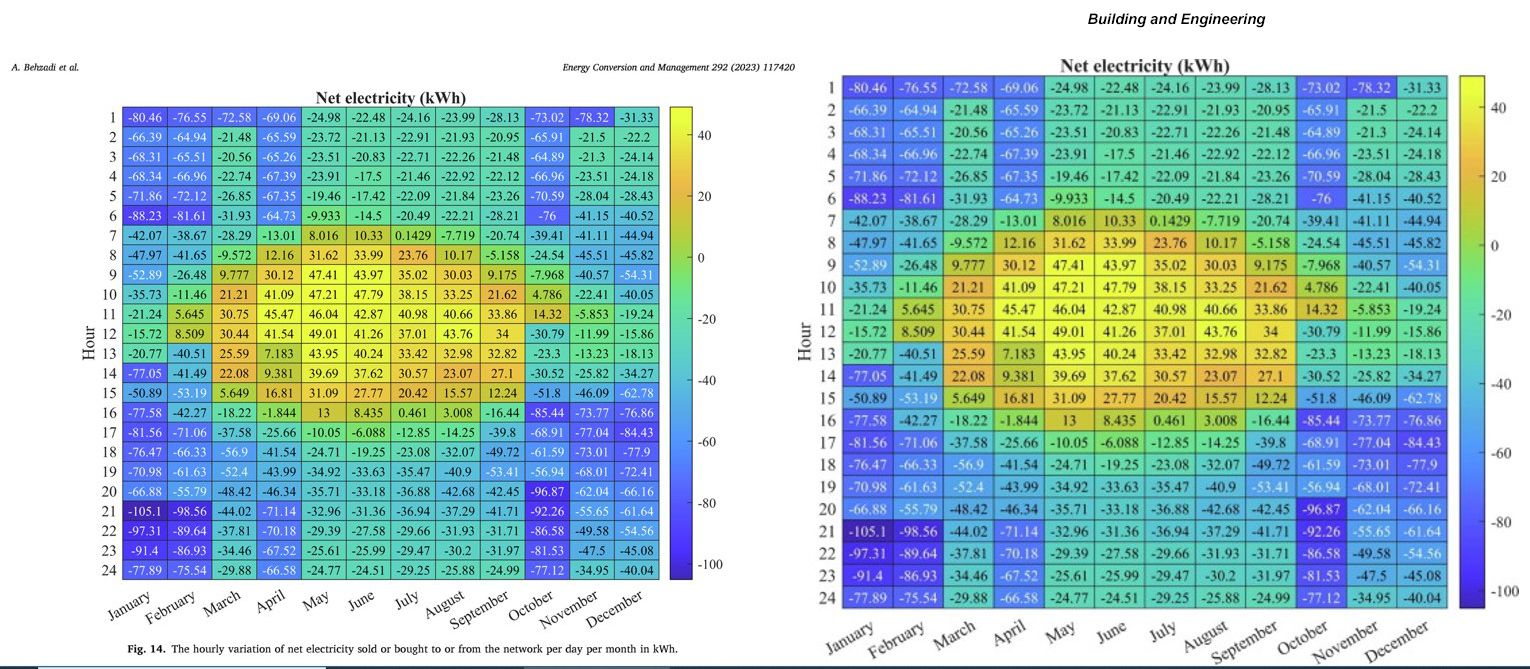
As reported by Retraction Watch, the paper was quickly withdrawn1 by Elsevier for ‘possible duplicates/manipulations in Figures 2, 5, 6, 11, 15, and 16’. This story was picked up by For Better Science in July 2024 Shorts.
In brief, Sadrizadeh’s victimized PhD student Amirmohammad Behzadi is quite likely a papermiller, with an h-index of 26 and almost 2400 citations, more than his PhD mentor Sadrizadeh. So far, Behzadi’s papers were flagged “only” for inappropriate citations to his own and his dodgy coauthors’ papers, outside of all scientific context. Sadrizadeh has a PubPeer record also. Also, one of his and Behzadi’s coauthors is a certain Pouria Ahmadi, who was seen papermilling with Ibrahim Dincer, read about the latter here:

Environmental Pseudoscience and Polluted Research
“We are living in a faked world and there is a lot of un-verified avatars. “, Philippe Garrigues, EiC

Here a paper by Sadrizadeh, Ahmadi and Behzadi:
Seyed Mojtaba Alirahmi , Amirmohammad Behzadi , Pouria Ahmadi , Sasan Sadrizadeh An innovative four-objective dragonfly-inspired optimization algorithm for an efficient, green, and cost-effective waste heat recovery from SOFC Energy (2023) doi: 10.1016/j.energy.2022.125607

Why does one cite a paper by Behzadi and Ahmadi to reference the first law of thermodynamics? Especially when that paper was coauthored by the toxic papermiller Somchai Wongwises? Other citations to Behzadi and his associates are similarly inappropriate.
A regular coauthor and fellow citation farmer of Behzadi and Ahmadi is a certain Ahmad Arabkoohsar, who is another papermiller, seen publishing with the known fraudsters Wongwises, Mikhail Sheremet and Omid Mahian (read August 2024 Shorts), plus with Mohsen Sheikholeslami and Zhixiong Li.
Sadrizadeh defended Behzadi’s activities in a later article on Retraction Watch by insisting that self-citations are “not only common but also often necessary to demonstrate the continuity and development of their research“.

The Thieves
Let’s return to the theft of Behzadi’s paper, whatever its original quality may have been.
In his LinkedIn post, Sadrizadeh noted that the paper had sixteen authors from six different countries, namely Iraq, Hungary, Saudi Arabia, Poland, Uzbekistan and Russia. How did all these authors meet and decide to collaborate?
The first author is Qusay Hassan of Diyala University in Iraq, whose deleted Research Gate profile is archived here. According to his profile, until October 2023 he was “Professor (Associate)” at the University of Stuttgart in Germany – clearly a lie. More closer to the truth is Hassan’s stated affiliation from 2015 to 2023 at AGH University in Kraków, Poland, in the lab of Marek Jaszczur, who happens to be the fourteenth author of the withdrawn paper (and vice-dean for education at his Faculty of Energy and Fuels). A comment by Marek Wroński under the Retraction Watch article suggests that Hassan completed his PhD with Jaszcur.

The withdrawn article above is not Hassan’s only paper with problems. The following paper was retracted on the 25th of July after being reported to the journal for irrelevant references:
Qusay Hassan, Ali Khudhair Al-Jiboory , Muna Al-Razgan , Patrik Viktor , Nouby M. Ghazaly , Emad Mahrous Awwad , Sameer Algburi , Bashar Mahmood Ali , I.B. Sapaev , Imad Ibrahim Dawood , Marek Jaszczur , Aws Zuhair Sameen , Maha Barakat Sustainable energy planning and integration for district heating systems: A case study in Nineveh Province, Iraq Journal of Building Engineering (2024) doi: 10.1016/j.jobe.2024.109411
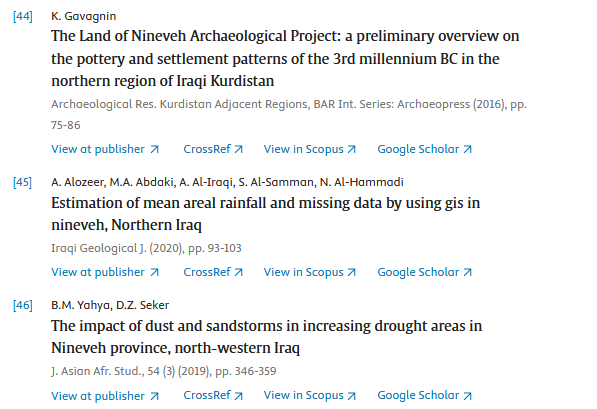
As noted on PubPeer, the authors needed to provide supporting data for their “comparative” [sic] of different regions. Their method was to type Nineveh into Google Scholar and pick three articles, with no concern for whether they contained relevant data.
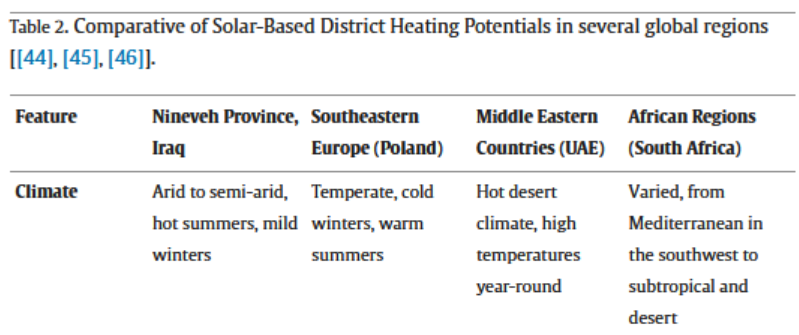
When the publisher investigated, they found more problems. The retraction notice from 25 July 2024 states:
‘Following identification of apparently unrelated citations, an investigation of this paper identified eight (8) authors added following initial review during the revision process. Contrary to journal policy, this was done without requesting or receiving permission from the editor. This is a form of authorship manipulation.
The 8 added authors were: Ali Khudhair Al-Jiboory, Muna Al-Razgan, Patrik Viktor, Nouby M. Ghazaly, Emad Mahrous Awwad, Bashar Mahmood Ali, I.B. Sapaev, Imad Ibrahim Dawood.
Additionally, a number of unrelated citations, including reference numbers 44, 45, 46, 62, 63, 66, 67 and 68 were identified. The corresponding author claims that these citations are correct although none provide support for the paper content in the context in which they were cited. This is an apparent instance of citation manipulation.
The corresponding author maintains that the authorship and citation are correct.’
The corresponding author with interesting standards for authorship and citation is Qusay Hassan. The other authors who were not added at revision stage are Sameer Algburi, Marek Jaszczur, Aws Zuhair Sameen and Maha Barakat.
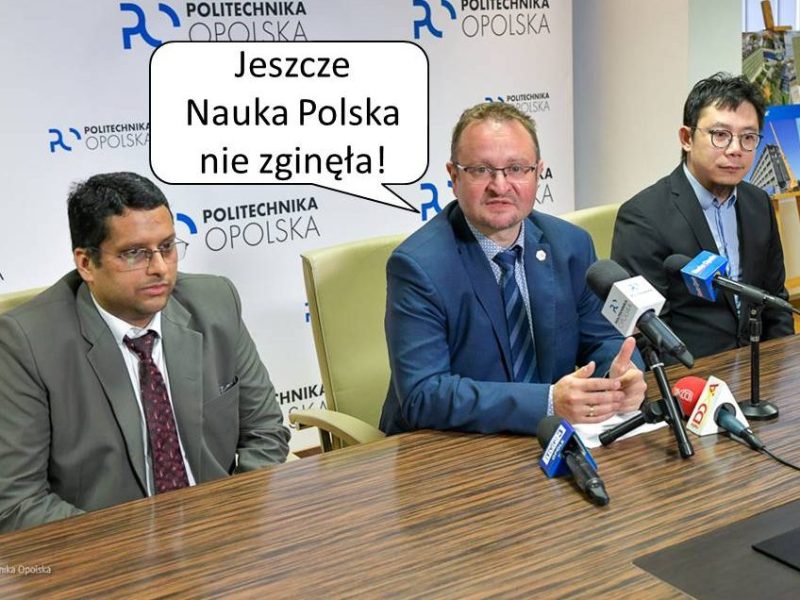
Polish science eaten by Papermill Krolczyk
“Prof. Grzegorz Królczyk, Vice-Rector for Science and Development of the Opole University of Technology, was elected President of the Council for Innovation in Higher Education and Science.”

That this is still possible in 2024 is ludicrous. A paper can be submitted with five authors and they can decide to add eight more during the revision stage and there is nothing to stop them. The editor is supposed to be asked for permission, but nothing in the system ensures that happens and the editor receives no notification that the author count has more than doubled. Of course some people will always try to commit publication fraud, but Elsevier doesn’t have to make it this easy! Anyway, I digress.
As with references 44-46, references 62 and 63 appear to have been used because ‘machine learning’ featured in the title, with no concern for whether the content was in any way relevant. However, 66-68 are different.

These references are again irrelevant but are all from the same journal, the Al-Kitab Journal For Pure Sciences, a journal run by Al-Kitab University in Iraq. Who is the managing editor of the journal? Sameer Algburi, author of both retracted papers. In fact, the same three references are also present in the first retracted paper as well, suggesting that Algburi is systematically including the papers in his publications to boost the citations count of his journal and have it indexed beyond ‘crossref/doi’ and ‘Iraqi academic scientific journals’.
The plagiarism, authorship manipulation and citation farming in the papers above are all hallmarks of a papermill. Let’s check it out.
The Papermill
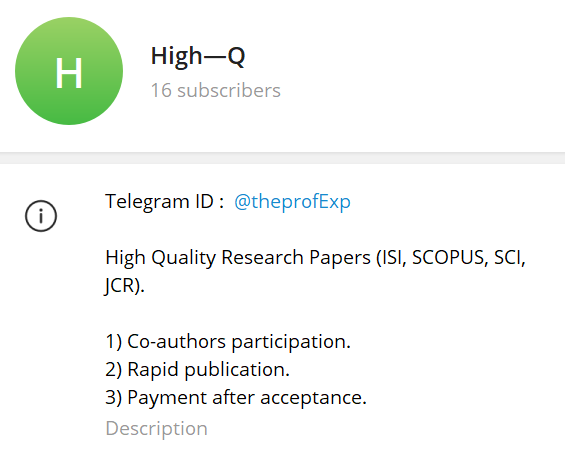
On the 20th of December, 2023, a channel called High–Q was created on Telegram by a user called @theprofExp. The channel promised:
“High Quality Research Papers (ISI, SCOPUS, SCI, JCR).
1) Co-authors participation.
2) Rapid publication.
3) Payment after acceptance.“
The same day, two adverts for authorship were published.
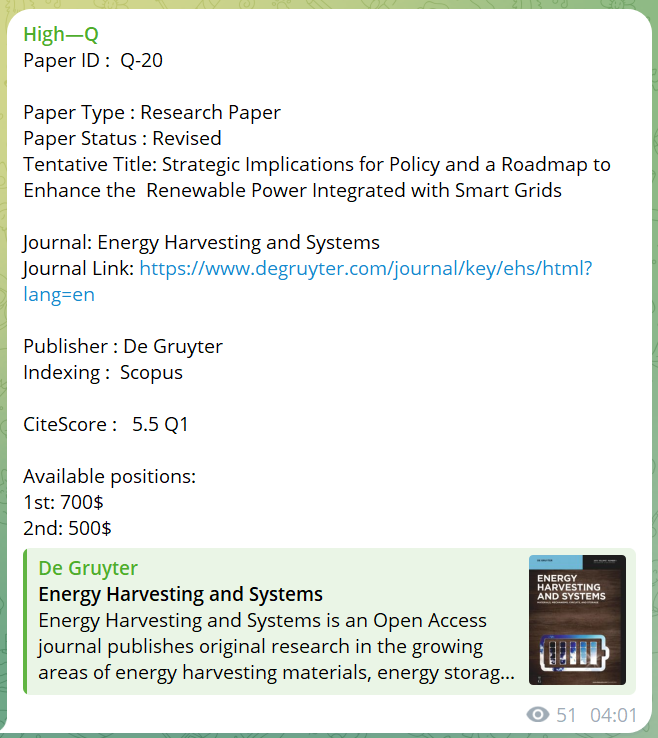
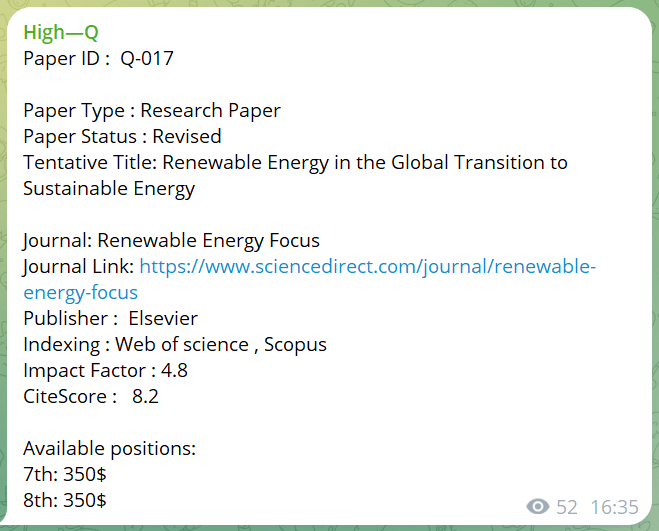
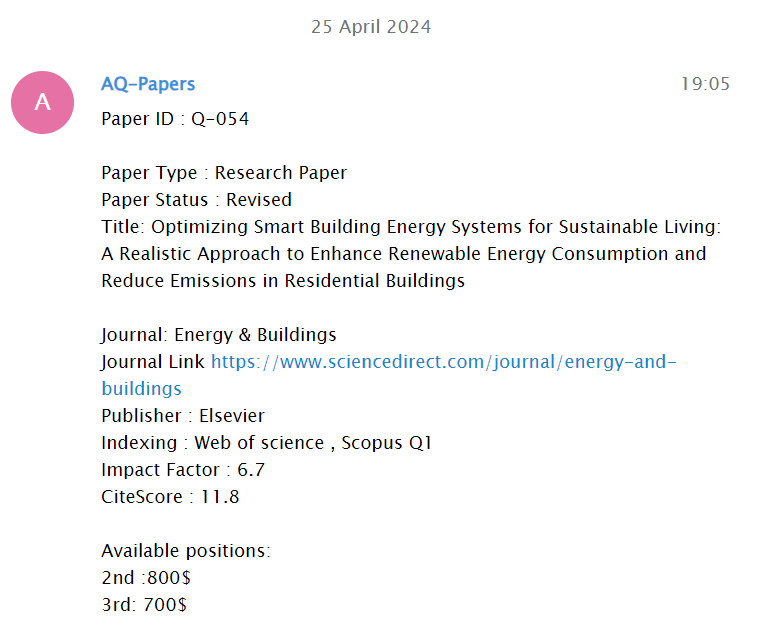
All the information a potential customer could want is there: journal, title, status, and most importantly prices. The journals advertised are top-tier, Q1 or Q2, in major publishers, whilst the reference numbers, Q-20 and Q-017, suggest that these adverts aren’t quite the beginning of the scheme.
Neither paper has been published under the titles in those posts, however in January there was a follow-up post saying that the paper Q-017 was accepted.
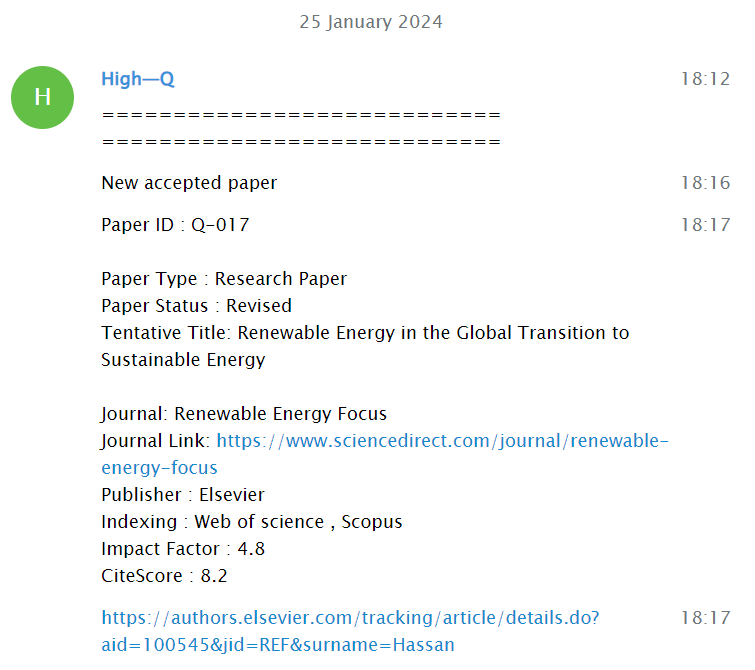
The post includes a link provided to the authors to track their article, which can be found here, with a slightly different title.
Qusay Hassan, Patrik Viktor, Tariq J. Al-Musawi , Bashar Mahmood Ali , Sameer Algburi , Haitham M. Alzoubi , Ali Khudhair Al-Jiboory , Aws Zuhair Sameen , Hayder M. Salman , Marek Jaszczur The renewable energy role in the global energy Transformations Renewable Energy Focus (2024) doi: 10.1016/j.ref.2024.100545

Once again we see that Qusay Hassan is the first author, along with many names that are already familiar: Algburi, Al-Jiboory, Jaszczur and others. The paper is not yet retracted but, as has been noted on PubPeer, it plagiarises heavily from Gielen et al 2019, “The role of renewable energy in the global energy transformation“, with the concept and figures copied almost without alteration.
High–Q continued to post and repost adverts on the channel throughout January and February, then on the 26th pointed to a new Telegram channel, AQ-Papers. That channel continued to post adverts for authorships every few days until June, when at least one journal started investigating one of their papers. The entire channel is now deleted, however archived posts from both channels can be found here and here. There was also a WhatsApp group for posting the adverts, a full transcript of which can be found here.

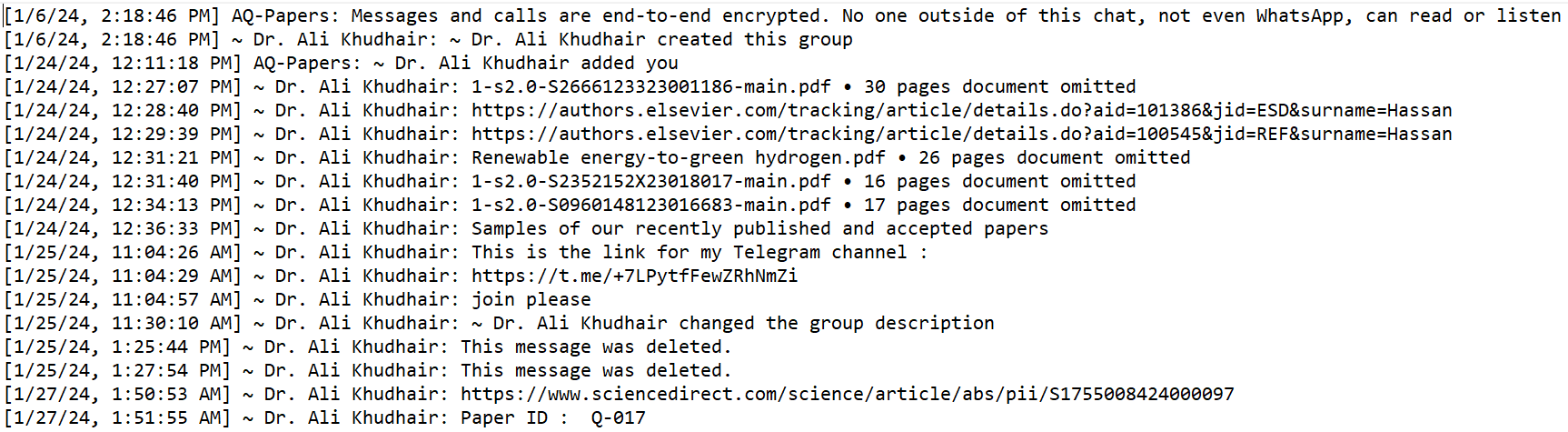
In total across all the adverts there were 24 unique paper IDs (Q-017 etc), which match 13 published papers for a success rate of 54%. All of the adverts were for papers related to energy, mainly renewable energy and the energy transition, except one, which was for a paper on nanofluids2. The intended journals for the papers were predominantly in Elsevier journals, with a few for MDPI and De Gruyter and one each for Springer, Taylor & Francis and Sage. I don’t know if the papermillers preferred Elsevier because there were many journals that matched their favourite topics, or because they knew of a particular weakness in Elsevier’s submission and editorial process, or for some other reason. Of the published papers, the nanofluids paper was successfully published in the MDPI journal Fluids and the other 12 are in Elsevier journals.
The adverts suggest an answer to how the authors came to collaborate on the two papers that have already been retracted, discussed above.

The full list of published papers is shown in the table below. Bar the nanofluids paper, all have Qusay Hassan, Sameer Algburi, Aws Zuhair Sameen and Marek Jaszczur as authors. In addition, all of the papers cite the same three articles from the aforementioned Al-Kitab Journal For Pure Sciences from Iraq.
| Title | Journal | DOI |
| The renewable energy role in the global energy Transformations | Renewable Energy Focus | https://doi.org/10.1016/j.ref.2024.100545 |
| GIS-based multi-criteria analysis for solar, wind, and biomass energy potential: A case study of Iraq with implications for climate goals | Results in Engineering | https://doi.org/10.1016/j.rineng.2024.102212 |
| Evaluating energy, economic, and environmental aspects of solar-wind-biomass systems to identify optimal locations in Iraq: A GIS-based case study | Energy for Sustainable Development | https://doi.org/10.1016/j.esd.2024.101386 |
| Hydrogen role in energy transition: A comparative review | Process Safety and Environmental Protection | https://doi.org/10.1016/j.psep.2024.02.030 |
| Implement and evaluate resilient energy infrastructures capable of withstanding spatial, temporal, and annual weather fluctuations in Saudi Arabia by 2050 | Sustainable Futures | https://doi.org/10.1016/j.sftr.2024.100182 |
| Mapping Europe Renewable Energy Landscape: Insights into Solar, Wind, Hydro, and Green Hydrogen Production | Technology in Society | https://doi.org/10.1016/j.techsoc.2024.102535 |
| Sustainable Energy Planning and Integration for District Heating Systems: A Case Study in Nineveh Province, Iraq | Journal of Building Engineering | https://doi.org/10.1016/j.jobe.2024.109411 |
| Evaluation of Solar and Biomass Perspectives Using Geographic Information System – the Case of Iraq Regions | Renewable Energy | https://doi.org/10.1016/j.renene.2024.120463 |
| Experimental Investigation of the Effects of Grooves in Fe2O4/Water Nanofluid Pool Boiling | Fluids | https://doi.org/10.3390/fluids9050110 |
| Enhancing smart grid integrated renewable distributed generation capacities: Implications for Sustainable Energy Transformation | Sustainable Energy Technologies and Assessments | https://doi.org/10.1016/j.seta.2024.103793 |
| Optimizing smart building energy systems for sustainable living: A realistic approach to enhance renewable energy consumfaption and reduce emissions in residential buildings | Energy & Buildings | https://doi.org/10.1016/j.enbuild.2024.114354 |
| Advancing Toward a Sustainable Future in subtropical semi-arid type climatic zone: Iraq case – The Progress of Solar Photovoltaic Energy Implementation | e-Prime – Advances in Electrical Engineering, Electronics and Energy | https://doi.org/10.1016/j.prime.2024.100565 |
| Adapting German energy transition rules for Iraq through industry, flexibility, and demand management | Futures | https://doi.org/10.1016/j.futures.2024.103411 |
Authors who appear on at least two of the papers are shown below, along with their institution and country. The authors of the papers are primarily from Iraq, as well as Poland, Hungary, Saudi Arabia and Qatar.
| Author | Papers | Institution | Country |
| Qusay Hassan | 12 | University of Diyala | Iraq |
| Sameer Algburi | 12 | Al-Kitab University | Iraq |
| Aws Zuhair Sameen | 12 | Al-Farahidi University | Iraq |
| Marek Jaszczur | 12 | AGH University of Science and Technology | Poland |
| Patrik Viktor | 10 | Óbuda Univeristy | Hungary |
| Ali Khudhair Al-Jiboory | 10 | University of Diyala | Iraq |
| Maha Barakat | 8 | Al-Turath University College | Iraq |
| Emad Mahrous Awwad | 7 | King Saud University | Saudi Arabia |
| Bashar Mahmood Ali | 7 | Al-Noor University College | Iraq |
| Tariq J. Al-Musawi | 6 | Al-Mustaqbal University | Iraq |
| Muhammad Ahsan | 4 | Silesian University of Technology | Poland |
| Hayder M. Salman | 4 | Al-Turath University College | Iraq |
| Muna Al-Razgan | 3 | King Saud University | Saudi Arabia |
| Nouby M. Ghazaly | 2 | Imam Ja’afar Al-Sadiq University | Iraq |
| Monika Fodor | 2 | Óbuda Univeristy | Hungary |
| Amjad Iqbal | 2 | Silesian University of Technology | Poland |
| Ahmad A. Telba | 2 | King Saud University | Saudi Arabia |
| Ahmed K. Nassar | 2 | Qatar University | Qatar |
| Ayesha Amjad | 2 | Silesian University of Technology | Poland |
| Hassan Falah Fakhruldeen | 2 | Imam Ja’afar Al-Sadiq University | Iraq |
We cannot be certain which authors, if any, paid for authorship, but we can have a good idea who was running the Telegram channels and WhatsApp group and how the papers in Table 1 were created.
The Telegram channel High–Q was created by @theprofExp, who has the logo for MatLab as their avatar, whilst the channel AQ–Papers and the WhatsApp group were both created by Dr. Ali Khudhair. That name matches Ali Khudhair Al-Jiboory, a co-author of ten of the papers in Table 1. Khudhair’s Telegram handle is @aljboor, and he also has a YouTube channel dedicated to teaching Matlab.


As for the papers themselves, almost all the papers have PubPeer posts demonstrating that figures have been plagiarised from other articles, with small changes in colour or font. The creators of the papers are clearly aware that whilst there are plagiarism checks for text, there are no such checks for figures and infographics etc. How was the new text created to avoid plagiarism? I doubt the authors wrote it all themselves, but there are no tortured phrases in the papers to suggest the use of simple paraphrasing software. However, there are other clues.
The overuse of certain words by ChatGPT has been noted since it came out in 2023, most notably ‘delve’. By searching on Dimensions, it is easy to see that, before 2023, Qusay Hassan had never used ‘delve’ in his papers. However, since 2023 the word has appeared in 23 of his 45 papers, including 11 of the 12 papers in Table 1.
I suspect that the method of the papermill was as follows:
- Identify a suitable paper that could serve as source material, typically on renewable energy or energy policy in a particular country or region.
- Rewrite the paper using ChatGPT, changing the focus to Iraq, Saudi Arabia or the Middle East. Make minor changes to figures so that they are not identical to those in the source material.
- Submit the paper with a few authors.
- When revisions are received, post an advert offering authorship of the paper.
- Either when submitting the revised version, or when the revised version is accepted, add in the extra authors. Also add in irrelevant references such as those to the Al-Kitab journal.
Here an example, flagged by Elisabeth Bik, published by Hassan and Jaszczur in Elsevier’s papermill-only outlet International Journal of Hydrogen Energy:
Qusay Hassan, Sameer Algburi , Aws Zuhair Sameen , Marek Jaszczur, Hayder M. Salman , Haitham A. Mahmoud , Emad Mahrous Awwad Saudi Arabia energy transition: Assessing the future of green hydrogen in climate change mitigation International Journal of Hydrogen Energy (2024) doi: 10.1016/j.ijhydene.2023.11.117
“as of my last update in 2021, policies and regulations around hydrogen are still in nascent stages worldwide”
Bik: “The text contains a sentence typically used by generative AI text bots, such as ChatGPT. “

Elisabeth also noted that 18 of 118 references (15%) went to Hassan and/or Jaszczur, and these “do not appear to support the statements in the text“. Also, Hassan “has been publishing about 1 article per week in 2024“. Hassan and Jaszczur published almost 70 papers together.
It is worth noting that Jaszczur didn’t always rely on Hassan for papermilling. Here is his joint effort in MDPI with the known fraudster Afshin Davarpanah. It is full of large blocks of irrelevant citation and actually a copycat of another simultaneously published papermill fabrication by Davarpanah in MDPI (Syah et al 2021):
Rahmad Syah, Safoura Faghri , Mahyuddin KM Nasution, Afshin Davarpanah, Marek Jaszczur Modeling and Optimization of Wind Turbines in Wind Farms for Solving Multi-Objective Reactive Power Dispatch Using a New Hybrid Scheme Energies (2021) doi: 10.3390/en14185919

On the 7th of September 2021 an advert was placed on a Telegram channel that offers citations. This is the only paper with keywords matching the advert according to Web of Science. This was the 1st paper on the channel and they appear to have gone slightly overboard with cramming the paper with references.
In any case, this scheme was working perfectly for Hassan and Jaszczur until an author of a plagiarised work happened to read the paper from the papermill that was copying them. On the 13 June 2024, Ali Khudhair messaged via WhatsApp:
“Dear respected co-authors, in case you have been contacted from editors of journals for any reasons, please let me know immediately.”
I emailed the publishers involved with all of the information at the end of June 2024 and by early July the channel AQ–Papers had been deleted, though at the time of writing High–Q is still up, adverts and all. Such a swift response has not been matched by Elsevier, and it remains to be seen how long the other papers produced by the papermill will stay unretracted.
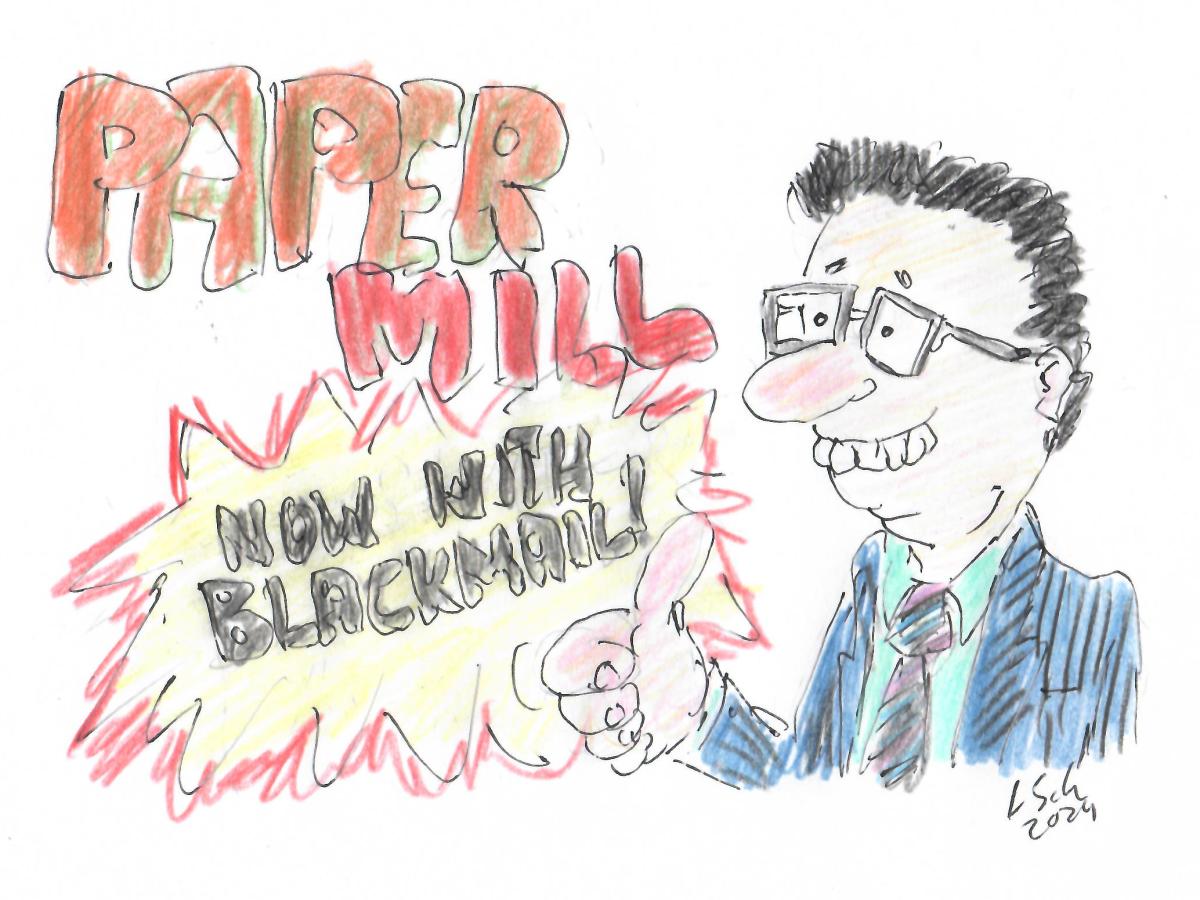
Retraction blackmail – new service by Iranian papermills
“I was asked to pay in bitcoin to avoid retraction”. – Zbigniew Leonowicz
The Hungarian
Hassan’s coauthor Patrik Viktor, President of the Doctoral School on Safety and Security Sciences of the Óbuda University in Hungary, deserves a mention also. He even commented as “Partik V.” on For Better Science under an article to defend his collaborator, the German-Iranian neurosurgeon and shameless papermiller, Reza Akhavan Sigari. Read here:
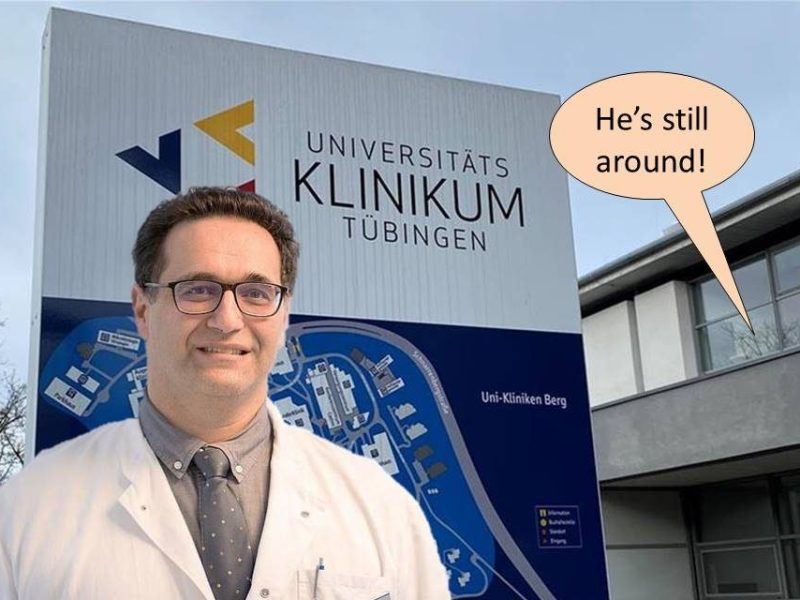
Gardening goats and external papermills in Tübingen
One shooting and one falling star of University Clinic Tübingen. Meet the research ethics champion Julia Skokowa and the eternally affiliated Renaissance Man Reza Akhavan-Sigari,
In June 2024, the Hungarian engineering student Viktor retracted this biomedical paper with Akhavan-Sigari and his Iranian minion Abolfazi Bahrami:
Hui Wang , Narayanan Jayasankar , Tamilanban Thamaraikani , Patrik Viktor , Mohamed Mohany, Salim S. Al-Rejaie , Hasan Khalid Alammar , Enaam Anad , Farah Alhili , Sinan F. Hussein , Ali H. Amin , Natrayan Lakshmaiya , Muhammad Ahsan, Abolfazl Bahrami, Reza Akhavan-Sigari Quercetin modulates expression of serum exosomal long noncoding RNA NEAT1 to regulate the miR-129-5p/BDNF axis and attenuate cognitive impairment in diabetic mice Life Sciences (2024) doi: 10.1016/j.lfs.2024.122449

Rounded cyan boxes highlight a group of EdU-stained cells present in three different panels, but surrounded by other cells.”


The retraction from 15 June 2024 referred to emails sent by Alexander Magazinov and Leonid Schneider to the University of Tübingen, where Akhavan-Sigari used to work:
“The journal was initially contacted by a concerned reader to query why the experiments followed German ethical guidelines when the mice were actually purchased in China. At the same time, the distribution of the authors (15 authors from 15 different institutions in 8 different countries) also looked suspicious.
An in-house investigation was conducted which then found evidence of image manipulation in Figs. 2, 5, 6, 7 and 10.
These concerns were also reported at PubPeer: https://pubpeer.com/publications/35F42AED9396E6E1173303AC0A9D41.
The Editor requested the authors to provide the raw data and an explanation addressing these concerns. The author replied that “the reason for the similarity is related to the low quality of the original images…regarding the image related to fluorescent, these images were voluntarily added to the article in the first round of reviewing to increase the scientific content (without the need or request of the reviewers)”.
This explanation was not satisfactory to the Editor and, due to the above concerns, the Editor decided to retract the paper.”
“Partik V.”‘s last comment on For Better Science before he was banned was: “Former research criminal is now independent journalist. Busted big time. I wonder how long you can keep up this blog on.“. Then, a “Viktor Patrik” arrived to claim that the previous commenter was an imposter. Which one of the two Patrik Viktors published all those plagiarised papermill papers with Hassan, Jaszczur, Algburi et al then?

The incredible collaborations of Renaissance men and women
Nick Wise and Alexander Magazinov on the authorships-for-sale market on social media. Merely $700 for the 7th position on some paper way outside your expertise!
Closing Thoughts
The papermill above showcases many of the different problems that currently exist in the publishing system, some of which are hard to fix and some of which should be easier. Firstly, there is such an emphasis on quantity of publications over quality that people are willing to pay hundreds of dollars to be an author on a paper in a top-tier, Q1 Elsevier journal. This is ‘publish or perish’, it has been discussed a thousand times before, and change will require international action across academia to reform how academics are hired, promoted, funded and assessed. In fact, these pressures do not apply just to individual academics, as evidenced by the inclusion of irrelevant references to the Al-Kitab Journal For Pure Sciences. Journals want to increase citations of their papers to improve their impact factor or be added to lists of ‘good’ journals, and they will continue to do so as long as journal rankings calculated on citations exist.
Secondly, anyone can start running a papermill. There are no capital requirements or significant technological barriers, anyone can create papers by rewriting already published works, either themselves or with the assistance of ChatGPT or other software. With a Telegram channel or WhatsApp group the papermiller can easily organise the sale of authorship of their papers, either with a close network of trusted colleagues or with strangers around the world. As far as I can see, nothing can be done to prevent someone from trying to do this.
However, the final set of problems is something that can definitely be addressed and that lies with the publishers. Why was it possible for eight authors to be added to a paper at revision stage without the editor or anyone else being notified? Why do authors by default have the ability in the submission system to add authors at all? Elsevier’s system is obviously inadequate, asking authors to obtain permission from the editor for authorship changes but not making it necessary is absurd. Likewise, it is clear that the plagiarism detection system needs development if it is unable to detect almost identical images or figures. Software such as ImageTwin is able to detect duplicated regions of biomedical images that have been significantly manipulated, it must be possible to flag the identical figures at the beginning of this post.
Welcome Agent Cooperate With Us
“There is so much money flowing through this system that I don’t see what will stop the network of papermills and corrupt editors.” – Nick Wise

Lastly, research integrity investigations vary from publisher to publisher and from journal to journal, as shown by the two retraction (or withdrawal) notices that began this piece. The first paper was withdrawn due to ‘possible duplicates/manipulations’ of figures. Ignoring the use of ‘possible’ to describe such blatant plagiarism, did anyone check for any problems with the authorship? What about with the references? The second retraction notice shows what is possible, with an investigation prompted by concerns about citations leading to the discovery of authorship manipulation. I can’t believe it takes very long for a publisher to see which authors were on a paper when it was submitted and when it was published, but if you don’t look you won’t know. Trying to find all the problems with a paper, rather than stopping when you’ve found just one, gives you more knowledge of how bad actors are exploiting your system, as well as information that could be provided in the retraction notice so that the wider scientific community can be better informed. If this is a problem due to either lack of a standardised investigation procedure, or lack of time to investigate thoroughly, both can be addressed by publishers establishing such procedures and investing more in their research integrity teams.
Whilst there is any incentive to publish academic papers for the sake of your career and not because you have something to share, then there will be papermills producing papers to sell. There is no need to make their life so easy.
Footnotes
1. An article appearing online does not count as ‘publishing’, it is the arbitrary assignment of the article to a volume or issue that means the article is ‘published’. This is why the article was withdrawn rather than retracted and why the article is no longer available to view in all its plagiarised glory. However, it’s also probably why the article was removed so quickly. Feel free to discuss the merits of this wherever you prefer shouting into the void.
2. Cross that off on your papermill bingo cards.
Donate!
If you are interested to support my work, you can leave here a small tip of $5. Or several of small tips, just increase the amount as you like (2x=€10; 5x=€25). Your generous patronage of my journalism will be most appreciated!
€5.00

 For Better Science
Elsevier’s business model depends on them playing dumb. Increasingly so. I’ve seen some positive changes at Dove Press, at Frontiers, at Spandidos even. Elsevier remains stubborn.
LikeLiked by 1 person
A big hand for Nick Wise (and Leonid Schneider). They have produced a tremendous article. In fact, this article should be sent to publishers such as Elsevier, Springer, etc., as well as databases such as WOS and Scopus, saying ‘we have done what you should do, maybe you will be more careful from now on’. Especially the ‘Closing Thoughts’ section is very wise.
I would like to add something on Closing Thoughts. Every sentence of this section is strong enough, but I have serious concerns about this part; “This is ‘publish or perish’, it has been discussed a thousand times before, and change will require international action across academia to reform how academics are hired, promoted, funded and assessed.” There is such a nexus between publishers, universities and funders (state funds, largely generated by taxpayers’ contributions) that once papermillers gain a prestigious position in this cycle, it is almost impossible to stop.
HORIZON may be a nice example. With the participation of Canada and South Korea, HORIZON is not only today’s, but perhaps the largest geographically spread, largest budgeted research programme in human history. An important achievement in the history of mankind. This is an undoubted fact.
Many of the researchers mentioned in the article do papermill work to make money or get promoted in their countries. However, in programmes such as HORIZON, the names that are part of this work gain both promotion and prestige, as well as the chance to train the next generation of researchers in their own papermilling culture. This is a much bigger danger than papermilling.
For example, Ahmadi and Dincer, whose names are mentioned in this article, are undoubtedly bigger papermill researchers than Qusay, Qusay’s group, Arabkoohsar and Sadrizadeh. However, the research budgets they manage and the projects they are involved in are either very small or of low quality (as far as I can find from open sources). Their only job is to publish papers. However, in the case of Arabkoohsar, as we can see from his LinkedIn post, I see something more dangerous.
This person’s papermill efforts have not only increased the number of citations and h-index, as he mentioned in his LinkedIn post. He was also recognised by the Danish decision-makers he mentioned in his post and promoted to full professor. And, moreover, he claims that he manages a research budget of 6 million euros, again according to his post. These sums probably come from funds contributed by Danish and EU taxpayers. In addition, as can be seen in the DTU profile, he can raise funds to train young researchers, whom he can teach his own papermill culture. Nabat is a good example. You can access his Google Scholar profile from the first image below his profile photo. Isn’t 800 citations a bit much when you are only in the first or maximum second year of your PhD? We are probably witnessing the rise of a new Behzadi. For Danish and EU taxpayers, funding such researchers was probably not something they had planned in their daily lives.
And all of this stems from the problem that Nick Wise has addressed in his brilliant sentence quoted above.
Oh, I almost forgot. Wise also touched on the editorial process. Actually, I think that’s easy to explain. Currently, Ahmadi, Dincer, Arabkoohsar (and Wongwises, Mahian, etc. mentioned in this post) are editors at the ‘prestigious’ journals of Elsevier, Springer, and Wiley. In other words, publishers paid by governments under open access agreements have papermillers on their editorial boards. Therefore, 8, 18, 28, …. x8 new authors are included in the articles during the revision process and the editors do not raise a concern. Because editors are also part of this business. Yes, unfortunately, it’s a business. Besides, as Wise mentioned, there’s no need for start-up money. Because the taxpayers have the money.
Thank you again for this beautiful post.
LikeLiked by 2 people
I agree with András Stipsicz.
LikeLike
What do you mean with that?
LikeLike
who is this
LikeLike
Sorry for my cynicism. The taxpayers might not have thought of particular ways of doing things. But if they learn that they are ultimately funding “from the River to the Sea” / “within our lifetime” / “intifada revolution” / “marg bar Amerika” / whatever else is in the Iranian foreign policy playbook, I don’t think that on average they’ll be much against this use of money.
LikeLike
Yes, from that point of view, I agree with you. I don’t think it’s cynicism, I think it’s a bitter truth. Iraqi papermill groups are mostly in their own countries, but Iranian papermill groups are very widespread in the West (of course ‘serviced’ by Iranian-based names like Ahmadi, Karimipour, Afrand, etc.), as far as I understand their connections by a simple tracking through academic publications and citation groups.
It seems that Europeans, Canadians, etc. sympathise with, embrace, and think they benefit from Iranian papermilling activities. The reason behind this may be the mentality you mentioned. After all, in any case, they have a very important leverage in the form of ‘a victim fleeing an oppressive regime’ and Europeans seem to embrace it. Instead of giving specific country names, I can generalise as Europe because what I can say with what I realise now is that there is a near-perfect Iranian papermilling network in the field of energy systems, energy engineering, energy storage, spread across almost all universities in Europe that can have high funding. It’s impossible for Europeans not to realise this. They obviously sympathise with it, and they also think that they benefit from it.
Just looking at the example in this article, the most effective way for Qusay is to email the LS and try to convince him, whereas people like Sadrizadeh can use their position in the West to play the ‘victim card’ on platforms like RW. Now I almost feel sorry for the helplessness of the Iraqis, who are probably now saying: ‘We are both doing the dirty work, but we became perpetrators they are the victims, it’s not fair’.
LikeLike
The couple Eva Trojovská and Pavel Trojovský are the emerging papermills in Czech with the fake nature inspired algorithms.
LikeLike
Hradec Kralove deserves to be looked into by a dedicated person. But I hope that someone else digs into this, for I am not a robot with infinite resources.
https://pubpeer.com/publications/7970A4649087BFC4A0ABC0251D30A2
LikeLiked by 1 person
Here we continue,
1 month and a half ago I made the following comment:
“We are probably witnessing the rise of a new Behzadi”
not “probably” anymore. DTU is determined to produce its own Behzadi. We can only marvel that this young researcher, who already has 827 citations and 9 h-index in the first years of his PhD, thanks to the citation cartel he belongs to – he had 800 citations a month and a half ago, has recently gained 27 citations in a month and a half, not bad – is being recognized as a pioneer of innovative technology at the Technical University of Denmark.
When we talk about innovation, we are of course talking about simple copy-and-paste energy systems designed only on paper. Apparently you can be an innovation pioneer at the Technical University of Denmark with simple thermodynamic analyses that are far removed from the real-life complications of these systems, as long as you bring hundreds of citations to DTU.
The harsh reality of the current situation is that this academic ingenuity is part of a 5 million project funded by HORIZON for about 1 million.
LikeLike
Any reason why your IP address is identical to that of Jan Drgona?
LikeLike
Qusay Hassan had never studied at Kraków, as he has no publication under this affiliation, ever. Qusay Hassan had never stepped out of his city in Iraq.
LikeLike
Patrik Viktor by himself able to use ChatGTP, he wont need Qusay Hassan.See this paper: https://dergipark.org.tr/en/pub/epess/issue/82112/1412833100% ChatGPT. Pure ChatGPT. Run the abstract in AI-detection, e.g., https://quillbot.com/ai-content-detector or https://www.zerogpt.com/
LikeLike
These are attempts to bring down anyone who can fabricate them.
LikeLike
Chat GPT avaliable for anyone, any researcher can use it to generate his paper, there is no need to buy paper positions.
LikeLike
go tell that to the people who buy authorship positions
LikeLike
A great update: Stanford University (Ioannidis) and Elsevier’s joint “most useless citation analysis”, ooopss sorry, “Stanford/Elsevier Top 2% Scientists List”, which presents us to see the annual performance of the best global level papermillers and citation farmers, has been updated. Link is here.
Just looking at the performance of the papermillers mentioned in this article and their peers, I have good news for almost all papermillers; Congratulations!
Dincer and Rosen are on the list, providing articles and citations from Ontario Tech to Iranian papermiller around the world and to Iranian researchers who are steadily moving towards being a global papermiller,
Ahmadi, Afrand, Sheikholeslami, Karimipour, etc. who provide articles and citation services from Iran to Iranian researchers around the world are on the list;
Omid Mahian, who has been in 5 different places at the same time and bends space time, is on the list ( excuse me, why is there only a Thai affiliation for Mahian? Please give this man his due, there should be many countries);
Wongwises, the master of Mahian, nanofluids, energy research, etc. is on the list;
Russian star Sheremet is on the list;
Arabkoohsar, who, unlike his masters and supreme leaders, besides creating an inflation of articles and citations, is on the list, who has exploited European funds for himself and his clan with his inflated citations and articles;
Hossein Nami (SDU Denmark), Amir Reza Razmi (U of Alberta) and of course the real star Amirmohammad Behzadi (KTH, Sweden) from Arabkoohsar’s team of wonders. I would like to ask KTH, SDU and U of Alberta how they think their researchers, who are still PhD students (Razmi and Behzadi) and assistant professors (Nami), made it to this amazing list at such a young age. And of course I would like to motivate Sadrizadeh to work harder in the time he has from normalizing his student Behzadi on every platform to get on this list.
Of course there are thousands of papermillers on the list, but these are just the names mentioned in this post and their team.
Finally, of course, I congratulate all Western universities, managers, and academic publishers for allowing these figures to manipulate academia and academic ethics. You have done a great job spending public funds on these names.
LikeLike
I had overlooked another name who is part of Arabkoohsar’s team of wonders or who has published many so-called academic papers with that team. Seyed Mojtaba Alirahmi. I assume his musical career is as extraordinary as his academic career. The world needs such renaissance men. In his academic publishing career that started in 2020, he reached 2206 citations and 23 h-indexes in just 4 years (Google Scholar). Moreover, he published 30 articles in 4 years. This means 7-8 articles per year! And he is still a PhD student! Of course in Denmark and of course at Aalborg University.
Of course, there are famous names in the field behind his success. Somchai Wongwises, Pouria Ahmadi, Jiří Jaromír Klemeš, Ahmad Arabkoohsar, and Sasan Sadrizadeh!
He also has many collaborations with Amirmohammad Behzadi (PhD student at KTH), Amir Reza Razmi (PhD student at University of Alberta), and Mohammad Hossein Nabat (PhD student at Technical University of Denmark) all wonder kids of his generation.
LikeLike
Thanks to the very elaborate posts on paper millers lately and to all the comments that shows how these people work. I would like to add information from my own short survey on Mr. Ahmad Arabkoohsar. The man everybody knew was cheating years before his Professorship at DTU.
The survey started quite randomly with this article: https://doi.org/10.1016/j.ijheatmasstransfer.2019.02.095, which really amazed me how short the method, the result and the conclusion sections could be in such a prestigious journal. Half a page! Wow, how is this even possible by all means? And how did all these authors from 7 different countries meet?
I then went to some of his other papers accepted in this journal and found this one: https://doi.org/10.1016/j.ijheatmasstransfer.2019.06.101 and quickly learned it had a duplicate in Springer: https://doi.org/10.1007/s10973-019-08643-5 (of course with very, very small twists), and one in Energies: http://dx.doi.org/10.3390/en12071299. These papers are so identically framed, scoped and share significant overlap, just have a look at the figures. The worst thing is that it has nonetheless zero research value. The whole simulation study is so basic that it barely survives an applied computational fluid dynamics (CFD) course. These papers indicate that the authors have no understanding of heat transfer, in general, and that they simply push the button using commercial software to generate results for useless papers.
I then turned my attention to this one: https://doi.org/10.1016/j.ijheatmasstransfer.2019.119123. First 12 citations are self-citations, with 18 in total out of 35. Very efficient. This paper involves a water bath heater, heating methane gas flowing through a pipe with some bends and twisted tape inserts. This kind of CFD simulation tutorials can be found on YouTube in great numbers. Could the authors please explain the news value? The conclusion is that twisted tape inserts with different pitch, increase the heat transfer and the pressure drop, but there is no mention of their relative performance in any kind. The final remark in the conclusion section says everything: “Naturally, a better overall heat transfer rate of the line-heater which results in a lower amount of fuel being used by the heater as the station.” Perhaps the authors forgot about the 1st law of Thermodynamics, yet I learned that they are extremely good at citing it with their own papers, instead of using a proper textbook. The paper is simply a delicate modification of this paper: https://doi.org/10.1016/j.cjche.2019.03.018, authored by other Iranians and published in the Chinese Journal of Chemical Engineering. They most likely got the idea from these papers using other inserts: http://dx.doi.org/10.1016/j.tsep.2017.07.005, https://doi.org/10.1016/j.csite.2017.11.007, whom the current paper also cited. However, how could the Authors then completely ignore equation 20 and 17 therein, respectively, an equation being compulsory and fundamental in such kind of studies? Of course, Ahmad also made his own delicate modification of his paper once again, which seem quite consistent to all his works: https://doi.org/10.1016/j.applthermaleng.2019.113829.
LikeLike
Nice catch! Pubpeer is a very useful platform for these points. So it would be possible to collect the flaws of each work in a single link. It would be very useful in case of reporting to the publisher.
I agree with you about the details you mentioned. Arabkoohsar has done this in many of his articles. But some of the people who have done it at least as much as Arabkoohsar, if not more, and more professionally than Arabkoohsar, are some of the names in the first work you mentioned… Sheikholeslami, Shafee, Li, and Tlili. What’s more? Milad Khosravi, Omid Mahian, etc… What makes Arabkoohsar more interesting than the others, as I mentioned in one of the comments above, is that he not only stays in papermill business and the citation exchange, but thanks to them he gets promoted in European universities, gets funding from European grants and maintains his own papermill clan in Denmark.
I don’t know when he got his professorship, only the second half of this year, according to the link I saw and shared from open sources. That’s the real danger. If this is what Europe’s new professors will be like, what will the next generation be like?
If Denmark really wants such professors, they can sign academic memorandum of understanding with Iran and bring many similar profiles from Iran. It would be cheaper for them because there are many such profiles there.
LikeLike
Warm congratulations to Dr. Sadi! Arabkoohsar and his team realized that papermilling and citation farming activities did not harm them in any way. So they want to organize themselves more firmly in Denmark, and we can see that Sadi, who was Arabkoohsar’s partner in many problematic articles, has been promoted. We congratulate the Technical University of Denmark. Please keep up the work. There are thousands more Iranian papermillers awaiting promotion. Could you show them an office desk too, please?
LikeLike
Pouria Ahmadi is the leader of the team. His sister (Kamilia Ahmadi) and brother in law (Ahmadreza (Farzin) Ghaffarizadeh) are both computer engineers. They developed a code for optimizing thermodynamic systems for him and he has used that code over and over again and written lots of papers. All papers are similar. He has created a team and they all write papers on the same topic “optimization” all citing each other. It started back in Iran when he was doing his masters degree in Iran University of Science and Technology. I am surprised that journals keep accepting and publishing his papers. I know some names in his team: Mehdi Aliehyaei (M.A Ehyaei), Shoaib Khanmohammadi, Hasan Barzegar Aval. I have also heard that Pouria A. and H. Barzegar Aval did add coauthors in exchange for cash in 2010-12.
LikeLike
I’m aware of Ahmadi’s organization but unfortunately, Ahmadi alone is not the problem. Hundreds of fraud groups like Ahmadi are operating in Iran. One of Ahmadi’s biggest advantages is that he completed his PhD with a scammer like Rosen. However, in line with Ahmadi’s article and citation trading, there are also organizations that market academic positions in Canada and Europe by exploiting their connections with Iranians in senior positions in those countries. For the right price, will Iranian professors in Canada or Europe write a project proposal for you to apply for a Marie Curie fellowship program in those countries? The answer is yes, but that’s where the real problem begins. The key is to expose this transfer of money and interest.
This is very difficult. Because it is very difficult to track money transfers to Iran through digital means. The only method is to track the articles and citations of a name you notice. Even if you succeed in doing this, if you can’t prove the money transfer, these names can continue to play the role of innocent parties.
You can look at the examples of Behzadi in Sweden and Arabkoohsar in Denmark mentioned in this article. The article and citation networks these individuals have established with Ahmadi and similar groups were revealed. There are also many examples on Pubpeer. Their conflicts of interest have also been revealed. Despite this, when I did a recent search, I saw that neither Behzadi nor Arabkoohsar faced any sanctions. Under normal circumstances, these individuals, whose ties to their institutions should be terminated, continue to be tolerated and protected.
The reason for this is simple. For many years, they successfully played the role of victims and suffering people. Though they may not attract as much attention now, even though they are using the same card in the current process, what has protected them until now is the innocent Iranian card.
In short, these networks are already known. What matters is proving the flow of money between names in the West and Iran. Otherwise, no matter what comes to light, they are protected by a sick mentality.
LikeLike