

Iranian papermillers extended their business model with a blackmail option. After you paid them for your authorship on whatever papermill product they had on sale, they wait till the paper is published and then report it to journal or publisher for fraud. If the journal investigates and contacts the authors about impending retraction, the Iranian criminal contacts the authors also, demanding a hefty ransom to prevent this retraction.
The moral is: don’t buy from papermills, but I guess some have to learn it the hard way.
And this is how the story unfolded, from the end.
An interesting retraction was recently published in MDPI, for an intentional team of papermillers, from Kuwait, Peru, India, Iraq, Iran, Pakistan, Poland and Czechia.
Abeer Anazi , Luis Barboza-Arenas , Rosario Romero-Parra , Ramaswamy Sivaraman , Maytham Qasim , Sara Al-Khafaji , Maher Gatea , Reza Alayi , Waqas Farooq , Michał Jasiński , Zbigniew Leonowicz , Filip Novak , Radomir Gono Investigation and Evaluation of the Hybrid System of Energy Storage for Renewable Energies Energies (2023) doi: 10.3390/en16052337

The retraction notice from 19 July 2024 stated:
“The journal Energies retracts the article “Investigation and Evaluation of the Hybrid System of Energy Storage for Renewable Energies” [1] cited above. Following publication, concerns were brought to the attention of the publisher regarding overlap with a previously published manuscript [2] with a different authorship group and published in another language. Adhering to our complaint procedure, an investigation was conducted by the Editorial Office, members of the Editorial Board, and the Editor-in-Chief that confirmed a significant overlap. This article [1] is therefore retracted.
This retraction was approved by the Editor-in-Chief of Energies.
Maytham T. Qasim agrees to this retraction. Luis Andres Barboza-Arenas, Rosario Mireya Romero-Parra, Zbigniew Leonowicz and Radomir Gono disagree to this retraction. The remaining authors did not provide a comment on this decision.”
The original paper which the papermillers stole from was Khazali, Azarsina, Haj MollaAli Kani 2022, published in Persian in an Iranian journal. This information will become important later.
Let us look at the authors. The Iraqi Maytham T. Qasim (the one who agreed with the retraction) is definitely a professional, his PubPeer record of buying and selling citations to his and crooks’ papermill garbage, does suggest that. This one of Qasim’s has also been retracted, dedicated For Better Science readers will applaud in recognition of the first two authors:
Dmitry Olegovich Bokov , Abduladheem Turki Jalil , Forat H. Alsultany , Mustafa Z. Mahmoud , Wanich Suksatan , Supat Chupradit , Maytham T. Qasim , Parvaneh Delir Kheirollahi Nezhad Ir-decorated gallium nitride nanotubes as a chemical sensor for recognition of mesalamine drug: a DFT study Molecular Simulation (2022) doi: 10.1080/08927022.2021.2025234
“Since publication, significant concerns have been raised about the use of irrelevant references, the authorship, source of this article, and the significant similarity in the results and conclusion of this article to other sources”
Retraction 22 November 2023.
Yes, the russian papermill ork Dmitry Bokov and Abduladheem Turki Jalil (who may even operate a papermill), plus their papermilling associates Wanich Suksatan and Supat Chupradit (who were apparently just sacked in Thailand for papermilling).
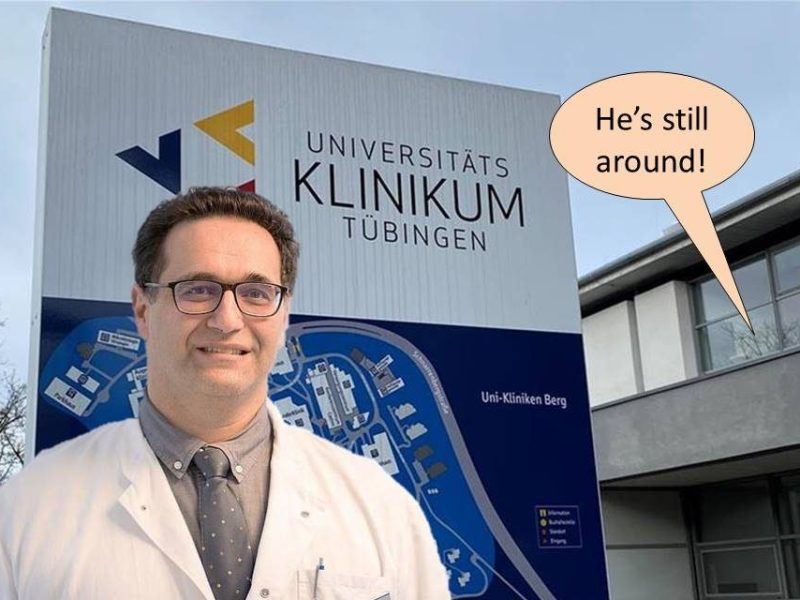
Gardening goats and external papermills in Tübingen
One shooting and one falling star of University Clinic Tübingen. Meet the research ethics champion Julia Skokowa and the eternally affiliated Renaissance Man Reza Akhavan-Sigari,

You get the message about Qasim. The PubPeer record of the University of Peru professor Rosario Mireya Romero Parra proves beyond all doubt that she buys from papermills. There are papers by Turki Jalil, in fact also the co-corresponding author of the retracted MDPI study, Luis Andres Barboza-Arenas (another professor of University of Peru), is on one retraction:
Omar Dheyauldeen Salahdin , Hamidreza Sayadi , Reena Solanki , Rosario Mireya Romero Parra , Mohaimen Al-Thamir , Abduladheem Turki Jalil , Samar Emad Izzat , Ali Thaeer Hammid , Luis Andres Barboza Arenas , Ehsan Kianfar Graphene and carbon structures and nanomaterials for energy storage Applied Physics A (2022) doi: 10.1007/s00339-022-05789-2
How to cite properly:

YM Chu and C. Li are two very notorious citation buyers. And the authorships for that paper were sold on the internet. Romero Perra is 4th author, she must have paid $600:

The retraction notice from 29 February 2024 indicates Romero-Parra was added after peer review, and so was probably Barboza-Arenas:
“The Editor-in-Chief has retracted this article because of substantial overlaps with previously-published papers by different authors [1,2,3]. Additionally, an investigation by the Publisher has found a number of articles, including this one, which share similar concerns, involving but not limited to, irregularities with respect to submission and authorship.”
Another one by Romero-Parra and Barboza-Arenas, again with evidence of authorships being sold on internet:
Widodo Brontowiyono , Indrajit Patra , Shaymaa Abed Hussein , Alimuddin Alimuddin , Ahmed B. Mahdi , Samar Emad Izzat , Dhuha Mohsin Al-Dhalemi , Ahmed Kareem Obaid Aldulaim , Rosario Mireya Romero Parra , Luis Andres Barboza Arenas , Yasser Fakri Mustafa Phosphate Ion Removal from Synthetic and Real Wastewater Using MnFe2O4 Nanoparticles: A Reusable Adsorbent Acta chimica Slovenica (2022) doi: 10.17344/acsi.2022.7594

And one more with the two Peruvian scammers, kind of sad Barboza-Arenas paid $550 for his name on a preprint on ResearchSquare:
Indah Raya , Usama S. Altimari , Baraa G. Alami , Seelam Srika , M. Abdulfadhil Gatea , Rosario Mireya Romero-Parra , Luis Andres Barboza-Arenas , Yasser Fakri Mustafa Synthesis of Rizatriptan Analogues via the Fischer Indole Synthesis in the Presence of Sustainable Natural Deep Eutectic Solvents and Catalyst Research Square Platform LLC (2023) doi: 10.21203/rs.3.rs-2930130/v1

I could continue, but Peruvian journalists of El Comercio already cracked the case a year ago (Google-translated):
“A newspaper report showed that some Professors from Peruvian universities have chosen to pay sums of money to appear as co-authors in scientific research , since this allows them to access bonuses granted by their study centers.
The “Punto Final” program indicated that private universities grant bonuses of 5,000 to 9,000 soles to professors who publish research in international scientific journals , while in national universities half an extra salary is given.
According to the report, professors pay to appear as co-authors of research carried out in other countries and their alleged co-authors are from Iraq, Iran, Saudi Arabia and Uzbekistan. […]
“Punto Final” showed the case of Rosario Mireya Romero Parra, who has a bachelor’s degree in Education, a master’s degree in Higher Education and a doctorate in Educational Sciences, but the most notable thing is that she appears as a co-author in dozens of scientific investigations in Mainly medical topics. These are indexed in magazines and she signs them with the seal of Continental University. When consulted, Romero did not know how to explain her contribution to the research and she did not remember the names of her co-authors.
However, the Continental University indicated that it became aware of the purchase of scientific co-authorships and found it responsible , so it let her go in August.”
There is even a video about Romero-Parra’s papermilling:
Let’s turn to the European authors of the retracted MDPI study. There are four of them:
Michał Jasiński, professor of the University of Ostrava in Czechia, and his faculty colleagues Filip Novak and Radomir Goňo. Jasinksi and Gono also declare a second affiliation at the Wroclaw University of Science and Technology in Poland, and this is where the main affiliation of the second co-corresponding author, Zbigniew Leonowicz, is. As it happens, Leonowicz has also a second affiliation (his Polish CV however says it was active in 1996 only) at the Sapienza University of Rome in Italy. Where lots of papermilling happens, read here:

Karimipour Saga III: All roads lead to Rome
“The academic career of D’Orazio is tightly coupled to that of Karimipour since she hosted him at Sapienza. Of the 57 papers she declared authorship for, 25 (44%) are published together with Karimipour.” – Maarten van Kmapen

Jasinski’s publication and citation index was microscopic until 2020, but then it exploded (see his Google Scholar). Same is true for Leonowicz and for Gono. They often publish together, accompanied by two former postdocs. One, Arsalan Najafi, who claimed to be associate professor at the Wroclaw University of Science and Technology, is now postdocking again at Chalmers University of Technology in Sweden. The other Iranian postdoc was Omid Homaee, who was “supported by the Polish National Agency for Academic Exchange (NAWA) under the Ulam Program Grant“. He is now at Nottingham Trent University, which is definitely a special place:

Nuttingham Trash University
“I will not by myself, or be instructing or encouraging any other person or howsoever othewise, publish or cause to be published words or otherwise howsoever make statements to others which wrongfully refer to Nottingham Trent University and/or their employees and for any person or any body associated with Nottingham Trent University”

Another fun fact about Michal Jasinksi: he seems to have a brother named Marek Jasiński (affiliated with Wroclaw University of Applied Informatics “Horizon”), as evidenced by this MDPI paper Khanna et al 2021, with both Jasinski brothers, Leonowicz, two Indians, and two russians including a Vadim Bolshev, who in turn seems to be running a little authorship-for sale business with a certain Pavel Kuznetsov. When russia began its genocidal full-scale war on Ukraine, Polish scientists stopped collaborating with russians, but not Marek Jasinksi. See his MDPI paper Kuznetsov et al 2022, submitted in August 2022. In fact, that paper seems to be a translated copy of the russian language paper Kuznetsov & Kotelnikov 2022, as Alexander Magazinov found out. During translation, Marek Jasinksi, Bolshev, more russians, and a Tunesian author joined.
And as for Leonowicz, well, we communicated before. Someone left a string of comments under my article about papermilling in Poland article, from an IP address in Wroclaw, signing as “ZBIGNIEW LEONOWICZ”, leaving behind Leonowicz’s professional email address.
“Why don’t you touch the greatest one Frede Blaabjerg ???”
Comment June 5, 2024
“You find a small cheater and meticulosly follow all possible “crimes”, but you don’t touch the biggest mogols like Blaabjerg – the emperor of papermilling”
“Very convenient and safe- persecute poor Iranians, but don’t touch our fabulous West-European honest SCIENTISTS !. Isn’t it a little racist?”
Without “poor Iranians”, Leonowicz’s own publication record would be way less impressive. Actually, two years ago, I did publish an article by Alexander Magazinov which mentioned Frede Blaabjerg, that surprisingly productive professor at the Aalborg University in Denmark:
Maybe stop accepting submissions, Herr Prof Dr Sauer?
Who needs science if you can have a 75 paper strong special edition by Afrand and Karimi? A guest post by Alexander Magazinov.

I guess this is a typical Blaabjerg paper:
Saeed Peyghami , Frede Blaabjerg Power Routing: Active Asset Management in Power Electronics Systems IEEE Transactions on Industry Applications (2022) doi: 10.1109/tia.2022.3189329
“A high number of SELF-CITATIONS (18 times) of the SECOND co-author; perhaps just to boost the citation indices. The FIRST CO-AUTHOR has used 8 times of his SELF-CITATIONS!”
Streblocera villosa
Back on 6 June 2024, the real Leonowicz meekly protested in an email: “I have no idea what you are talking about.” I think he did, look at the authors of this IEEE conference abstract:
Mantosh Kumar , Mahajan Sagar Bhaskar , Sanjeevikumar Padmanaban , Pierluigi Siano , Frede Blaabjerg , Zbigniew Leonowicz Electric field analysis of extra high voltage (EHV) underground cables using finite element method 2017 IEEE International Conference on Environment and Electrical Engineering (2017) doi: 10.1109/eeeic.2017.7977883
So I wrote to Leonowicz again, on the occasion of that fresh MDPI retraction. Before we get to the main bit, Leonowicz defended his former postdoc Najafi as “a good guy“, who unfortunately left for Sweden because he “wanted more money (higher salary and social benefits)“.
Well, here is a book chapter by this “good guy” with a certain iranian gentleman named Behnam Mohammadi-Ivatloo, professor at LUT University, Finland:
Arsalan Najafi , Ali Masoudian , Behnam Mohammadi-Ivatloo Optimal Capacitor Placement and Sizing in Distribution Networks Studies in Systems, Decision and Control (2020) doi: 10.1007/978-3-030-34050-6_4
Mohammadi-Ivatloo, like so many proud Iranian science superstars, is an owner of a worrisome PubPeer record of bad science and citation farming to his collaborator, Fazel Mohammadi. One paper of Mohammadi-Ivatloo’s (Nojavan et al 2015) was retracted for self-plagiarism.
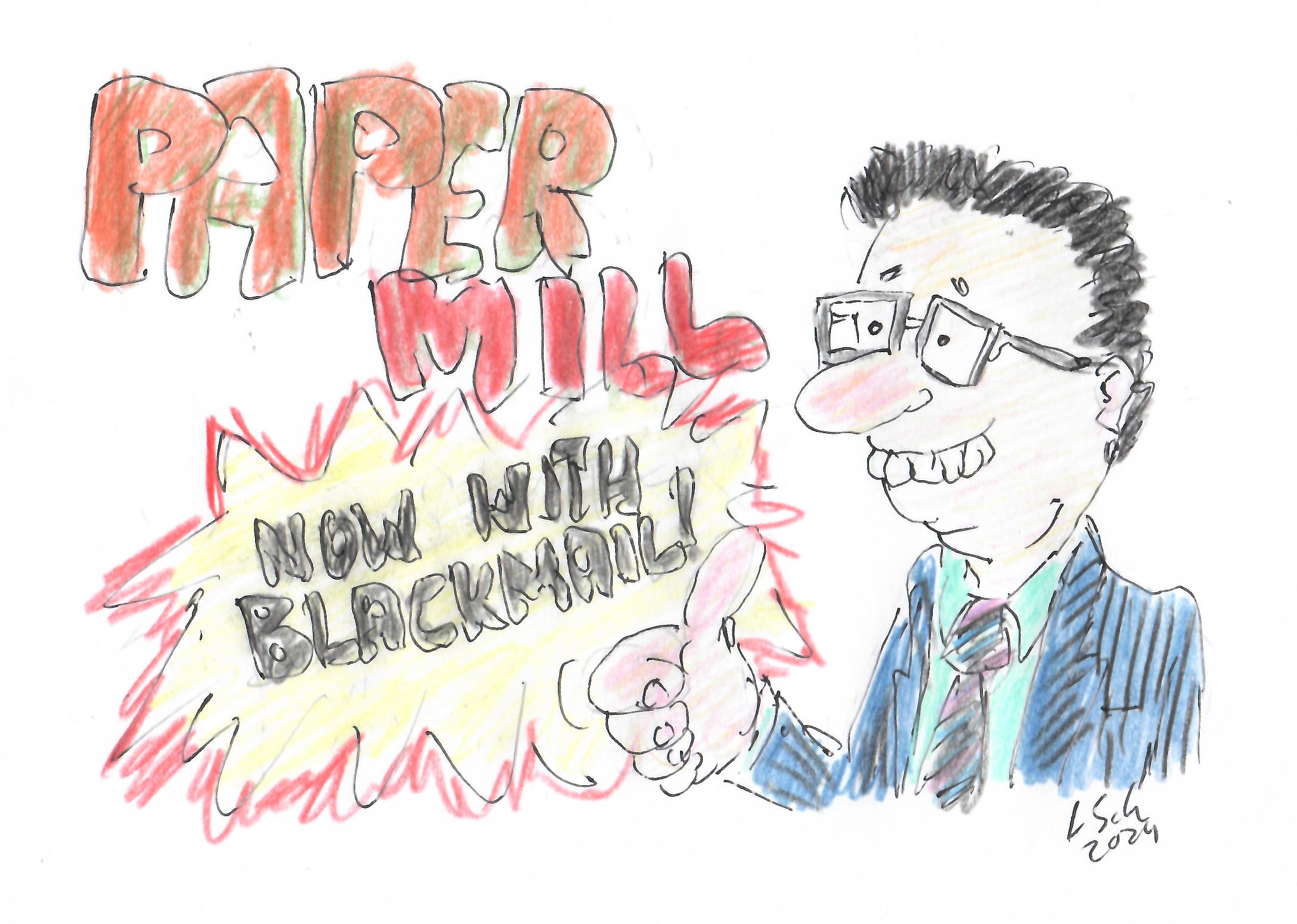
And now, it gets really got interesting. The Wroclaw professor told me about that MDPI retraction:
“I was asked to pay in bitcoin to avoid retraction“.
Then, Leonowicz shared with me this email he received on 29 April 2024, signed by “Advocate Alayi Tehran IRAN“:
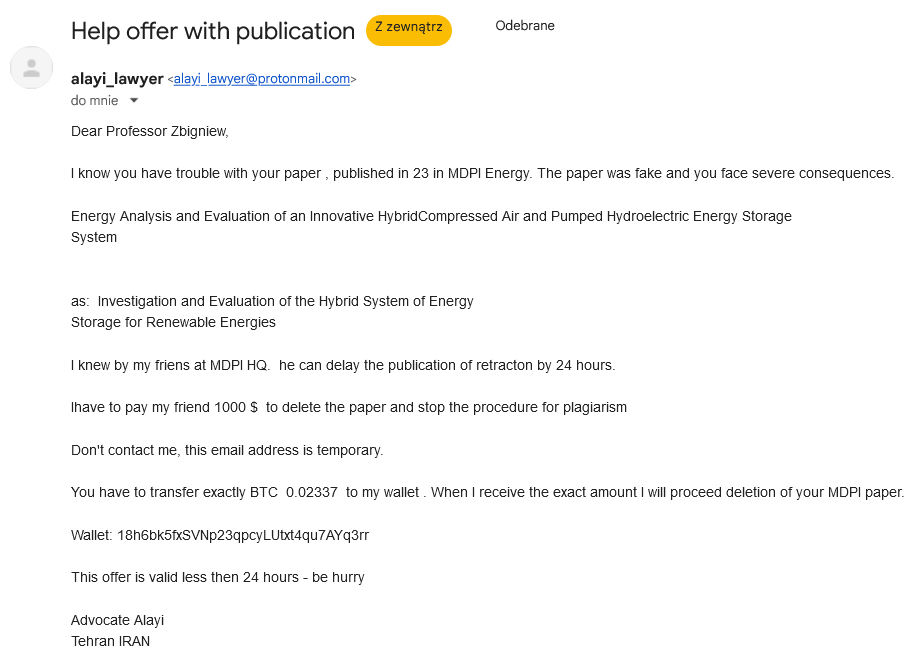
The demand was to immediately pay $1000 (Bitcoin 0.02337 ) to the Wallet 18h6bk5fxSVNp23qpcyLUtxt4qu7AYq3rr, in order “to delete the paper and stop the procedure for plagiarism“.
Leonowicz explained to me he published in MDPI because “I had money from coupons (earned as reviewer) and because my university is poor and they want us to publish as much as possible – otherwise we would lose our jobs.” He also insisted: “I am not guilty“. And attached this email without explaining who its original recipients were:
“Unfortunately, my colleagues and I fell victim to a fraudster named Reza Alaya [MDPI coauthor Reza Alayi, -LS] (he is from Iran), who also tried to force me to pay a “ransom” in bitcoins for withdrawing the article.
The idea from the “original” article that none of the honest co-authors knew about (written in Persian) was presented by R. Alayi as his own idea for a new article in Energies.
We made calculations, edited the text based on his crooked and often incorrect ideas and stories, a friend made illustrations based on this fraudster’s hand sketches, another person made calculations, and then there were many months of corrections. Everything seemed OK until the article was published.Then the fraudster reported himself to MDPI and started blackmailing me, then even demanded about PLN 5,900 for “deleting” the article.
The case was not clear, so the retraction lasted as long as 15 months. The correspondence with the editor was prolonged, MDPI did not want to admit that only one fraudster was guilty in this case.We all carefully checked all the databases, but you can see that the case was staged – because no search engine is able to find similarities in a text in a different language and written in a different alphabet. Only the literature was in English, but literature is usually not checked because it always gives a similarity, which is not plagiarism.
The attitude of MDPI is also strange to me, they refused to conduct a fair procedure, it was written falsely that I was against retraction (and I was the first to demand it in May 2023!)
then it was written that a committee had made a decision, and then it turned out that there was no “ethics committee” at all, and the decision was made only by prof. Sciubba.All this proves the quagmire that science has become, thanks to open-access and the new Act on Higher Education and Science.
Of course, I am resigning from my job at Wrocław University of Science and Technology and I will no longer engage in studies. I’m retiring and will never publish anything again.
When I started working, my mentor, prof. Tadeusz Łobos always said that one good article per year is too often.
Today? prof. Josep M. Guerrero, publishes hundreds of articles in magazines a year and no one even wonders how he does it? He is even a role model for young people, he educates crowds of young “scientists” who will write 5,000 articles a year? And there are hundreds of such Guerreros and other Blaabjergs.I will not mention that the University of Technology threatens scientists if they do not publish at least four articles. for >70 points, they will be thrown out… If you don’t publish like a printer, you can forget about habilitation or the title of professor…”
Linked at the end was a Google Scholar profile of that Josep M. Guerrero.
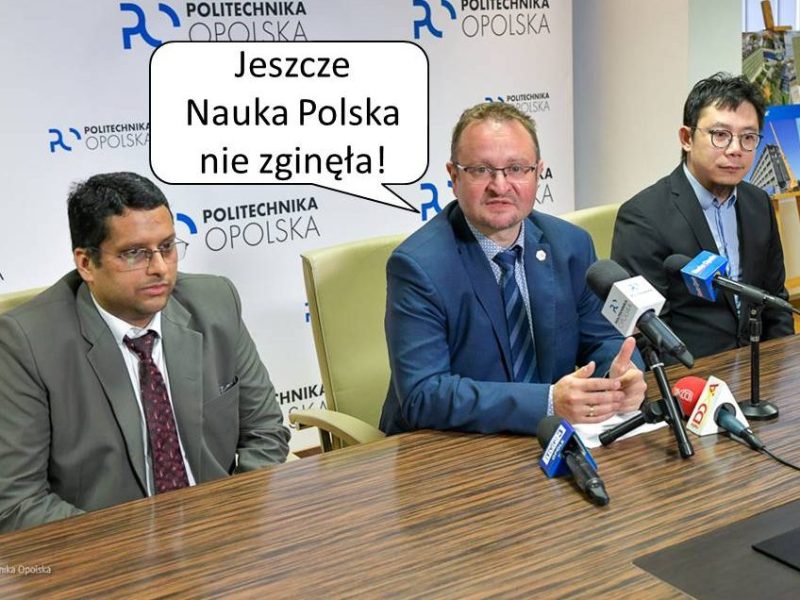
Polish science eaten by Papermill Krolczyk
“Prof. Grzegorz Królczyk, Vice-Rector for Science and Development of the Opole University of Technology, was elected President of the Council for Innovation in Higher Education and Science.”
This Iranian fellow named Reza Alayi of Islamic Azad University was not on my colleagues’ radar yet, except for a case in Frontiers where he acted as reviewer to extort a bunch of citations to himself. But now Alexander Magazinov noticed this retracted paper, where Alayi is the only Iran-affiliated author:
Wajdi Rajhi , Rassol H. Rasheed , Dheyaa J. Jasim , Walid Aich , Badreddine Ayadi , Reza Alayi Energetic and Exergetic Performance Improvement of a Solar Flat Plate Collector Working with Nanofluid Thermal Science and Engineering Progress (2024) doi: 10.1016/j.tsep.2024.102554
“This article has been withdrawn at the request of the author(s) and/or editor. The Publisher apologizes for any inconvenience this may cause.”
Maybe this is what really is going on. Advanced papermill fraudsters like Reza Alayi first sell authorships, pocket the money and publish a paper, then contact the journal again and report their own paper for fraud in order to extort their “coauthors” for money to prevent retraction.
Maybe, just maybe, Iranian scientists are not your friends, especially when they bring gifts? Leonowicz seems to have learned his lesson.
Or maybe not yet. This was freshly published, on 11 July 2024, by Leonowicz, Jesinski and their amazing Iranian postdoc Homaee:
Mohammad Javad Nasiri , Omid Homaee , Ahmad Gholami , Michal Jasinski , Zbigniew Leonowicz Lightning Transients in Wind Turbines: A Study on How to Segmentize the Tower, Blades, and Grounding Rods IEEE Transactions on Industry Applications (2024) doi: 10.1109/tia.2024.3426470
Donate!
If you are interested to support my work, you can leave here a small tip of $5. Or several of small tips, just increase the amount as you like (2x=€10; 5x=€25). Your generous patronage of my journalism will be most appreciated!
€5.00

 For Better Science
Reza Alayi…! quite a character! he must be studied and analysed carefully.
LikeLike
I am Reza Alayi the president of University of Garmi, please see and translate the following official university link. I am vising a conference in EU where I was informed about this article. I am too busy with the management roles to be able to take the role of writing an article. I suspect this was a trap. It is many years that I am not directly doing research. I wrote to MDPI why I was not informed about this.
https://germi.iau.ir/fa/page/27/%D8%B1%DB%8C%D8%A7%D8%B3%D8%AA-%D9%88%D8%A7%D8%AD%D8%AF
LikeLike
I am too busy with the management roles to be able to take the role of writing an article.
Let’s call it what it is: bullshit. Too busy writing articles, not too busy attending conferences in the EU, right.
And what about this recent thing of yours, an Iran – India – Iraq – Tunisia – Saudi collaboration? Where you are the only corresponding author, with your personal yahoo address (known to be yours as of 2016), while the other email address is obviously garbled.
To believe characters like you, one needs to have strong independent evidence. And it is simply not there, sorry dude.
LikeLike
Dear colleagues, please be aware of an impostor communicating with private email addresses. I only use my academic email. I wonder what email they used to submit that MDPI article. The impostor made some believe that I wrote an article and made an effort to retract it myself damaging my own reputation and others. I appreciate if an expert deal with it. I am too busy now. Thanks.
LikeLike
The identity of the piece of shit commenting above is certainly not “Reza Alayi”.
I just deleted their comment attacking Alexander Magazinov in the usual pattern.
We saw it before. This person comments under an FBS article using the identity of one of its protagonists, then, once passing moderation, this person starts posting the usual insults against A. Magazinov.
We suspect Rafael Luque being this troll. or maybe he is rather an ork, since Luque hides in russia.
LikeLike
Proofs or fuck off.
LikeLiked by 1 person
The identity of the piece of shit commenting above is certainly not “Reza Alayi”.
I just deleted their comment attacking Alexander Magazinov in the usual pattern.
We saw it before. This person comments under an FBS article using the identity of one of its protagonists, then, once passing moderation, this person starts posting the usual insults against A. Magazinov.
We suspect Rafael Luque being this troll. or maybe he is rather an ork, since Luque hides in russia.
LikeLike
Ah, the Empire strikes back at itself. Have these papermillers switched sides?
LikeLike
Unbelievable things… Probably not the first time they’ve done this. Maybe someone will read this and get in touch and we can learn more stories. Thanks to this post I learned a new name in the Iranian papermill and academy organization in Europe, Behnam Mohammedi-Ivatloo. European universities are really Iranianized. And I don’t know how they do it, but they all find academic positions in different universities in specific fields. As in this post, Energy Storage and Renewable Energy are just two of them.
It is the publishers themselves who need to capture these processes. Because these scams are going on on their platforms. And then, of course, universities need to take action because these scams also affect universities. As long as one of them falls short, this scam will continue to increase.
I also looked up Frede Blaabjerg after he was mentioned in one of the previous posts. It’s really an incredible profile. According to Dimensions, he had 182 publications in 2023 alone. I’ve always heard about the “IEEE mafia” but I think this is the first time I’ve met one of its members. I also found something more interesting, this guy is the winner of the prestigious Villum award in Denmark. And what’s more, he is the Chairman of the Danish Council for Research and Innovation Policy since 2020! Now I understand better why Denmark has such a problematic research structure. This is normal when you have a papermill king at the chairman position of research and innovation policy.
But Blaabjerg has also trained others like him in this adventure, like Remus Teodorescu and Tomislav Dragicevic. Would you look at these publication records? How is this possible? Remus is still at Aalborg and Tomislav is a professor at the Technical University of Denmark. They both published 35 papers last year (2023) alone. It’s hard not to notice that they have interesting connections with IEEE. Remus has just received an IEEE award. Dragicevic has also received a prestigious award from the IEEE, and at one point he says “I am also humbled to get to stand on the shoulders of giants”. It was funny to be honest. Also, Dragicevic has received prestigious awards within Denmark, although not as prestigious as Blaabjerg.
It’s actually very sad. Increase your publication record as a papermill researcher, get ahead of researchers who want to do their job properly, and then collect the money and awards from research funds. How long do you think this can be sustained? And also, Blaabjerg may be paying special attention to the Iranians at Aalborg, as both profiles, as associate professors, continue with the Blaabjerg approach.
Another thing I have noticed is that almost all of the papermill researchers I have come across in Denmark have a background in Aalborg. Why does this university host so many papermill researchers?
LikeLiked by 1 person
In some years this Blaabjerg guy according to scopus had more than 300 publications. How is this even in a legit way plausible?
LikeLike
It is impossible in terms of research integrity, but after all the posts I have read on this blog, I have rarely seen legal consequences for those who manipulate in academic publishing, as there are many legal loopholes in these matters. The main problem is the lack of control. So many publications are being published that the authors now outnumber the readers. In such a situation, I think the publishers, who are supposed to monitor these processes, are looking to make a profit by handing over the editorial boards of journals to people who are inconvenient instead of monitoring.
When I was looking at Blaabjerg, I realized that in parallel with the increase in the speed of academic publishing, especially starting in the 90s, he established his own journal article and citation kingdom. Thanks to the advantage of being from Northern Europe, he was less controlled. However, he also trained the names that came after him. Remus and Tomislav I mentioned above are good examples of the continuity of this kingdom. IEEE journals are not academic journals for these names, but almost like school newspapers. They can publish whatever they want. As a result, they received awards and grants from both IEEE and prestigious institutions in their country. And as mentioned earlier, I think Blaabjerg now prefers the young members of his kingdom from Iran.
It is really disappointing that such profiles can be appointed as responsible for a country’s research and innovation, rather than the opposite, when they should legally see the consequences of what they do. Denmark may be the worst example in Europe in this regard. A small country, a small academy but with a very high rate of papermill researchers. It is unbelievable.
LikeLike
As a fresh graduate of Aalbrog University I find that last paragraph particularly juicy. I mean teaching there is mostly crap, and research as well?
As a potential explanation, AAU claims to use the Problem Based Learning method, which means unleashing hordes of students doing barely thought out semester projects into the labs, with minimal or no supervision. Having had to elbow my way to get bench space while working on my thesis, that AAU has a paper mills problem does not surprise me.
LikeLike
To be fair, Aalborg is the only Danish university where I know good oldschool people whom I respect (hope Jesper Møller is active and doing well).
LikeLike
I don’t know what field you have worked in, but what I have observed is that there is a very serious intensity of papermill researchers in energy and chemistry in all universities in Denmark. Aalborg University is ahead of other universities in this regard. If you are a student working on these subjects, they may not have had time to consult with you because they were too busy with papermill activities.
My observation is that a few more Danish names like Blaabjerg are active as papermill researchers. These names bring to Denmark names who have already increased their academic records and h-indexes with papermills in Iran and continue to increase their academic records through them. But examples like Remus and Tomislav I mentioned above are rare because they are not from Iran. Usually papermill-based articles and citation movements are based on Iranian researchers in Denmark. I have seen many examples of this and you can find similar observations in other posts on this blog.
When I looked into the background of these people, many of them came to Aalborg first. Then they either stayed in Aalborg and continued their academic life or moved to other Danish universities. In any case, the inflation of papermill researchers in energy and chemistry in Denmark is seriously affecting both academic publishing and academic budgets.
I have to say that I gave the example of Denmark because it came up, because it started to come up very often. But there are similar trends in the Netherlands, Sweden and Germany, although not as intense as in Denmark. What they all have in common is that academic budgets are relatively higher than in other countries in Europe. This shows that the papermill organization is actually sustaining itself through academic funding.
LikeLiked by 1 person
This is exactly Rafael Luque, trying to divert attention to others. He is stealing the identification of others as usual. Everyone knows you, Rafael Luque, as a bullshit king of paper milling, and you’re so ignorant that you don’t even dare to deliver a lecture at an international conference with such a huge citation and H-index. Shame on you, Rafael Luque, for doing such vile things.
LikeLiked by 1 person
There is a bit more papermilling in Wroclaw to look at.
https://link.springer.com/article/10.1007/s10973-023-12803-z
A partnership of a local and an infiltrator, Krzysztof Kędzia and Ahmed Zubair Jan, respectively.
Because it has so much applied value to study blood with a lot of (i.e., possibly, a deadly amount of) gold, silver and copper nanoparticles (all-in-one mix!) flowing in a stenotic artery.
“This problem has an impact on many biological science and engineering processes, including blood circulation, plasma flow, die casting, paper production, motor oil transfer wire pulling, heat rolling, copper deformation, crystal growth, and other processes.”
Die casting. Heat rolling. Butt burning might well fit in this mix, too.
LikeLiked by 1 person
I wish Professor Blaabjerg success in his new role. I am sure it will solve the lack of innovation that Europe has been complaining about lately. Come on Blaabjerg, Make Europe Great Again! Together with Iranian papermillers of course!
LikeLike