

Schneider Shorts of 2 August 2024 – Two British stem cell biotechs in trouble, a baldness cure found in Pakistan, papermill clean-up in Vietnam and Thailand, a guide on finding papermill experts, Kosta’s first retraction, and finally, a Polish chemist trolls back!
Table of Discontent
Industry Giants
- Seriously jeopardising the rights, safety and well-being of trial participant – Celixir sanctioned by British authorities
- If the cost is not a big deal for you – umbilical cord blood scam of Cells4Life
Science Elites
- Six scientists sacked – Thailand tidies up on papermillers
- Violated scientific integrity – two papermillers demoted in Vietnam after media coverage
Scholarly Publishing
- Philosophical and Scientific Inquiry into the Limits of Divine Power – Konrad Szacilowski trolls PiS
- Unfortunately, much of the relevant information is not found in original peer-reviewed papers – Roland Seifert seeks experts in a haystack
Retraction Watchdogging
- Authors willingly supported independent investigation – a retraction for Dundee researcher
- Corresponding author unable to recover the requested data – first retraction for Konstantinos Konstantopoulos
- The authors would like to apologise for any inconvenience caused – Elsevier journal noticed nothing despite 2 corrections
- Unaware of this submission – another retraction for identity thief Mostafa Jalal
Science Breakthroughs
- Good news for nearly half the world’s men – Sheffield’s star biotechnologist’s bold approach
Industry Giants
Seriously jeopardising the rights, safety and well-being of trial participants
Years ago, the Liverpool University professor Patricia Murray reported the biotech start-up Celixir to the British authority Medicines and Healthcare products Regulatory Agency (MHRA), for unethical clinical practices with their cell therapy drug, which used to be blood from unsuspecting heart attack patients, and now is (allegedly!) commercially purchased bone marrow.

Requiem for Celixir
How the Nobel Prize winner Sir Martin Evans and the lying crook Ajan Reginald almost succeeded, were it not for Patricia Murray.

As a reminder, Celixir is owned by the Nobel Prize laureate Sir Martin Evans and his dear young friend Ajan Reginald, a struck-off dentist, pathological liar, and a psychopath. Most recently, Ajan has been impersonating third parties to place fraudulent DMCA take-down claims against my reporting (read May 2024 Shorts), and sending Pakistani lawyers to fraudulently claim his copyright to what I wrote about him (read June 2024 Shorts).
You can read about Celixir’s clinical trials and Prof Murray’s struggle with MHRA here:

Celixir-critic Murray: “MHRA is prioritising business interests over patient safety”
Liverpool professor Patricia Murray continues investigating shady dealings of the regmed company Celixir, owned by struck-off dentist Ajan Reginald and Nobelist Sir Martin Evans
This is MHRA Infringement Notice to Celixir:
“A Good Clinical Practice (“GCP”) inspection carried out on 22 July 2020 (Clinical Investigator site) and on 28-29 September 2020 (Sponsor site) identified 9 critical and 3 major findings and it is the view of the Enforcement Authority that Celixir, the trial sponsor, failed to ensure the conduct of the trial in accordance with the conditions and principles of good clinical practice and therefore risked seriously jeopardising the rights, safety and well-being of trial participants.”
“There was a lack of evidence that sponsor staff had the appropriate clinical trial experience to be able to adequately oversee the conduct of a clinical trial and perform their responsibilities as sponsor to ensure the rights, safety and well-being of trial participants were protected and that all aspects of GCP were complied with. […]
“Batch certificates for the IMP signed by the Qualified Person (“QP”) supplied to the trial in April 2019 indicated a 12 Month shelf life which was used for labelling of the IMP. The Investigational Medicinal Product Dossier (IMPD) in the Clinical Trial Authorisation submission contained the stability period. The 12-month shelf life was beyond that specified in MHRA approvals which were 3 months (IMPD version 2) at the time of labelling, and 9 months (IMPD version 3) at the time of shipping of the IMP. […]
The MHRA granted a CTA [Clinical Trial Authorisation, LS] for a Phase two trial. The previous clinical information was based on results from a clinical trial conducted in Greece in 2012 and the sponsor subsequently submitted a substantial amendment and removed any reference to this trial. The MHRA issued a notice of non-acceptance of the amendment in 2020, however, the trial commenced, and a single patient was dosed3 contrary to the understanding of the licensing authority that this would not occur. The IMP had also technically expired at the time of dosing based on the approved IMPD3.”
There is also coverage in 1 August 2024 issue of Private Eye.
If the cost is not a big deal for you
Another victory for Liverpool professor Patricia Murray, this time with umbilical cord scammers. For her previous achievements on this field, read November 2022 Shorts and July 2023 Shorts.
The BMJ brought an article by Jacklin Kwan titled “Cord blood banking: Experts raise concern over claims made for stem cell applications“:
“Umbilical cord blood banking has gained prominence in the past decade as an option for expectant parents worried about their child’s future health.1 Parents pay private biobank companies up to £3000 (excluding annual storage fees) to freeze their baby’s cord blood, which contains stem cells, in case the infant develops a condition that could be treated with stem cell therapy.”
“Cells4Life, which claims to be the UK’s largest private biobank for cord blood banking, says that its particular method delivers more stem cells from umbilical cord blood than its competitors’ processes. For this marketing message it relies on research published in the Journal of Stem Cells Research, Development & Therapy. Publication of this research took place just 17 days after receipt of the manuscript, a timescale far shorter than is typical for peer reviewed journals. Two editors listed on the journal’s editorial board say they did not in fact hold these roles, The BMJ discovered”
The garbage was dumped in a journal by the predatory publisher Herald:
Jeff Drew, Rachel Slaughter, Alexander Klimentov, Wayne M Channon, Claudia Rees, William Harrington, Megan Watts and Lesley-Ann Martin TotiCyte, a Paradigm Shift in Stem Cell Isolation and Storage from Umbilical Cord Blood Stem Cells Research Development & Therapy (2021) doi: 10.24966/srdt-2060/100073
In a Twitter/X thread, the journalist Jacklin Kwan mentioned:
“When reaching out to @heraldopenaccess about allegations that they operated a predatory journal, I began receiving strange messages that pressured me to submit a manuscript […] The CEO of @Cells4Life? Her name is Claudia Rees – one of the listed co-authors of the Toticyte paper. To my knowledge, I don’t believe she studied STEM in university “
From the BMJ article:
“Patricia Murray, professor of stem cells and regenerative medicine at the University of Liverpool, says that there is no clear scientific reason why TotiCyte should outperform market alternatives. “All they’ve got in TotiCyte is DMSO and dextran, which are well established cryoprotectants,” she said, “There may just be a slight difference in the percentages of DMSO and dextran, but you wouldn’t expect it to have such a dramatic effect on cell survival.”[…]
Murray points to a written opinion by an international searching authority (ISA or patent office) in 2014 when Cells4Life applied for a patent under the World Intellectual Property Organisation. The ISA examined TotiCyte’s application to sediment red blood cells as well as its role as a cryoprotectant and concluded: “It follows that the addition of DMSO to the dextran composition does not add any technical effect in the use and method for white blood cell enrichment and appears merely to serve as a patent strategical means to establish novelty over the art.””

Peacock Thieves – Review of “Dr. Death: Cutthroat Conman”
“Your website is the best source for information about Paolo Macchiarini. Full stop. ” – Maxine Productions
Another expert is cited:
“Charles Murry, director of the Institute for Stem Cell and Regenerative Medicine at the University of Washington, Seattle, says claims that stem cells can develop into almost any type of cell in the body have been “very rigorously disproven.” […] Murry says the decision whether to bank their infant’s cord blood ultimately lies with parents: “If the cost is not a big deal for you, and it brings you peace of mind, go for it.”
There is also Box 2 in the BMJ article, explaining the idea behind cord blood storage:
“Blood in the umbilical cord contains haematopoietic stem cells, which can be used to develop into different kinds of blood cells (such as red blood cells), and mesenchymal stem cells (stromal cells), which are important for repairing some body tissues. After birth, the umbilical cord can be clamped and the blood within it and the placenta cryogenically stored. […] Stem cell therapies are showing promise in treating some conditions that diminish quality of life, such as cerebral palsy.4“
Reference 4 is a “study” published in a predatory journal by the known predatory publisher Baishideng:
Simone Eggenberger , Céline Boucard , Andreina Schoeberlein , Raphael Guzman , Andreas Limacher , Daniel Surbek , Martin Mueller Stem cell treatment and cerebral palsy: Systemic review and meta-analysis World journal of stem cells (2019) doi: 10.4252/wjsc.v11.i10.891
It is “a systematic literature search on PubMed and EMBASE to find randomized controlled clinical trials (RCT) investigating the effect of stem cell transplantation in children with CP”. The authority stems from the scientifically solid and undeniable fact that the authors of the review are white and Swiss, from the University Hospital Bern. Science has spoken.
Science Elites
Six scientists sacked
Bangkok Post brought these news on 18 July 2024:
“Six academics from three Thai universities have been sacked and eight others are being investigated for research paper fraud, according to the Ministry of Higher Education, Science, Research and Innovation (MHESI).
Three lecturers from Khon Kaen University were terminated and will also face criminal charges, according to the ministry.
Also fired were two lecturers from Chiang Mai University (CMU) and one from Chulabhorn Royal Academy, deputy permanent secretary Supachai Pathumnakul said on Thursday.
An investigation into allegations of phoney research papers involving 109 academics from 33 universities stemmed from a report in August last year saying that a CMU lecturer had purchased his paper for 30,000 baht.
The investigation found five websites offering the service to buyers. It also found 14 lecturers, including a former high-ranking executive of Thaksin University, were involved in committing fraud, Mr Supachai said.”

The incredible collaborations of Renaissance men and women
Nick Wise and Alexander Magazinov on the authorships-for-sale market on social media. Merely $700 for the 7th position on some paper way outside your expertise!

The sacked Thai scientists are not named. But it seems the notorious papermill duo Wanich Suksatan (formerly at Chulabhorn Royal Academy, PubPeer record) and Supat Chupradit (formerly at Chiang Mai University, PubPeer record) were among them.
Shouldn’t this be followed by mass-retractions? Hello, Elsevier? Anyone there?
Violated scientific integrity
More dismissals, this time in Vietnam. Dai-Viet N Vo, “one of four Vietnamese people in the “top 1% most highly cited in the world” by Clarivate” and an associate of Pau Loke Show, lost all his power positions. See Vo’s PubPeer record and read about his and Show’s joint papermilling in July 2024 Shorts.
On 22 July 2024, the Vietnamese newspaper Tuoi Tre wrote (Google-translated):
“Tonight, July 22, talking to Tuoi Tre Online , a representative of Nguyen Tat Thanh University said: “The school’s Science and Training Council met and approved Dr. Vo Nguyen Dai-Viet’s application to withdraw from the council. The school principal also signed a decision to dismiss Mr. Viet from the position of deputy director of the Institute of Technology Application and Sustainable Development effective from July 15.
Also according to the school representative, after Tuoi Tre published a series of articles Colliding to produce international scientific articles , which contained content reflecting that Dr. Vo Nguyen Dai Viet violated scientific integrity. The school has had many meetings with Mr. Viet and relevant departments to clarify.
“According to the initial conclusion, the school found that the above actions were personal to Mr. Viet but affected the school. Dr. Viet is the deputy director in charge of training, but when there is such bad public opinion, he cannot continue to hold this role.
Currently, Mr. Viet is only a researcher and no longer holds any management positions at Nguyen Tat Thanh University,” he added.”

Karimipour Saga I: Setting Boundaries
“The business of selling authorships and citations needs a steady supply of paper-shaped vehicles. It is most efficient to produce these in assembly lines that focus on a narrow topic.” – Maarten van Kampen

On 24 July 2025, Tuoi Tre brought another bit of news, regarding Quang-Vu Bach, “one of 73 Vietnamese people on the list of “100,000 most influential scientists in the world” in 2020” and an associate of the papermill mastermind Arash Karimipour (see Bach’s PubPeer record). Again, Google-translated:
“Dr. Bach Quang Vu , chairman of the academic advisory board of the Knowledge Bridge Economic Research Institute (KBERI), was accused by the scientific community of “violating academic integrity” and had 3 articles removed by journals because the peer review process was manipulated.
On the afternoon of July 24, talking to Tuoi Tre Online , Dr. Phan Hong Duc, director of KBERI, said that KBERI has just dismissed Dr. Bach from the position of chairman of the academic advisory council and member of the scientific and technical council. Quang Vu.
Also according to the director of KBERI, this dismissal was decided after Tuoi Tre Online posted the article “Removed 3 articles” and still serves as a speaker in a course teaching international journalism skills , including content reflecting Dr. Bach Quang Vu’s behavior which violated scientific integrity.
“KBERI has announced the decision to relieve Mr. Bach Quang Vu of his duties and he accepts this decision of the director,” Ms. Duc added.”

Karimipour Saga III: All roads lead to Rome
“The academic career of D’Orazio is tightly coupled to that of Karimipour since she hosted him at Sapienza. Of the 57 papers she declared authorship for, 25 (44%) are published together with Karimipour.” – Maarten van Kmapen
Scholarly Publishing
Philosophical and Scientific Inquiry into the Limits of Divine Power
Science is always outside of politics, as we are told. Which is of course is utter nonsense.
In Poland, the previous ruling party PiS, which is anti-democratic, ultra-nationalist and catholic-fundamentalist, managed to inflict immense damage to Polish academia in its 8 years of rule. One example is here, at the Opole University of Technology, whose papermill-enabling potty-mouthed rector Marcin Lorenc is a PiS candidate for the Senate:
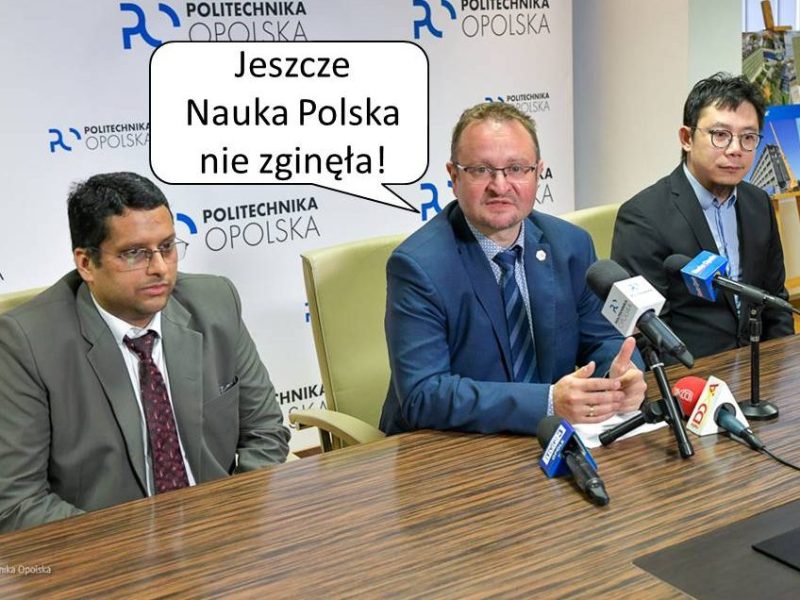
Polish science eaten by Papermill Krolczyk
“Prof. Grzegorz Królczyk, Vice-Rector for Science and Development of the Opole University of Technology, was elected President of the Council for Innovation in Higher Education and Science.”
PiS not only installed its loyal bootlickers as university leaders, it also changed the academic evaluation criteria. Under PiS legislation, publishing theological drivel in Polish-language catholic magazines was officially a metrical achievement equal to publishing a research study in Nature.
Well, Poland is not russia. There was protest, and here is a case of very creative protest. Here is an interview article in Love Krakow from May 2024 (Google translated):
“Prof. Konrad Szaciłowski, a chemist from the Academic Center for Materials and Nanotechnology of the AGH University of Science and Technology in Krakow, became famous at the end of last week when his name appeared in the context of unusual publications. Unusual because they were devoted to theology or Pope John Paul II, and attention was especially drawn to the work on “Karol Wojtyła’s philumenistic passion”, i.e. “the little-known passion for collecting matches”
The whole matter came to light thanks to a Facebook profile called the Theological Institute. Desert Demon. According to its authors, prof. Szaciłowski had been creating such publications for years, all to ridicule the point system and the reality of reviews.
Prof. On Friday, Szaciłowski confirmed that he was behind the publications, explaining that his actions were intended to show the imperfections of the Polish evaluation system. He also admitted that the co-author of some of his texts, the Turkmen scientist Kapela Pilaka, does not actually exist.”
I invite you to visit Kapela Pilaka’s ResearchGate profile. The fictional Turkman and the satirist Szacilowski published some scholarly breakthroughs like (titles translated from Polish original):
- “Karol Wojtyła’s philumenistic hobby” WSCHODNI ROCZNIK HUMANISTYCZNY (2023), DOI:10.36121/pilakaszacilowski.20.2023.4.195 , retracted
- “The role of Catholic radio stations in shaping the moral attitudes of young people” Fides Ratio et Patria Studia Toruńskie (2024) DOI: 10.56583/frp.2517, retracted
- “God’s Omnipotence Versus the Pauli Principle. Philosophical and Scientific Inquiry into the Limits of Divine Power and the Fundamental Nature of Reality. Part 1” Rocznik Teologii Katolickiej (2024) DOI: 10.15290/rtk.2023.22.08
- “Is theology an experimental science? Exploring the boundaries of empirical enquiry and religious understanding” European Journal of Science and Theology 19(6):91-11819(6):91-118 (2023)
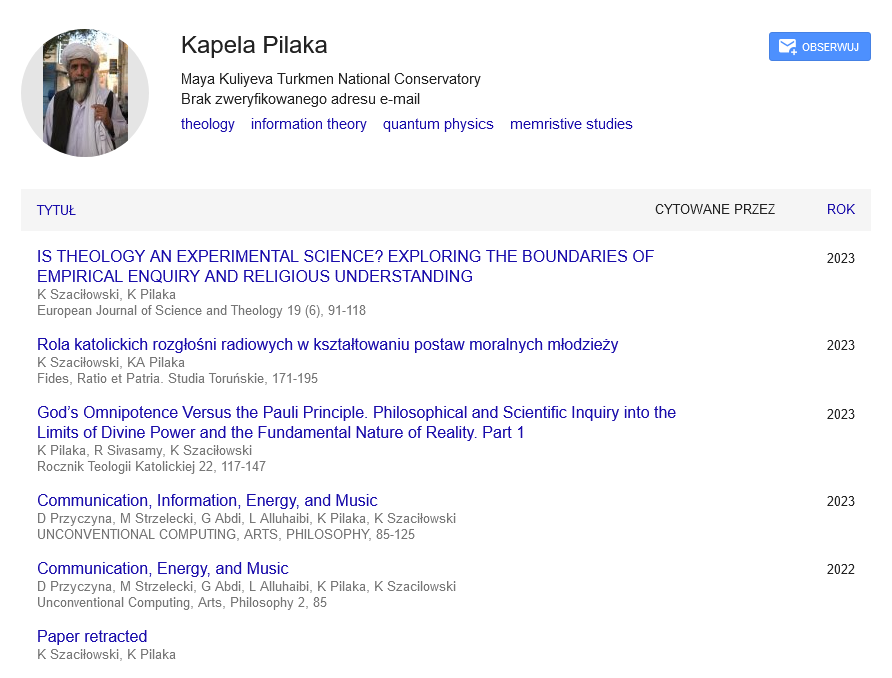
Szacilowski explained in the interview how he invented Kapoela Pilaka and why he decided to troll the PiS metrics:
“In recent years, it has happened that Polish, local journals, sometimes of marginal importance or minimal international reception, were scored higher or on par with prestigious international magazines. For example, a publication in “Przegląd Sejmowy” or “Rocznik Teologii Katolickiej” became worth exactly the same as a publication in “Science”, “Nature” or “Physical Review Letters”. These are global journals with very strict quality control, the best scientists from all over the world, the absolute leaders, publish there. Meanwhile, on the Polish publishing market, you can already earn a significant number of points for publications in magazines in which, as you can see, any nonsense or made-up story can be published.”
Unfortunately, much of the relevant information is not found in original peer-reviewed papers
On 6 July 2024, the Springer-published German journal Naunyn-Schmiedeberg’s Archives of Pharmacology released a new white paper. It is authored by the journal’s Editor-in-Chief and Hannover Medical School (MHH) Professor Roland Seifert, together with another MHH professor, Jonathan Wittau:
Jonathan Wittau , Roland Seifert How to fight fake papers: a review on important information sources and steps towards solution of the problem Naunyn-Schmiedeberg’s Archives of Pharmacology (2024) doi: 10.1007/s00210-024-03272-8
As reminder, this journal became victim of papermills twice, first by Chinese ones, and after all Chinese submissions were banned following Smut Clyde’s revelations on For Better Science, by Egyptian, Iranian and Pakistani papermills:

An attractive and “natural” target for fraudsters
“In the various excellent texts on paper mills the question is discussed why Naunyn-Schmiedebergs Archives of Pharmacology has become a target for fake papers. I oppose the assumption that we simply want to fill pages with pseudo-scientific content. We actually look for quality and good science.” – Prof Dr Roland Seifert, Editor-in-Chief
From the abstract of the new white paper:
“Scientific fake papers, containing manipulated or completely fabricated data, are a problem that has reached dramatic dimensions. Companies known as paper mills (or more bluntly as “criminal science publishing gangs”) produce and sell such fake papers on a large scale. The main drivers of the fake paper flood are the pressure in academic systems and (monetary) incentives to publish in respected scientific journals and sometimes the personal desire for increased “prestige.” Published fake papers cause substantial scientific, economic, and social damage. There are numerous information sources that deal with this topic from different points of view. This review aims to provide an overview of these information sources until June 2024.”
The term “criminal science publishing gangs” instead of “paper mills” was invented by Bernhard Sabel, Germany’s greatest academic genius who both cured COVID-19 and vanquished Asian papermills. You can read about the amazing papermill detection tool by this University of Magdeburg professor in March 2023 Shorts.
What are those authoritative sources Wittau and Seifert wish us to rely upon? As they boldly admit: “Unfortunately, much of the relevant information is not found in original peer-reviewed papers, but rather in other publication formats“. The sources are presented in several tables.
According to “Table 1 Original peer-reviewed papers” and “Table 2 Reviews dealing with fake papers“, the highest authorities on papermills are Jennifer Byrne, Lex Bouter, and the Naunyn-Schmiedeberg’s Archives of Pharmacology editors and contributors Seifert, Wittau, Sabel and Marcel van der Heyden, Unfortunately, there is hardly anyone else who is both educated and knows anything of value about papermills.
“Table 3 Non-peer-reviewed preprints dealing with fake papers” has two entries, one of them is Sabel’s disastrous preprint which I already wrote about in in May 2023 Shorts and which never made it into a peer reviewed journal. Not even into Naunyn-Schmiedeberg’s Archives of Pharmacology. That’s how awful Sabel’s papermill detection tool is.
“Table 4 Editorials dealing with fake papers” lists 6 editorial articles, two of them by Sabel in Naunyn-Schmiedeberg’s Archives of Pharmacology.
“Table 5 Other article formats (including journalistic articles) dealing with fake papers” informs you that Elisabeth Bik‘s legendary 2016 study in mBio was merely a non-peer-reviewed “perspective”, an opinion piece. As reminder, back then Bik visually screened “a total of 20,621 papers published in 40 scientific journals from 1995 to 2014” for image duplications.
Then there is “Table 6 Science blogs dealing with fake papers“, where For Better Science, PubPeer, Retraction Watch and Elisabeth Bik’s blog are listed. Except that PubPeer is not really a blog. “Table 7 Further information sources on fake papers” lists white papers by STM and COPE.
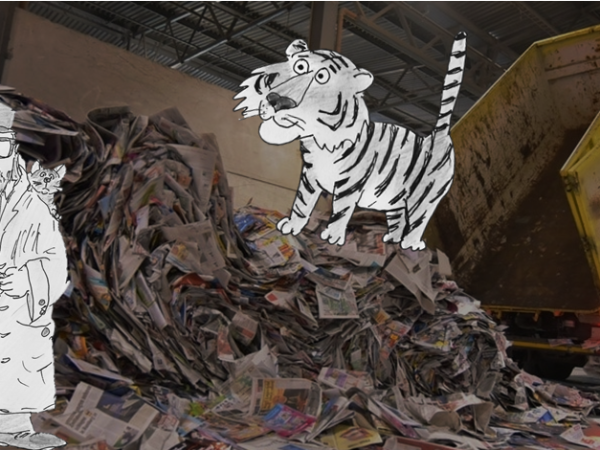
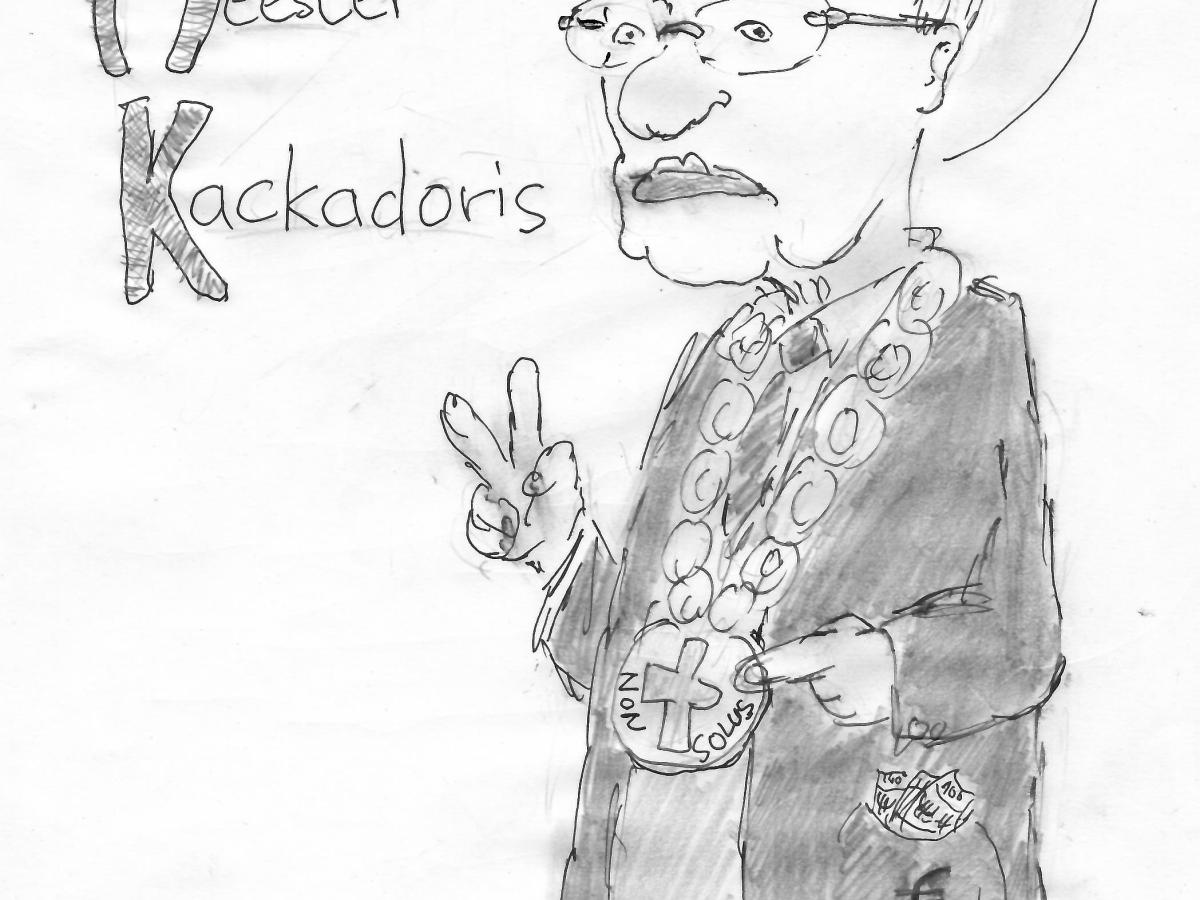
The Chinese Paper Mill Industry: Interview with Smut Clyde and Tiger BB8
Unlike those fake paper mill products, this interview failed editorial review and journal quality control.
Where Bik’s and other sleuths’ investigative work of many years is being as hardly relevant, there are still some proper academic experts to be found! Table 1 list this authoritative and peer-reviewed original research:
Dadkhah M, Oermann MH, Hegedüs M, Raman R, Dávid LD (2023) Detection of fake papers in the era of artificial intelligence. Diagnosis. doi: 10.1515/dx-2023–0090
Really? I wrote about the Hungarian last author Lorant David Denes in February 2024 Shorts. That dude is rather evidently a papermiller (see PubPeer), so yes, he is the right authority for Seifert and Wittau. It seems Denes was invited by a certain Iranian gentleman named Mehdi Dadkhah, who in turn publishes on all possible topics including publication ethics. His recent papers are all with Denes, not just on publication ethics but also about “Transitioning from net-zero to climate-positive supply chains” (2024).
Seifert and Wittau keep grabbing for straws, anything with a doi and remotely resembling a peer-reviewed publication is an authoritative source for them. By citing news articles in Nature, Seifert and Wittau credit science writers with the work of actual sleuths. And then they also proudly cite some outright garbage by the stalking looney Jaime A Teixeira da Silva (JATdS):
Teixeira da Silva JA, Daly T Against “silent” retractions in neuroscience. Eur J Neurosci (2024) doi: 10.1111/ejn.16330
Seifert knows what kind of character JATdS is, and still he keep citing him, because this unhinged rant is an academic paper for him, so much more authoritative than some un-scientific blog by an actual sleuth. JATdS, who is a former plant scientist, has established himself as expert opinion writer on EVERYTHING, thanks to predatory publishing, read here:
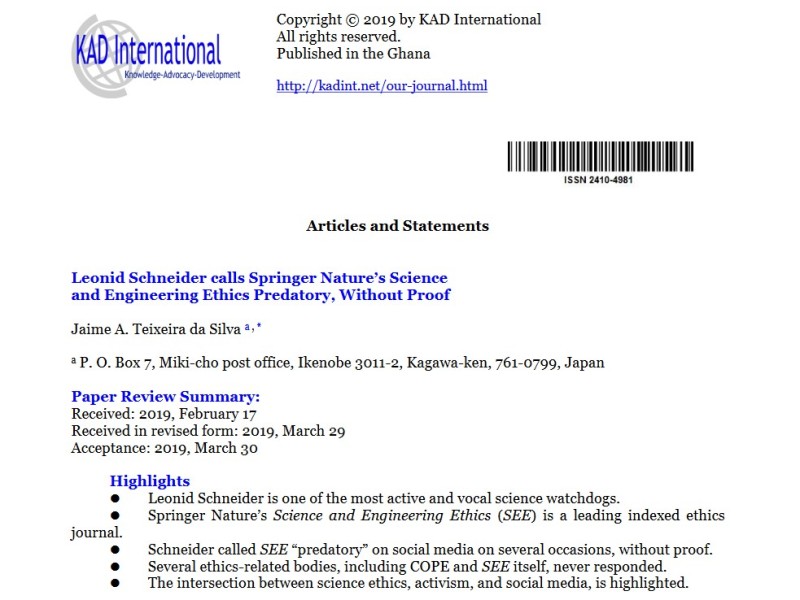
Editors and other real papermill heroes
“Long story short, we investigated our published papers and then retracted those with data integrity issues. That is it.” – Dr Heather Smith, Editor-in-Chief
For example, more recently, JATdS’ recent authoritative views on:
- “The video assistant referee in football“
- “A debate on the use of artificial intelligence, as an electronic line judge, for line calls in tennis”
- “What does ChatGPT advise about predatory publishing?“
- “ORCIDs of “researchers” with the names of vegetables“
The Wittau & Seifert 2024 editorial is a paragon of academic arrogance and naivety. The two German professors assume that problems in academia can only be solved by peer-reviewed academic research or at least by other scholarly communications, i.e. in editorials. Definitely not by failed scientists posting on PubPeer or writing on For Better Science.
My suggestion is that Seifert writes another white paper. On how to fix other academic problems with expert papers in peer reviewed journals. Problems of bullying and sexual harassment, maybe? Surely JAtdS can whip up some rants on that? Oh dear, I think I just gave him ideas.
Retraction Watchdogging
Authors willingly supported independent investigations
Retraction for Scottish researchers of University of Dundee. The paper was not previously flagged on PubPeer:
Alfonso Mora, Christopher Lipina , François Tronche , Calum Sutherland , Dario R. Alessi Deficiency of PDK1 in liver results in glucose intolerance, impairment of insulin-regulated gene expression and liver failure Biochemical Journal (2005) doi: 10.1042/bj20041782
“This article is being retracted from the Biochemical Journal at the request of the authors. The authors willingly supported independent investigations, which have confirmed concerns regarding image duplications in Figures 3B and 5B in the original publication. The authors apologise for the inconvenience caused. The Editorial Board agrees with the decision to retract.”
Retraction 26 July 2024
There is however another paper by same lead authors on PubPeer, flagged already 7 years ago:
Alfonso Mora , Anthony M Davies , Luc Bertrand , Isam Sharif , Grant R Budas , Sofija Jovanović , Véronique Mouton , C Ronald Kahn, John M Lucocq , Gillian A Gray , Aleksandar Jovanović , Dario R Alessi Deficiency of PDK1 in cardiac muscle results in heart failure and increased sensitivity to hypoxia The EMBO Journal (2003) doi: 10.1093/emboj/cdg469
Fig 5C

You may have recognised a toxic coauthor above, the Harvard superstar C Ronald Kahn.
C Ronald Kahn and The Problem of Irreproducible Bioscience Research
“not everyone in the research community accepts that the problem requires such attention; some believe it is overblown.” -Jeffrey Flier, emeritus dean of Harvard Medical School
Corresponding author unable to recover the requested data
Thanks to PLOS One, Johns Hopkins University superstar Konstantinos Konstantopoulos gets his first retraction. Read about the case here:
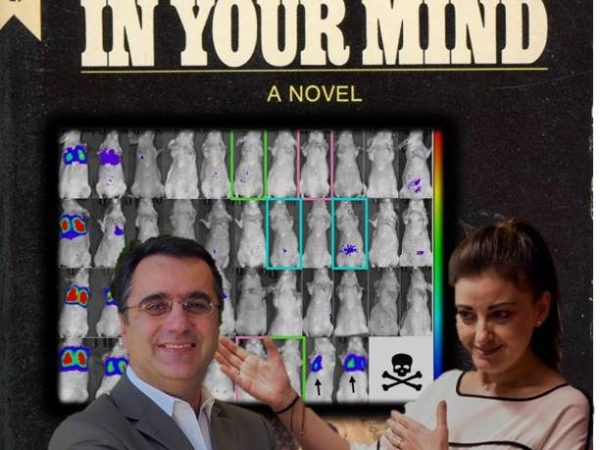
Johns Hopkins celebrates Kostas as “the inaugural William H. Schwarz Professor” whose “research is unique and at the forefront of innovation“. Presumably, Kostas is about to revolutionise cancer diagnostics, with advanced image manipulation tools you can admire on PubPeer.
This paper was flagged on PubPeer by Cheshire and is now no more:
Pu Wang , Fei Zhu , Konstantinos Konstantopoulos Interleukin-6 synthesis in human chondrocytes is regulated via the antagonistic actions of prostaglandin (PG)E2 and 15-deoxy-Δ(12,14)-PGJ2 PLoS ONE (2011) doi: 10.1371/journal.pone.0027630


On 30 July 2024, PLOS One issued a long and detailed retraction:
“After this article [1] was published, concerns were raised regarding Figures 1, 3, 4, 7 and 8.
Specifically, when the aspect ratio and color levels are adjusted:
- The following lanes appear similar to each other:
- The following lanes appear similar to each other:
- The following lanes appear similar to each other:
- The following lanes appear similar to each other:
- The p-ERK1/2 panel in Figure 4A appears similar to lanes 1–4 of the p-ERK1/2 panel in Figure 4B in [1].
- The p-CREB (ser133) panel in Figure 4A of [1] appears similar to the IL-6 panel in Figure 1A of [2].
- In Figure 7 of [1], the following appear similar:
- The middle band in lane 6 of Figure 7B and the middle band in lane 3 of Figure 7D.
- The upper bands in lane 1 of Figures 7B and 7D.
- The top edges of the bottom bands of lanes 2, 3, 5 and 6 of Figure 7B and top edges of the bottom bands of lanes 2, 3, 5 and 6 of Figure 7D, respectively.
- The upper band in lane 1 in Figure 7E and the upper band in lane 1 of Figure 7F.
- The upper band in lane 3 in Figure 7E and the middle band in lane 4 of Figure 7F, when flipped horizontally.
- In Figure 8D of [1] the IP and Input panels appear to have similar background patterns, when exposure levels are altered.
The corresponding author indicated they are unable to recover and provide the requested underlying data. In light of the unresolved concerns affecting multiple figures, which cannot be resolved in the absence of the data underlying the published figures, the PLOS ONE Editors retract this article.
The Figure 1A, 1B, and 3C Beta-actin panels, and the Figure 4A p-CREB (Ser133) panel were previously published in [2] and may not have been offered under a CC-BY 4.0 license. Please refer to [2] for the correct copyright for these panels.
KK agrees with the retraction decision and apologizes for the issues with the published article. PW and FZ either did not respond directly or could not be reached.”
The authors would like to apologise for any inconvenience caused
A twice-corrected papermill fabrication got finally retracted in Elsevier.
Hisham Alghamdi , Chika Maduabuchi , Abdullah Albaker , Ibrahim Alatawi , Theyab R. Alsenani , Ahmed S. Alsafran , Abdulaziz Almalaq , Mohammed AlAqil , Mostafa A.H. Abdelmohimen , Mohammad Alkhedher A prediction model for the performance of solar photovoltaic-thermoelectric systems utilizing various semiconductors via optimal surrogate machine learning methods Engineering Science and Technology, an International Journal (2023) doi: 10.1016/j.jestch.2023.101363
The paper received two corrections. Corrigendum Nr 1 (June 2023):
“The authors acknowledge the Deanship of Scientific Research at King Faisal University for funding this work under the Research Collaboration Funding program Grant Number 3128.”
Corrigendum Nr 2 (November 2023):
“The authors regret that they need to correct and update the affiliation of ‘Ibrahim Alatawi’ from the current affiliation to: ‘Department of Mechanical Engineering, College of Engineering, University of Ha’il, Ha’il 81451, Saudi Arabia’.
The authors would like to apologise for any inconvenience caused.”
This is the undated retraction notice (highlight mine):
“In investigating concerns regarding late-stage authorship changes to this article, the editors reached out to the authors for an explanation. In addition to the concerns regarding the late-stage authorship changes the editors were unable to verify the contribution of any of the added authors.
Abdullah Albaker, Ibrahim Alatawi, and were added to this paper after the first round of revision. Abdulaziz Almalaq was added after the second round of revision. Hisham Alghamdi, Theyab Alsenani, Ahmed Alsafran, Mohammed AlAqil, Mostafa A.H. Abdelmohimen, and Mohammad Alkhedher were added post acceptance. All these changes were made without explanation and without exceptional approval by the handling Editor, which is contrary to the journal policy on changes to authorship. The authors were unable to provide a reasonable explanation for either of the issues raised. The editor therefore feels that the findings of the manuscript cannot be relied upon and that the article needs to be retracted.”
No way the Editor-in-Chief Ilker Turker, professor at Karabuk University in Turkey, could have noticed anything when approving this paper and its two Corrigenda, right?
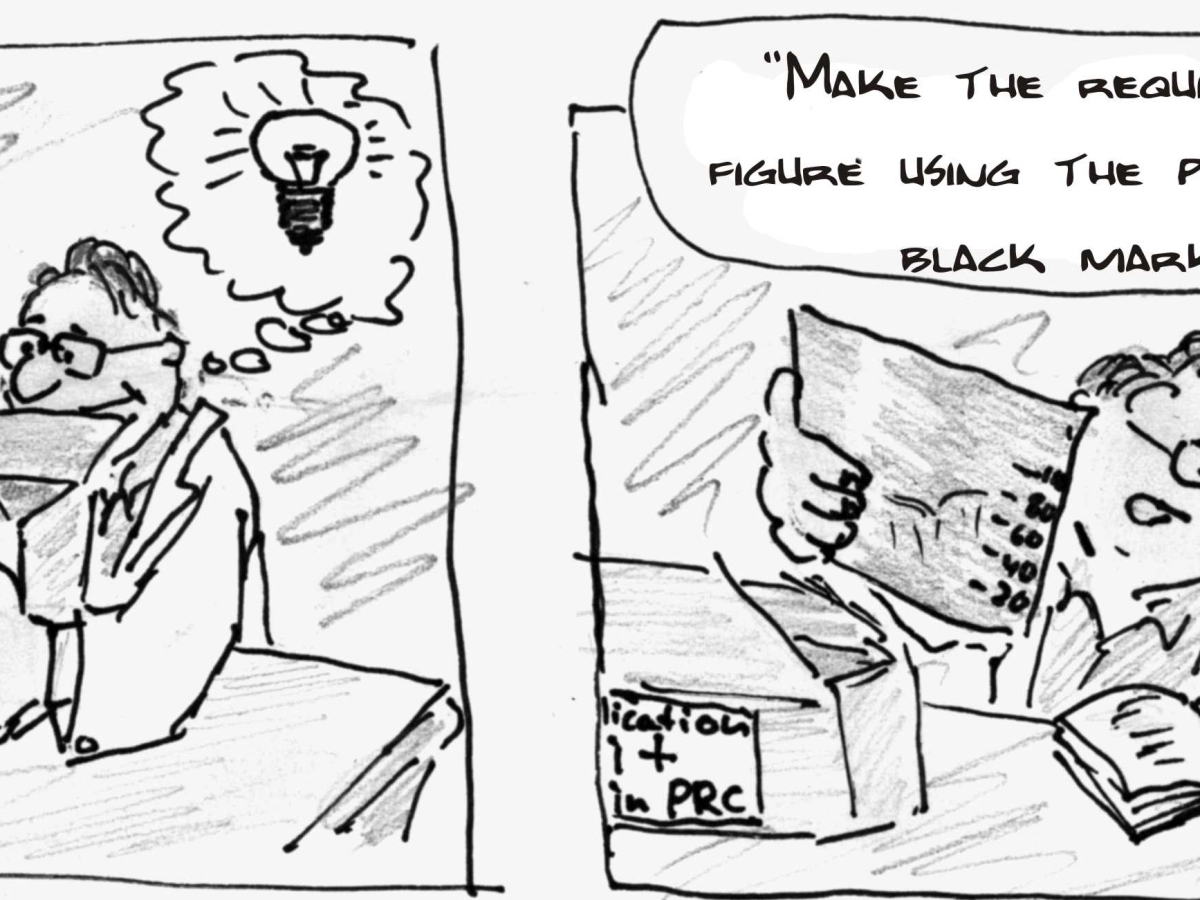
Elsevier’s research integrity
A Chinese paper gets rejected at Elsevier after reviewer spotted fraud. Same paper re-appears unchanged in another Elsevier journal, the editors refuse any action.
Unaware of this submission
Another interesting papermill retraction, at another Elsevier journal.
Mostafa Jalal , Zachary Grasley , Navid Nassir , Hamid Jalal Strength and dynamic elasticity modulus of rubberized concrete designed with ANFIS modeling and ultrasonic technique Construction and Building Materials (2020) doi: 10.1016/j.conbuildmat.2019.117920
Undated recent retraction notice:
“This article has been retracted at the request of the stated author Zachary Grasley.
Zachary Grasley did not consent to being added as a co-author on this paper, he was not informed of the submission to the journal as an erroneous email address was provided by the corresponding author. We have not received a response from the third or fourth authors. It is the responsibility of the corresponding author to submit the correct authorship list and details on submission and to gain consent from all authors. As this was not done, the corresponding author is in breach of the journal’s ethical policy.”
Zachary Grasley is described by his US instittuion as “a renowned civil engineer” and ” department head, professor and Presidential Impact Fellow in the Zachry Department of Civil and Environmental Engineering at Texas A&M University.”
There was a similar situation in a retraction from 2022:
Mostafa Jalal , Zachary Grasley , Charles Gurganus , Jeffrey W. Bullard A new nonlinear formulation-based prediction approach using artificial neural network (ANN) model for rubberized cement composite Engineering with Computers (2022) doi: 10.1007/s00366-020-01054-3
“The Editor in Chief has retracted this article due to concerns regarding originality and authorship irregularities. Table 3 appears to correspond to Table 5 in article [1] by the same author (now retracted), and there is a textual overlap with article [2] by the same author (now retracted). The corresponding author has not provided a sufficient explanation for the re-use of data. Additionally, co-authors Zachary Grasley and Jeffrey W. Bullard contacted the journal to state they were unaware of this submission and they did not agree to being named as co-authors. Zachary Grasley, Jeffrey W. Bullard and Charles Gurganus agree to this retraction. Mostafa Jalal did not respond to correspondence from the editor about the wording of this retraction.”
Retraction November 2022
There are a total of 14 retractions for Mostafa Jalal, who was a former postdoc of Jeffrey Bullard, professor at Grasley’s department at Texas A&M University. Grasley is on 4 such retractions, Bullard on 3. Retraction Watch reported in 2021 and 2020 about this fraud case and published the whistleblower report about “287 potentially compromised papers” by Jalal’s associate Ali Nazari (see PubPeer record).
Science Breakthroughs
Good news for nearly half the world’s men
A British elite scientist joined a Pakistani fabrication, or maybe even an outright papermill product, hilarity ensued.
New Atlas brought the big news on 22 July 2024:
“In some good news for nearly half the world’s men, scientists have found that a naturally occurring sugar in humans and animals could be harnessed as a topical treatment for male pattern baldness. […]
An international team of scientists from the University of Sheffield and COMSATS University Pakistan has found that the organic compound 2-deoxy-D-ribose (2dDR) can stimulate new hair growth, following eight years of research into how this deoxy sugar could assist wound healing. […]
“Male pattern baldness is such a common condition, affecting men all over the world, but at the moment there are only two FDA licensed drugs to treat it,” said Sheila MacNeil, a professor at the University of Sheffield. “Our research suggests that the answer to treating hair loss might be as simple as using a naturally occurring deoxy ribose sugar to boost the blood supply to the hair follicles to encourage hair growth.”[…]
“This pro-angiogenic deoxy ribose sugar is naturally occurring, inexpensive and stable and we have shown it can be delivered from a variety of carrier gels or dressings,” said Muhammed Yar, an associate professor at COMSATS. “This makes it an attractive candidate to explore further for treatment of hair loss in men.””
According to Wikipedia, Sheila MacNeil is an award winning biotechnology professor and entrepreneur, who, among other things, “developed MySkin, skin bandages that are used to treat burns in 11 of 13 major UK burns units.” Lets hope her other inventions have a stronger scientific basis than her new hair-loss masterpiece from Pakistan:
Muhammad Awais Anjum , Saima Zulfiqar , Aqif Anwar Chaudhary , Ihtesham Ur Rehman , Anthony J. Bullock , Muhammad Yar , Sheila MacNeil Stimulation of hair regrowth in an animal model of androgenic alopecia using 2-deoxy-D-ribose Frontiers in Pharmacology (2024) doi: 10.3389/fphar.2024.1370833

In Acknowledgements, the authors thank “for helpful discussions” a certain Mubashra Zehra, who has a worrisome PubPeer record. Specifically, these two papers with Muhammad Yar, the lead author of the hair-loss breakthrough:
Mubashra Zehra , Azra Mehmood , Muhammad Yar , Lubna Shahzadi , Sheikh Riazuddin Development of NSAID-loaded nano-composite scaffolds for skin tissue engineering applications Journal of Biomedical Materials Research Part B Applied Biomaterials (2020) doi: 10.1002/jbm.b.34634

Tayyba Sher Waris , Syed Tahir Abbas Shah , Azra Mehmood , Zohaib Iqbal , Mubashra Zehra , Aqif Anwar Chaudhry , Ihtesham Ur Rehman, Muhammad Yar Design and development of thyroxine/heparin releasing affordable cotton dressings to treat chronic wounds Journal of Tissue Engineering and Regenerative Medicine (2022) doi: 10.1002/term.3295

Actually Yar doesn’t need Zehra to publish fake science (see Yar’s PubPeer record):
Ahmad Khan , Anisa Andleeb , Maryam Azam , Saimoon Tehseen , Azra Mehmood , Muhammad Yar Aloe vera and ofloxacin incorporated chitosan hydrogels show antibacterial activity, stimulate angiogenesis and accelerate wound healing in full thickness rat model Journal of Biomedical Materials Research Part B Applied Biomaterials (2023) doi: 10.1002/jbm.b.35153

Well done Professor MacNeil! Almost as great as hers and her Sheffield colleague’s Anthony Bullock‘s previous collaboration with certain fellow English bioengineers and trachea transplanters, Martin Birchall and Mark Lowdell:
Tahera Ansari , Peggy Lange , Aaron Southgate , Karin Greco , Carla Carvalho , Leanne Partington , Anthony Bullock , Sheila MacNeil , Mark W. Lowdell , Paul D. Sibbons , Martin A. Birchall Stem Cell-Based Tissue-Engineered Laryngeal Replacement Stem cells translational medicine (2017) doi: 10.5966/sctm.2016-0130


You can read about this very study here:
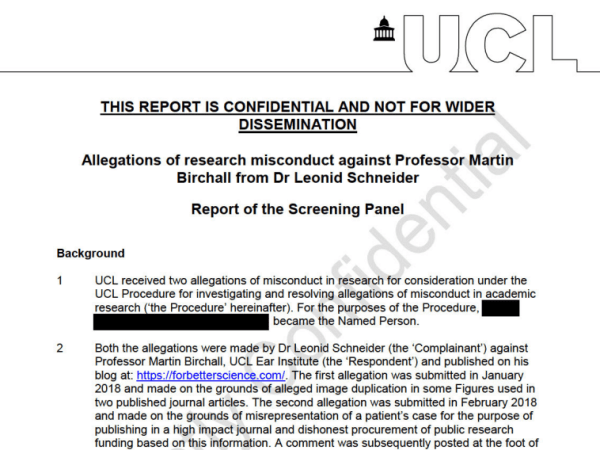
Martin Birchall innocent, UCL decides once again
In yet another investigation, UCL whitewashed Martin Birchall of all responsibilities. I publish here the confidential report and excerpts from a secret PhD thesis, which the UCL committee carefully avoided to read.
Donate!
If you are interested to support my work, you can leave here a small tip of $5. Or several of small tips, just increase the amount as you like (2x=€10; 5x=€25). Your generous patronage of my journalism will be most appreciated!
€5.00

 For Better Science
Science Breakthrough
Connection Between Depression, Sexual Frequency, and All-cause Mortality: Findings from a Nationally Representative Study
https://journals.sagepub.com/doi/10.1177/26318318241256455
‘When considering sexual frequency, overall, only female participants with lower sexual frequency were at a higher risk of all-cause death in a dose-response manner with a hazard ratio (HR) of 1.70 (95% CI 1.38–2.10, p trend < .001)’
‘A unique finding of this study is the long-term effect of low sexual frequency on premature mortality after long follow-up in a large-scale nationally representative population. Without adjusting for multiple causal factors for premature mortality (e.g., demographic and mental health comorbidities), low sexual frequency was associated with 70% higher probability of mortality compared to those who had higher sexual frequency. After adjusting for multiple demographic factors, physician and mental health risk factors, the probability of mortality in low sexual frequency remained 46% higher compared to those who had high sexual frequency. The findings are similar to a smaller-scale study conducted in Israel, where it was found that despite confounders, sexual activity after a myocardial infarction was inversely related to mortality.21 This finding warrants additional research…’
Disclaimer:
The studies and research articles posted are shared for a variety of reasons including, but not limited to, their unconventional findings, importance, humorous content, or potential for being fraudulent.
LikeLike
Science Breakthrough
Thomas Pohl & Chinese friends up for Nobel Prize?
Room temperature time crystals could solve one of the biggest problems in quantum computing: figuring out how to create stable qubits that don’t require massive amounts of power and infrastructure to form and maintain.
Dissipative time crystal in a strongly interacting Rydberg gas
https://www.nature.com/articles/s41567-024-02542-9
‘The notion of spontaneous symmetry breaking has been well established to characterize classical and quantum phase transitions of matter, such as condensation, crystallization or quantum magnetism. Generalizations of this paradigm to the time dimension can lead to a time crystal phase, which spontaneously breaks the time-translation symmetry of the system. Although the existence of a continuous time crystal at equilibrium has been challenged by no-go theorems, this difficulty can be circumvented by dissipation in an open system. Here we report the experimental observation of such a dissipative time-crystalline order in a room-temperature atomic gas, where ground-state atoms are continuously driven to Rydberg states. The emergent time crystal is revealed by persistent oscillations of the photon transmission, and we show that the observed limit cycles arise from the coexistence and competition between distinct Rydberg components. The non-decaying autocorrelation of the oscillation, together with the robustness against temporal noises, indicates the establishment of true long-range temporal order and demonstrates the realization of a continuous time crystal.’
LikeLike
I am cheered to see Thailand and Vietnam doing better than the West in terms of academic ethics and research integrity. After all, both of these countries are still developing countries and it is likely that both researchers and regulatory bodies may be less aware of academic ethics in these countries. However, they have done an exemplary job and acted in a more correct way than Western countries that always emphasize academic ethics but do almost nothing when it comes to action. When I saw Thailand, I immediately wondered if I would see Somchai Wongwises on the list, but I think the current list is more for people who buy articles for money. Both Chupradit and Suksatan are relatively low level papermill researchers. People like Wongwises, on the other hand, don’t need to buy papers, because his current group of colleagues have already achieved good positions in universities and academic journals around the world.
This is actually an answer to your question “Shouldn’t this be followed by mass retreats? Hello, Elsevier? Is anybody there?”:
“Don’t worry, we are here, there were so many complaints about us so we decided to hold our group meetings at Elsevier editorial boards.”
Normally, what should happen is that after the publisher notices problematic points in academic journals, the publisher contacts the one’s university and informs the committees at the university, but Elsevier has been trying to solve the problem from the core by including papermill researchers on editorial boards for a long time. I guess it’s like making a fraudster the chief financial officer.
LikeLike
https://www.ilfattoquotidiano.it/2024/07/31/si-e-dimesso-perche-indagato-ora-bernini-lo-vuole-lex-rettore-cuzzocrea-sara-consulente-del-ministero-delluniversita-e-della-ricerca/7643153/
LikeLike
That is… just insane.
LikeLike
“Authors willingly supported independent investigations
Retraction for Scottish researchers of University of Dundee.”
Second 2024 retraction for Dario R Alessi.
24 October 2024.
RETRACTION: Role of the PDK1–PKB–GSK3 Pathway in Regulating Glycogen Synthase and Glucose Uptake in the Heart – FEBS Letters – Wiley Online Library
RETRACTION: A. Mora, K. Sakamoto, E. J. McManus, and D. R. Alessi, “Role of the PDK1–PKB–GSK3 Pathway in Regulating Glycogen Synthase and Glucose Uptake in the Heart,” FEBS Letters 579, no. 17 (2005): 3632–3638, https://doi.org/10.1016/j.febslet.2005.05.040
1 comment on PubPeer (by: Hoya Camphorifolia).
The above article, published online on 06 June 2005 in Wiley Online Library (wileyonlinelibrary.com), has been retracted by agreement between the authors; the journal Editor-in-Chief, Michael Brunner; FEBS Press; and John Wiley and Sons Ltd. The journal was contacted by a representative of the research integrity group at the authors’ institute, since an institutional investigation revealed inappropriate splicing and duplication of image sections within Fig. 2A, B and Fig. 3A. Consequently, the conclusions of the paper are substantially compromised, and the institute has recommended the paper to be retracted. The editors of the journal agree with the retraction based on the institutional investigation.
D.R. Alessi is Dario Alessi – Wikipedia
Dario Alessi | MRC PPU
LikeLike
Pubpeer list for Daro Alessi.
https://pubpeer.com/search?q=Dario+Alessi
LikeLike
Dundee, where Dario Alessi is, linking up with the Dana-Farberications?
Dana-Farberications at Harvard University – For Better Science
Evidence for the linking up.
PubPeer – Search publications and join the conversation.
Nathanael Gray was at the Dana Faber Cancer Institute, now at Stanford.
Principal Investigator
“In 2006, Dr. Gray joined faculty of the Dana Farber Cancer Institute and Harvard Medical School in Boston. “
LikeLike
Nat Gray is a close associate of Dave Sabatini.
LikeLike