

Sometime in around mid-2022 Sholto David decided to bother the mighty Queen’s University Belfast in Northern Ireland (UK) about two papermilled studies by their professor in pharmaceutics, Raghu Raj Singh Thakur. It ended with Sholto getting gaslighted and being told to get lost. Eventually, the university agreed to publish corrections, as part of their “active engagement to uphold the integrity of the research record“. Never mind that Thakur’s papermilling coauthors are collecting one retraction after another.
Maybe it’s because Thakur is not only a full professor (since 2021) at Queen’s University Belfast, but also Founder & Chief Technical Officer of its spin-off biotech Re-Vana which markets biologics drugs for blindness prevention. In late 2022, Thakur’s company raised $11.9 million in funding. So you see why he can never be associated with papermills and fake science.
Thakur is the only British author on these 2 papers, the others, including the corresponding author, are all based in Pakistan.
Samiullah Khan , Muhammad Usman Minhas, Naveed Akhtar , Raghu Raj Singh Thakur Sodium alginate/N-(Vinylcaprolactam) based supramolecular self-assembled subcutaneously administered in situ formed gels depot of 5-fluorouracil: Rheological analysis, in vitro cytotoxic potential, in vivo bioavailability and safety evaluation International Journal of Biological Macromolecules (2022) doi: 10.1016/j.ijbiomac.2022.05.035


“Figure 6 the time refers to something to do with how the gel is prepared. It seems odd that these photos just show the same plate at different angles and magnifications.“

The data was previously used in another paper by Thakur, which is about curcumin as a magic multi-purpose drug, and had its own issues:
Samiullah Khan , Naveed Akhtar , Muhammad Usman Minhas, Hassan Shah , Kifayat Ullah Khan , Raghu Raj Singh Thakur A difunctional Pluronic®127-based in situ formed injectable thermogels as prolonged and controlled curcumin depot, fabrication, in vitro characterization and in vivo safety evaluation Journal of Biomaterials Science Polymer Edition (2021) doi: 10.1080/09205063.2020.1829324

A rather clear case. The papers are very new, they contain fabricated data, and no way the authors can provide original data. Simply because these studies were most obviously generated by a papermill, considering that other papers by Thakur’s corresponding author Samiullah Khan were most definitely bought from papermills (fake data, tortured phrases, nonsense references, authors from all over the world), as certified by his PubPeer record and his two retractions. Number 1:
Sushovan Chaudhury , Alla Naveen Krishna , Suneet Gupta , K. Sakthidasan Sankaran , Samiullah Khan , Kartik Sau , Abhishek Raghuvanshi , F. Sammy Effective Image Processing and Segmentation-Based Machine Learning Techniques for Diagnosis of Breast Cancer Computational and mathematical methods in medicine (2022) doi: 10.1155/2022/6841334
“This article has been retracted by Hindawi following an investigation undertaken by the publisher [1]. This investigation has uncovered evidence of one or more of the following indicators of systematic manipulation of the publication process: (1) Discrepancies in scope (2) Discrepancies in the description of the research reported (3) Discrepancies between the availability of data and the research described (4) Inappropriate citations (5) Incoherent, meaningless and/or irrelevant content included in the article (6) Peer-review manipulation”
Retraction July 2023
Also this masterpiece by Khan and Thakur’s other Pakistani collaborator, Muhammad Usman Minhas, was retracted (also remember the name Shahzeb Khan, you will soon meet him again):
Samiullah Khan , Muhammad Usman Minhas , Muhammad Tahir Aqeel , Ihsan Shah , Shahzeb Khan, Mohsin Kazi , Zachary N. Warnken Poly (N-Vinylcaprolactam-Grafted-Sodium Alginate) Based Injectable pH/Thermo Responsive In Situ Forming Depot Hydrogels for Prolonged Controlled Anticancer Drug Delivery; In Vitro, In Vivo Characterization and Toxicity Evaluation Pharmaceutics (2022) doi: 10.3390/pharmaceutics14051050

Imagine how fraudulent a paper must be to get retracted by MDPI, and indeed the figures were stolen from an older Hindawi paper from China: Tan et al 2013. The retraction happened on 22 January 2024:
“Following publication, concerns were brought to the attention of the publisher regarding overlapping figures with a previously published article [2], with no common authorship and representing different experimental conditions.
[…] While the authors fully cooperated with the Editorial Office during the investigation, they were unable to satisfactorily explain the overlapping of figures, nor were they able to meet the required quality standards of raw images in order to consider a correction as per the journals original image requirements policy […]. As a result, the Editorial Board and Editor-in-Chief were unable to confirm the reliability of the findings and subsequently decided to retract the paper […] The authors disagree with this retraction.”
Another one by Samiullah Khan and Minhas, not retracted because this is Elsevier’s papermill-only journal:
Syed Faisal Badshah , Naveed Akhtar , Muhammad Usman Minhas, Kifayat Ullah Khan , Samiullah Khan , Orva Abdullah , Abid Naeem Porous and highly responsive cross-linked β-cyclodextrin based nanomatrices for improvement in drug dissolution and absorption Life Sciences (2021) doi: 10.1016/j.lfs.2020.118931

Sholto previously made a whole video about Minhas (his PubPeer record here, over 30 fake papers), watch:
Minhas, who is professor at the University of Sargodha in Pakistan, reacted to the YouTube video like a proper scholar. By threatening Sholto:

The threats obviously didn’t work. Minhas so far suffered six retractions (be aware that Retraction Watch database lists only 2). You saw one of them already, here is more:
- Muhammad Usman Minhas , Kifayat Ullah Khan , Muhammad Sarfraz , Syed Faisal Badshah , Abubakar Munir , Kashif Barkat , Abdul Basit , Mosab Arafat Polyvinylpyrrolidone K-30-Based Crosslinked Fast Swelling Nanogels: An Impeccable Approach for Drug’s Solubility Improvement BioMed research international (2022) doi: 10.1155/2022/5883239
“This article has been retracted by Hindawi, as publisher, following an investigation undertaken by the publisher [1]. This investigation has uncovered evidence of systematic manipulation of the publication and peer-review process. We cannot, therefore, vouch for the reliability or integrity of this article.”
Retraction 9 January 2024
Same retraction notice, published on the same day here:
3. Aousaf Ahmad , Mahmood Ahmad, Muhammad Usman Minhas, Muhammad Sarfraz , Muhammad Sohail , Kifayat Ullah Khan , Sana Tanveer , Shakeel Ijaz Synthesis and Evaluation of Finasteride-Loaded HPMC-Based Nanogels for Transdermal Delivery: A Versatile Nanoscopic Platform BioMed Research International (2022) doi: 10.1155/2022/2426960


In February 2024, Minhas lost another paper:
- Kifayat Ullah Khan , Naveed Akhtar , Muhammad Usman Minhas Poloxamer-407-Co-Poly (2-Acrylamido-2-Methylpropane Sulfonic Acid) Cross-linked Nanogels for Solubility Enhancement of Olanzapine: Synthesis, Characterization, and Toxicity Evaluation AAPS PharmSciTech (2020) doi: 10.1208/s12249-020-01694-0
“The Editor-in-Chief has retracted this article. After publication, concerns were raised regarding image similarities between Fig. 12 in this article and Fig. 11 in the authors’ earlier article [1]. Further checks by the publisher have found that Fig. 12 Intestine Group I and II images appear to contain a highly similar area, suggesting that they may have originated from serial sections of the same sample.
Retraction 21 February 2024.
The authors have provided alternative images for a correction; however, these images appear to contain further overlap between samples indicated to represent different animal groups. The Editor-in-Chief therefore no longer has confidence in the presented data.”
Here the fifth retraction for Minhas, with another papermiller named Khan: Shahzeb Khan of University of Bradford in England, with around 20 fraudulent papers on PubPeer. You already met that Khan on a retraction by Samiullah Khan and Minhas above. Shahzeb Khan was briefly mentioned in February 2024 Shorts and April 2024 Shorts, where he screamed: “this is very unprofessional to change the resolution and brightness of the images by different softwarers.” In that case, Shahzeb Khan’s ridiculously fraudulent paper Ndlovu et al 2019 was corrected by a journal where Raghu Raj Singh Thakur happens to be Associate Editor. Coincidence?
5. Syed Ahmed Shah , Muhammad Sohail , Muhammad Usman Minhas  , Nisar-ur-Rehman , Shahzeb Khan , Zahid Hussain , Mudassir , Arshad Mahmood , Mubeen Kousar , Asif Mahmood pH-responsive CAP-co-poly(methacrylic acid)-based hydrogel as an efficient platform for controlled gastrointestinal delivery: fabrication, characterization, in vitro and in vivo toxicity evaluation Drug delivery and translational research (2019) doi: 10.1007/s13346-018-0486-8

“The Editor-in-Chief has retracted this article after concerns were raised about the data reported. Specifically, in Fig. 14, the panel for kidney T1 appears to overlap with the panel for kidney T3, and the panel for colon C1 appears to overlap with the panel for colon T3. The Editor-in-Chief no longer has confidence in the findings or conclusions of this article.”
Retraction 11 April 2024
In December 2023, Harris Beider, Pro Vice-Chancellor for Research, Innovation & Engagement of the University of Bradford, informed Sholto that “a thorough investigation is being undertaken in line with our University policies and procedures; this investigation was being led by Dr Claire Trinder, our Head of Research Operations, as an independent and impartial party.” Sholto was also infomed that “as an external party it is not appropriate for us to have an ongoing dialogue with you about the outcome of a confidential employee process.” Yet Trinder told him, also in December 2023: “Our investigation is reaching its conclusion and is continuing to follow our internal policies and procedures.” Indeed, something happened to Shahzeb Khan’s institutional profile: the December 2024 version had his email, phone and department affiliation listed, all that information was gone from the current version. Also Khan’s LinkedIn profile was recently deleted.
Now the most recent, sixth Minhas retraction, where images were reused across 5 papers:
6. Kashif Barkat, Mahmood Ahmad, Muhammad Usman Minhas, Ikrima Khalid, Asif Mahmood Understanding mechanical characteristics of pH-responsive PEG 4000-based polymeric network for colorectal carcinoma: its acute oral toxicity study Polymer Bulletin (2021) doi: 10.1007/s00289-020-03356-4
“Figure 11: Overlaps between different experimental groups.”

“The Editors-in-Chief have retracted this article. After publication, concerns were raised regarding highly similar areas between the group I and II images in Fig. 11 representing stomach, lung and intestine tissues. In addition, the heart group II and intestine both group images appear highly similar to Fig. 10 heart I and intestine II images, respectively, in [1].
Retraction 20 June 2024
The Editors-in-Chief therefore no longer have confidence in the presented data.”
This is what happens when a rotten publisher tries to correct a Minhas paper:
Nadia Shamshad Malik , Mahmood Ahmad, Muhamad Usman Minhas, Ruqia Tulain , Kashif Barkat , Ikrima Khalid , Qandeel Khalid Chitosan/Xanthan Gum Based Hydrogels as Potential Carrier for an Antiviral Drug: Fabrication, Characterization, and Safety Evaluation Frontiers in chemistry (2020) doi: 10.3389/fchem.2020.00050
“Figure 10: There are repeated elements within the images.”

Frontiers issued this Correction in January 2023, and it was fraudulent also:
“In the original article, there was an error in Figure 10, page 13, as published. The corrected figure and its caption appear below.”

But let’s leave Professor Minhas and return to Thakur’s other friend, Samiullah Khan, associate Professor at University of Lahore, Pakistan. Here is another great paper of Khan’s, containing tortured phrases like “sodium hypocrite solution“, “electronic processing“” (for electron microscopy) “loud bands” and “phenol and alcohol bonds“:
Hafsa Zulfiqar , Muhammad Shoaib Amjad, Ansar Mehmood , Ghazala Mustafa , Zakia Binish , Samiullah Khan , Huma Arshad , Jarosław Proćków, José Manuel Pérez De La Lastra Antibacterial, Antioxidant, and Phytotoxic Potential of Phytosynthesized Silver Nanoparticles Using Fruit Extract Molecules (2022) doi: 10.3390/molecules27185847


Khan’s “co-authors” are known papermillers Jarosław Proćków from Poland and José Manuel Pérez De La Lastra from Spain, members of the Abhijit Dey gang, read here:
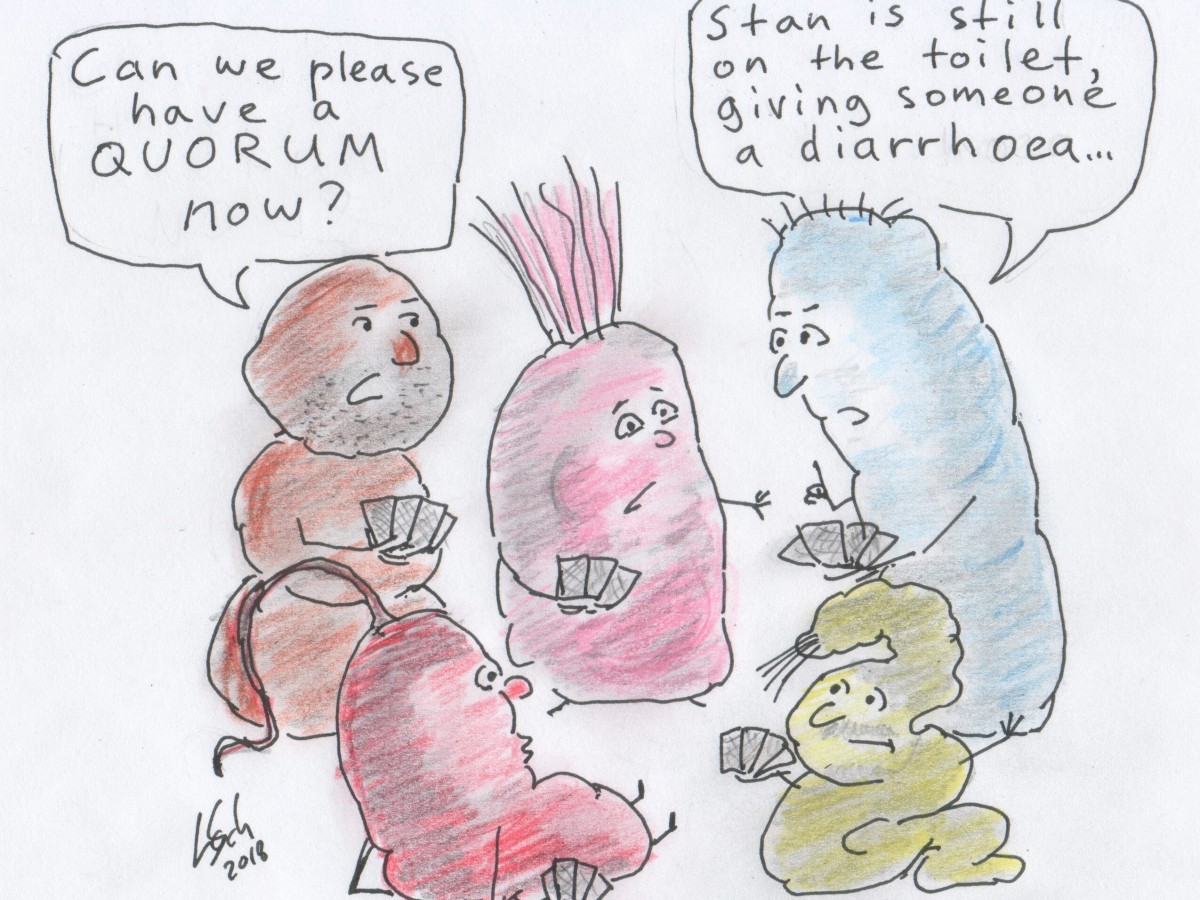
I have almost 100 manpower with me at any time
“WE DONT PAY FOR PAPERS. YOU MUST KNOW THAT THESE BEST IN THE PLANET JOURNALS GO THROUGH RIGOROUS PEER REVIEW” – Abhijit Dey, papermiller

Perez De La Lastra even openly admitted on PubPeer to have bought that study:
“I do not see any concern about that, provided that you always have to pay for such service. […] Nowadays, research is more and more outsourced, and research support services from different institutions can be used that do not even have to be located within the campus of the particular center. They all have prices for internal and external customers.”
The Spaniard who pays for his authorships then accused his PubPeer critics of hiding their conflicts of interest of “being paid to find flaws in the papers of certain authors” and misusing PubPeer to illegally “Promote a business or other commercial venture or event“. In his long tirades, Perez De La Lastra also announced to “ask this declaration to all PupPeer users before going into their comments“.
Queen’s University Belfast professor Thakur most obviously teamed up with the worst of papermill fraudsters to author two fraudulent papermill studies himself. His university could have solved this quickly and easily. Except there was too much Re-Vana money at stake. So this proud British university decided to cover everything up. And to attack the critic.
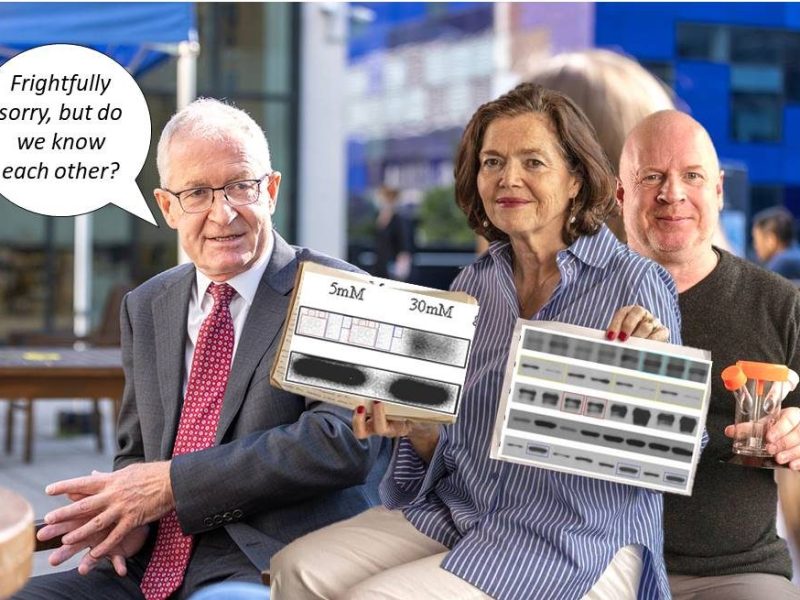
Imperial Irishman Hugh Brady (and his Dublin leprechauns)
When your Irish past catches up with your English future.
Back in 2022, Sholto was informed in an out-of-office message that Louise Dunlop, Head of Research Governance, Ethics and Integrity, was unavailable due to a death of a close family member. But her Ethics and Integrity Team employs 10 more un-bereaved people, so Sholto waited, and in October 2023 and in November 2023 he wrote again, to numerous responsible addressees in Belfast, to inquire about the progress. There, he suddenly received this bizarre email from Dunlop:
“Dear Sholto David,
Thank you for your email, which need only be sent to Professor Thakur and I. You are not being ignored, rather I have been on extended bereavement leave following the death of a significant family member. I’m sure you received my out of office.
Unfortunately, your scatter gun approach has undermind a process that is undertaken confidentially under the Regulations Governing an Allegation of Misconduct in Research. Whilst I have confidence my Team will treat as confidential, I have no control over other parts of the University. It is sad that you are determined to undermine people’s reputations in the way you do.
This matter has been investigated and efforts are ongoing with the journals to make the necessary erratum.
Regards,
Louise“
Sholto is Welsh, presumably they have zero tolerance for celtic antics in Belfast.
So yes, Queen’s University Belfast swiftly decided that their professor Thakur was an innocent genius, and Sholto an evil thug who terrorises scientists. Yes, they went for gaslighting Sholto for sabotaging by his indiscretion an investigation which they never planned to perform anyway. Yes, they ratted out Sholto’s identity to Thakur the first thing. Yes, the papermill forgery was be fixed with a correction to explain that no conclusions were ever affected, just as I predicted back in December 2023 Shorts.

On 13 April 2024, Sholto wrote to the university again. And two weeks later, received a reply from Wendy McLoone, Interim Director of Research at Queen’s University Belfast:
“I can confirm that the author is in correspondence with the Journal editors and would hope to reach an outcome on this matter shortly.”
And of 27 June 2024, Sholto received this letter, marked “STRICTLY PRIVATE AND CONFIDENTIAL”
They didn’t even bother to figure out which was first and last name with Sholto David:
Dear Dr Sholto
You emailed the University in August 2022 raising concerns with two manuscripts which were co-authored by a member of Queen’s staff, Professor Raj Singh Thakur. The manuscripts in question were[…Khan et al 2022 and Khan et al 2021…]
During the intervening period the University investigated your concerns and subsequently requested Professor Thakur work with his co-authors to ensure the research record was corrected.
I know from correspondence that the authors raised this matter with the relevant journals following the outcome of our investigation. They have actively pursued a correction to the research record with the respective Editor’s in Chief (EiC) since then.
Earlier this month the EiC for the Journal of Biomaterials Science Polymer Edition approved the corrigendum requested by the authors and a corrected figure 8 will be published. The figures contained in the original article are not to be removed but the corrected figure added. The authors still await a response from the International Journal of Biological Macromolecules.
Corrections to published work, and the timelines required, remain outside of the University’s control, but we are still keen to ensure there is active engagement to uphold the integrity of the research record.
Yours sincerely,
Dr Wendy McLoone
Thakur or the Belfast university never replied to my emails. The Corrigendum for the utterly fraudulent Khan et al 2022 paper was published on 12 June 2024:
“We express our sincere regret for the error identified in Fig. 8C within the above published article. We kindly request the Editor to substitute this incorrect figure with the accurate original Fig. 8C. The authors would like to apologise for any inconvenience caused and state that this does not change the scientific conclusions of the article in any way.”
If you wonder what stupid plonker of an editor accepted that: Elsevier’s International Journal of Biological Macromolecules is run by a John F Kennedy. No, not the dead US president, but a very much alive British crook: an 82 year old carbohydrate and protein chemistry researcher, formerly professor somewhere in UK, now owner of a small and possibly defunct biotech company called Chembiotech. He still calls himself professor, specifically “Prof. John F. Kennedy BA, BSc, PhD, DSc, EurChem CChem FRSC, EurProBiol CBiol FSB, CEng FIMC, CEnv FCIWEM, CSci FIFST, CText FTI, FCMI“.
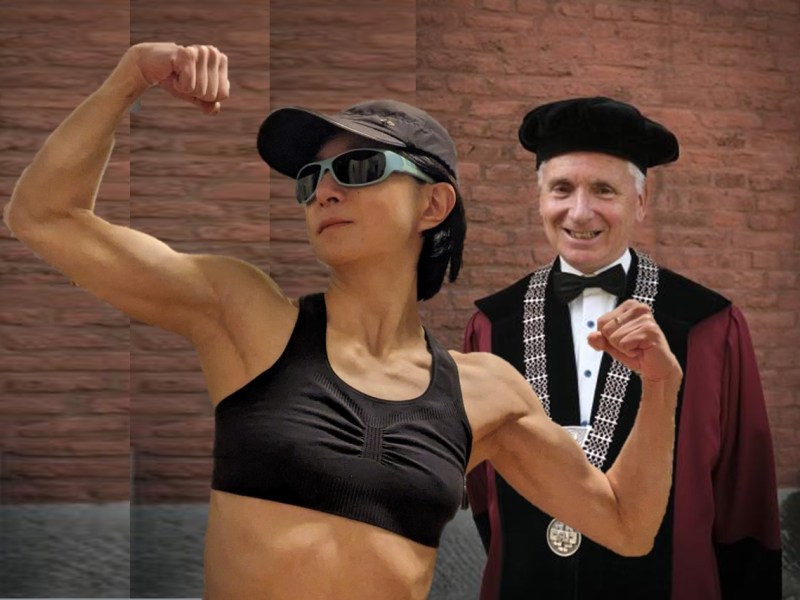
Sir Harry’s Full Withdraw
“First you are starting that this issue is fraud, which is a negative attitude. I always would like to give the other part the benefit of the doubt.” – Sir Prof. dr. Harry W.M. Steinbusch
As a suitable ending, I will now explain why this man with Irish blood and English heart is so full of understanding for papermill fraud in his journal.
A few years ago, Kennedy discovered Asian papermills, specifically Iranian ones, as his PubPeer record testifies. Courtesy of Alexander Magazinov, who found out that Kennedy’s Iranian papers are coauthored by and simultaneously excessively cite some Roohallah Saberi Riseh and some Mohadeseh Hassanisaadi. Utterly coincidentally, Kennedy’s papers were published in two Elsevier journals, Carbohydrate Polymers and, well, International Journal of Biological Macromolecules where Kennedy acts as Editor-in-Chief. Here one example:
Mohadeseh Hassanisaadi , John F. Kennedy , Ali Rabiei , Roohallah Saberi Riseh, Abdolhossein Taheri Nature’s coatings: Sodium alginate as a novel coating in safeguarding plants from frost damages International Journal of Biological Macromolecules (2024) doi: 10.1016/j.ijbiomac.2024.131203
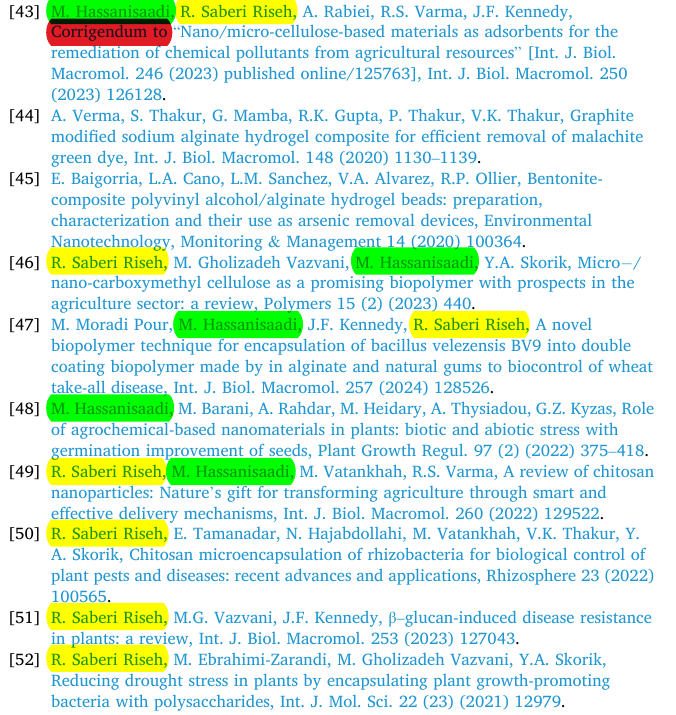
In fact, Kennedy was seen papermilling with some much bigger fishes before, caught by Elisabeth Bik. Published in another papermill-infested Elsevier journal and “written by authors from 17 different affiliations in Italy, United Arab Emirates, Algeria, Qatar, United Kingdom, Turkey, Saudi Arabia, Romania, Malaysia, Nigeria, Ecuador, and Hong Kong“. In Posadino et al 2023, Kennedy joined the pros of papermilling and citation-stacking – Daniela Calina, Javad Sharifi-Rad, William C. Cho – further international members of the famous Abhijit Dey papermill gang, which also Thakur’s friend Samiullah Khan collaborates with.
One could think, maybe Kennedy is senile, or even dead, and his identity was stolen? After all, he initially didn’t reply to my email, but after I wrote to him, he commented on PubPeer, on a paper flagged by Magazinov for containing “many self-citations to a certain R Saberi Riseh“:
“I agree that unnecessary self citation is inappropriate and I have therefore taken this up with dr Riseh for explanation of relevance to the paper.”
And a few days later, Kennedy also wrote back to me to protest with “I have no idea who you are” and denying all Iranian papermill evidence. And now that old fart corrected Thakur’s papermill garbage.
I hope you enjoyed seeing Great British Research Integrity in action.
Much of the above material was previously published in Friday Shorts
Donate!
If you are interested to support my work, you can leave here a small tip of $5. Or several of small tips, just increase the amount as you like (2x=€10; 5x=€25). Your generous patronage of my journalism will be most appreciated!
€5.00

 For Better Science
I am only half Welsh, I’m not sure if it’s a dominant trait. And to be fair to Louise, I always copied in their professor, so she didn’t really rat me out. Perhaps this case can be reviewed by the UK committee on research integrity committee, which Louise is a member of.
LikeLiked by 1 person
Your efforts deserve great respect. You’ve done a great job. The fact that they still remain inactive despite all this shows how uncaring they are when it doesn’t work for them.
LikeLike
“The Editor-in-Chief therefore no longer has confidence in the presented data.”
It would be nice if sometimes an Editor-in-Chief would no longer have confidence in (any or all of) the presenting authors.
LikeLike
“Imagine how fraudulent a paper must be to get retracted by MDPI” – the mind boggles. It’s like Trump admitting he told a fib.
LikeLike
I am starting to think that tMDPI actually retracts faster than Elsevier.
LikeLike
You are quite right, Elsevier is indeed the worst of all.
LikeLiked by 1 person
“… Kennedy’s Iranian papers are coauthored by and simultaneously excessively cite some Roohallah Saberi Riseh and some Mohadeseh Hassanisaadi.”
No one really knows why, and what’s going on in between these two characters, but under the table!
LikeLike
Pingback: Science Integrity Digest, July 2024 – Science Integrity Digest