

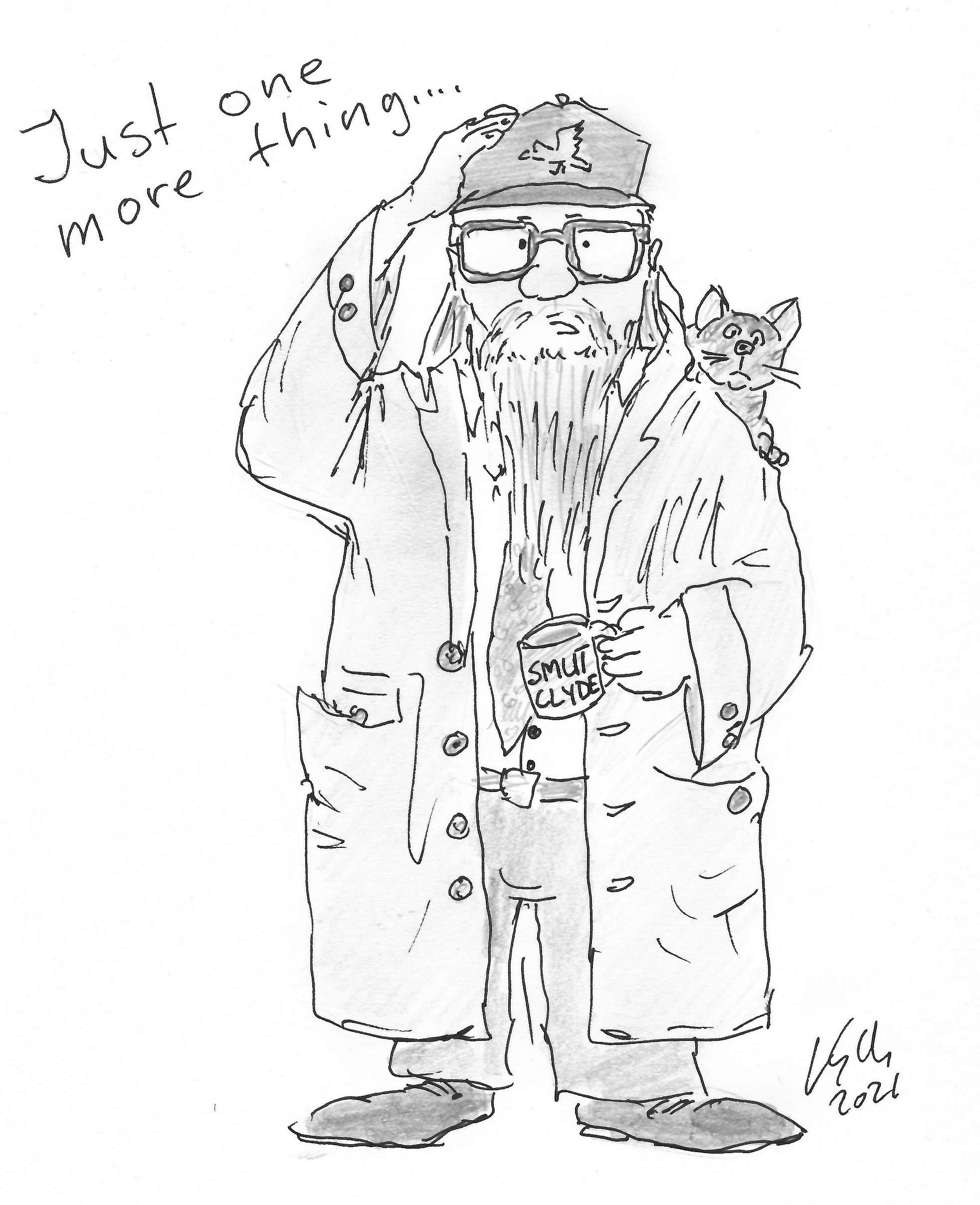
Poor Smut Clyde spent so much time investigating papermills that he started to suspect that peer-reviewed science of computer simulations is indeed all a computer simulation itself and nothing there is real. What if papermill characters like Muthu BalaAnand, Gunasekaran Manogaran, Seifedine Kadry or Vicente Garcia Diaz are merely external projections of human-shaped algorithms into the computer simulation we naively take as our reality?
Anyway, Smut Clyde even tried to read those computer papers, so you don’t have to. Be grateful for his self-sacrifice!

Is this the Spirit of the Age? (sciencing with the Sims)
By Smut Clyde
“Simulacron-3” sounds like a mockademic scamference with some corrupt Nobelist as the keynote speaker. It was in fact a computer simulation of an entire world in silico. Its purpose was to enable the programmers and Reactions, Inc to run market research experiments on its simulated but self-aware inhabitants, outsourcing the intrusive market research and endless opinion polls that were imposing an onerous burden on real-world society. The MR anxieties say a great deal about the Zeitgeist in 1964 when Simulacron-3 was published.


The novel was adapted as The Thirteenth Floor, which deserved better reviews than it received; and earlier, as Fassbinder’s superior TV miniseries World on a Wire. The protagonists eventually realise that ** SPOILER ALERT ** their real world is also a simulation, existing only in the processor cycles of computers in another ‘outside’ reality, and subject to the whims of that reality’s programmers. The novel was an influence on Dark City, but critics who claim it as the inspiration for The Matrix are overlooking the separate origins of Philip K. Dick’s counterfeit-existence Gnostic worldview.
In the manner of a Pokémon, the Zeitgeist evolves (it should not be confused with Weltschmerz or else we will have to deal with crossover Teutonic concepts like Zeitschmerz and Weltgeist). In the recent movie reboot Free Guy, the purpose of the simulated world is to let customers act out their violent asocial fantasies on its self-aware inhabitants without any real-world consequences. See, progress!!
I mention all this after reading far too many papermill products from a ‘simulation’ genre. Perhaps they represent an intermediate phase of the Zeitgeist‘s evolution where the self-contained virtual reality was created for faking research.
A rule-based structure of three pigs
Smut Clyde came to check how the Elsevier journal Microprocessors & Microsystems so far handled its “problems caused by dishonest guest editors and reviewers”.

Here we are back in the ekphrastic aspirational approach, familiar from Microprocessors & Microsystems and from the Hindawi debauch – where the millers mock up ‘serving suggestions’ of what results might look like, hypothetically, if some inchoate brainfart had been developed into implementable form.
So here is “An enhanced graph-based semi-supervised learning algorithm to detect fake users on Twitter” (BalaAnand et al 2019). The graph-shaped images use every style offered in the graphics-software menu to plot imaginary numbers.

The authors could more usefully have applied their enhanced semi-supervised learning algorithms to detect fake papers in Journal of Supercomputing.
To show the superiority of an algorithm over its rivals, authors might collect sensor measurements from experimental situations (or they might source data from archives). Or they might model the interactions within the situation under more-or-less realistic assumptions, and run simulations. But even simulations require a vague scheme of icons and arrows to be thought through to the point that it becomes a ‘model’; while both strategies require time-consuming analyses afterwards, with no guarantee that the results will match one’s preference. So who can blame Muthu BalaAnand, department head at the Tagore Institute of Engineering in India, for skipping the boring part and just plotting some made-up numbers against meaningless unexplained axes? It’s not as if the Special-Issue Guest Editors or the imaginary ‘Peer Reviewers’ pay attention to the provenance of the images that fill the Figure-shaped gaps, or care whether the supposed alternatives in these horse-races are even algorithms at all.

Cyclotron Branch, Before the Fall
“sadly, no-one could find any other evidence of existence for these festively-named individuals, who may well be Knock-Knock jokes that somehow gained sentience.” – Smut Clyde
I only pay attention because of the Crimes Against Visual Communication. Every time an author can’t decide among all the Excel options and switches from line plot to bar graph to ribbon plot to pyramid obscenity, Edward Tufte kills a kitten. This is Chaotic Evil. Also it is the exact opposite of what to do when the goal is providing readers with information. It is almost as if the real goal is to distract from the rectally-sourced nature of all numerical values.
“Classification analysis of burnout people’s brain images using ontology‐based speculative sense model” is deranged even by current standards. 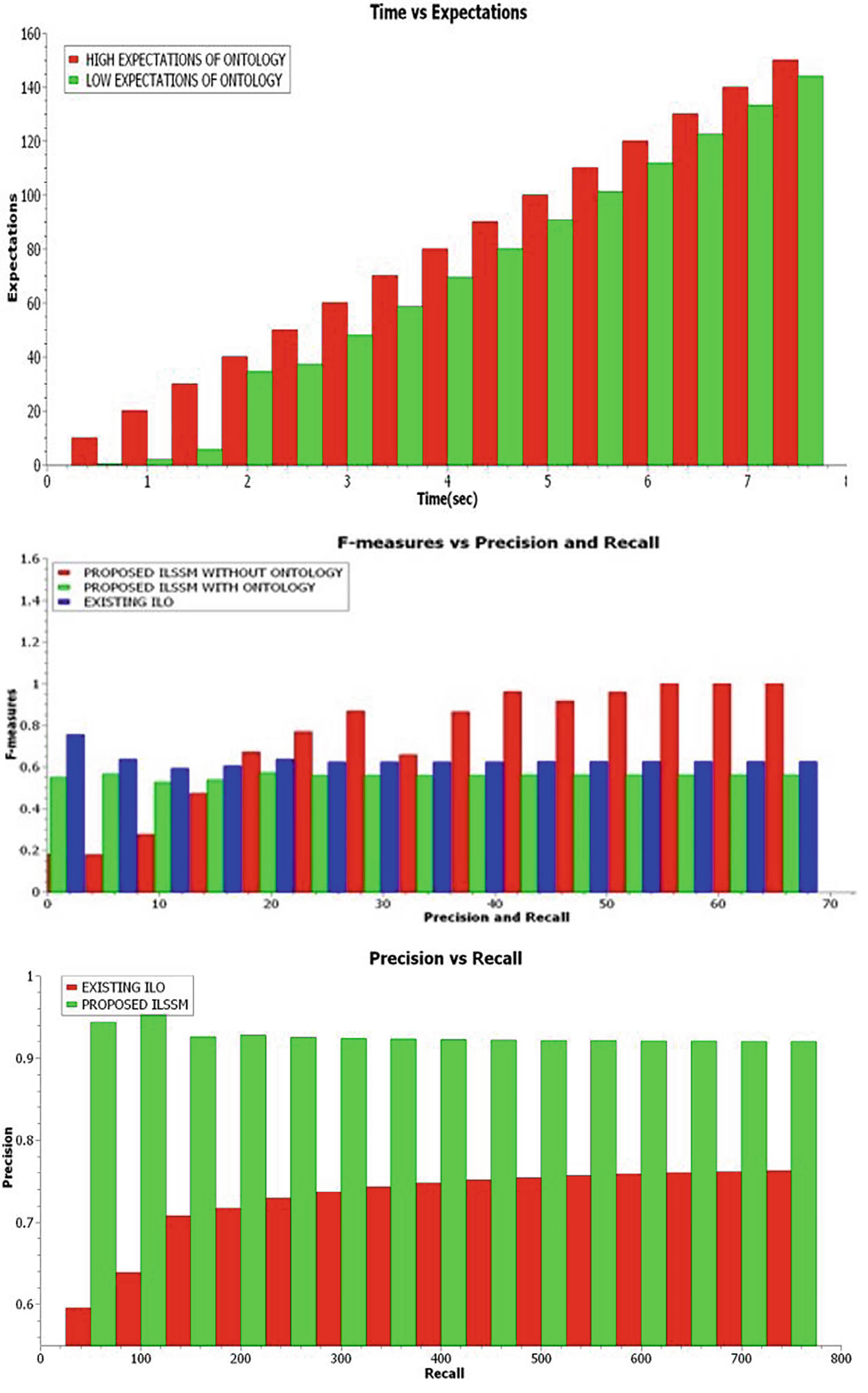 BalaAnand &c claimed to measure brain-damage correlates of burn-out, using no brain-scan data and no subjects, though they do report some skin-conductivity and pulse-rate measurements from an unspecified source. To distract readers from this absence a paragraph of text was swiped from some other source about epilepsy.
- “This model avoids the risk of reoccurrence of epilepsy. If proper treatment and guidance are given, epilepsy can be controlled easily.”
 Then the authors swivelled quickly to Ontology and “user stories”, illustrating ‘expectations of Ontology’ with a series of garish striped
 picket fences that are why the neighbourhood hates me bar graphs. ‘Ontology’ is not used in the information-sciences or the philosophical sense. They progressed to explaining the workings of Protégé software by providing a dictionary definition of “protégé”, but even this was still not sufficiently insulting to the readers’ intelligence, which is why we are treated to the scholarly professionalism of Figure 1.
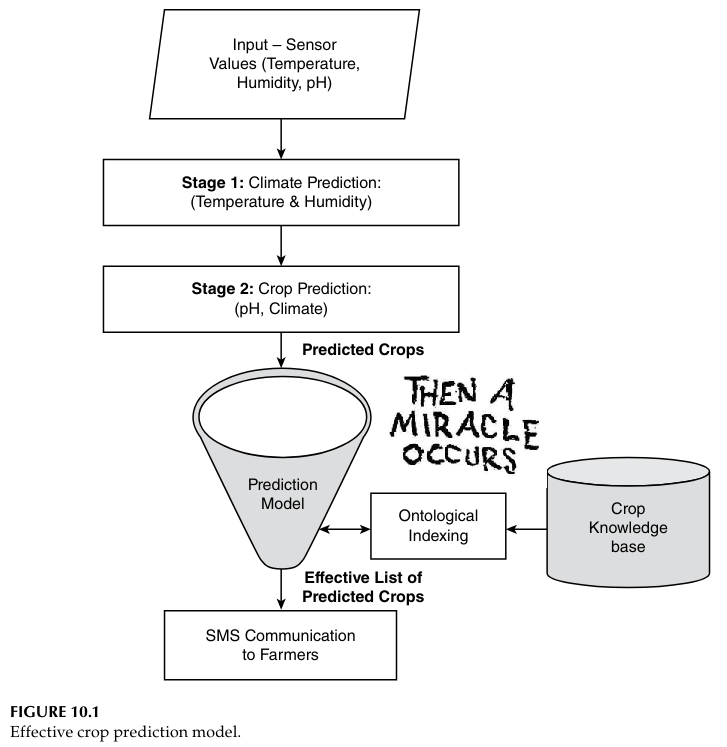 In 2022, BalaAnand and a few of his regular cronies (J. Alfred Daniel, C. B. Sivaparthipan) assembled Chapter 10 on Fuzzy Logic and the Internet-of-Tractors, in which they harnessed the awesome powers of Big Data and Deep Learning to discover that in some unspecified location, humidity and temperature are not constant through the year. Also, there are alluvial and desert soils with pH as low as 0 and as high as 14. These are the kind of insights that make the book worth $341.00.

History tells us that farmers always welcome the advice of Tech Bros working out which crops grow best for specific conditions. When soil has pH = 0 or 14 they will need all the Fuzzy Rules and Ontology-Based Information Retrieval they can get.
“IoT sensors have the capability to produce data regarding crop yields, downfall to the farmers.”
DOWNFALL TO THE FARMERS!!! CRUSH THE KULAKS!!!
Farmers will be reassured to learn that the authors measured the accuracy of the seed-planting advice their proposed system would provide (on a scale from Poor_er to Good_er), if someone ever paid them to assemble it.


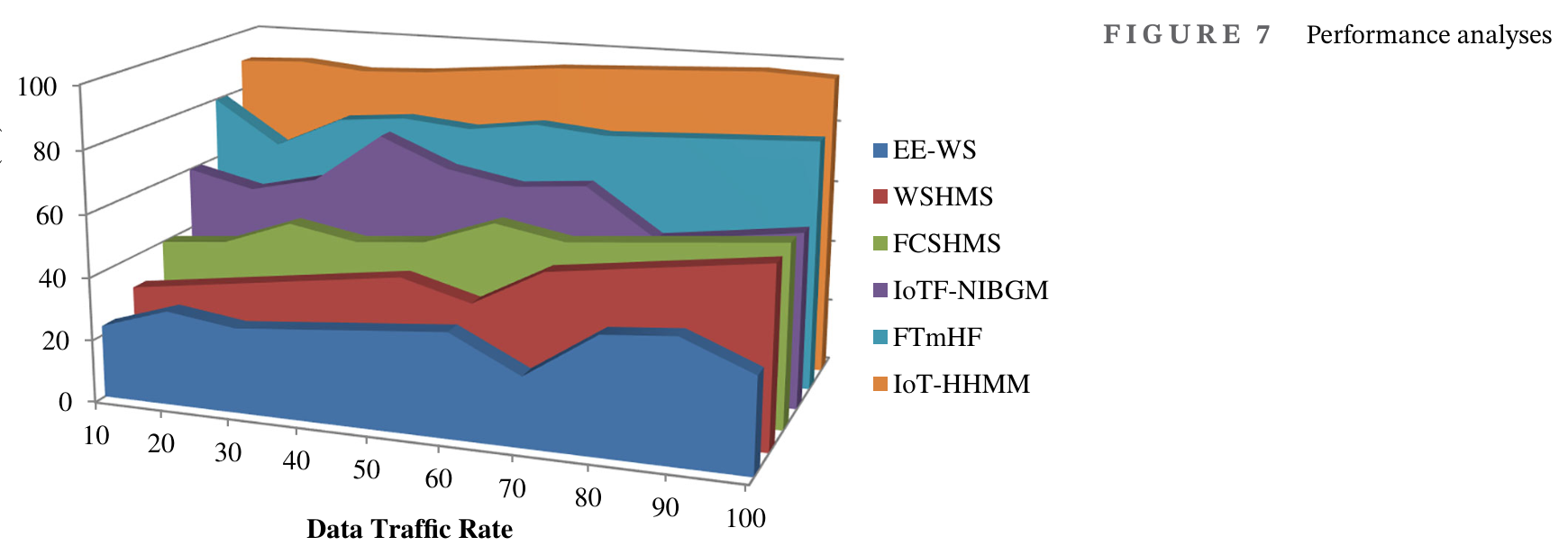
At right (in color) are Figures 5, 7, 8, 9 from “Procuring Cooperative Intelligence in Autonomous Vehicles for Object Detection through Data Fusion Approach” (Daniel et al 2020), which used identical text as well as identical images.


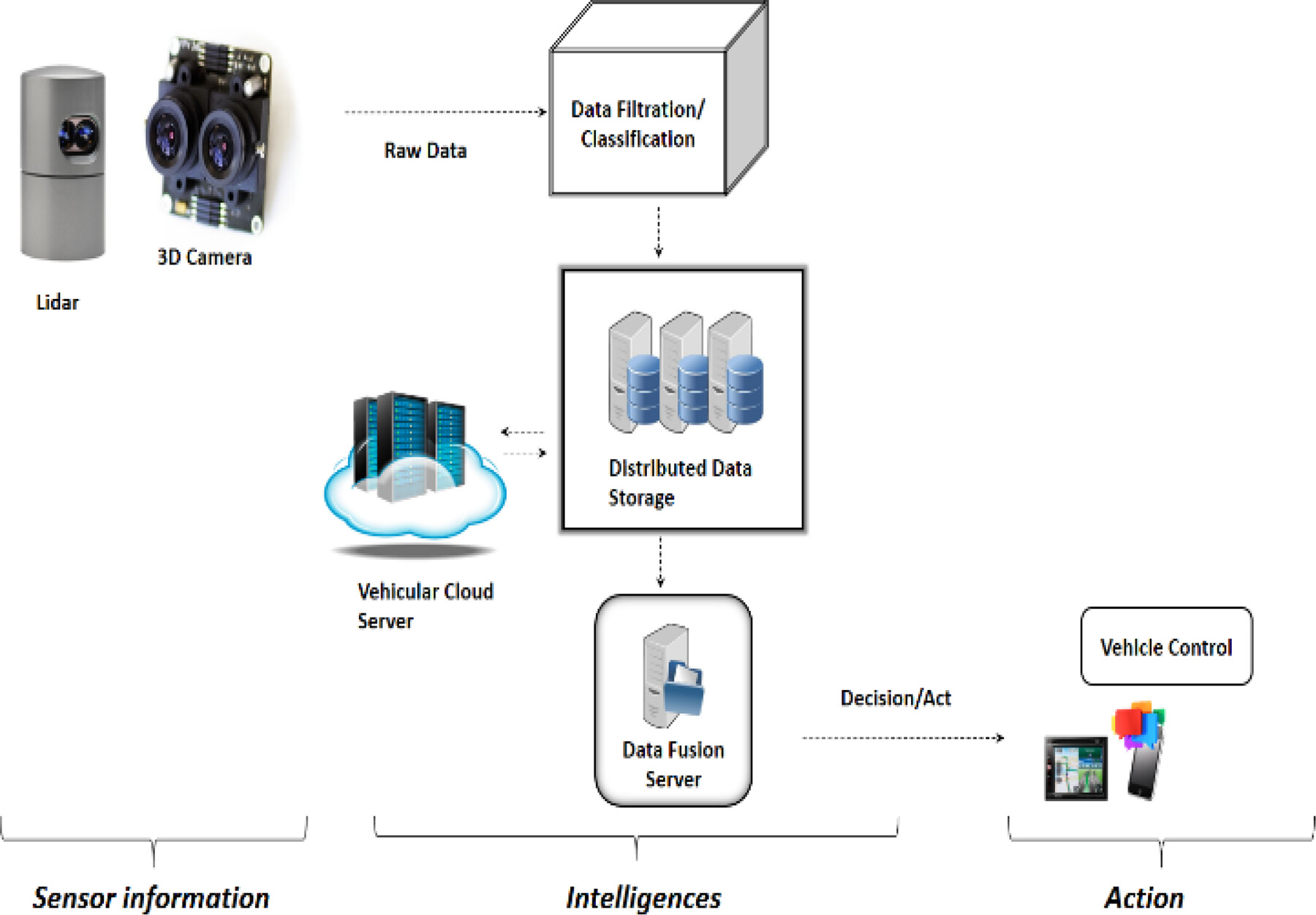 In that 2020 paper “Procuring Cooperative Intelligence in Autonomous Vehicles...”, BalaAnand et al. had connected a stack of random icons with arrows and called it an ‘architecture’. This was enough to solve the problem of fusing signals from stereo cameras and LIDAR sensors, and thereby enabling self-driving cars to detect obstacles. They were joined in that endeavour by coauthor Seifedine Kadry, professor at the Noroff college in Norway, who comes with history, and baggage, and a number of undetected obstacles. A general observation: when authors feel free to use the same graph-shaped images to illustrate their experimental validations of models for two completely different situations, it’s fairly clear that experiments and models are both fictitious, but the authors were just too lazy to forge two sets of fraudulent results.
 2022 also gave us “Blockchain Assisted Disease Identification of COVID-19 Patients with the Help of IDA-DNN Classifier” (Sivaparthipan et al.). Here BalaAnand fed symptoms and measurements from 303 heart-disease patients (or maybe 369) into a Neural Network and trained it to distinguish the subset of cases whose heart disease ensued from a COVID-19 infection. It goes without saying that blockchain was involved, and an Improved Dragonfly Algorithm to make the DNN more magical, and coauthors Priyan Malarvizhi Kumar, assistant professor at University of North Texas in USA and Vicente García Díaz, associate professor at University of Oviedo in Spain. The journal’s editors and reviewers were so convinced by the colored bars that they didn’t notice that Figs 5(a) and (c) are the same.
 They performed the same classification for 5000 cases of liver disease, from “the Egyptian Liver Research Institutes and also the Mansoura Central Hospital, Dakahlia Governorate, Egypt”. More colored bars resulted. These must serve as substitute for any details or links for those supposed liver-disease databases which are TOTALLY NOT IMAGINARY. Sadly, Fig 4 exhausted the supply of colored bars, so for Lung and Kidney disease – the other two potential sequelae of COVID-19 considered here – we only have tables to prove the algorithm’s superior performance. Lung symptoms came from “A total of 300 datasets aimed at the diseases emphysema, bronchitis, pleural effusion, and also normal lung”. As for kidney symptoms, “The dataset utilized in the examination comprises 461 CKD Indian patients and encompasses 35 variables (21 numerical, 14 categorical)”, so TOTALLY NOT IMAGINARY.
Just saying, no honest researcher would have ever tried to use that heart-disease data set to discriminate COVID cases as it was archived in 1988.
The race is not always to the swift, nor is promotion always to the most Highly-Cited Researchers, but that is how the smart people bet
In recent years we passed through a transition point when consistently conducting well-received research was no longer a guarantee of academic employment, because the new standard was a hyper-prolific or prodigious publication record.¹ One might think that appearing in a Clarivate List of Highly-Cited Researchers (HCRs) signifies a career history of shenanigans, but somehow it became an employment asset, and something that people boast about in their faculty webpages. It helped that universities had been forced to seek out these flimflam firehoses, to elevate their own statistics in their higher-level competition against rival institutions for funding and fee-paying students.

The incredible collaborations of Renaissance men and women
Nick Wise and Alexander Magazinov on the authorships-for-sale market on social media. Merely $700 for the 7th position on some paper way outside your expertise!

You can guess whereof I speak: this rant is revisiting earlier posts, and Alexander Magazinov’s reportage on the academic ‘log-rolling economy’. I single out Mohamed Elhoseny, N. Arunkumar, Mohamed Abdel-Basset and Gunasekaran Manogaran, not to credit them with any transformative role in the Publication Profligacy Revolution, but because they have already featured at For Better Science. Muthu BalaAnand belongs to their cosmopolitan circle-jerk of mutual assistance.

BalaAnand is less industrious than many of Elhoseny’s associates but in partnership with recurring co-author Chandrakirishnan Balakrishnan Sivaparthipan he provides a useful encapsulation of the circle’s general style.

The Highly Cited Researchers of Clarivate
“here is my advice to Clarivate: better get lost. ” – Alexander Magazinov
I can at least agree with them that Deep Learning is all about eliminating higher-level functionalities:
“Deep learning is an algorithm of neural networks that utilizes multiple layers to eliminate higher-level functionalities from actual data gradually”
The source of that gnomic apothegm is “Design of an energy‐efficient IoT device with optimized data management in sports person health monitoring application” (Qiu et al 2022), where Yonghong Qiu and Gaicheng Liu are the first two authors. They do not appear again in BalaAnand’s oeuvre: this is typical of his output, for the business model requires paying passengers as coauthors.

Welcome Agent Cooperate With Us
“There is so much money flowing through this system that I don’t see what will stop the network of papermills and corrupt editors.” – Nick Wise


The paper caught my eye with the explanation that glucose monitors are best concealed under a hat. It may be that synonym-spinning plagiarism-concealment software went horribly wrong here, as Ref [33] is to the use of a glucose-monitoring glove.

Qiu et al (2022) is also another example of visual-communication barbarity in the course of plotting fabricated numbers. WHAT KIND OF MONSTER DOES THIS??



That text-engarblement software keeps going wrong. I have read many papers on image-processing efforts to recognise facial expressions automagically, and this is the first time where one step is measuring the bladder.

The References Section of “Design of Internet of Things and big data analytics-based disaster risk management” (Zhou et al 2021) is the usual citation-delivery vehicle. But BalaAnand introduces a citational innovation by citing his own Call for Papers for a Special Issue he had supposedly Guest-Edited.² What stopped him referring to the Special Issue itself (“Big Data Analytics for Agricultural Disaster Management”) to support his claim that “The IoT can be implemented to handle disaster situations, which grows quickly into the Internet of Everything” – or some germane paper from it – is perhaps that Big Data never published it.

The less said about the Figures in Zhou et al, the better. They are iconic in a “made of icons” sense.
The failure of “Big Data Analytics for Agricultural Disaster Management” to progress from the fictive domain into a state of existence did not stop 13 later papers from citing BalaAnand’s invitation. Those 13 were papermill contributions to another ill-fated Special Issue, called “Envisage Computer Modelling and Statistics for Agriculture”, in Acta Agriculturae Scandinavica, Section B. It comprised 80 papers in total, all depublished on 30 January 2024 on account of fake-review malarkey from the Guest Editor, who happened to be one Gunasekaran Manogaran.

 There are some recurring themes here:
FabricatedAspirational results (serving suggestions only), not designed to be taken seriously.- Illustrations in a distinctive house style and color palette, purporting to show “architectures” or “frameworks”, all pictograms and boxes and arrows arranged to give the impression that things influence other things (in some ill-specified way). A glimpse into the dystopian future where science communication is reduced to Graphic Abstracts. They could be slides for a hastily-prepared presentation to middle-management, which would explain their absence of content. It would also explain much of the dreamlike, insubstantial vacuity of Dall-E / MidJourney output if those packages had been trained on figures like these.
- Special Issues curated by cartel members to inflate other members’ CVs.
- Reference Sections carrying heavy payloads of citations to benefit members of the cartel. They are at least a useful tool for tracing the cartel’s extent.
- Muthu BalaAnand in some role.
 All are evident in the 53 papers that comprised “Frontiers in Parallel Programming Models for Fog and Edge Computing Infrastructures” in Arabian Journal for Science and Engineering,
 edited recruited by Ruben Gonzalez Crespo in the course of a year from April 2021 to March 2022. You can read about this papermilling vice-rector of the International University of La Rioja in Spain in a revealing El Pais article, summarised in October 2023 Shorts.
Later in 2022 the SI went comprehensively pear-shaped in a protracted agony of depublication, while the Editor-in-Chief recited the usual litany of malfeasance: citation payola, purchasable peer-review, papermilling, purchased authorship – all illustrated together in one convenient package.
Also, “A preliminary study on the Earth’s evolution and condensation” (Guo et al 2021). This was the highlight of the 43 papers in “Remote Sensing in Water Management and Hydrology” (a Special Issue in European Journal of Remote Sensing; edited by Karuppiah, Li & Chaudhry). It deserves an IgNobel Prize if anyone knows how to make nominations. The presence of fossils within mudstone and sandstone and limestone forced the renegade-geologist authors to the conclusion that early vertebrates were thermophilic creatures who lived within flowing magma until it cooled too much, solidified, and trapped them – for they’d already shown that these rocks, classified as “sedimentary” by all the other captains, are in fact igneous in origin.  As those early life-forms evolved into us, they adjusted to the lower temperatures and different conditions associated with a non-molten-rock habitat. Though the authors warn us that the Earth will continue to cool beyond the limits of adaptability so we need to prepare for the coming age of Ice. I think their paper is sincere and not just a cynical attempt to usurp Chonosuke Okamura‘s title as “World’s Most Bonkers Palaeontologist”.
More relevant here are four egregious dumpster fires from elsewhere in that SI.

- “Estimating snow depth Inversion Model Assisted Vector Analysis based on temperature brightness for North Xinjiang region of China” (Chen, BalaAnand & Sivaparthipan 2020).
- “Chlorophyll-a concentration in the hailing bay using remote sensing assisted sparse statistical modelling” (Liu, Wei, BalaAnand & R. Dinesh Jackson Samuel 2021).
- “A novel approach for scene classification from remote sensing images using deep learning methods” (Xu, … P. Anandhan & A. Manickam 2021).
- “Application of active remote sensing in confirmation rights and identification of mortgage supply-demand subjects of rural land in Guangdong Province” (Hu, Fu, R. Dinesh Jackson Samuel & P. Anandhan 2021).

 Figure 2 has these intriguing reflectance spectra for seawater with varying levels of phytoplankton chlorophyll, for wavelengths ranging from “soft X-ray” to “extremely hard UV”. They certainly aren’t part of NASA satellite imagery, leaving “BalaAnand’s
 butt active imagination” as the source. #3 and #4 are equally entertaining, but NO SPACE.
I have not finished with that Greater Co-Prosperity Sphere of individuals around Elhoseny and Abdel-Basset and Manogaran. Without aiming for an exhaustive list, here are some of the recurring coauthors and gratuitous-citation recipients:

These adepts of the Dark Arts brought professionalism to the academic log-rolling sport that had previously been dominated by gentlemanly amateurism. They turned up on the scene at a time when big publishers were embracing the Special Issue business model (with its promise of increasing income while unloading administrative costs), so their offers to take on Special Issue editorial duties and recruit all the contributors were accepted without question. After all, this cavalcade of charlatans were all Highly Cited Researchers… even more highly-cited after each Special Issue.
The core group of mountebanks once straddled the Special-Issue / co-authorship scene like colossi, sought-after and head-hunted as an adornment to any faculty… but there are no more banks to mount. They are increasingly recognised as what they are and the universities that were housing them when the music stopped are now stuck with them. The unravelling began when G. Manogaran / M. Gunasekaran and many associates came to the attention of Undark, El Pais and Retraction Watch, thanks to Nick Wise and an anonymous whistle-blower. So we can express our suspicions about their activities more openly than last time, without arousing concern among more professional observers.
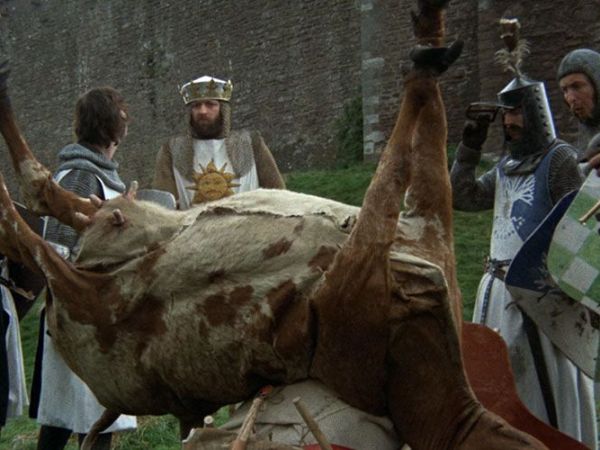
The Men Who Stare at Ketotic Cows
“The References dwell on bovine indigestion, seizures, and the work of N. Arunkumar.” – Smut Clyde, jazz-punk Klezmer musician.
See also M. Abdel-Basset / Baset, whose special crime against Authorship Integrity involved exploiting the multiple ways of rendering his name into the Latin alphabet and European naming conventions. Apparently this transgresses the bounds of decency (and hides the fact that the author of a paper and the Guest Editor who accepted it for a Special Issue were the same individual). Not to neglect Mohamed E. Ibrahim, who is the same person as Mohamed Elhoseny.

However, everyone in this Circensis Personae would benefit from having a cold eye cast over their CV, if anyone wants to go through so many lists of publications and tick off ones where there is any sign of actual experiments. Any of them could become a topic for a blogpost. The posts would grow repetitive after a while, with endless lists of Special Issue scandals, mass retractions and promotions to new institutions… but there would be variations, and room for speculation.
To pick a random example, Jiechao Gao is in the list because of the facilitated Special-Issue publication pathway for his recent CS papers, and their coauthors, and the intense citational payola pushing up their statistics (yes, IEEE journals and Conference Proceedings³ count as a “facilitated publication pathway”). He is “currently working toward the PhD degree with the Department of Computer Science of University of Virginia” according to his profile at IEEE. What happened?
 “Task Failure Prediction in Cloud Data Centers Using Deep Learning” (Gao et al 2022).
- “Redemptive Resource Sharing and Allocation Scheme for Internet of Things-Assisted Smart Healthcare Systems” (Gao et al 2022).
- “Enhanced bat algorithm for COVID-19 short-term forecasting using optimized LSTM” (Rauf et al 2021) [retracted].
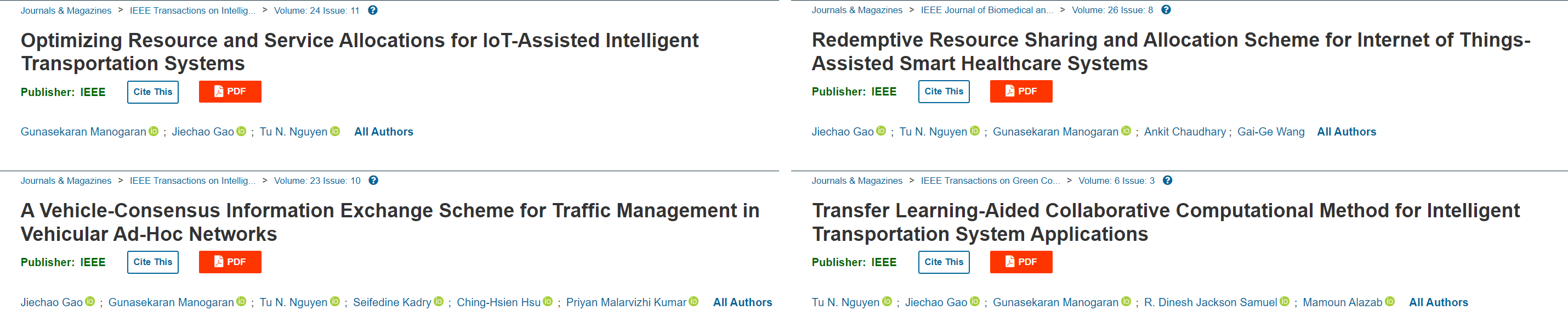
Gao was a real researcher once – a grad student at Jilin University. His earlier papers from 2015-2016 address photoluminescence in nanomaterials. But the same citational payola has been expended on raising their profile, and they are on References high-rotate in Comp. Sci. journals despite their utter irrelevance.
- “Studying of photoluminescence characteristics of CdTe/ZnS QDs manipulated by TiO2 inverse opal photonic crystals” (Chi et al 2015).
- “Spontaneous emission of semiconductor quantum dots in inverse opal SiO2 photonic crystals at different temperatures” (Yang et al 2016).
- “Study of photoluminescence characteristics of CdSe quantum dots hybridized with Cu nanowires” (Chi et al 2016). Cited 45 times but not by physicists.
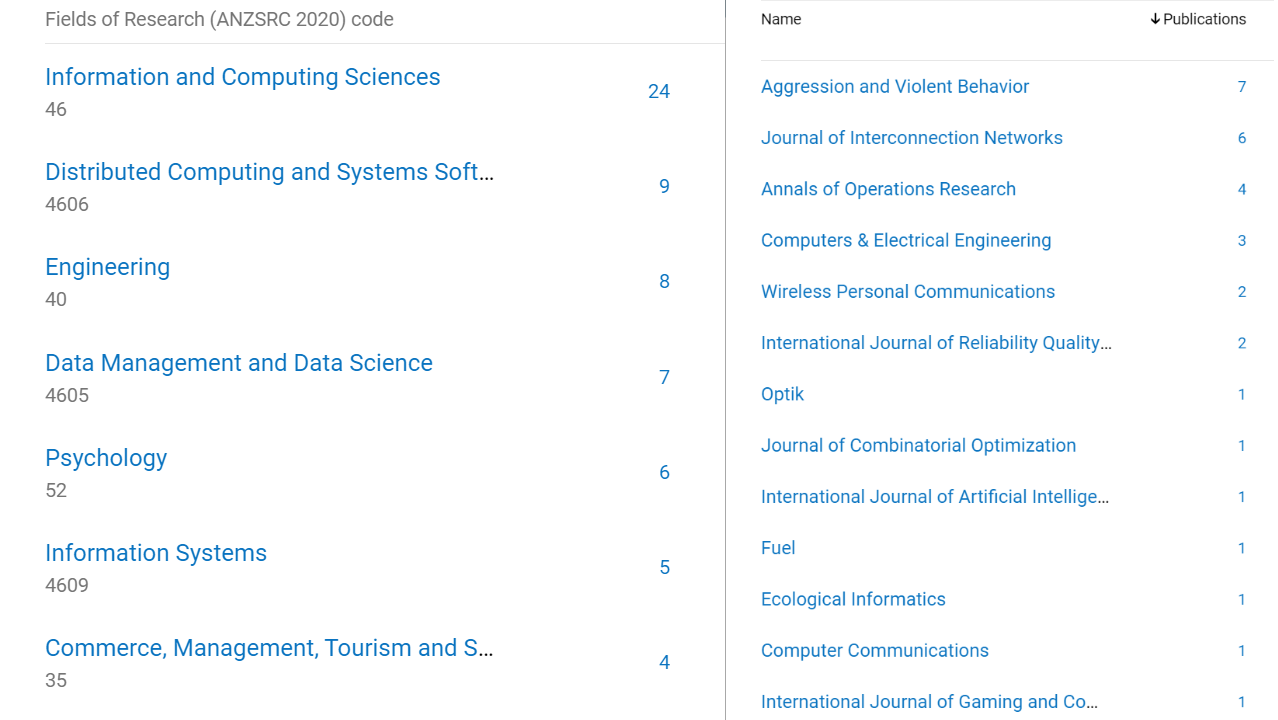
There is a sad story here of compromise, crushed idealism, shattered dreams and falling in with ill-advised companions.

The papers are coming from inside the house!
“It feels like half the higher-echelon professors at Jilin University have built their careers on these fairy-tales, with successions of papers itemising the interactions of ADAM10 or GRIM-19. […] if only they had published instead about the Tooth-Fairy circ-RNA and how it targets the Easter-Bunny Pathway…”, – Smut Clyde
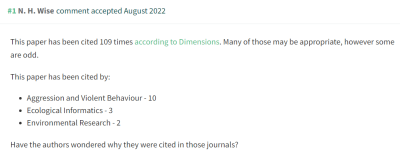
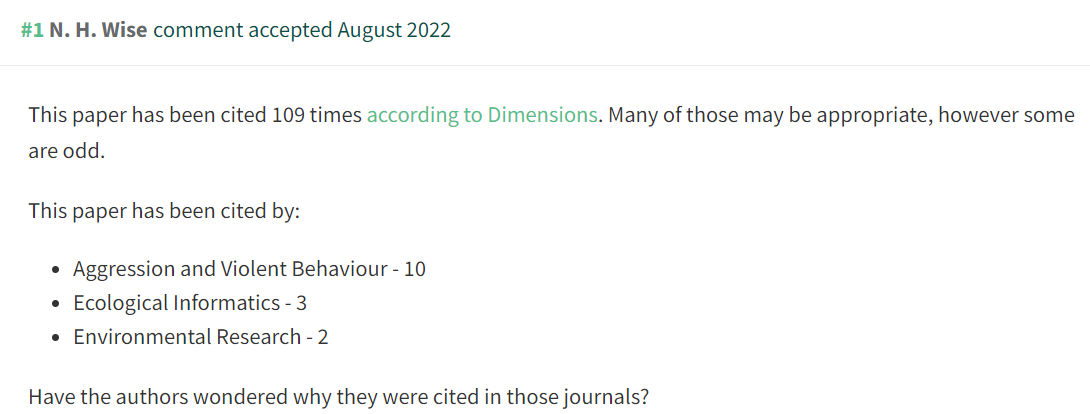
Note that much of this citation endowment, contributing to Jiechao Gao’s popular-and-wonderfully-run-after status, flows from Aggression & Violent Behavior of all places. Two Special Issues there are involved (before they became mass-retraction crime scenes): “Prevention of Workplace Disease” and “Psycho Abuse & Depression”, which accepted 36 and 32 paper-shaped artefacts in September and December 2021, under the guest-editorship of Hassan Fouad and Crespo’s associate Vicente García Díaz respectively. Then these lingered in “In Press” limbo for months, available on-line and accruing citations but not attached to an issue, as if the manager who had green-lit these projects went on to un-light them. See the Undark exposé.
Elsevier have a policy that papers are not published until they formally receive digital-issue page numbers, which is the pretext they need to withdraw papers rather than retract them: “they never really happened, we just stopped believing in them”. This is what happened to the 68 manuscripts here: scrubbed from the system without trace. They do not appear in searches. Only the citation databases like Crossref and Dimensions retain a record, which is enough information to include the ex-papers within the present miasma of mass-production.
I forgot to mention many of the Special Issue mass retractions! They unavoidably came to dominate the spreadsheet, and paint a rosy picture where ex-papers outnumber the problematic ones still in print. Did I mention that there was a spreadsheet? – how could there not be one? It draws heavily on an earlier, more-diffuse spreadsheet that swept up no end of citational shenanigans but did not try to delineate a self-contained cluster of recipients.
Kudos to Neural Computing and Applications for a pair of recent Extinction Events:
- “Intelligent Biomedical Data Analysis and Processing” – 14 papers. Guest-Edited by Deepak Gupta & Victor Hugo C. de Albuquerque.
- “Emerging intelligent algorithms: challenges and applications” – 12 papers, plus an Editorial. Guest-Edited by Gunasekaran Manogaran, Naveen Chilamkurti & Ching-Hsien Hsu.

Though if the current Editors-in-Chief are working through compromised Special Issues in chronological sequence, starting from the early ones from 2018 when the journal was entering its Logistic Growth Phase, it could take a while for the process to catch up with the ones being published now. The journal is still hooked on easy Special Issue money. It would be nice to think that closer scrutiny is applied these days to Volunteer Editors when they rock up with a Special Issue proposal and an agenda, but “restoring Smut Clyde’s shaken confidence” is not high on Springer‘s to-do list.
The 20 papers comprising “Neural Computing in Next Generation Virtual Reality Technology” – another 2018 SI from Neural Computing – just underwent their own comprehensive demise. I left them out of the spreadsheet because although the Special Issue curator was one Zhihan Lv (read about this associate professor at University of Uppsala in May 2024 Shorts), the papers he stovepiped into print don’t otherwise belong to the “Sims” production-line (they weren’t coauthored by and don’t cite members of the circensis personae). They were garbage in other ways. See also “Internet-of-Things and Cyber-Physical System in Smart City” special-edited by Lv.

Lv’s cartel membership manifested as invasions of the References Sections of other people’s papers – in the manner of Nicolas Cage haunting the dreams of strangers in ‘Dream Scenario‘ – which is how he first came to my attention. He went on to contribute to the Hindawi trainwreck by providing journals with a string of corrupted Special Issues.
Z. Lv may be related to lower-profile occasional coauthor Haibin Lv. Both Lvs were was on the Editorial Board of PLoS One, until concerns arose about papermill sources and the existence standards of peer-review. Then the retractions rained down like the Hammer of Thor.


There is an argument here for arranging the Special Issues as the focus of their own separate spreadsheet, with journals and guest-editors as attributes. The obstacle is Springer journals and their habit of deleting crucial information. A string of Notes for retracted papers might allude to a condemned Special Issue to explain why they were ever published (like these 81 artefacts from Annals of Operational Research in 2021, depublished in June 2023) – but a policy of Damnatio memoriae sends the Special Issue’s title and instigator down the memory hole. In December 2022, the editors of Wireless Personal Communications re-housed 23 disowned ex-papers in a special Supplement after scrubbing the boring ‘guest-editor’ SI details.

How can someone sleep at night after creating a three-dimensional plot of made-up numbers with only two parameters? What kind of monster does that? The plots’ only redeeming feature is the segue they provide to more Simulated Research.
 I mention “Research on Intelligent Trash Can Garbage Classification Scheme Based on Improved YOLOv3 Target Detection Algorithm” (Wang et al 2022) because:
- Second author is Muthu BalaAnand.
- Appeared in a SI (“Supplementary Issue 3 – Blockchain Technology for Critical Infrastructure Security“) with Guest Editors Gunasekaran Manogaran, Hassan Qudrat-Ullah and Qin Xin.
- The References section is an unabashed Citation-Delivery vehicle, dispensing citational largesse upon a list of familiar highly-cited recipients.
- Every other paper in the Special Issue is as bad.
Alas, the paper is behind a paywall. Thus I am not in a position to give more details on the Intelligent Trash Cans of the title, though I imagine they are similar to R2-D2. Like other journals from World Scientific, Journal of Interconnection Networks is not an outlet favoured by authors who want their papers to be read (or who have any other options). It is not high-profile – or any other kind of profile – and few libraries subscribe.
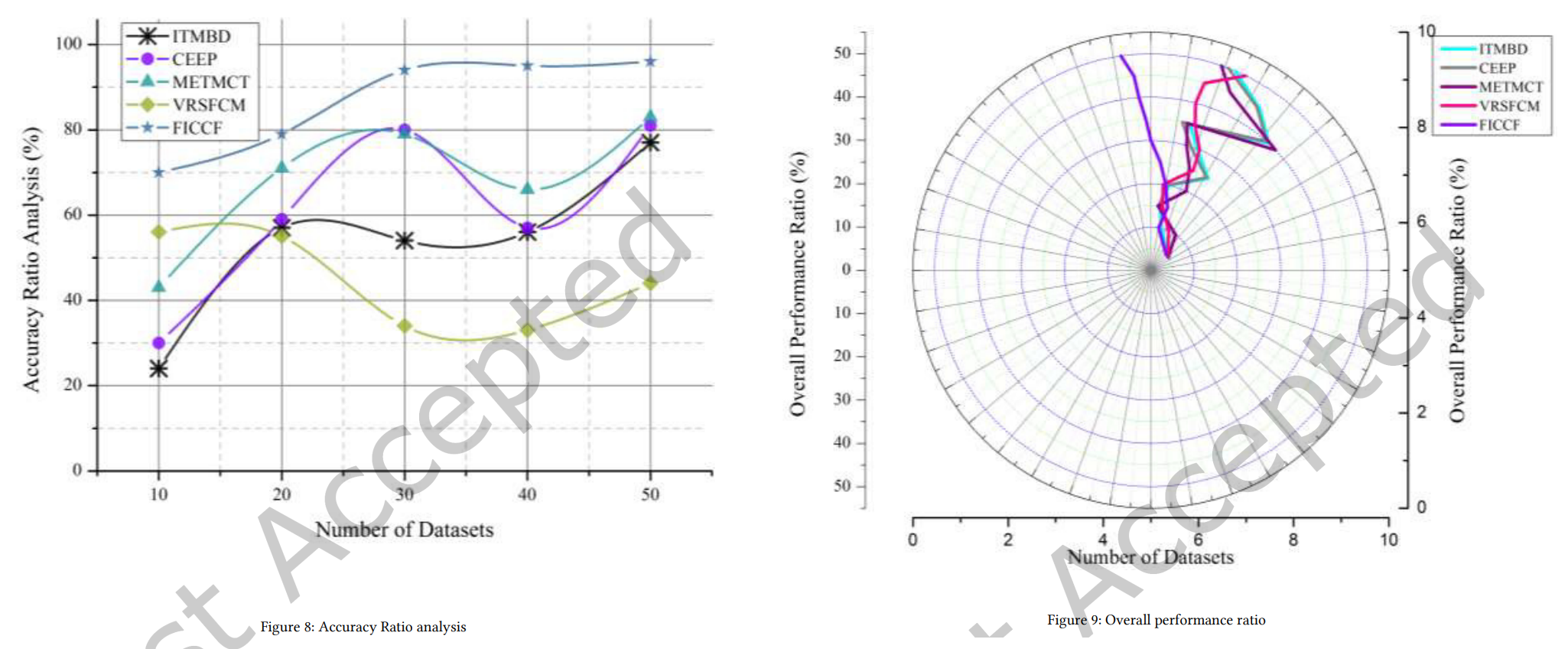
 I choose to think that the Figures in “Multi-Objective Heuristic Decision Making and Benchmarking for Mobile Applications in English Language Learning” (Zhao et al 2021) show “Mobile application” in the sense of the Surrealist collaborations between Calder and Miró. The alternative is that the authors measured something at irregular millisecond intervals but forgot to say what. We only know that three experts were recruited in some unknown way from an unknown background, and evaluated six English-learning apps on an unspecified questionnaire.

 In “Deep learning convolutional neural network (CNN) With Gaussian mixture model for predicting pancreatic cancer” (Sekaran et al 2020), S. Kadry and a team of fee-paying passengers present a “LFE+LR” method for
 predicting diagnosing pancreatic cancer from CT scans, this being short for “Lump Feature Extraction / Lump Recognition”. Their conceptual breakthrough was (1) find lumps, and (2) recognise them as cancerous, don’t worry about the details.  They trained a CNN on 82 CT-scans from healthy controls (which somehow grew into 1000 images), and it found tumors everywhere. Indeed, larger tumors than rival methods (just saying, clinicians generally prefer to catch tumors when they are small). Pancreatic tumors up to 30 cm long.
N.H. Wise had this to say in June 2022:
“Another paper in Acta Agriculturae etc that is paper shaped but does nothing. Like other papers in this genre, there is a figure plotting a ‘value’ or ‘score’ which is supposedly the result of some analysis”.

 This now-retracted citation plantation was typical of the 80 comprising that Special Issue on “Envisage Computer Modelling and Statistics for Agriculture” described already (guest-edited by Gunasekaran Manogaran, mentioned in the Undark exposé). The millers do deserve credit for varying the color-palette of the random wiggly lines.
The authors of “LAMSTAR: For IoT‐based face recognition system to manage the safety factor in smart cities” (Medapati et al 2020) do not include M. BalaAnand. Never mind, they cited a few junk papers from P. M. Shakeel to advertise their membership of the cartel. They also claimed to have trained a Neural Network to recognise faces from surveillance-camera images, as part of the Smart City / panopticon initiative of ensuring that all citizens operate with maximum efficiency by monitoring exactly where they are and what they are doing at every moment.  The sample images allegedly came from unknown researchers in the Smart City of Zagreb (Croatia), and no-one – not the authors, not the SI Editors, not the fictional peer-reviewers – noticed that they were “Sexy Lady” clip-art. Very professional! Figure 7 showed more Real Life surveillance-camera images from the database, and Sylvain Bernès found the original on Pinterest.

In this case the Special Issue was “Advanced microprocessor optimization methods for the Internet of Things” (curated by Seifedine Kadry, Yu-Dong Zhang & Shuai Li). So far no mass retractions, only PubPeer threads.
Seifedine Kadry, Yu-Dong Zhang & Shuai Li also curated a Special Issue on “Emerging Applications for IoT-Sen Technology in Wearable Medical Devices“, for Measurement. The highlight is perhaps “Deep brain simulation wearable IoT sensor device based Parkinson brain disorder detection using heuristic tubu optimized sequence modular neural network” (Alzubi et al 2020). “Tubu” seems to be an engarblement of “tuba tabu optimization”, which does exist.
Between citation payola and the acceptance of endemic incompetence that marks the Comp.Sci literature, this wholly fraudulent paper has already been cited 22 times. None of the citing papers ever read the source, and many simply copied Alzubi’s bungled “Tubu optimization”, so now it has acquired a life of its own.

But wait, there’s more! “Advances in Evolutionary Computation for Image Processing” was edited by Kadry, Zhang, and Li again. Retractions are unlikely to happen, and there is little incentive to point and laugh at the papers, the publisher being World Scientific. Again.
In particular, Krishnamoorthy et al (2021) – the authors of “Regression Model-based Feature Filtering for Improving Hemorrhage Detection Accuracy in Diabetic Retinopathy Treatment” – can safely steal other people’s images of various forms of retinal deterioration, relabeling them as “retinal bleeding from diabetic retinopathy” in the hope of misleading clinicians, without pushback.

Meanwhile over at International Journal of Speech Technology, a Special Issue happened, thanks to the editorial efforts of Vicente Garcia Diaz: “Human Computer Interaction for Speech and Augmentative Communication“. So far two of the 12 papers have gone to live on that farm in the country.
 How many retracted papers will be attributed to this piratical band, once all the Special-Issue retraction trees have been shaken? 1000? 2000? I expect a high three-digit number from Journal of Intelligent & Fuzzy Systems alone. H/t to Rhipidura albiventris, who flagged an immense number of JI&FS papers on PubPeer.

And that will only be the tip of the fatberg. Manogaran was not only a citations pimp; he was (I cannot stress this enough) running (still runs?) his own papermill. He had ramped up production by recruiting an atelier and could fabricate material at an industrial scale. All the authorship positions on a paper might be purchased, making it less obvious (or it might be signed by one or two of Manogaran’s collaborators, in addition to paying passengers). Most will never be retracted.
“According to Wise, Manogoran and his team have overseen at least 67 special issues across nearly fifty journals. These issues included over 1,250 studies and involved around 70 guest editors.”
El Pais
I can’t prove that some of the students whom Manogaran upskilled to be professional, production-line fraudsters took his templates for fake figures and went into business for themselves, in time for the Zerg-Rush conquest of Hindawi and Microprocessors & Microsystems. But I can’t prove that they didn’t, either.
“The anonymous tipster claimed that Manogaran set up a factory assembly line with young researchers from Vellore to churn out scientific papers. In return, these researchers were given the opportunity to publish their work in international scientific journals.”
El Pais
 The real concern with all these fictitious, fraudulent results is that our simulated world only exists for us to carry out real science on behalf of the people in the real “outside” world, saving them the expense of running experiments themselves. If they realise that so much science is fake – not even a second-order in-silico simulation – they might as well reboot the servers and find some other use for them.
Humane Treatment Declaration: No data were injured or tortured in the creation of this blogpost. In keeping with the theme, no data were consulted at all.
Feetnotes
1. The Revolution was made easier by “Sokal’s Revenge” where universities and journals mainstreamed various genres of fiction: Machine Learning, optimisation algorithms, nanoflow, Fuzzy Computation, Bio-sourced Nanoparticles, in silico DFT studies of toxin adsorption… to the point that authors can confidently expect a manuscript to be published if it contains some combination of the Worship Words ‘Big Data’, ‘Deep Learning’, ‘Digital Twin’, Blockchain and Internet-of-Things. Mentioning these concepts in the text of the paper is optional.
This was a twist sequel to the Sokal Affair: it turned out that the real danger to honest scholarship – infiltrating the Academies and threatening to drown falsifiable fact-based theories in a spume of word-wooze – was not cultural relativity or deconstructionism after all. These new indisciplines are quantifiable at least (in contrast to Sokal’s bêtes noires of sociology, hermeneutics and Critical Studies), in the sense that research funding is a very important Quantity to everyone. For some reason, the money flow had shifted to these content-free glass-bead games, despite their disconnection from reality. Perhaps governments were unwilling to tolerate a Nanotech Gap or a Blockchain Gap.
2. The other known example of this impudent citational practice is the Call for Papers for “Multimedia big data analytics for engineering education“. Guest-Edited by P. M. Kumar, H. M. Pandey & G. Srivastava (2020) and unpublished in Big Data (again). It was cited by
- “Big data analytics and augmentative and alternative communication in EFL teaching” (Zhang et al 2022) as the authors took a brief break from lavishing citations upon BalaAnand, Manogaran and Elhoseny (and other random recipients). The SI housing that paper is “Human Computer Interaction for Speech and Augmentative Communication“, edited by Vicente García Díaz.
- “Human emotion recognition for enhanced performance evaluation in e-learning” (Du, Crespo & Martínez 2023). The SI housing that paper is Smart Technologies for Blended Learning, edited by Díaz, Lin & Molinera.
3. IEEE is the Institute of Electrical and Electronics Engineers. In theory, just another professional association, dedicated to raising the status of its members while shielding them from competition and lawsuits, and no more corrupt than FIFA or International Olympic Committee or any other organised-crime gang. In practice it plays an important role in the criminality covered here. The IEEE are facilitators of academic fraud – providing fraudsters with journals, scamferences, and the imprimatur of email accounts and Senior Memberships to legitimise their activities.
Coda
Fig 3 from “Wearable sensor devices for early detection of Alzheimer disease using dynamic time warping algorithm” (Varatharajan et al 2018).

I think it’s a homage to the classics.

 My explanation for the fake Fig 7 in Varatharajan et al, is that Alzheimer Disease patients walk without rhythm so as not to attract sandworms.
But wait, there’s more! For Manogaran’s cadre includes P. Parthasarathy and S. Vivekanandan. They admired this paper so much that they decided to recycle it as “A typical IoT architecture-based regular monitoring of arthritis disease using time wrapping algorithm” (2020). Fig 4 of Varatharajan et al became Fig 6…

 Fig 8 of Varatharajan et al. became Fig 7, though undergoing heinous hand-copied degradation in the process and acquiring some alarming overhangs. Like everything, Fig 7 benefits from the addition of googly eyes. The language of this present paper was stolen from elsewhere in the network and subjected to several phrase-torturing passes through engarblement software.

The “Walk without rhythm” image from the older paper became Fig 8 of the present paper, which is hand-drawn and incomprehensible.

This whole preposterous farrago is now up to 88 citations.
Donate to Smut Clyde!
If you liked Smut Clyde’s work, you can leave here a small tip of 10 NZD (USD 7). Or several of small tips, just increase the amount as you like (2x=NZD 20; 5x=NZD 50). Your donation will go straight to Smut Clyde’s beer fund
NZ$10.00

 For Better Science
Fun fact: They walk without rhythm because they’re ALS patients, not Alzheimer’s. The data (and probably all the code) are from a MATLAB example (https://www.mathworks.com/help/signal/ug/extracting-classification-features-from-physiological-signals.html).
LikeLike
Well spotted! Who wants to comment in PubPeer?
LikeLike
What a timing for this great contribution! Exactly 25 years ago, “The Matrix” premiered in German cinemas (June 17, 1999). Back then, no one could have predicted that there would one day be a “Rinklebe” (a sentinel program that keeps us trapped in papermill-cycles!).
LikeLiked by 1 person
Yesterday evening I collapsed laughing over my own joke having imagined that after Weltlöwe, the University of Wuppertal awards Rinklebe as Weltelefant and Weltkrokodil.
LikeLike
Papiertiger 😂😂😂
LikeLike