
The following article provoked a response by Philipp Jungebluth’s lawyer, presented here. The title was changed following a court injunction against me, passed in my absence on 24.01.2017, declaring that he left his job entirely voluntarily.
In the wake of the scandal around the fallen star surgeon Paolo Macchiarini, his German acolyte Philipp Jungebluth now left his job as resident/junior doctor (Assistenzarzt) in Heidelberg in the Thoraxklinik at Heidelberg University Hospital.
This is what Kirsten Gerlach, assistant to the clinic director, told me today:
“Dr. Jungebluth is no longer employed at the Thoraxklinik, Universitätsklinikum Heidelberg. He left the Klinikum at his own request“.
Update 13.09.2016: Gerlach now specified to me in another email:
“Dr. Jungebluth left the Thoraxklinik on 31. August 2016 at his own request”.
Jungebluth was Macchiarini’s award-winning medicine graduate at the Hannover Medical University (MHH), which had huge plans on regenerative medicine back then, with living tracheas, lungs and hearts growing inside plastic boxes. The loyal young graduate then followed his idol Macchiarini to Spain, Russia and Sweden, where he hands-on participated in their disastrous trachea transplantations. In a 2012 article in Deutschlandfunk, Jungebluth insinuated against better knowledge that “regenerated” plastic tracheas were first tested on mice and rats, before human subjects were tricked into sacrificing their lives. Yet there was no advance animal testing, as Macchiarini eventually admitted it.
His loyal student was also involved into the first ever trachea transplant in human in Barcelona, published as Macchiarini et al, 2008. It is still being hailed a success, despite the overwhelming evidence to the contrary which is being ignored by the journal The Lancet (see my report here). According to Jungebluth’s own medical doctorate thesis (made at MHH under Macchiarini’s supervision), the laboratory preparation of donor trachea began in November 2007, the transplantation of a “regenerated” cadaver trachea into the patient Claudia Castillo took place in June 2008. In fact, it was not an entire trachea, but just one bronchus, which might have save this patient’s life thanks to a stent (she lost a lung though, see details here). According to today’s report by the Spanish newspaper El Periodico, the hospital ethics committee in Barcelona found that Macchiarini committed “fraud” and hid subsequent complications.
There is no evidence that also this trachea “regeneration” and transplant method was initially tested in animal models. The proof-of-principle study on pigs (Go et al 2009), which Jungebluth co-authored and attached to his dissertation, was submitted for publication only in May 2009. Apparently, noone at Jungebluth’s dissertation commission at MHH noticed this irregularity, or bothered to check if they did.
From my earlier communications with one of Jungebluth’s medical examiners at the MHH in Hannover, I learned that it was simply assumed, apparently evidence-free, that the animal experiments were already performed, while the intervention on the patient Castillo were deemed as an “individual cure attempt”, which needed no ethics permit. Peculiarly, the Hannover doctorate commission never asked Jungebluth to provide any documentation that he really performed any animal testing in Barcelona. When I repeatedly attempted to contact the Office of Research Management of University of Barcelona or the University’s animal research ethics committee about the animal experiment ethics permits, I received dead silence back. It is safe to assume Jungebluth et al tested their trachea transplants on humans first, before moving on to animals. That is, if these later publications reflect any reality, which can be doubted under the circumstances. A notorious paper on oesophagus regeneration in rats which Jungebluth co-authored with Macchiarini (Sjöqvist et al 2014), was determined as fraudulent on September 9th 2016 by the Swedish Ethics Board, all authors were found guilty.
Another Macchiarini “experiment” which Jungebluth happily participated in, was the bizarre science-free stuffing of blood cells and erythropoietin down their patient’s windpipe. This happened at the Karolinska Insitutet (KI) in Stockholm, the plan was to somehow achieve tissue regeneration. It was this intervention which most likely killed the patient, yet the disaster did not prevent the authors to turn it into a success, in the journal Respiration (Jungebluth et al 2015), long after the patient’s death.
Jungebluth and Macchiarini were repeatedly accused of research misconduct by the KI medical researchers Matthias Corbascio, Oscar Simonson, Karl-Henrik Grinnemo and Thomas Fux. In a dossier from May 2016 (published on my site), the KI whistle-blowers listed evidence for data manipulation and misrepresentation of patient’s conditions regarding Jungebluth’s and Macchiarini’s first plastic trachea transplant into the patient Andemariam Beyene, who died two years after receiving the transplant (details see here). The paper in question was The Lancet (Jungebluth et al, 2011).
Peculiarly, the German doctor Jungebluth treated Macchiarini’s trachea transplant patients like Beyene at Karolinska, despite that he had no permit to work as a doctor in Sweden, as noted in the investigative report by the Karolinska University Hospital:
“He [Jungebluth, -LS], was directly involved in the care of the patient, he was contacted to advise on drug treatment, and he stood as an 2nd operator at two bronchoscopies. The German thoracic surgeon seems at times to have acted as a link between Macchiarini and patient. Reportedly from the Board, he is a licensed as physician since 2016-03-18 and has no special appointment working clinically in Sweden”.
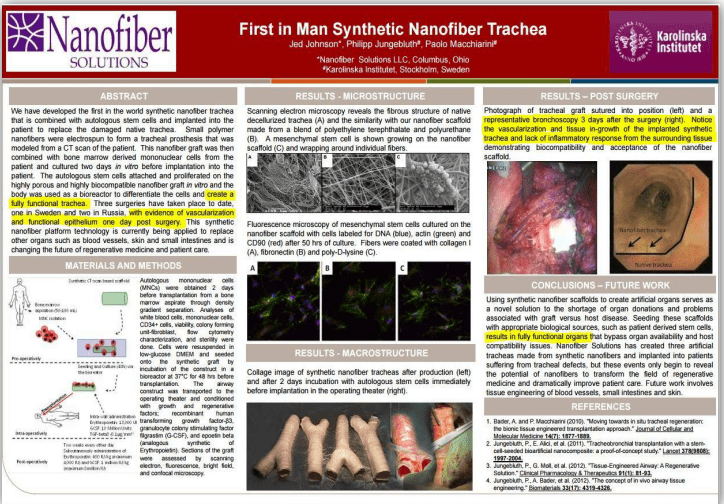
The most recent accusation by the KI whistleblowers related to the Jungebluth-Macchiarini poster from August 2012, “ First in Man Synthetic Nanofiber Trachea”, co-authored by Jed Johnson (described as “Chief Technology Officer (CTO) at the company Nanofiber Solutions that synthesized the tracheal scaffold described in the poster”). The entire dossier is available here. According to the newspaper Dagens Medicin, the patient whose state is deceptively presented on the poster is Chris Lyles, the second person to receive a plastic trachea. Lyles died shortly after.
Previously, the Heidelberg clinic directorship seemed to have little issues with what Jungebluth did before, in Sweden or in Russia. This is what I was told by Gerlach on March 8th 2016:
“Dr. Philipp Jungebluth is employed as Assistenzarzt in the Thoraxklinik since 2014. He is currently in the process of specialist training as thorax surgeon. He works scientifically in the area of regenerative medicine in the laboratory, on cells. The criticized therapy methods (trachea transplantation or tracheal division) are not being performed or offered in the Thoraxklinik-Heidelberg. We can offer no comment on the reported events at Karolinska-Institute (KI) in Stockholm, since these are not connected to the Thoraxklinik”.
Seems the German university clinic has changed their supportive stance in the meanwhile.

 For Better Science
Pingback: Expert review: Macchiarini papers on plastic trachea transplants are misconduct – For Better Science
Pingback: The one who asked questions: interview with Johannes Wahlström, by Alla Astakhova – For Better Science
Pingback: Karolinska gets taught German medical ethics – For Better Science
Pingback: Karolinska’s haunted leadership – For Better Science
Pingback: Paolo Macchiarini indicted for aggravated assault in Sweden – For Better Science