

Gather around, scientists, and learn a lesson why you should never outsource your experiments to an external company. And we are not talking about trashy papermills here! Serious North American labs in serious universities publishing in very serious journals chose to engage the services of a presumably serious California-based “global laboratory service company” called Neurodigitech. They must regret it now. Probably.
The entire credit for uncovering academic nightmare goes to Sholto David.
It all started with a PubPeer post by the very prolific commenter Yong‐Chang Zhou, on a recent Nature paper from the Harvard Medical School:
Violetta Karwacki-Neisius, Ahram Jang , Engin Cukuroglu , Albert Tai , Alan Jiao , Danilo Predes , Joon Yoon , Emily Brookes , Jiekai Chen , Aimee Iberg , Florian Halbritter , Katrin Õunap , Jozef Gecz , Thorsten M. Schlaeger , Shannan Ho Sui , Jonathan Göke, Xi He , Maria K. Lehtinen, Scott L. Pomeroy, Yang Shi WNT signalling control by KDM5C during development affects cognition Nature (2024) doi: 10.1038/s41586-024-07067-y

Illustrated by Sholto David: “There’s a little more to this. As well as the rotated section identified above, there is a mirrored section.”
Indeed, it was the first author and Harvard research fellow Violetta Karwacki-Neisius, who informed Sholto where her images came from:
“The images shown in Figure 5F were generated by Neurodigitech, which specializes in spine analysis (please refer to Acknowledgements). The samples were blinded for their analysis. We were in touch with Neurodigitech and were assured that everything was done properly.”
Indeed, the acknowledgements credit “M. Wu from Neurodigitech LLC for spine density analysis (Fig. 5e,f)“. Then Sholto found something even more worrisome:

Following are these three other papers:
- Amaan L Shaikh , Kathleen E Murray , Vijayalakshmi Ravindranath , Bruce A Citron Gulf war toxicant-induced effects on the hippocampal dendritic arbor are reversed by treatment with a extract Frontiers in Neuroscience (2024) doi: 10.3389/fnins.2024.1368667
- Thomas D Prevot, Akiko Sumitomo , Toshifumi Tomoda , Daniel E Knutson , Guanguan Li , Prithu Mondal , Mounira Banasr , James M Cook , Etienne Sibille Reversal of Age-Related Neuronal Atrophy by α5-GABAA Receptor Positive Allosteric Modulation Cerebral cortex (2021) doi: 10.1093/cercor/bhaa310
- Ravinder N. Dharavath , Ashley M. Bernardo , Cassandra Marceau-Linhares , Michael Marcotte , Carla Mezo-Gonzalez , Kayla Wong , Celeste Pina-Leblanc , Adrien Bouchet , Dishary Sharmin , Kamal P. Pandey , James M. Cook , Thomas D. Prevot, Etienne Sibille α5-GABA-A Receptor Positive Allosteric Modulation prevents neuronal atrophy and cognitive decline independently of p-Tau accumulation in the PS19 mouse model bioRxiv (2024) doi: 10.1101/2024.09.07.611810
The first one, from the lab of Bruce Citron at Rutgers University in USA acknowledged “Dr. Michael Wu of NeuroDigiTech for excellent technical discussion“. The other two papers are from the Campbell Family Mental Health Research Institute in Toronto, Canada. One thanks “Dr Michael Wu and his team at NeuroDigiTech, LLC (San Diego, CA) for the service provided in this study in regards of the Golgi staining quantifications.” The other is a preprint, likely currently in peer review or even in press somewhere, its authors thank “the members of NeuroDigitech for their contribution to data generation, and all the animals that contributed to these studies.” Pity that the animals died in vain, the bioRxiv preprint has an outrageously fake image of a neuron:

Sholto David: “Figure 2B: There are several cloned areas in this image. I’ve added the coloured rectangles to show where I mean. The red rectangle was already in the image.”
More bad neurons from the same Canadian lab of the University of Toronto professor Etienne Sibille. Again, the authors thanked “the members of NeuroDigitech for their contribution to data generation, and all the animals that contributed to these studies“:
Ashley M. Bernardo , Michael Marcotte , Kayla Wong , Dishary Sharmin , Kamal P. Pandey , James M. Cook , Etienne L. Sibille, Thomas D. Prevot Procognitive and neurotrophic benefits of α5-GABA-A receptor positive allosteric modulation in a β-amyloid deposition mouse model of Alzheimer’s disease pathology Neurobiology of Aging (2025) doi: 10.1016/j.neurobiolaging.2024.12.001

Another Sibille paper with his mentee Thomas Prevot, same problems, and again the authors thank “NeuroDigitech for their contribution to data generation“:
Ashley Bernardo , Philip Lee , Michael Marcotte , Md Yeunus Mian , Sepideh Rezvanian , Dishary Sharmin , Aleksandra Kovačević , Miroslav M Savić , James M Cook , Etienne Sibille, Thomas D Prevot Symptomatic and neurotrophic effects of GABAA receptor positive allosteric modulation in a mouse model of chronic stress Neuropsychopharmacology (2022) doi: 10.1038/s41386-022-01360-y

The following PLOS Biology study by UCL researchers in UK from 2019 actually has the Neurodigitech owner Michael Wu as coauthor, it shares image data with an older paper from a completely different group of authors from University of Wisconsin–Madison in USA (and without Wu on it):
- Naila Haq , Christoph Schmidt-Hieber , Fernando J. Sialana , Lorenza Ciani , Janosch P. Heller , Michelle Stewart , Liz Bentley , Sara Wells , Richard J. Rodenburg, Patrick M. Nolan , Elizabeth Forsythe , Michael C. Wu , Gert Lubec , P. Salinas , Michael Häusser, Philip L. Beales, Sofia Christou-Savina Loss of Bardet-Biedl syndrome proteins causes synaptic aberrations in principal neurons PLoS Biology (2019) doi: 10.1371/journal.pbio.3000414
- D.C. Knutson , A.M. Mitzey , L.E. Talton , M. Clagett-Dame Mice null for NEDD9 (HEF1α) display extensive hippocampal dendritic spine loss and cognitive impairment Brain Research (2016) doi: 10.1016/j.brainres.2015.12.005

The 2016 paper mentions in its Experimental Procedure “FD Rapid GolgiStain Kit as directed for analysis by Neurodigitech (San Diego, CA)” and that “Sterological analysis of BrdUþ cells was performed by Neurodigitech“.
Trials and Errors of Martin Gleave
“The magnitude was much greater than we had expected or hoped for,” – Martin Gleave

These two papers share images of neurons with yet another study, by the same lead author as in the Nature paper at the beginning: Yang Shi, formerly Harvard professor, now professor at the Ludwig Institute for Cancer Research of the University of Oxford in UK. It briefly credits “Neurodigitech, LLC for Sholl analysis“:
Shigeki Iwase, Emily Brookes, Saurabh Agarwal , Aimee I. Badeaux , Hikaru Ito , Christina N. Vallianatos , Giulio Srubek Tomassy , Tomas Kasza , Grace Lin , Andrew Thompson , Lei Gu , Kenneth Y. Kwan , Chinfei Chen , Maureen A. Sartor, Brian Egan , Jun Xu , Yang Shi A Mouse Model of X-linked Intellectual Disability Associated with Impaired Removal of Histone Methylation Cell Reports (2016) doi: 10.1016/j.celrep.2015.12.091

Shi’s former postdoc Shigeki Iwase, now professor at University of Michigan, must have been so impressed by Neurodigitech’s services that he continued using them in his own lab. In the following 2024 paper, the company’s boss Wu is coauthor (his COI statement is “M. C. W. is the CEO of Neurodigitech, LLC“). Sholto found pictures of neurons being reused from the studies we already encountered: Shi’s Nature paper Karwacki-Neisius et al 2024, as well as two studies from Sibille’s lab: Prevot et al 2021 and the preprint Dharavath et al 2024.
Masayoshi Nagai , Robert S. Porter , Maxwell Miyasato, Aijia Wang , Cecilia M. Gavilan , Elizabeth D. Hughes, Michael C. Wu, Thomas L. Saunders, Shigeki Iwase Neuronal splicing of the unmethylated histone H3K4 reader, PHF21A, prevents excessive synaptogenesis The Journal of biological chemistry (2024) doi: 10.1016/j.jbc.2024.107881


There must be many more studies out there which used Neurodigitech’s services, and quite possibly not all of them divulge this information. Sholto found one more, with Wu as coauthor. It reuses images of neurons we saw in papers by Sibille and Prevot (Bernardo et al 2025 and Dharavath et al 2024), its authors belong to the biotech company PTC Therapeutics in New York. The study declared: “M.C.W. is the President and CEO of NeuroDigiTech and was paid by PTC Therapeutics for this work.”
Gregory Voronin , Jana Narasimhan , Jamila Gittens , Josephine Sheedy , Philip Lipari , Melinda Peters , Steven DeMarco , Liangxian Cao , Yakov Varganov , Min Jung Kim , Lisset Pear , Eman Fotouh , Supriya Sinha , Balmiki Ray , Michael C. Wu , Padmaja Yalamanchili , Christopher Southgate , Joseph Pick , Khalil Saadipour , Stephen Jung , Jeanee Lee, Anna Mollin, Ellen M. Welch, Zhijian Wu, Marla Weetall Preclinical studies of gene replacement therapy for CDKL5 deficiency disorder Molecular therapy (2024) doi: 10.1016/j.ymthe.2024.07.012

There are also at least some duplicated regions within the figure, I’ve added the yellow rectangles.
The red rectangles are part of the original figure.”

A real entity in San Diego
So what is this “global laboratory service company” Neurodigitech? Well, it’s website only informs you of what services they offer (“Neurohistology, Golgi-Cox staining & Morphometrics analysis of CNS“) and what their terms and conditions are. It is certainly not the Neurodigitech website where one can learn who owns this company, but from external sources like Tracxn and Michael C Wu‘s profiles on LInkedIn and X.

There is no information on who owns or who works there. No photos of the labs. Searching the provided address (1106, 2nd St, Encinitas, California) in Google Streetview shows that it is located inside a small building:
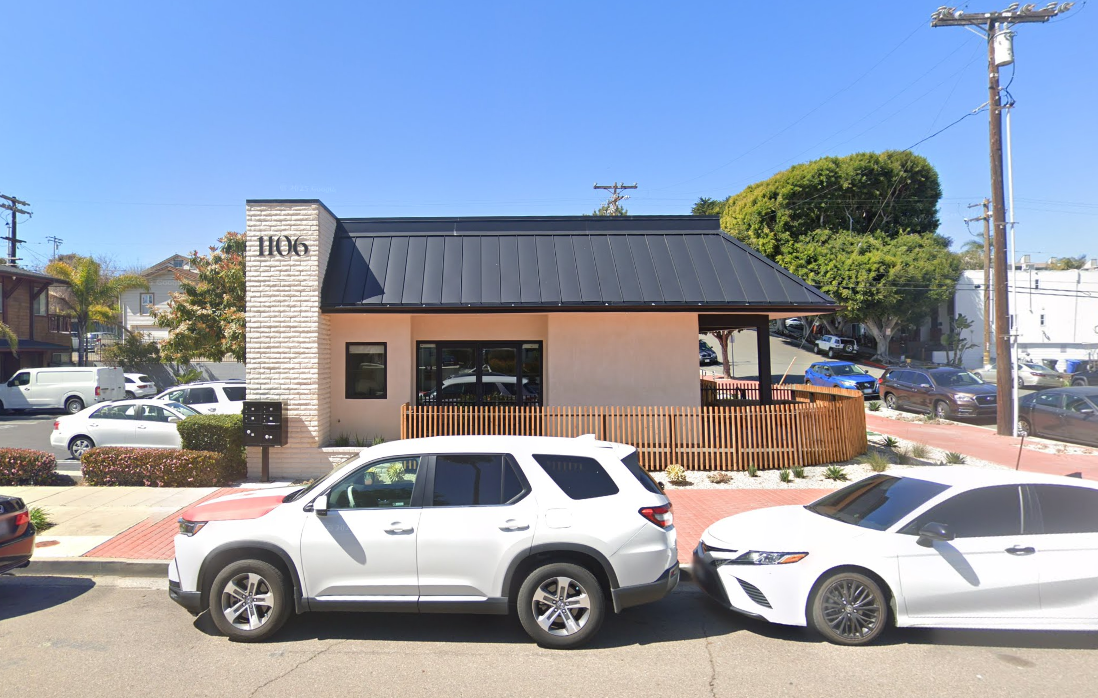
A high-tech biomedical research lab with laser scanning microscopes and so on, able to perform all that “high-throughput digital imaging & stereology-based quantitative morphology”, certainly won’t fit into this small building. And indeed, this is just a mailbox station. You can send your biological samples there, and maybe Wu will eventually come and pick them up.
According to his LinkedIn profile, Wu briefly worked in US academia, which he left in 2001 for various jobs in biotech industry. Neurodigitech was founded in 2007 or 2009 (depending on the source).
Fake-O-Meat by Ali Khademhosseini
Ali Khademhosseini is the greatest American researcher in regenerative medicine. His mentees are all professors themselves now. In his own Californian institute, he grows not only all possible organs, but even hamburgers!
Sholto wrote to the authors and Neurodigitech, For some time, the authors chose to remain silent, which is strange. Shouldn’t they be, you know, concerned? I mean, they paid money, obviously not their own, but still not exactly nobody’s money either, to receive data supporting their scientific discoveries for their peer-reviewed publications, and now it all turns out to be fake? Wouldn’t those fabrications, I wonder, possibly and hypothetically, uhm, affect the conclusions?
But Wu replied to Sholto:
“We thank you for the investigations using ImageTwin.AI that included the diagnosis of all the images produced by our team across different publications. After our vigorous effort in high-volume quantitative neuron morphology in the past, your claims have concerned us dearly, especially since we are currently processing image validation on DOI: 10.1038 against such claims with the Harvard team. We conducted our investigations on the accused image parts by analyzing the detailed spine subtype morphology present in those images. We will still make it available upon request.“
Followed by some drivel about selecting “representative images from each group for illustrations ” which aren’t important anyway because it’s the “quantitative data” which matters. And of course he blames some unnamed staff by suggesting they may have made errors with “double coding and traceability of blinded and unblinded slides, image acquisitions, and multiple projects“. Thus, Wu announced “internal investigations into our QA/QC procedure, the integrity of all steps regarding image acquisition, and our high-volume image library“, which will take a week, and, “if needed,” to “explore strategic and collaborative solutions for future work involving all affected members mentioned in this post.”
Basically, Wu offers his customers a refund, or maybe just vouchers.
I chimed in to ask Wu if he can prove there is an actual Neurodigitech lab with any actual people working in it. Wu insisted:
“my office is not a virtual office; it is a real entity in San Diego”
Yes, it is a real entity, a real mailbox. Does Wu trash all those samples his clueless customers send him, and then just fabricates stuff in Photoshop? Seems so. Eventually, after enough prodding from Sholto, the authors replied.
Shi thanked Sholto and assured: “We are taking this very seriously and have been working on it.” His current mentee Karwacki-Neisius also expressed thanks and wrote: “We are all quite shocked by what you uncovered and are working hard on finding a way to resolve this.” Shi’s past mentee Iwase wrote:
“Thank you for letting me know. This is disheartening. […]
We probably need to involve first the research integrity office of my university to do the investigation and then have them work with other institutions.
My lab will need to find a way to redo the measurements again to determine whether what we reported is real. “
Sibille and Prevot jointly wrote back to thank Sholto and assured him that they “take it very seriously“, and “are committed to making sure the data and research meet the highest standards of integrity.” Also Citron expressed his appreciation and said he is “checking into this in depth.”
Only two employees of PTC Therapeutics replied. Their Associate Director Balmiki Ray told Sholto that he was “just one of the coauthors and provided a complete different set of data“, and advised him to keep writing to the corresponding author Marla Weetall. Also Khalil Saadipour, who left PTC in January 2024, sent Sholto on his way: “The paper has a corresponding author and you can communicate with her“, and wished him good luck. Weetall never replied.
Sholto wondered why scientists would pay some obscure company to do such analyses instead of doing them themselves. My guess is that this kind of staining and microscopy of the neural system in mice is technically very challenging, and even if a lab masters it, they might still not obtain the desired results to support a certain theory.
But with Wu, there were only happy customers, so far.
Donate!
If you are interested to support my work, you can leave here a small tip of $5. Or several of small tips, just increase the amount as you like (2x=€10; 5x=€25). Your generous patronage of my journalism will be most appreciated!
€5.00

 For Better Science
Finally an external lab that may deserve the authors’ blame!
The Wayback machine first saw NeuroDigiTech 2005-11, https://web.archive.org/web/20051125100013/http://www.neurodigitech.com/contactus/4000.html.
“Neurodigitech (NDT) is a global laboratory service company that promotes both cost- and time-effective neural staining kits and laboratory services for the biomedical research community. The company was founded by a group of experienced neuroscientists, software engineers, and IT experts, who manage all aspects of modern technologies to deliver most reliable outcomes with full satisfaction.“
LikeLiked by 1 person
A team of Mike Wus! Or is it Mikes Wus?
“For the laboratory services, NDT provides the fastest turnaround of the results for our customers […] Using the state-of-the-art digital imaging and analysis protocol, “
LikeLike
“1106, 2nd St, Encinitas, California”. The low wooden fence, and the collection of plants in gravel look well tended. The well-appointed, grey building, and official looking mail boxes, suggest some form of business. All in all it sets a nice tone for the neighbourhood.
LikeLiked by 1 person
And, it’s only two blocks from the beach!
Despite having been around since circa 2007, there are no reviews for Neurodigitech on glassdoor, which is a bit suspicious.
LikeLiked by 1 person
““my office is not a virtual office; it is a real entity in San Diego” According to the Bernardo paper, “Neuronal morphology was assessed using Golgi Staining. The analysis was performed by NeuroDigiTech (San Francisco CA., USA). After arrival, a cryostat was used to cut 100μm thick serial, coronal slices from anterior to posterior and slices were mounted on glass slides. Basal and apical dendrites of pyramidal cells were identified in layers II/III of the PFC and the dorsal portion of CA1, occupying most of anterior two-thirds of CA1 (A-P axis) in the CA1 of the hippocampus and determined to be the regions of interest (ROIs). For quantification, NeuroLucida v10 (Microbrightfield, VT) software was used on a Dell PC computer and controlled a Zeiss Axioplan 2 image microscope with Optronics MicroFire CCD camera (1600×1200). A motorized X, Y and Z focus allowed for high resolution images and later quantification. ROIs were first considered under low magnification (10x and 20x) to identify those with the least truncations of distal dendrites at high-magnification (40x and 60x). Zeiss 100x objective was then used with immersion oil to construct 3D images and allow for spine counting along the complete dendritic tree. Neurons analyzed (n=6 per animal) were required to visually have a completely filled soma and dendrites, not overlap with other soma and have complete 3D visualization of the dendritic tree. Neurons with incomplete staining and/or incomplete visualization due to section plane were not included in the analysis. Analysis protocol and inclusion/exclusion criteria were adapted from Wu et al.7. For spine sampling, only those orthogonal to the dendritic shaft were well characterized and included as those above or below could not be adequately distinguished. Raw data was extrapolated and quantified using NeuroExplorer (Microbrightfield, VT).”
Maybe their main processing site is in Frisco.
LikeLike
Here by the way is Mike Wu’s other business, Axel Bio Corporation, located inside the same mailbox office.
https://www.bizprofile.net/ca/encinitas/axel-bio-corporation
” Phasellus fermentum, neque eget suscipit varius, neque sapien varius orci, nec dignissim mauris dolor quis ante. Donec vestibulum mi id dolor mollis mattis. Aenean et ultrices eros. In hac habitasse platea dictumst. Morbi tincidunt fermentum felis quis convallis.”
LikeLike
The Axel Bio Corporation was set up to sell syringes from Taiwan.
https://www.linkedin.com/pulse/axel-bio-corporation-abcorp-formally-enters-commercial-michael-wu
It seems Mike never took it seriously, as its content is literally just lorem ipsum placeholder text.
LikeLike
The other address for its product & lab service seems to be overlapping with a psychiatrist office. This is the address on the website:
8400 Miramar Rd, Suite 212A, San Diego, CA 92126, USA
This is the greenwavespsych address (Contact | Green Waves Psychiat):
8400 Miramar Rd, Suite 200-230A, San Diego, CA 92126
LikeLike
The company lists as address for its lab services indeed
PRODUCT & LAB SERVICE:
8400 Miramar Rd, Suite 212A
San Diego, CA 92126, USA
Tel: +1 (844) 899-0300
This address belongs to a building providing private office and co-work space, see https://www.miracre.com/mira-office-suites-miramar. It has pictures of the interior that seem to lack a laboratory handling neural tissues. The same page also presents the floorplan: https://images.squarespace-cdn.com/content/v1/59286bc49f7456197565648e/777f210f-9459-4c65-a1e3-53f54d75efa1/OS+FLOORPLAN+FOR+WEBSITE.jpg.
No surprise that Suite 212A is an at most 3×3 m^2 private office.
LikeLike
With respect to locations: the FBS post shows a Google streetview image labeled ‘Seat of Neurodigitech’. The building is correct, but the imaged ‘office’ is not. One can look back at historic streetview images. And by that find that until September 2022 the imaged location housed “Nufaces Day Spa“: https://www.google.com/maps/@33.0378387,-117.293705,3a,34.3y,266.65h,85.6t/data=!3m8!1e1!3m6!1sSyGO7KLbkAryzwRuVu6Qmg!2e0!5s20220901T000000!6shttps:%2F%2Fstreetviewpixels-pa.googleapis.com%2Fv1%2Fthumbnail%3Fcb_client%3Dmaps_sv.tactile%26w%3D900%26h%3D600%26pitch%3D4.399986519958105%26panoid%3DSyGO7KLbkAryzwRuVu6Qmg%26yaw%3D266.65240785167623!7i16384!8i8192
NeuroDigiTech ‘exists’ since 2006 at this location. Just like the ‘Mailbox station’ in that same building (https://www.google.com/maps/@33.0380123,-117.2940809,3a,66.9y,145.43h,87.15t/data=!3m8!1e1!3m6!1sYXsBHfgiGGMvIFm95fQG6Q!2e0!5s20070601T000000!6shttps:%2F%2Fstreetviewpixels-pa.googleapis.com%2Fv1%2Fthumbnail%3Fcb_client%3Dmaps_sv.tactile%26w%3D900%26h%3D600%26pitch%3D2.8546534898686957%26panoid%3DYXsBHfgiGGMvIFm95fQG6Q%26yaw%3D145.42580860210646!7i3328!8i1664).
LikeLike
I have noticed that when you try to establish an LLC through some online services websites (Tailor Brands for example), they offer you an option to buy a virtual mail address for less than a hundred dollars a month. I think this was probably the case here; he simply bought a virtual mailbox. His other company’s (AxelBio) office is also within a mall (https://www.newofficeamerica.com/details/serviced-offices-4445-eastgate-mall-sunroad-corporate-centre-suite-200-san-):
4445 Eastgate Mall, Suite 200
San Diego, CA 92121 USA
It says it has 192 Specialized laboratories in 16 states (https://axelbio.com/?page_id=16) which does not make any sense given the address and website. He advertises himself as a researcher and someone with a PhD in neuroscience from UCSD (https://about.me/michaelwu) but the exact year of his graduation from the university is unclear. I was unable to find any dissertations or records of him graduating from UCSD. There are actual research articles that he claims on his orcid and Google Scholar page affiliated with UCSD and then Neurome (which was apparently a legitimate company founded by Floyd Bloom) but the name (his?) on them is Chi-Cheng Wu not Michael. All of the papers on which the affiliation is Neurodigitech has his name is listed as Michael Wu.
LikeLike
Chi Cheng Wu is our Mike, that we already know.
He clearly worked in Floyd Bloom’s lab.
https://orcid.org/0000-0002-3829-8039
LikeLike
The same Xi He from the 1st mentioned paper:
https://pubpeer.com/publications/9F3694A1B488CEFE66DEA3DF66C7FF#0
https://pubpeer.com/publications/003BDACC3887EEAD706A5EA1679B39#0 (author’s list not complete)
LikeLiked by 1 person
If you read the NeuroDigiTech website carefully, it is evident that they do not do the actual imaging work, but rather it is consigned to independent contractors. For that, evidently, we can read Chinese paper mill. That would appear to leave the methods section from Prevost’s paper somewhat dangling in the wind.
LikeLike