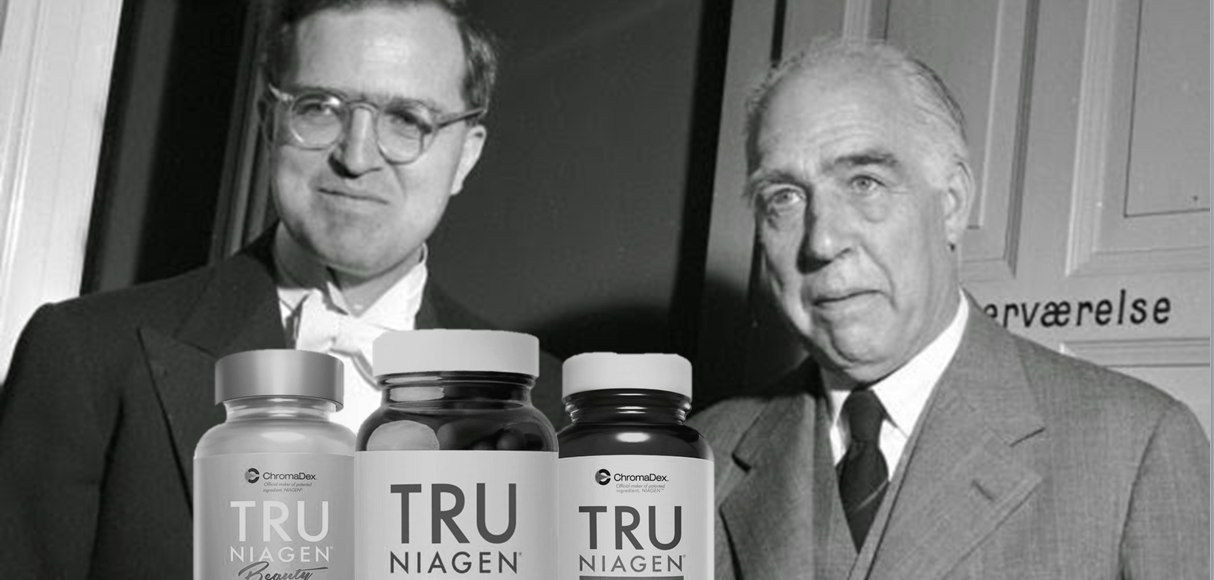

In October 2024, the University of Copenhagen announced the “Grand opening of the Niels Bohr Building with a royal inauguration “. Over a hundred years before that, in 1922, the Danish physicist Niels Bohr won the Nobel Prize for his discoveries of atomic structure. Later, in 1975, Niels Bohr’s son Aage Bohr won his own Nobel Prize in Physics, also on the structure of atoms.
Niels’ grandson and Aage’s son Vilhelm Bohr is also professor at the same University of Copenhagen. Will Vilhelm win a Nobel Prize of his own? And for what?
Vilhelm Bohr is 75 years old, and back to Denmark from the National Institute on Aging in Baltimore, USA. His new lab in Copenhagen is very small, its members can be counted on one hand. He will probably soon retire completely and sit by the phone, waiting for the Nobel Committee to congratulate him for having found a cure for old age.
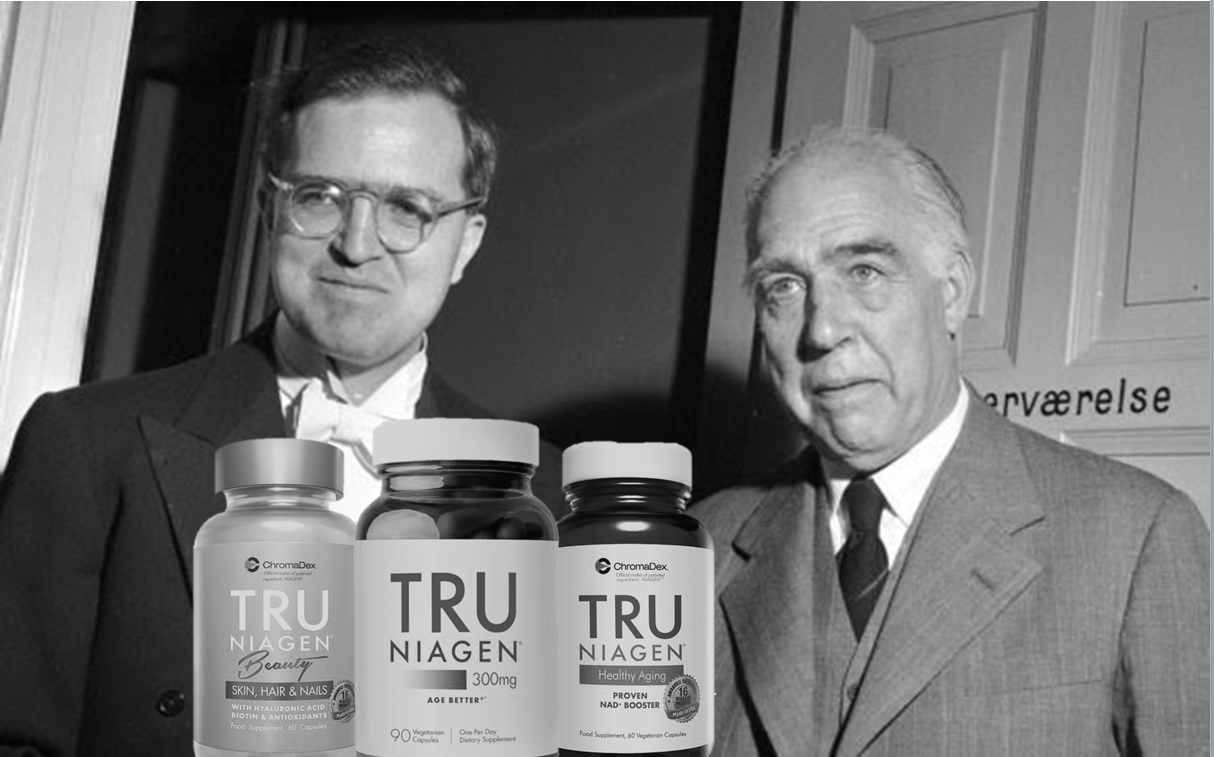
In January 2023, Bohr was recruited to the Scientific Advisory Board of the anti-aging supplement company ChromaDex. The announcement mentioned that Bohr’s research on the ChromaDex product Niagen® (the NAD+ supplement nicotinamide riboside) was funded by this company since 2014 and “resulted in 11 peer-reviewed publications“. Bohr’s current ChromaDex profile states:
“Dr. Bohr is one of the world’s most published researchers on aging and neurodegenerative disease with over 590 journal publications. For the past 30 years, Dr. Bohr served as Chief of the Laboratory of Molecular Genetics at the National Institute on Aging, which is part of the National Institutes of Health. […]
Although retiring from the National Institutes of Health, Dr. Bohr will maintain a research lab at the University of Copenhagen”
ChromaDex’s arch-rival in the NAD+ supplement business is the company Elysium Health, which was founded by the MIT professor Leonard Guarente, which has no less but EIGHT actual Nobel Prize laureates on its advisory board, including Thomas Südhof.
The original sins of Leonard Guarente
“Without specific and credible allegations of research misconduct, MIT is unable to take any action.”

In 2018, ChromaDex sued Elysium for nicotinamide riboside patent infringement, the lawsuit doesn’t seem to be over yet, with neither side clearly winning.
This is the kind of studies which earned Bohr the extra income with ChromaDex:
Yujun Hou , Yong Wei , Sofie Lautrup , Beimeng Yang , Yue Wang , Stephanie Cordonnier , Mark P Mattson , Deborah L Croteau , Vilhelm A Bohr NAD supplementation reduces neuroinflammation and cell senescence in a transgenic mouse model of Alzheimer’s disease via cGAS-STING Proceedings of the National Academy of Sciences (2021) doi: 10.1073/pnas.2011226118
“Competing interest statement: V.A.B. has a Cooperative Research and Development Agreement (CRADA) with Chromadex Corporation but receives no personal benefits.”
Now there are also personal benefits! And more recently, Bohr switched to pushing another anti-aging product, Urolithin A, which is manufactured by ChromaDex and sold under the name “Mitopure”. The University of Copenhagen in Denmark announced in May 2024 that “Naturally occurring substance in pomegranates can improve treatment of Alzheimer’s disease“:
“Our study on mouse models with AD shows that urolithin A, which is a naturally occurring substance in i.a. pomegranates, can alleviate memory problems and other consequences of dementia,” […]
“We still cannot say anything conclusive about the dosage. But I imagine that it is more than a pomegranate a day. However, the substance is already available in pill form, and we are currently trying to find the right dosage,” Vilhelm Bohr says.”
This is Bohr’s paper, again with Deborah Croteau, associate scientist at NIH National Institute of Aging:
Yujun Hou , Xixia Chu , Jae‐Hyeon Park , Qing Zhu , Mansoor Hussain , Zhiquan Li , Helena Borland Madsen , Beimeng Yang , Yong Wei , Yue Wang , Evandro F. Fang , Deborah L. Croteau , Vilhelm A. Bohr Urolithin A improves Alzheimer’s disease cognition and restores mitophagy and lysosomal functions Alzheimer s & Dementia (2024) doi: 10.1002/alz.13847
Janine Erler dossiers which ERC does not want
Janine Erler is a star of Danish cancer research, funded by ERC. Her earlier research led to the discovery of the key role of the enzyme lysyl oxidase in cancer metastasis and brought the scientist and businesswoman very close to curing cancer. Until some sad envious bad-wishers found duplicated gel bands in Erler papers.
Bohr actually used to be friend with Guarente’s mentee and NAD+ supplement entrepreneur David Sinclair, who also runs a NAD+ supplement company (read December 2024 Shorts). Here a common paper, on the obvious topic:
Hongying Yang , Tianle Yang , Joseph A. Baur , Evelyn Perez , Takashi Matsui , Juan J. Carmona , Dudley W. Lamming , Nadja C. Souza-Pinto , Vilhelm A. Bohr , Anthony Rosenzweig , Rafael De Cabo , Anthony A. Sauve , David A. Sinclair Nutrient-sensitive mitochondrial NAD+ levels dictate cell survival Cell (2007) doi: 10.1016/j.cell.2007.07.035


The friendship still went strong in 2011:
Michel Bernier, Rajib K. Paul , Alejandro Martin-Montalvo , Morten Scheibye-Knudsen , Shaoming Song , Hua-Jun He , Sean M. Armour , Basil P. Hubbard , Vilhelm A. Bohr , Lili Wang , Yaping Zong , David A. Sinclair, Rafael De Cabo Negative regulation of STAT3 protein-mediated cellular respiration by SIRT1 protein Journal of Biological Chemistry (2011) doi: 10.1074/jbc.m110.200311

There’s another joint paper by Bohr, Sinclair and the Senior Investigator at NIH National Institute on Aging, Rafael De Cabo, Martin-Montalvo et al Nature Comms 2013, where we can see from the “raw data” how the authors tricked and cheated when selecting data for main figures. De Cabo has a PubPeer record of dodgy science, the really serious stuff is all with Sinclair.
But also Bohr has a PubPeer record of his own. I contacted him about it in November 2024, and Bohr replied with one sentence:
“We are responding and these are not falsifications“
Ok, what are these then:
Peter Sykora , Jenq-Lin Yang , Leslie K. Ferrarelli , Jingyan Tian , Takashi Tadokoro , Avanti Kulkarni , Lior Weissman , Guido Keijzers , David M. Wilson , Mark P. Mattson , Vilhelm A. Bohr Modulation of DNA base excision repair during neuronal differentiation Neurobiology of Aging (2013) doi: 10.1016/j.neurobiolaging.2012.12.016

What kind of amateur lab produces such ridiculous western blot figures? Bohr responded on PubPeer:
“As seen from the FEN1 the bands had to be cut extremely closely because there were trailing bands from other proteins (probably Bactin) that entered the view in the differentiated samples due to the dip in the blot clearly seen in PCNA and Bactin.“
Well, actually the problem with the FEN-1 ( and Pol e) blots is not of horizontal cropping, but of the vertical one. But Bohr also stated that “both labs involved in the work are now closed original blot was not located.” Case closed.
But what about this, considering that Bohr is an expert for western blots:
Peter Ravn, Svend Kjær , Kristian Hobolt Jensen , Troels Wind , Kim Bak Jensen , Peter Kristensen, Robert M. Brosh, David K. Orren, Vilhelm A. Bohr, Brian F. C. Clark Identification of phage antibodies toward the Werner protein by selection on Western blots Electrophoresis (2000) doi: 10.1002/(sici)1522-2683(20000201)21:3<509::aid-elps509>3.0.co;2-5

Sloppiness, or worse? This is on PubPeer since 2015:
Venkateswarlu Popuri , Deborah L. Croteau , Vilhelm A. Bohr Substrate specific stimulation of NEIL1 by WRN but not the other human RecQ helicases DNA Repair (2010) doi: 10.1016/j.dnarep.2010.02.012


Bohr chose not to comment there. Or issue any corrections.
Again with Croteau, also flagged PubPeer in 2015, and then corrected:
Venkateswarlu Popuri , Jing Huang , Mahesh Ramamoorthy , Takashi Tadokoro , Deborah L. Croteau , Vilhelm A. Bohr RECQL5 plays co-operative and complementary roles with WRN syndrome helicase Nucleic Acids Research (2013) doi: 10.1093/nar/gks1134

More was found in that same paper and in fact in the same Figure 8A which should qualify for a retraction:


The paper where the bands of Figure 8A were recycled from, has other issues:
Venkateswarlu Popuri , Deborah L. Croteau , Robert M. Brosh , Vilhelm A. Bohr RECQ1 is required for cellular resistance to replication stress and catalyzes strand exchange on stalled replication fork structures Cell Cycle (2012) doi: 10.4161/cc.22581
Potential lane duplication in figure 3 D

A related set of papers, flagged on PubPeer in November 2015:
- Venkateswarlu Popuri , Joseph Hsu , Prabhat Khadka , Kent Horvath , Yie Liu , Deborah L. Croteau , Vilhelm A. Bohr Human RECQL1 participates in telomere maintenance Nucleic Acids Research (2014) doi: 10.1093/nar/gku200
- Venkateswarlu Popuri , Mahesh Ramamoorthy , Takashi Tadokoro , Dharmendra Kumar Singh , Parimal Karmakar , Deborah L. Croteau , Vilhelm A. Bohr Recruitment and retention dynamics of RECQL5 at DNA double strand break sites DNA Repair (2012) doi: 10.1016/j.dnarep.2012.05.001


A year later, in December 2016, the authors agreed to issue a Correction for only one of the above issues:
“In Figure 3A, signs of splicing are visible in the RECQL1 bands. The Authors have repeated the experiment and provide a new Figure 3A, shown below, confirming the results.”
Maybe Bohr just totally doesn’t believe in corrections. See this case, flagged in 2016:
Somnath Ghosh , Chandrika Canugovi , Jeong Seon Yoon , David M. Wilson , Deborah L. Croteau , Mark P. Mattson, Vilhelm A. Bohr Partial loss of the DNA repair scaffolding protein, Xrcc1, results in increased brain damage and reduced recovery from ischemic stroke in mice Neurobiology of Aging (2015) doi: 10.1016/j.neurobiolaging.2015.04.004

In February 2016, Somnath Ghosh admitted “an error in cropping the gel” and provided “the corrected figure we are sending to the Journal“. More than nine years passed and it was never published. In any case, the Actin gel may match the Xrcc1 and DBA Ligase II gels in Fig 4C, but it certainly doesn’t match the Caspase gels in Fig 3C which totally do not match each other either, making it at least 3 physically separate gels. Bohr obviously is very inept in western blotting. Thus I agree, the proposed correction would be wrong.

Kristian Helin gets the perfect job
ICR London has a new director. The Great Dane Kristian Helin is the perfect successor to continue the ideological line of fictional cancer research.
Similar problem:
Jingping Hu, Syed Z Imam, Kazunari Hashiguchi, Nadja C de Souza-Pinto, Vilhelm A Bohr Phosphorylation of human oxoguanine DNA glycosylase ( -OGG1) modulates its function Nucleic Acids Research (2005) doi: 10.1093/nar/gki636

Another bad job from National Institute on Aging:
Tinna Stevnsner, Simon Nyaga , Nadja C De Souza-Pinto , Gijsbertus T J Van Der Horst, Theo G M F Gorgels , Barbara A Hogue , Tina Thorslund , Vilhelm A Bohr Mitochondrial repair of 8-oxoguanine is deficient in Cockayne syndrome group B Oncogene (2002) doi: 10.1038/sj.onc.1205994

And this? Is Bohr sure this is not a falsification?
Jingsheng Tuo , Catheryne Chen , Xianmin Zeng , Mette Christiansen, Vilhelm A Bohr Functional crosstalk between hOgg1 and the helicase domain of Cockayne syndrome group B protein DNA Repair (2002) doi: 10.1016/s1568-7864(02)00116-7
Fig 6

Bohr wrote to me in his second email:
“Most are claims of similarity, but we have documentation that they are different and will upload.“
Narrator: they didn’t upload, at least not there. An interesting fact is that Bohr is perfectly able to find raw data from old papers to address concerns, as he did for Muftuoglu et al 2009. But strangely not for other cases!
By the same lead author Jingsheng Tuo, who is now Scientific Review Officer at the Office of Extramural Research in NIH:
Meltem Muftuoglu, Rebecca Selzer, Jingsheng Tuo , Robert M Brosh, Vilhelm A Bohr Phenotypic consequences of mutations in the conserved motifs of the putative helicase domain of the human Cockayne syndrome group B gene Gene (2002) doi: 10.1016/s0378-1119(01)00870-8


For Bohr, no reason for concern as he commented on PubPeer:
“We do not any longer have the original data and clearly these inserts should have been noted and explained in the Figure legend. However, we believe that the Figures overwhelmingly clearly show the UV-induced apoptosis in CS1AN.S3.G2 transfectant cell lines”
Here is a more recent paper by Bohr, which earned him a juicy salary as ChromaDex’s board member:
Evandro F. Fang, Yujun Hou , Sofie Lautrup , Martin Borch Jensen , Beimeng Yang , Tanima SenGupta , Domenica Caponio , Rojyar Khezri , Tyler G. Demarest , Yahyah Aman , David Figueroa , Marya Morevati , Ho-Joon Lee , Hisaya Kato , Henok Kassahun , Jong-Hyuk Lee , Deborah Filippelli , Mustafa Nazir Okur , Aswin Mangerich , Deborah L. Croteau , Yoshiro Maezawa, Costas A. Lyssiotis, Jun Tao, Koutaro Yokote, Tor Erik Rusten, Mark P. Mattson, Heinrich Jasper, Hilde Nilsen, Vilhelm A. Bohr NAD augmentation restores mitophagy and limits accelerated aging in Werner syndrome Nature Communications (2019) doi: 10.1038/s41467-019-13172-8

In Supplementary Figure 3k, the Western blots have no background. No background noise is seen when adjusting the contrast to the extreme for the source file, which is surprising.
The provided source files for the Western immunoblots show entire membranes where MW overlaps, indicating that the individual blots are not from the same run.”
The first author Evandro F. Fang (now group leader at the University of Oslo) replied in February 2022 and explained that “it is common to have very clean background” because “antibodies used were very specific + good washing of the membranes“, an argument he already used for Fang et al Nature Neuroscience 2019, and otherwise:
“An erroneous panel was included in Fig. 5d as the images in the first row (N2 veh) was identical to that of the data in the last row (wrn-1 NMN). The panel (N2 veh) in Fig. 5d has now been corrected. This error occurred during figure preparation and does not affect the results and conclusions of the study. The authors deeply regret this oversight.
An erratum notice will be sending to Nature Communications to ask for their suggestions.“
However, three and a half years passed since and no correction was published. Maybe the authors never sent any.
At least this paper was flagged just when it was published and then swiftly corrected:
Deblina Ghosh , Vilhelm A. Bohr , Parimal Karmakar Acetylation of Werner protein at K1127 and K1117 is important for nuclear trafficking and DNA repair DNA Repair (2019) doi: 10.1016/j.dnarep.2019.04.010


The Correction from November 2019 went:
“The authors here provide revised images in Figs. 1F, 2E, and 3F. These are all unintentional mistakes by the first author during data representation. Supplementary Fig. 4B and Fig. 5B have overlapping representative images of main Fig. 1F and Fig. 2E respectively so, it was also corrected accordingly. The present figure contains all the revised representative images. This correction does not affect the conclusion of the article.
Fig 1 F. WT WRN at 0 h and K1413R at 24 h are revised images.
Fig 2E. WT WRN and K1117R at 0 h and K1127R at 24 h are revised images.
Fig 3 F. K1127R, K1117R and EGFPC1 at 0 h are newly revised.
We also added here a detailed figure legend for Supplementary Fig. 2″
But then why not correcting a paper by same lead authors, Bohr and his mentee Parimal Karmakar, now professor at Jadavpur University? Too old?
Parimal Karmakar, Vilhelm A. Bohr Cellular dynamics and modulation of WRN protein is DNA damage specific Mechanisms of Ageing and Development (2005) doi: 10.1016/j.mad.2005.06.004

I reported the case to the University of Copenhagen. They never replied. And their named person for such investigations is a certain Nils Billestrup, who previously tried to save Karin Dahlman-Wright by declaring her guilty of nothing else but honest mistakes of oversight. It was also about fake western blots. Read here:

The Wonderful Adventures of Nils Billestrup with Swedish gels
I obtained the full report on the case of Karin Dahlman-Wright, Vice-Rector of the Karolinska Institutet. The investigation by Danish researcher Nils Billestrup for CEPN found 6 out of 8 papers contained data manipulations, but only in 2 cases serious enough to affect the conclusions.
A chemical element was named after Niels Bohr. Will an anti-aging supplement by ChromaDex be eventually named “Vilhelmborium”?

Donate!
If you are interested to support my work, you can leave here a small tip of $5. Or several of small tips, just increase the amount as you like (2x=€10; 5x=€25). Your generous patronage of my journalism will be most appreciated!
€5.00

 For Better Science
Completely out-of-topic, but it calls for sharing:
The prophet has spoken: https://link.springer.com/article/10.1007/s13762-023-04818-8
LikeLiked by 1 person
And the prophecy was 99% accurate. Not even worth investigating.
LikeLiked by 1 person
What’s that, Copenhagen you say? Reminds me I’d been sitting on this draft for quite a while… https://psblab.org/?p=319. TL/DR: my lab got a drug from a Danish company via a material transfer agreement (MTA), who then threatened legal action if we published our results, even though the MTA didn’t allow them to stop us.
LikeLike
Fang’s work before joining Bohr’s lab: https://pubpeer.com/publications/3A780BF98012175240762034237D36#0
LikeLiked by 1 person