As you all saw on the news, the US company Colossal Biosciences just de-extincted the dire wolf and is about to de-extinct mammoths, thylacines and dodos. Ronan Taylor is a wildlife conservation biologist and he has some comments on this company and their claims.
Colossal was founded by the MIT professor George Church and a tech bro called Ben Lamm. You can read about this company and Church’s other business activities (which are mostly about anti-aging, but also eugenics) here:
Colossal may be nowhere near cloning and de-extincting of the mammoths, but the company already informed the world what to do with them. You see, the mammoths, or some approximation thereof, are to be then deployed in the Arctics to somehow solve the climate change.
Hordes of excited journalists who grew up with Jurassic Park have been churning out Colossal bollocks like:
“How the Woolly Mammoth Could Prevent Trillions in Economic Loss” (Inc., January 2025)
“Is the age of de-extinction upon us?” (CNN, January 2025)
Already in early 2025, Colossal was valued at over $10 Billion, a ridiculous amount for a company which has no product except for science fiction stories.
But wait, they have a product now. Two in fact!
One is wooly mice, or micro-mammoths if you like. The Guardian was very excited in March 2025, reporting that Colossal geniuses have succeeded in “creating healthy, genetically modified mice that have traits geared towards cold tolerance, including woolly hair“. Here are these impressive biests, ready to stomp all over the Arctic:
The first real mammoth calf are said to follow “by the end of 2028“. Here is the relevant preprint:
Rui Chen, Kanokwan Srirattana, Melissa L. Coquelin, Rafael Vilar Sampaio, Raphael Wilson, Rakesh Ganji, Jacob Weston, Alba Ledesma, Jessie Beebe, Jacob Sullivan, Yiren Qin, J. Chris Chao, James Papizan, Anthony Mastracci IV, Ketaki Bhide, Jeremy Mathews, Rorie Oglesby, Mitra Menon, Tom van der Valk, Austin Bow, Brandi L. Cantarel, Matt James, James Kehler, Love Dalén, Ben Lamm, George M. Church, Beth Shapiro, Michael E. Abrams Multiplex-edited mice recapitulate woolly mammoth hair phenotypesbioRxiv (2025) doi: 10.1101/2025.03.03.641227
But even the most gullible journalist won’t confused mice, no matter how orange or furry, with mammoths. In this regard, Colossal’s previous “breakthrough” of alleged success with establishing induced pluripotent stem cells from an elephant, something rather necessary for any mammoth plans, is stuck at the stage of un-peer-reviewed preprint since March 2024:
Evan Appleton, Kyunghee Hong, Cristina Rodríguez-Caycedo, Yoshiaki Tanaka, Asaf Ashkenazy-Titelman, Ketaki Bhide, Cody Rasmussen-Ivey, Xochitl Ambriz-Peña, Nataly Korover, Hao Bai, Ana Quieroz, Jorgen Nelson, Grishma Rathod, Gregory Knox, Miles Morgan, Nandini Malviya, Kairui Zhang, Brody McNutt, James Kehler, Amanda Kowalczyk, Austin Bow, Bryan McLendon, Brandi Cantarel, Matt James, Christopher E. Mason, Charles Gray, Karl R. Koehler, Virginia Pearson, Ben Lamm, George Church, Eriona Hysolli Derivation of elephant induced pluripotent stem cellsbioRxiv (2024) doi: 10.1101/2024.03.05.583606
That despite celebratory reporting by all the media worldwide, like Forbes (“a game-changer”, “breakthrough” etc”. Maybe a clue: “there’s ongoing debate among scientists outside of Colossal’s project regarding the true nature of these iPSCs”.
Obviously no serious scientific journal was so far prepared to publish what is most likely a elephant cancer cell line. A fate which will await the silly new preprint about orange wooly mice, and the next great achievement by Colossal, the dire wolves.
“The dire wolf once roamed an American range that extended as far south as Venezuela and as far north as Canada, but not a single one has been seen in over 10,000 years, when the species went extinct. Plenty of dire wolf remains have been discovered across the Americas, however, and that presented an opportunity for a company named Colossal Biosciences
Relying on deft genetic engineering and ancient, preserved DNA, Colossal scientists deciphered the dire wolf genome, rewrote the genetic code of the common gray wolf to match it, and, using domestic dogs as surrogate mothers, brought Romulus, Remus, and their sister, 2-month-old Khaleesi, into the world during three separate births last fall and this winter—effectively for the first time de-extincting a line of beasts whose live gene pool long ago vanished. TIME met the males (Khaleesi was not present due to her young age) at a fenced field in a U.S. wildlife facility on March 24, on the condition that their location remain a secret to protect the animals from prying eyes.
The dire wolf isn’t the only animal that Colossal, which was founded in 2021 and currently employs 130 scientists, wants to bring back. Also on their de-extinction wish list is the woolly mammoth, the dodo, and the thylacine, or Tasmanian tiger.”
A separate TIME article described the genetic technology Colossal used to de-extict the dire wolf:
“Scientists first analyzed the genome of the dire wolves contained in the ancient tooth and skull. Comparing those genomes to that of the gray wolf—the dire wolf’s closest living relative—they identified 20 differences in 14 genes that account for the dire wolf’s distinguishing characteristics, including its greater size, white coat, wider head, larger teeth, more powerful shoulders, more-muscular legs, and characteristic vocalizations, especially howling and whining.
Next, they harvested endothelial progenitor cells (EPCs), which form the lining of bloodvessels, from the bloodstreams of living gray wolves—a less invasive procedure than taking a tissue sample—and edited the 14 genes in their nuclei to express those 20 dire wolf traits.”
Colossal’s CEO Lamm then described the technology as “magic”. Well, it is magic, of the circus or sleight-of-hand variety.
Ronan Taylor will now tell you why.
Colossal Liar Wolves
By Ronan Taylor
Direwolves are back!?! Well… Not exactly. Well… Not at all, the announcement that rocked the world a couple weeks ago from Colossal Biosciences that the first successful de-extinction was achieved was eaten up by media outlets with hardly any critical thought. Before we dive into Colossal’s questionable announcement. We need to have a look at the history of the Co-founder of Colossal, serial entrepreneur Ben Lamm.
Lamm’s Prehistory
During his senior year at college, Ben Lamm started a company called Chaotic Moon Studies. It produced games for the Oculus Rift like Shark Punch and Death from Above, both of which don’t appear to have been published anywhere, despite being featured in multiple press releases back in 2014.
In 2015, Chaotic Moon studios was acquired by Accenture, a company that Ben Lamm himself was managing director of at the time.
Lamm then founded an AI company called Conversable. It produced chatbots for fast food companies like Mcdonalds and Pizza Hut, as well as Booz Allen Hamilton. In 2018 Lamm’s business was acquired by AI language company LivePerson for an undisclosed amount.
Lamm would then go on to found Hypergiant, a tech company with big names on its board of advisors like Bill Nye the Science Guy. In 2019, Hypergiant announced a world altering device that would give climate change a run for its money. This was the EOS bioreactor, a device that utilizes AI to optimize algal growth and can sequester as much carbon as an acre of forest despite being as big as a fridge.
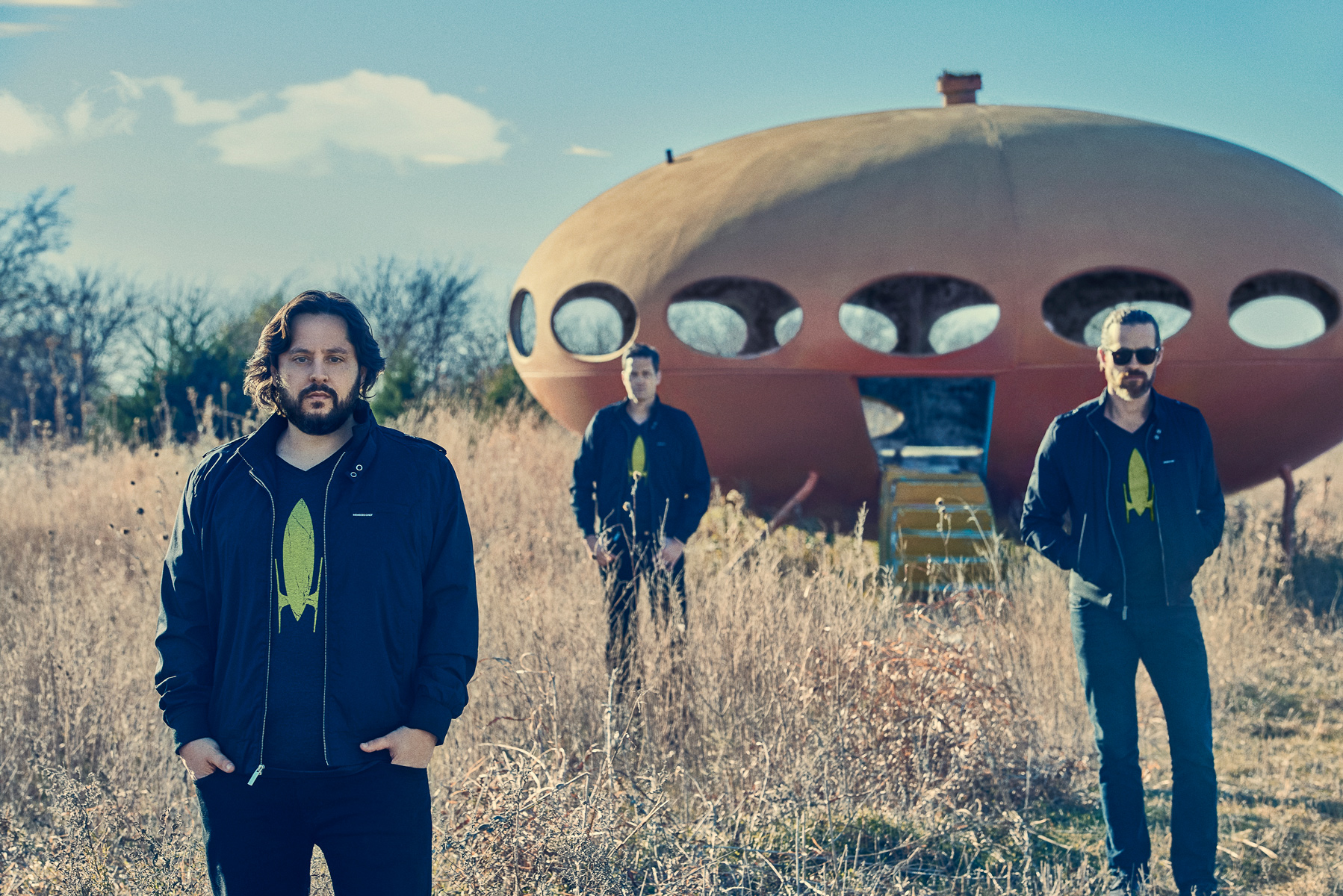
An actual promotional image for Hypergiant and not Ben Lamm’s Depeche Mode tribute band. (credit: John Davidson / D magazine)
So where is it? Good question! It appears to have been last mentioned in the media a couple of times in 2021.
One such mention was Hypergiant announcing in Forbes that they were soon to make the bioreactor open source, which we are still waiting on. The other was that it was to be featured in the Smithsonian Futures Exhibit. This author remembers attending said exhibition and thinking that it was essentially a dumping ground for failed prototypes from a variety of companies. Beyond that, there has been no news regarding the bioreactor. Good news for Hypergiant is that it looks like they did succeed, at least in accelerating climate change by using their satellite software to find new fossil fuel reserves.
Hypergiant was purchased by Trive Capital in 2023. One former employee of Hypergiant stated on Glassdoor:
“There is no secret sauce, there is no product, there is no money, just Hype.” and another commented “This isn’t a software company, it’s VC marketing hype”.
Colossal Biosciences
Of course, the most recent and famous of Lamm’s ventures is Colossal Biosciences; the self -proclaimed “World’s first de-extinction company”, now on a mission to resurrect the woolly mammoth, the dodo and the Tasmanian tiger and, apparently, the dire wolf. They brought in some of the most renowned geneticists on the planet, like questionable dating app developer George Church and ancient DNA specialist Beth Shapiro.
Having raised nearly half a billion dollars from celebrities who don’t understand genetics, like Peter Jackson, Paris Hilton and George R.R. Martin, Colossal is now worth over 10 billion dollars.
Strangely, according to Forbes, George Church does not have an equity stake in Colossal. Also according to Forbes, the company’s 10 billion dollar valuation is centred entirely around the promise of reviving extinct creatures. It should also be noted that while raising these funds, a court found Colossal had stolen dodo artwork from an artist for their pitch deck.
Apart from their de-extinction work, Colossal has the Colossal Foundation. Its stated aim is to support conservation work around the world, including groups like Biorescue, Save the Elephants and the Vaquita monitoring group, an organization I could find no record of (Outside of Colossal’s press releases.)
Of course, announcing project after project will only get you so far if you are going to maintain a multi billion dollar evaluation. You need to show results and on April 7th, 2025 Colossal showed to the world what they claimed to be the first successful de-extinction, ignoring that a Pyrenean ibex was briefly resurrected in 2001. We need to ask, did Colossal really bring back the famed dire wolf from extinction?
No. They did not.
Liar Wolves
Colossal is claiming that a mere 20 modifications to a grey wolf genome were all they needed to turn a grey wolf into a direwolf (none of the spliced genes originated from a direwolf) and that the two animals shared 99.5% of their DNA. That’s 0.3% greater than the difference between a human and a chimp. That’s right, we are more closely related to chimps than modern wolves are related to dire wolves. Even if those 20 genes were from a direwolf, there are likely at minimum thousands more genes required before these animals could be considered dire wolves by any reasonable measure.
Direwolves have remained a unique canid lineage for millions of years. A 2021 study (Perri et al Nature 2021) demonstrated that their closest living relatives were, in fact, jackals. However, Colossal has contradicted these claims by stating they have conducted their own study of the direwolf genome:
Gregory Gedman , Kathleen Morrill Pirovich , Jonas Oppenheimer , Chaz Hyseni , Molly Cassatt-Johnstone , Nicolas Alexandre , Will Troy , Chris Chao , Olivier Fedrigo , Savannah J. Hoyt , Patrick G.S. Grady , Samuel Sacco , William Seligmann , Ayusman Dash , Mithil Chokshi , Laura Knecht , James B. Papizan , Tyler Miyawaki , Sven Bocklandt , James Kelher , Sara Ord, Audrey T. Lin, Brandon Peecook, Angela Perri, Mikkel-Holger S. Sinding, Greger Larson, Julie Meachen, Love Dalén, Bridgett VonHoldt, M Thomas P. Gilbert, Christopher E. Mason, Rachel J O’Neill, Elinor Karlsson, Brandi L. Cantarel, George R. R. Martin, George Church, Ben Lamm, Beth Shapiro On the ancestry and evolution of the extinct dire wolfbioRxiv (2025) doi: 10.1101/2025.04.09.647074
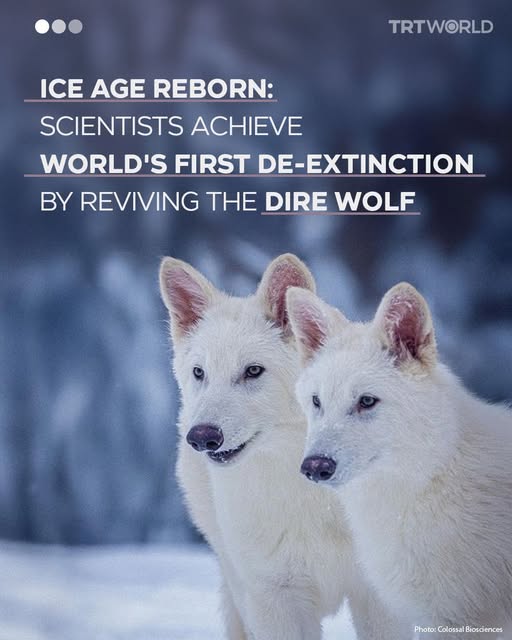
The study itself has not been peer reviewed and strangely lists Game of Thrones creator George R.R. Martin as an author. Given the numerous red flags surrounding the announcement, it would be unwise to accept the preprint as scientific fact. In truth, the preprint does not actually help Colossal’s case for their animal being a direwolf. According to the preprint, direwolves are more or less equally removed from most other canid lineages. Colossal released this preprint as a way to silence their critics in spite of nothing in it substantiating their claims. Of course, that’s not the part that really sticks out with this announcement. The part that literally sticks out is the wolf’s bright white fur.
A statement from our Chief Science Officer, Dr. Beth Shapiro, on the dire wolf project pic.twitter.com/upl3WPSeUw
Colossal is claiming that they have found evidence that direwolves were, in their words, “pale in coloration”, without publishing any evidence for that claim. Could direwolves have been pale in coloration? Absolutely, but in a way that some subspecies of coyote could be described as “pale”, but with added words such as “tan” or ”brown”. There is absolutely no way they could’ve been this stark white color. Why? Well, in spite of Ben Lamm’s claims on Joe Rogan Experience of direwolves only being found in the United States, they existed pretty much everywhere in between northern Argentina and the Great Lakes region. This means these animals only lived in temperate and tropical environments. In other words, in areas where snow only existed some of the year or never at all (even during ice ages). If you’re a white predator living in that environment, your prey will see you coming a mile away.
Also, most canids change coat color throughout their lifetime. This is so the pups can remain camouflaged from potential predators. According to Colossal, this predator who hardly saw snow wasn’t just white like an Arctic wolf in adulthood, but as a puppy as well. It is important to note that even Arctic wolf cubs are born with what Colossal would likely describe as a “pale brown color”. I have a feeling that the white color was deliberately added to evoke the image of the creatures from Game of Thrones and isn’t a trait that would’ve been found in the real creature.
Note the differences in ear coloration (“dire wolves” left, arctic wolves right (Gunnar Ries, CC BY-SA 2.5 via Wikimedia Commons), in case you couldn’t tell the two animals Colossal dubbed separate species, apart
Another strange detail is that these wolves have visible pink skin around the ears. Contrast this, with arctic wolves, arctic foxes or even polar bears. Notice how these other animals covered in white fur have fluffy ears? The reason is quite simple: constant exposure to frigid conditions means the whole body has to be insulated. A predator like a wolf needs good hearing and months of having its ears exposed to below freezing temperatures wouldn’t exactly do it any favors. Of course, this would make sense for a predator that wasn’t in arctic conditions, but if it wasn’t, why the fluffy white coat?
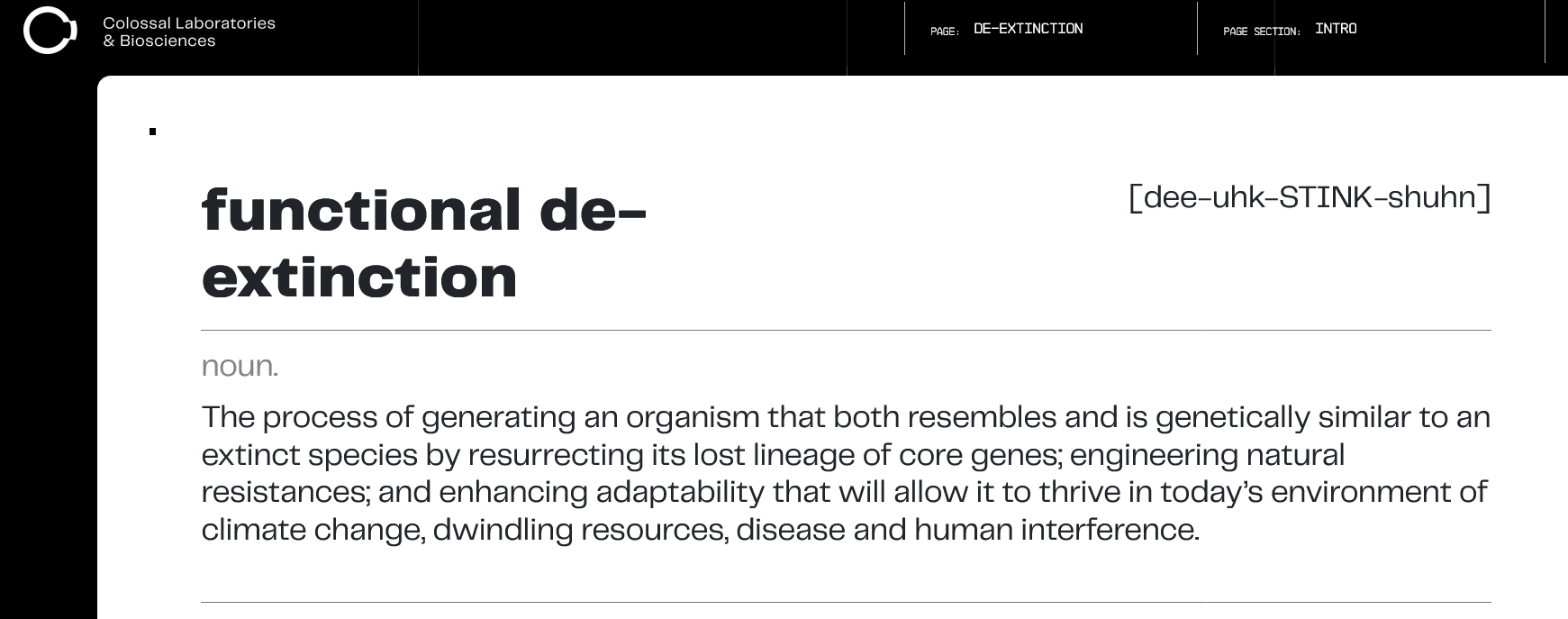
This also doesn’t lineup with Colossal’s definition of “functional de-extinction”, as these “direwolves” would have no chance of surviving in the wild, never mind filling the niche the animals once occupied. One might think the white coat was deliberately added to make the animal look like its wildly inaccurate portrayal in Game of Thrones.
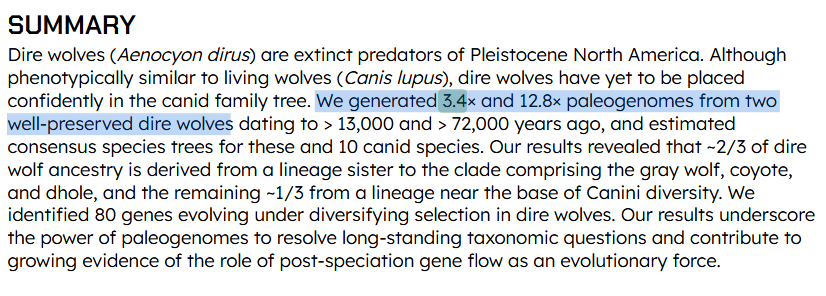
Suspiciously, Colossal cannot seem to stay consistent with just how much direwolf DNA they sequenced. According to Colossal’s preprint (Gedman et al 2025), they achieved 3.4x and 12.8x sequence reads of the genome’s from two different direwolf:
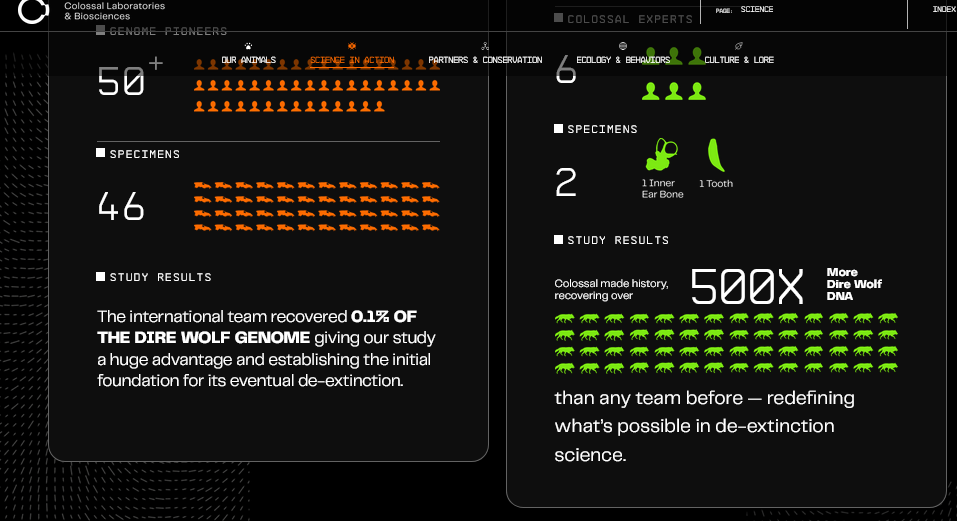
However, their website is claiming 500x greater coverage than the (Perri et al Nature 2021 study:
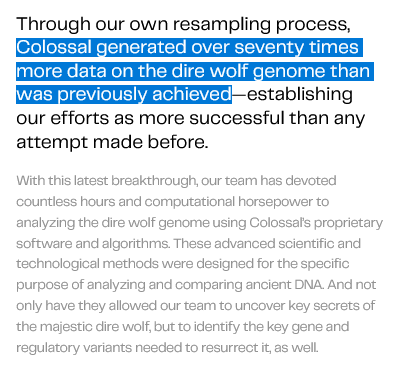
It is also claiming 55x time more and 70x more. If they only sequenced two individuals as they claimed, why am I seeing three differing figures?
The irony is, much of Colossal’s marketing has been centred around distancing themselves from Jurassic Park, a film now infamous for its numerous inaccuracies, like for example oversized, non-feathered velociraptors. If Colossal’s “direwolf” were to be featured in a Jurassic Park film, it would be just as inaccurate as the naked raptors.
When he was a guest on the Joe Rogan experience, Ben Lamm responded to criticisms from scientists by saying:
“They live in this sort of fortune and glory world, where it’s a popularity contest […] so one of the things people bitch about is they’re like , you guys don’t write scientific papers for every single thing you do. We’re not an academic university… I don’t have to write a paper on anything ever… If we wrote scientific papers for every single thing we did that went through peer review, like we would have 3000 scientific papers and no mammoths.”
Instead, Colossal has produced 0 peer reviewed papers and 0 mammoths. Thankfully, the CEO of Colossal, the company which is now valued at over ten billion dollars and clearly isn’t being honest about what it has accomplished, is in this for purely altruistic reasons and not “fortune and glory” like all those greedy academics. I would like to point out that Colossal is worth around a hundred times more than the annual operating budget of the WWF.
Ben Lamm seen cleary avoiding any tempations of “fortune and glory”.
For the sake of being ‘balanced’, these articles feature retorts from Colossal Biosciences CSO, Beth Shapiro. For example, ABCquoted her as saying:
“I think that the best definition of a species is if it looks like that species, if it is acting like that species, if it’s filling the role of that species, then you’ve done it.”
Where do you even begin with that? I’d say firstly that this line of reasoning is dependent on acknowledging that this is not the same species as a direwolf. This was never a shift in the conversation, these are questions that people have been discussing for years. In fact, there’s a whole new field for it, called conservation genetics.
Now, that being said, let’s assume Colossal actually did resurrect a proper direwolf and not the wish.com version of the animal. What next? All of its regular prey animals, with the exception of pronghorn, are now extinct. On top of that, dire and gray wolves had different behavior. We’ve pulled out way more direwolves than gray wolves from La Brea (Coltrain et al 2014), and it’s not clear as to why. This is just one of several open questions regarding behavioral differences. If we are restoring the ecology of Pleistocene North and South America, why start with the predator and not the prey? Again, I can’t help but feel that these “direwolves” were never made with any intention of producing an approximation of the actual animal.
Of course, many zoologists, geneticists and palaeontologists have been pointing out that this animal which Colossal has produced, isn’t a dire wolf, and Colossal seems to have walked back their claims of this being a true de-extinction, but rather a “functional de-extinction”. This is a definition accepted by the international Conservation body; the IUCN. However in a recent statement released by the IUCN Canid specialist group, the IUCN has decreed
“The three animals produced by Colossal are not dire wolves. Nor are they proxies of the direwolf based on IUCN SSC guiding principles of extinct species for conservation benefit.”
Colossal is also claiming that, beyond this obvious PR stunt, they have cloned what they refer to as red wolves. Trumpeting this supposed milestone, Colossal has plastered their social media with the announcement of the first cloned red “ghost” wolves, claiming that we can now produce endangered species en masse. Unfortunately, these wolves are actually coyotes. Now, they are coyotes with some redwolf alleles, as confirmed by Colossal’s on-the-ground partners who conducted the tissue collection, but still, they are coyotes and having them reintroduced and interbreeding with wolves, risks genetic pollution for an endangered species.
I believe it’s important to note that Colossal, when confronted with this on social media, responded by saying “Our cloned Red “ghost” Wolf has more Red Wolf DNA than any of the actual animals in the Red Wolf recovery program”. It should be noted the animals in the red wolf recovery program are in fact red wolves and not coyotes with some red wolf DNA. Given all this, the most charitable interpretation one could make of Colossal’s current predicament is that the company is run by a bunch of well-meaning yet confused scientists who have a lot of trouble telling apart different species of animals.
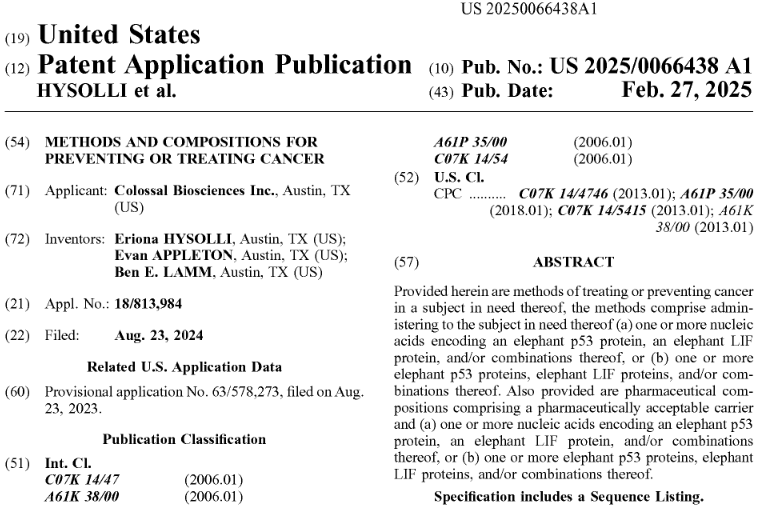
However I find it unlikely that such a group of people were able to raise around half a billion dollars and use it to produce a company worth over ten billion that doesn’t seem to sell anything. What is Colossal’s product? How is this supposed to make money? Perhaps all this “de-extinction research” is meant to attract attention with the hope of raising funds for patents? Looking at the patents Colossal has filed, this makes sense. For example, they filed a patent that they claim is a potential cancer treatment that utilizes the elephant protein p53.
Why this Grift Must go Extinct
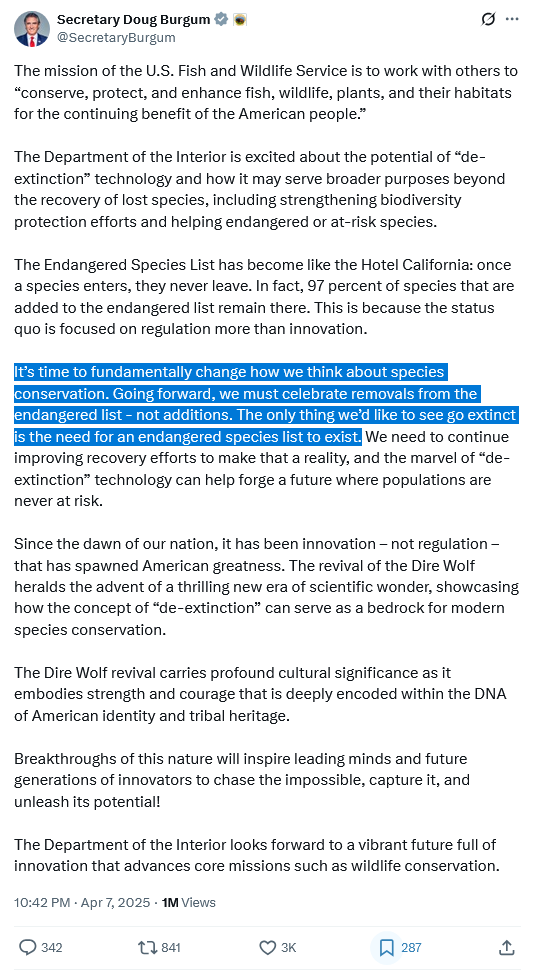
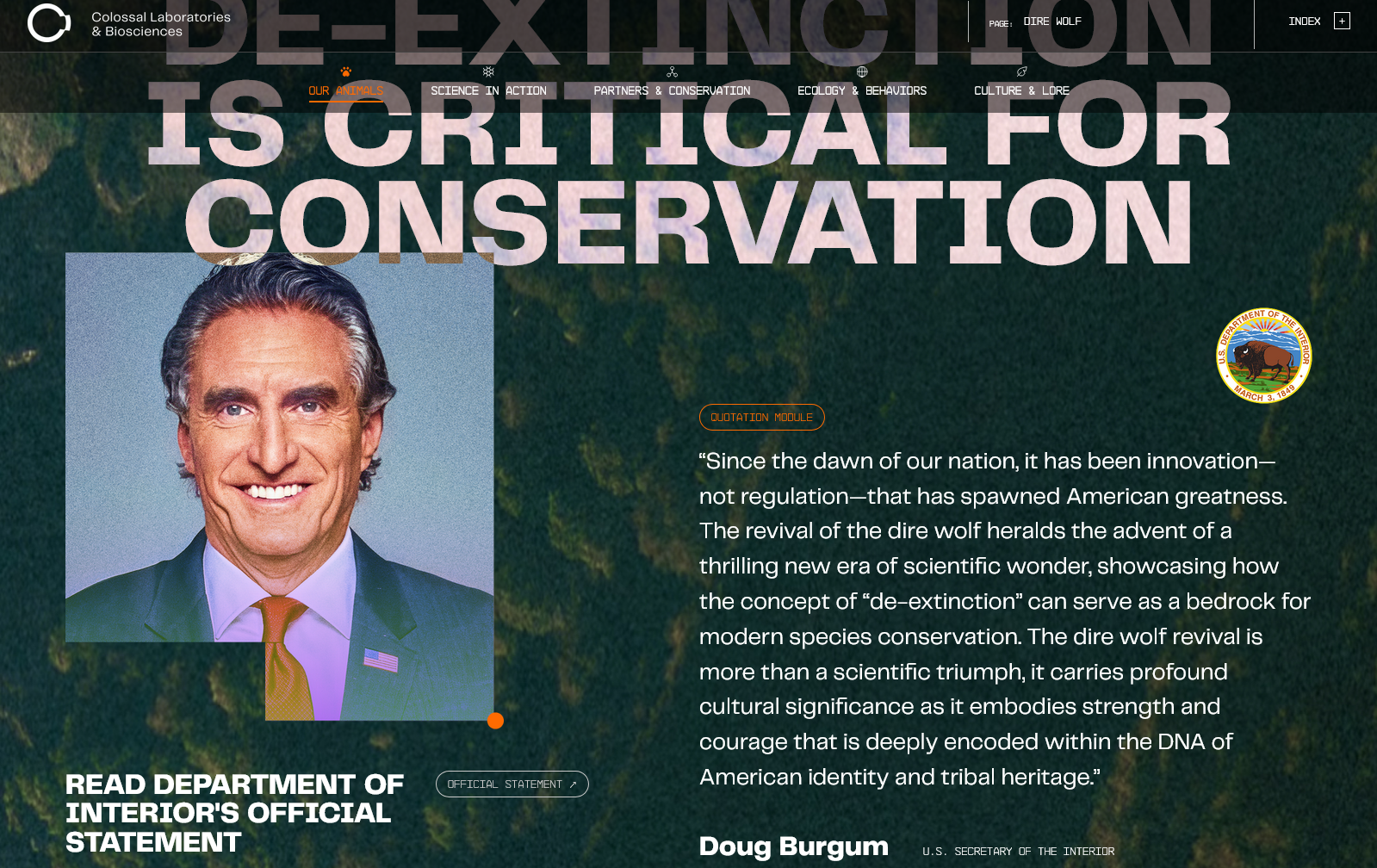
What is most concerning is that Colossal’s ‘dire wolves’ have now attracted the attention of the Trump administration. Trump’s Department of Interior head, Doug Burgham visited the company and according to the Washington Post, held a town hall meeting citing Colossal’s achievements with the “dire wolves” and “red wolves” as a reason to move past The Endangered Species Act. This is happening in accordance with the Trump administration moving to remove federal protections for North America’s remaining wolf populations and giving the Department of Interior the ability to approve projects that may result in a species’s extinction.
Doug Burgumon X “Going forward, we must celebrate removals from the endangered list – not additions. The only thing we’d like to see go extinct is the need for an endangered species list to exist.”
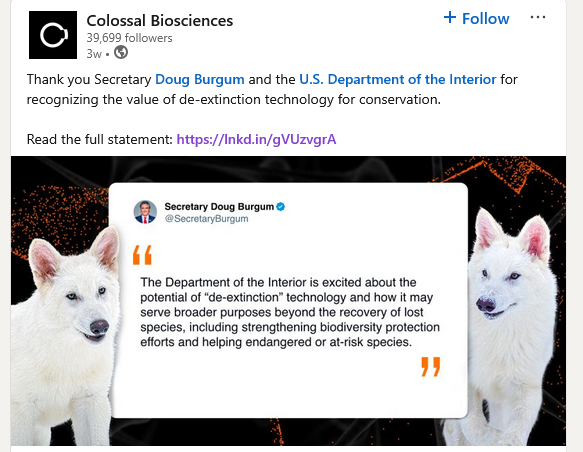
Recently, Ben Lamm went onto CBS Mornings to attempt damage control, stating that we do need an Endangered Species Act. If Ben was so insistent to the Trump administration that the Endangered Species Act was needed then why did the Secretary of Interior Doug Burgham, cite Colossal as a reason to do away with the act? Why is Burgham massively featured on Colossal’s site?
This reveals a disturbing but likely future for Colossal, similar to the way SpaceX reaps billions from government contracts while doing nothing at the expense of entities that produce actual research like NASA. It’s not hard to imagine Colossal taking government money to create the illusion of species preservation at the expense of the American taxpayer as the Trump administration further pummels the ecology of the planet and privatizes more or less every single function of the US Government.
For those of us working in rewilding, the existence of something like Colossal is an insult. We are constantly having to fight people like Doug Burgham just to restore even a small amount of land. We have to compete with entrenched interests spewing their own brand of bullshit. I have been far too many policy meetings with hunting lobbyists and beef industry shills lying about cows being a climate solution or hunters being an effective replacement for wolves, who effectively pushed something like wolf reintroduction completely out of the conversation.
These interest groups are constantly foaming at the mouth for any excuse to call someone like me an idiot so they can continue to lie to policy makers and the public. It looks like Colossal just provided all the big interests against rewilding with an excellent excuse to dismiss it out of hand and has given a fascist administration an excuse to do away with protection for endangered species.
It is time for Colossal to go extinct.
Postscriptum
On 8 May 2025, Colossal and their Australian collaborator Andrew Pask, professor at University of Melbourne, announced in the media to have “successfully mapped the complete DNA of the thylacine.” Pask was quoted:
“We’ve been able to make the first really key stem cells that we can do this whole genetic engineering process that we need to recreate the thylacine.”
This time, there is no peer-reviewed paper and no preprint, because journalists and investors don’t need those, and actual experts just ridicule whatever Colossal publishes. Pask is not bothered with scientific technicalities, he is already talking about “where we would put the animals, how we would monitor the animals, what impact they might have on the ecosystem“.
Donate!
If you are interested to support my work, you can leave here a small tip of $5. Or several of small tips, just increase the amount as you like (2x=€10; 5x=€25). Your generous patronage of my journalism will be most appreciated!
‘Lamm then founded an AI company called Conversable. It produced chatbots for fast food companies like Mcdonalds and Pizza Hut, as well as Booz Allen Hamilton. In 2018 Lamm’s business was acquired by AI language company Conversable for an undisclosed amount.’
IIRC Conversable was acquired by LivePerson (2018), a publicly traded AI-powered conversational commerce company.
PS: LivePerson acquired Conversable, Inc. on September 27, 2018, for a total estimated purchase price of $9.3 million. The deal included $1.2 million in cash, approximately $3.0 million in LivePerson common stock, and potential earn-out considerations totaling $2.1 million in cash and $0.3 million in stock, contingent upon achieving specific financial and strategic objectives. Additionally, there was a $0.6 million earn-out consideration for Conversable employees, treated as compensation and expensed over 12 months. The acquisition also accounted for $0.3 million in deferred revenue.
You pays your money, you has your fun, but I don’t see how they’re gonna make dollar one. Vanity project all around, but if you can get the cash from dumb celebs then why not? I agree with their policy of not publishing papers, which would simply pollute the literature with passing fancies. Also, who would review/publish this sort of thing – they could of course just start their own journal, but bioashcan is so convenient. As for the definition of species put forward by Shapiro – didn’t somebody else claim to have produced a dire wolf by breeding really big German shepherds? That might be fun, but having spent considerable time with regular ones I expect that all you would end up with is a sizeable food and dog bag bill.
This is very strange. This week I spoke to a co-worker who is visiting his in-laws in Jaktorow Poland, which is apparently the last place that the auroch (or tur, as they say there) was seen alive in the 1600s.
I prefer this Colossal website that’s been in my bookmarks for longer than I can remember… https://www.thisiscolossal.com/ But now a BS tech unicorn has to come along and spoil things. Boooo.
Church and others were also behind the recent editorial “Confronting risks of mirror life” Science (doi: 10.1126/science.ads9158) in which science mavericks warn of the day when we’ve figured out biology to the extent that we can re-write billions of years of evolution using mirror biomolecules. Nevermind we don’t know how most of molecular biology actually works in isolation, or together. More news headlines and science fiction.
The bioRxiv preprint server that you cite for Gedman et al. has a comments section, where I have set out the speciation science that is being disregarded. This is also posted at the Making Science Public site: The (not) de-extinct dire wolf: Metaphors, myths and magic – Making Science Public. Here is the corresponding cut-and-paste:
On the ancestry and evolution of the extinct dire wolf Donald R. Forsdyke
THE “ACCENT” OF DNA
You can explain the “de-extinction” problem, be it with mice or dire wolf, historically by considering the four bases in DNA sequences:
1. Chargaff circa 1950 discovered that DNA base composition (not sequence) was a species characteristic, simply expressed as GC% (as opposed to AT%).
2. So, there were GC%-rich species and AT%-rich species, with the exact values differing between species.
3. We biochemists and others discovered circa 1990 that actually the difference was due to short sequences (k-mers).
4. Thus, for k=3. GC%-rich species would be enriched in GTC, GGA, GGC, CAG, etc. Whereas for an AT-rich species ACT, AAG, AAT, TGA, etc.
5. Given 4 bases (A, C, G, T), for k=2 there would be 4×4 = 16 possibilities. For k=3 there would be 4x4x4 = 64 possibilities.
6. In practice the range varies from k=3 to k=8.
7. Fragments of DNA from, say, a soil sample, will correspond to a variety of species in the sample. But just by assessing the k-mer patterns in the fragments, those corresponding to each species can be identified.
8. Then you can look at the fragments corresponding to one species and examine long sections to identify gene sequences (viewed as “sentences” or “word strings”).
9. So, k-mers can be seen as the “accent” or “dialect” of DNA that relates to what species it belongs to. Unless you take that into account you cannot make a new species by just inserting a few genes to change appearance.
10. Just as accent can influence reproductive choices between humans (remember Eliza Doolittle), so it influences the reproductive isolation that is the defining characteristic of a species.
[A paper in the December 2024 issue of the Journal of Theoretical Biology goes into more details. Or see my textbook – Evolutionary Bioinformatics (3rd edition, 2016).]
” Now, in a subsequent interview, Colossal’s chief scientist Beth Shapiro appears to agree. “It’s not possible to bring something back that is identical to a species that used to be alive. Our animals are grey wolves with 20 edits that are cloned,” she tells New Scientist. “And we’ve said that from the very beginning. Colloquially, they’re calling them dire wolves and that makes people angry.””
How Ben Lamm Sells Hype and Stays Untouchable
Set aside the “disregard for speciation science,” as the De-Extinction Research Foundation put it. The bigger question is this: How the f** does a hype seller like Ben Lamm manage to exit his vapourware companies unscathed? So far, it seems he’s never faced any legal trouble.*
In an era where tech entrepreneurs are being hauled into court for misleading investors or collapsing billion-dollar ventures, Lamm stands out — not because he’s under fire, but because he isn’t. Despite launching a string of high-concept, high-hype startups — often with vague or scientifically dubious goals — he’s managed multiple clean exits and continues to attract funding. How?
He Sells a Vision, Not a Product
Lamm is a master of speculative storytelling. He doesn’t promise deliverables. Instead, he positions his companies as “platforms for the future”, where the goal is to inspire imagination rather than deliver immediate results. This ambiguity gives him insulation from legal repercussions. There’s no fraud if nothing was technically promised — just vision.
His Investors Know the Game
Most of Lamm’s ventures are funded by private venture capital or strategic buyers — not retail investors. These are so-called “sophisticated investors,” who are presumed to understand the risk of moonshot bets. Whether they truly understand the limits of synthetic biology or not is another question, but legally, they’re expected to.
Regulation Can’t Keep Up
Many of Lamm’s companies operate in lightly regulated sectors — artificial intelligence, synthetic biology, and biotech R&D. These fields are still evolving faster than the law can follow. Unless there’s outright deception or financial malfeasance, authorities have little reason — or ability — to step in.
He Exits Before Reality Bites
A key part of Lamm’s strategy seems to be getting out before a company’s promises are truly put to the test. He sells at the peak of the hype cycle — before results are due, expectations turn into scrutiny, or scientific limitations become undeniable. It’s exit timing, not execution, that he appears to optimize.
He Never Lies — Technically
This is perhaps the most important distinction between Ben Lamm and figures like Sam Bankman-Fried. SBF lied. He falsified records, misused funds, and misled customers and regulators. Lamm, by contrast, chooses his words carefully. He doesn’t make provably false claims — just aspirational ones. Statements like “we’re bringing back the mammoth” are framed as goals, not guarantees. As long as the language is vague, there’s nothing to prosecute.
Ben Lamm has built a career on moonshots and media buzz. His ventures — especially Colossal Biosciences — raise eyebrows among scientists and ethicists, but they remain legally clean. He plays a high-risk game, but plays it smart: lean on vision, stay ambiguous, exit early, and never promise more than you can plausibly deny.
Is that savvy entrepreneurship or scientific snake oil? The answer might depend less on law — and more on whether his investors and the public ever stop buying the story.
‘TE WAIPOUNAMU/SOUTH ISLAND, New Zealand–(BUSINESS WIRE)–In a historic indigenous-coordinated initiative, the Ngāi Tahu Research Centrehas entered into a collaboration with Colossal Biosciences, a Texas-based genetic engineering and de-extinction company, and acclaimed filmmaker Sir Peter Jackson, to work together to resurrect the extinct South Island Giant Moa.’
It’s a move oddly on-brand for Jackson, whose early masterpiece Braindead glorified the grotesque consequences of bringing the dead back. Now, he’s applying the same philosophy to paleogenetics, apparently determined to prove that no species—no matter how flightless or fossilised—is safe from a reboot.
And let’s be honest: the title Braindead feels more apt than ever, both as a callback to Jackson’s undead-splattered origins and as a quiet commentary on the decision-making here. Because what better time to reintroduce a giant, clumsy, ecological wildcard than during a global biodiversity crisis?
Still, one has to admire the dedication. If Peter Jackson insists on giving us sequels no one asked for, at least this one squawks.
Critics of de-extinction research hit by mystery smear campaign
Several researchers who have been critical of Colossal Biosciences’ plans to revive extinct animals say they have been targeted by online articles trying to discredit them
Academics who have questioned the validity of efforts to “de-extinct” animals like the woolly mammoth and the dire wolf have complained of an apparent campaign to discredit them. They believe the attacks are intended to deter criticism of de-extinction projects, a controversial research area attracting considerable attention from the media and investors.







 For Better Science
A fun read. Found small confusing statement:
‘Lamm then founded an AI company called Conversable. It produced chatbots for fast food companies like Mcdonalds and Pizza Hut, as well as Booz Allen Hamilton. In 2018 Lamm’s business was acquired by AI language company Conversable for an undisclosed amount.’
IIRC Conversable was acquired by LivePerson (2018), a publicly traded AI-powered conversational commerce company.
LikeLike
Thank you, we corrected the error now. Conclusions remain unaffected.
LikeLiked by 1 person
PS:
LivePerson acquired Conversable, Inc. on September 27, 2018, for a total estimated purchase price of $9.3 million. The deal included $1.2 million in cash, approximately $3.0 million in LivePerson common stock, and potential earn-out considerations totaling $2.1 million in cash and $0.3 million in stock, contingent upon achieving specific financial and strategic objectives. Additionally, there was a $0.6 million earn-out consideration for Conversable employees, treated as compensation and expensed over 12 months. The acquisition also accounted for $0.3 million in deferred revenue.
LikeLike
Where did you find the sum?
“Financial terms of the transaction were not disclosed. “
(https://pr.liveperson.com/index.php?s=43&item=539)
LikeLike
https://www.marketscreener.com/quote/stock/LIVEPERSON-INC-9909/news/LivePerson-Inc-acquired-Conversable-Inc-for-9-3-million-34563323/
LikeLiked by 2 people
Utterly disturbing. Thanks for sharing.
LikeLiked by 1 person
You pays your money, you has your fun, but I don’t see how they’re gonna make dollar one. Vanity project all around, but if you can get the cash from dumb celebs then why not? I agree with their policy of not publishing papers, which would simply pollute the literature with passing fancies. Also, who would review/publish this sort of thing – they could of course just start their own journal, but bioashcan is so convenient. As for the definition of species put forward by Shapiro – didn’t somebody else claim to have produced a dire wolf by breeding really big German shepherds? That might be fun, but having spent considerable time with regular ones I expect that all you would end up with is a sizeable food and dog bag bill.
LikeLike
There are Nazi Aurochs, btw. Who needs George Church when you have Hermann Göring.
https://www.vice.com/en/article/the-nazi-attempt-to-breed-ancient-cattle/
LikeLike
This is very strange. This week I spoke to a co-worker who is visiting his in-laws in Jaktorow Poland, which is apparently the last place that the auroch (or tur, as they say there) was seen alive in the 1600s.
LikeLike
George RR Martin falls victim to publish or perish culture. So sad.
LikeLiked by 1 person
I prefer this Colossal website that’s been in my bookmarks for longer than I can remember… https://www.thisiscolossal.com/ But now a BS tech unicorn has to come along and spoil things. Boooo.
LikeLike
Church and others were also behind the recent editorial “Confronting risks of mirror life”
Science (doi: 10.1126/science.ads9158) in which science mavericks warn of the day when we’ve figured out biology to the extent that we can re-write billions of years of evolution using mirror biomolecules. Nevermind we don’t know how most of molecular biology actually works in isolation, or together. More news headlines and science fiction.
LikeLiked by 1 person
The bioRxiv preprint server that you cite for Gedman et al. has a comments section, where I have set out the speciation science that is being disregarded. This is also posted at the Making Science Public site: The (not) de-extinct dire wolf: Metaphors, myths and magic – Making Science Public. Here is the corresponding cut-and-paste:
On the ancestry and evolution of the extinct dire wolf
Donald R. Forsdyke
THE “ACCENT” OF DNA
You can explain the “de-extinction” problem, be it with mice or dire wolf, historically by considering the four bases in DNA sequences:
1. Chargaff circa 1950 discovered that DNA base composition (not sequence) was a species characteristic, simply expressed as GC% (as opposed to AT%).
2. So, there were GC%-rich species and AT%-rich species, with the exact values differing between species.
3. We biochemists and others discovered circa 1990 that actually the difference was due to short sequences (k-mers).
4. Thus, for k=3. GC%-rich species would be enriched in GTC, GGA, GGC, CAG, etc. Whereas for an AT-rich species ACT, AAG, AAT, TGA, etc.
5. Given 4 bases (A, C, G, T), for k=2 there would be 4×4 = 16 possibilities. For k=3 there would be 4x4x4 = 64 possibilities.
6. In practice the range varies from k=3 to k=8.
7. Fragments of DNA from, say, a soil sample, will correspond to a variety of species in the sample. But just by assessing the k-mer patterns in the fragments, those corresponding to each species can be identified.
8. Then you can look at the fragments corresponding to one species and examine long sections to identify gene sequences (viewed as “sentences” or “word strings”).
9. So, k-mers can be seen as the “accent” or “dialect” of DNA that relates to what species it belongs to. Unless you take that into account you cannot make a new species by just inserting a few genes to change appearance.
10. Just as accent can influence reproductive choices between humans (remember Eliza Doolittle), so it influences the reproductive isolation that is the defining characteristic of a species.
[A paper in the December 2024 issue of the Journal of Theoretical Biology goes into more details. Or see my textbook – Evolutionary Bioinformatics (3rd edition, 2016).]
LikeLike
Here’s hoping that Doug Burgum (aka the world’s second-stupidest human) meets up with a real Dire Wolf some day – the one that’s 600 pounds of sin.
LikeLike
https://www.newscientist.com/article/2481409-colossal-scientist-now-admits-they-havent-really-made-dire-wolves/
Oops!
LikeLiked by 1 person
” Now, in a subsequent interview, Colossal’s chief scientist Beth Shapiro appears to agree. “It’s not possible to bring something back that is identical to a species that used to be alive. Our animals are grey wolves with 20 edits that are cloned,” she tells New Scientist. “And we’ve said that from the very beginning. Colloquially, they’re calling them dire wolves and that makes people angry.””
LikeLike
“UCSC professor Beth Shapiro with a dire wolf pup”
https://lookout.co/dire-wolf-uc-santa-cruz-biologist-beth-shapiro-part-of-team-that-brought-version-back-to-life/story
LikeLike
How Ben Lamm Sells Hype and Stays Untouchable
Set aside the “disregard for speciation science,” as the De-Extinction Research Foundation put it. The bigger question is this: How the f** does a hype seller like Ben Lamm manage to exit his vapourware companies unscathed? So far, it seems he’s never faced any legal trouble.*
In an era where tech entrepreneurs are being hauled into court for misleading investors or collapsing billion-dollar ventures, Lamm stands out — not because he’s under fire, but because he isn’t. Despite launching a string of high-concept, high-hype startups — often with vague or scientifically dubious goals — he’s managed multiple clean exits and continues to attract funding. How?
He Sells a Vision, Not a Product
Lamm is a master of speculative storytelling. He doesn’t promise deliverables. Instead, he positions his companies as “platforms for the future”, where the goal is to inspire imagination rather than deliver immediate results. This ambiguity gives him insulation from legal repercussions. There’s no fraud if nothing was technically promised — just vision.
His Investors Know the Game
Most of Lamm’s ventures are funded by private venture capital or strategic buyers — not retail investors. These are so-called “sophisticated investors,” who are presumed to understand the risk of moonshot bets. Whether they truly understand the limits of synthetic biology or not is another question, but legally, they’re expected to.
Regulation Can’t Keep Up
Many of Lamm’s companies operate in lightly regulated sectors — artificial intelligence, synthetic biology, and biotech R&D. These fields are still evolving faster than the law can follow. Unless there’s outright deception or financial malfeasance, authorities have little reason — or ability — to step in.
He Exits Before Reality Bites
A key part of Lamm’s strategy seems to be getting out before a company’s promises are truly put to the test. He sells at the peak of the hype cycle — before results are due, expectations turn into scrutiny, or scientific limitations become undeniable. It’s exit timing, not execution, that he appears to optimize.
He Never Lies — Technically
This is perhaps the most important distinction between Ben Lamm and figures like Sam Bankman-Fried. SBF lied. He falsified records, misused funds, and misled customers and regulators. Lamm, by contrast, chooses his words carefully. He doesn’t make provably false claims — just aspirational ones. Statements like “we’re bringing back the mammoth” are framed as goals, not guarantees. As long as the language is vague, there’s nothing to prosecute.
Ben Lamm has built a career on moonshots and media buzz. His ventures — especially Colossal Biosciences — raise eyebrows among scientists and ethicists, but they remain legally clean. He plays a high-risk game, but plays it smart: lean on vision, stay ambiguous, exit early, and never promise more than you can plausibly deny.
Is that savvy entrepreneurship or scientific snake oil? The answer might depend less on law — and more on whether his investors and the public ever stop buying the story.
LikeLiked by 1 person
Colossal is to biomedical science what Bitcoin is to world economy.
LikeLike
Et tu, Peter Jackson?
https://crisprmedicinenews.com/press-release-service/card/the-ngai-tahu-research-centre-has-entered-into-a-strategic-partnership-with-de-extinction-company-c/
‘TE WAIPOUNAMU/SOUTH ISLAND, New Zealand–(BUSINESS WIRE)–In a historic indigenous-coordinated initiative, the Ngāi Tahu Research Centrehas entered into a collaboration with Colossal Biosciences, a Texas-based genetic engineering and de-extinction company, and acclaimed filmmaker Sir Peter Jackson, to work together to resurrect the extinct South Island Giant Moa.’
LikeLiked by 1 person
The buggers were 2 meters tall and ate hobbits for lunch. Nice pick.
LikeLike
It’s a move oddly on-brand for Jackson, whose early masterpiece Braindead glorified the grotesque consequences of bringing the dead back. Now, he’s applying the same philosophy to paleogenetics, apparently determined to prove that no species—no matter how flightless or fossilised—is safe from a reboot.
And let’s be honest: the title Braindead feels more apt than ever, both as a callback to Jackson’s undead-splattered origins and as a quiet commentary on the decision-making here. Because what better time to reintroduce a giant, clumsy, ecological wildcard than during a global biodiversity crisis?
Still, one has to admire the dedication. If Peter Jackson insists on giving us sequels no one asked for, at least this one squawks.
LikeLike
https://www.nrahlf.org/articles/2025/5/5/9/de-extinction-debunked-dire-wolves-are-extinct-explains-wildlife-biologist/
way better than my attempt!
LikeLiked by 1 person
https://www.newscientist.com/article/2490643-critics-of-de-extinction-research-hit-by-mystery-smear-campaign/
Critics of de-extinction research hit by mystery smear campaign
Several researchers who have been critical of Colossal Biosciences’ plans to revive extinct animals say they have been targeted by online articles trying to discredit them
Academics who have questioned the validity of efforts to “de-extinct” animals like the woolly mammoth and the dire wolf have complained of an apparent campaign to discredit them. They believe the attacks are intended to deter criticism of de-extinction projects, a controversial research area attracting considerable attention from the media and investors.
LikeLike