

Parashorea tomentella found a group of young Chinese students who play academic superstars. Without having a PhD degree, and sometimes even as undergraduates, they sit on oodles of editorial boards and handle masses of papers and special issues. As editors and reviewers, these jumped-up youngsters not only help each other publish their trash, they also extort citations from other authors. The publishers are perfectly happy with the arrangement, except maybe when the papermills take over.
MDPI and BioMedCentral do not seem to place any requirements on their potential editors’ academic qualifications (see here and here). Hindawi asks at least for “a track record of publishing well-received papers within the journal’s scope“, whatever that may mean. Frontiers is their usual pretentious dishonest self:
“Review editors hold a PhD with post-doctoral experience, or an equivalent degree with several additional years of academic work, or the equivalent number of years to a recognized qualification in the relevant field of research. […] Associate editors are high-impact researchers and recognized leaders in their field, with a strong publication record in international, peer-reviewed journals and with a recognized affiliation. They are typically associate professor level or higher, or an equivalent position of equal standing in their field.”
In reality, Frontiers, just like the other publishers, takes anyone who asks.
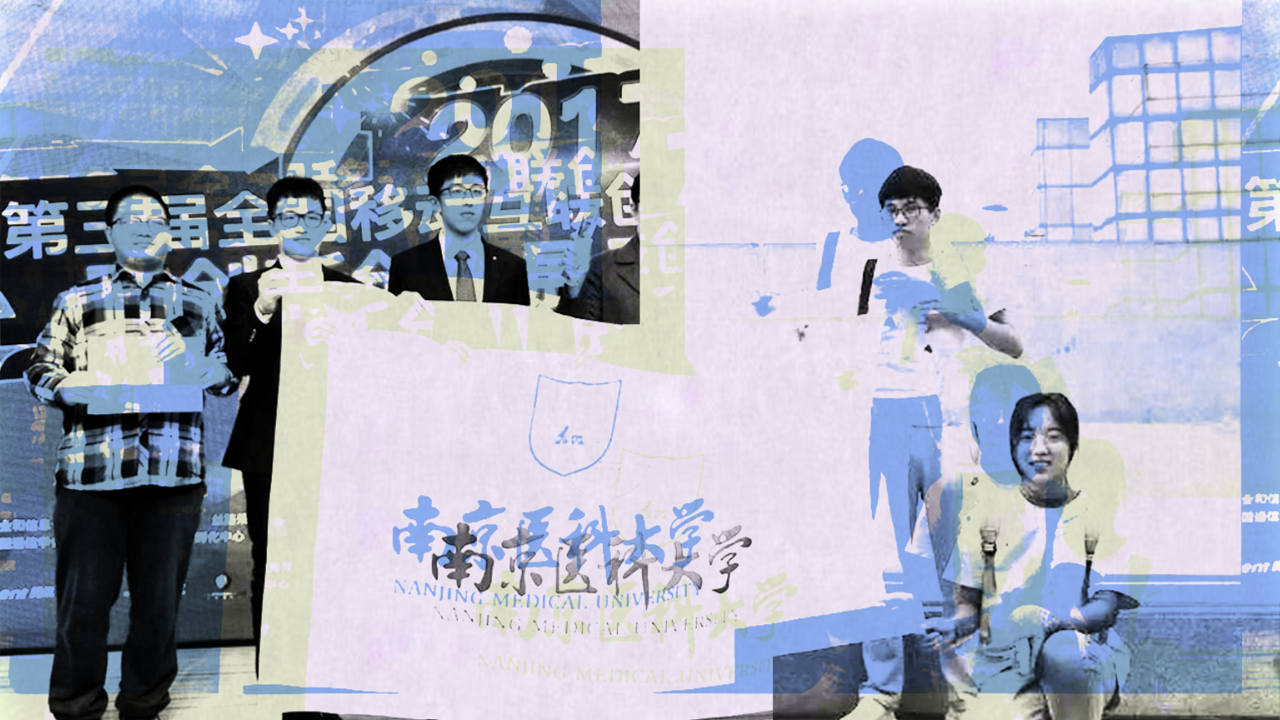
Up-and-coming stars in Nanjing Medical University
By Parashorea tomentella
One of the major changes in scholarly publishing since the COVID-19 pandemic has been the dramatic increase in the number of submissions and publications. While we are buried by an avalanche of papers, there is a constant shortage of reviewers, but also editors, needed to read manuscripts, reviewer reports, and make editorial decisions. This is why journals started to invite early career researchers, even students, to join their editorial boards.
Unfortunately, it is not only a lack of qualification which such editors often bring. I found a case where a lack of publisher oversight allowed ambitious Chinese editors to practice editorial misconduct. Some students and early career researchers affiliated with Nanjing Medical University holding editorial positions may have been involved in manipulating citations in dozens of articles that recently appeared in Hindawi, MDPI, Frontiers and BMC journals. I also observed how one such young man responsible for editorial misconduct acted as key opinion leader (KOL) instructed Chinese authors in defending themselves on PubPeer.
Enlarge my border
Against own rules, many journals do not prevent students and early career researchers from becoming editorial board members or guest editors. These journals are more interested in applicants who can supply many publications and a commitment to unpaid editorial work, while a doctorate degree is not really required. Hence, these three young Chinese could get those positions.
Hongda Liu, unlike the other two, does have a PhD degree, which he received from Shandong University in 2017. He joined the First Affiliated Hospital with Nanjing Medical University (Jiangsu Province Hospital) in 2019. Liu is a member of the editorial boards of Hindawi journals Genetics Research and International Journal of Genomics, Spandidos journals Medicine International and Oncology Letters, European Journal of Medical Research, Genes & Genomics, Lab Medicine, and Biomolecules and Biomedicine, and serves as a guest editor for Frontiers in Oncology (here, here, here and here), Frontiers in Immunology (here), Bentham journal Current Cancer Drug Targets (here), and Journal of Cancer Metastasis and Treatment (here).
Jincheng Wang graduated from Nanjing Medical University in 2018 and received his master’s degree from the First Affiliated Hospital with Nanjing Medical University in 2021 (although his advisor is affiliated with Nanjing Drum Tower Hospital). In the winter of 2022, he got funded by the China Scholarship Council – Hokkaido University Scholarship Program to study abroad for his PhD at Hokkaido University in Japan. He is on the editorial board of BMC Gastroenterology, PeerJ, Spandidos journals Biomedical Reports and Medicine International, PLOS One, and Hindawi journal Disease Markers, and serves as a guest editor for Hindawi journals Computational and Mathematical Methods in Medicine (CMMM) (here) and PPAR Research (here), MDPI journals Medicina (here) and Journal of Personalized Medicine (here), Frontiers in Immunology (here), Sage Publishers’ Technology in Cancer Research & Treatment (here), and Current Cancer Drug Targets (here).
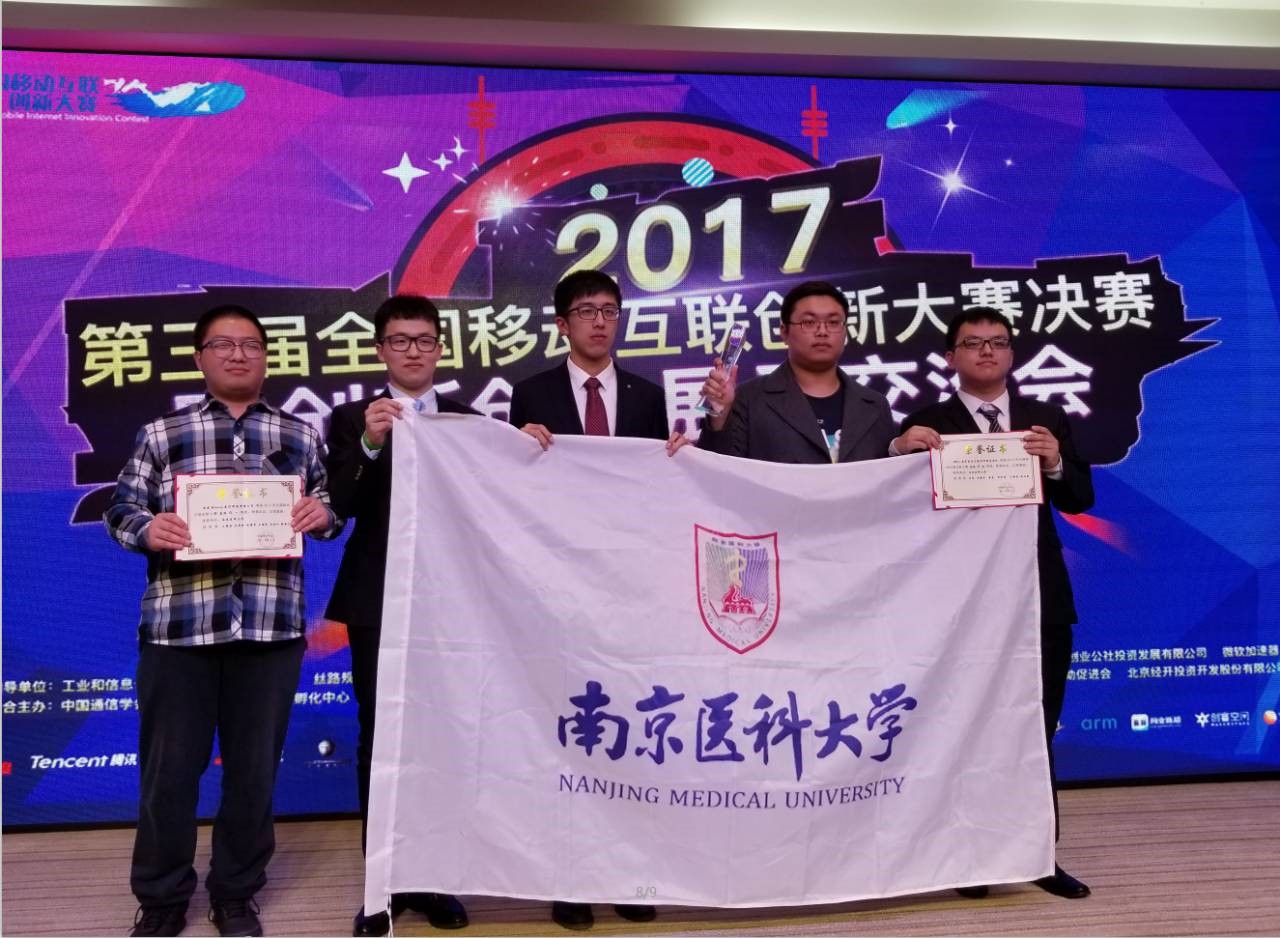
Xiaohan Ren graduated from Nanjing Medical University in 2020 and received his master’s degree from the First Affiliated Hospital with Nanjing Medical University in 2023. He is on the editorial board of BMC Medical Genomic and Hindawi journal International Journal of Clinical Practice. He seems to have acted as guest editor only once, in the special issue on “Machine Learning Approaches Based on Multiscale Data in Diagnosis, Treatment and Prognosis of Diseases” (here) of CMMM, which was led by Jincheng Wang as the lead guest editor. While he was in the second year of his master’s program, Ren was working on the special issue. At the same time Wang was at the Preparatory School for Chinese Students to Japan in the Northeast Normal University preparing for his future studies in Japan.
This collaboration was problematic, as records show that both Ren and Wang approved manuscripts that fell beyond the scope of the special issue. A retrospective cohort study on brain tumours in a Special Issue titled “Machine Learning Approaches Based on Multiscale Data in Diagnosis, Treatment and Prognosis of Diseases” never even mentioned machine learning, is one typical example of out-of-scope publication. This case is one of hundreds of out-of-control special issues that have appeared since Hindawi was acquired by Wiley. In an attempt to deal with the issue, Wiley decided to go for a mass retraction in two waves, and by now there have been about 7000 papers retracted from special issues of 50 Hindawi journals.

Cyclotron Branch, Before the Fall
“sadly, no-one could find any other evidence of existence for these festively-named individuals, who may well be Knock-Knock jokes that somehow gained sentience.” – Smut Clyde


Hindawi Garbage Sorting System, Based on Citations
Parashorea tomentella continues their investigation of Hindawi’s uneasy collaboration with Chinese papermills. Can it be solved with the promised 511 retractions?

Ren handled at least three manuscripts between June and August 2022 for this special issue, an experience that likely helped him gain experience with Hindawi’s corrupted system. Later, an irrelevant citation to Ren appeared in a manuscript submitted to the regular issue of Genetics Research on 7 September 2022, it was edited by Hongda Liu.
“…An additional study demonstrated that AKR1B10 and SPP1 were closely related to NAFLD and NAFLD-hepatocellular carcinoma immune cell infiltration and immunosuppressive cytokine expression [36].
36. X. Zhang, Z. Lu, X. Ren et al., “Genetic comprehension of organophosphate flame retardants, an emerging threat to prostate cancer,” Ecotoxicology and Environmental Safety, vol. 223, Article ID 112589, 2021.”
That study was published on November 3, 2022, and it might have marked the first step in Ren’s subsequent collaboration with Liu and Wang on manipulating citations.
Fundamentals of Biochemistry by Jakubowski and Flatt
Selected citations
I prepared a spreadsheet listing 20 articles edited by Liu and Wang, plus 23 references they cited. The latter include four articles by Hongda Liu, which appear in articles editorially handled by him (!), and 19 articles by Xiaohan Ren or Xu Zhang from the First Affiliated Hospital with Nanjing Medical University. Xu Zhang is a co-author of Ren, and he earned his master’s degree from the First Affiliated Hospital with Nanjing Medical University in 2020, and his MD there in 2023. In the spreadsheet, the author’s co-occurrence is noted, while “Wang” refers to the superiors of Ren and Zhang at the First Affiliated Hospital with Nanjing Medical University, Zengjun Wang, Shangqian Wang or Chao Qin, but not Jincheng Wang.
An article published in the regular issue of Genetics Research on 28 December 2022 is a good example of showing the citation manipulation in these articles.
“…In recent years, many studies focused on bioinformatics analysis to explore the genes that play an important role in the prognosis of tumor patients [21–25].”
It’s a vague, broad sentence that may be redundant in the paragraph. References 21-24 are all by Ren or Zhang, and reference 25 is by Hongda Liu, the editor of this paper. In at least 9 other articles, Ren and Zhang’s articles were cited in similar pattern. These citations sometimes are irrelevant, sometimes not. Besides this one, another study in the International Journal of Genomics (handled by Liu) says:
“…The development of bioinformatics can provide direction for finding potential biological targets [25–28].”
These four references are: two by Ren, one by Zhang, and one by both. From a study in Frontiers in Oncology, handled by Hongda Liu and reviewed by Jincheng Wang:
“…Bioinformatics can enhance people’s understanding of diseases (11, 12).”
Both are Ren’s papers. In PPAR Research, a study handled by Wang:
“…In recent years, the development of bioinformatics is accompanied by the arrival of the big data era, which provides convenience for researchers [11–13].”
One reference authored by Ren, one by Zhang, and one by both. In MDPI journal Medicina, a study handled by Wang and titled “Comprehensive Investigation Illustrates the Role of M2 Macrophages and Its Related Genes in Pancreatic Cancer“:
“…The rapid development of bioinformatics and open-access data is helpful for researchers [38,39,40,41].”
One reference authored by Ren, one by Zhang, and two by both. In this special issue, “Natural Products for Cancer Treatment: From Traditional Medicine to Modern Drug Discovery“, Wang approved the publication of manuscripts that were out of scope. For example, the above article makes no mention of any natural products.
Unless these manuscripts were not products of citation-selling papermills, the preference of different research groups to cite certain authors could only be interpreted as citation extortion from editors and reviewers. Specifically, this means instructions on which papers to cite, i.e. some papers by Ren or Zhang, as a condition for acceptance and publication of manuscripts. Whether editors themselves directly provided such citation instructions to authors, or whether they allowed their invited reviewers to do so – this implies editorial misconduct. We don’t know the true extent of this malpractice: I could find out about cases where the journals name the handling editors or reviewers. Many journals don’t do this.
Abuse of review reports
I also found some articles with editors other than Liu or Wang, two of which were published in Frontiers in Oncology and reviewed by Xinglin Chen (here and here). Chen is a co-author and business partner of Ren. He graduated from Nanjing Medical University in 2019 and received his Master’s degree from the First Affiliated Hospital with Nanjing Medical University in 2022, and is now affiliated with Shuguang Hospital, Shanghai University of Traditional Chinese Medicine. For both articles, the suggestion to cite Ren and Zhang was clearly made by this reviewer.
Some journals publish their review reports, and I have found 30 dubious ones in BMC journals (see spreadsheet). These reports use the same template and suggest that authors cite Ren:
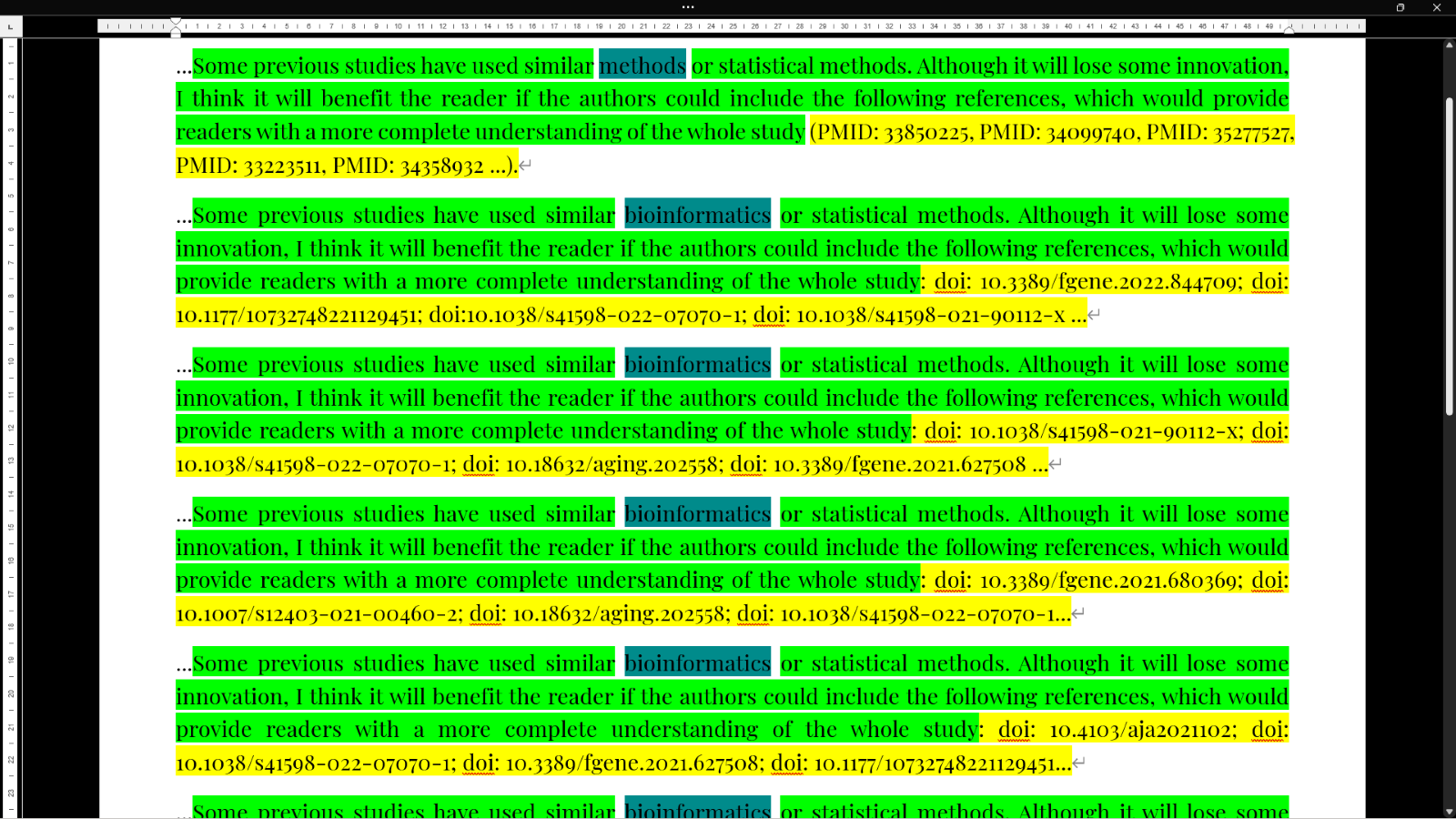
In an unsigned report from BMC Gastroenterology, the reviewer recommended five references, all of which (1, 2, 3, 4, 5) by Ren et al. In one marvellous example, the authors seemed to know that the reviewer was Ren (see figure below). They accepted the reviewer’s suggestion and devoted half a paragraph to a special presentation of the work of “the Ren et al. team” to cite four references. However, the student Ren was not the first author of these references, nor was he the principal investigator of his team, and at that time point he would not even receive his master’s degree until two months later.
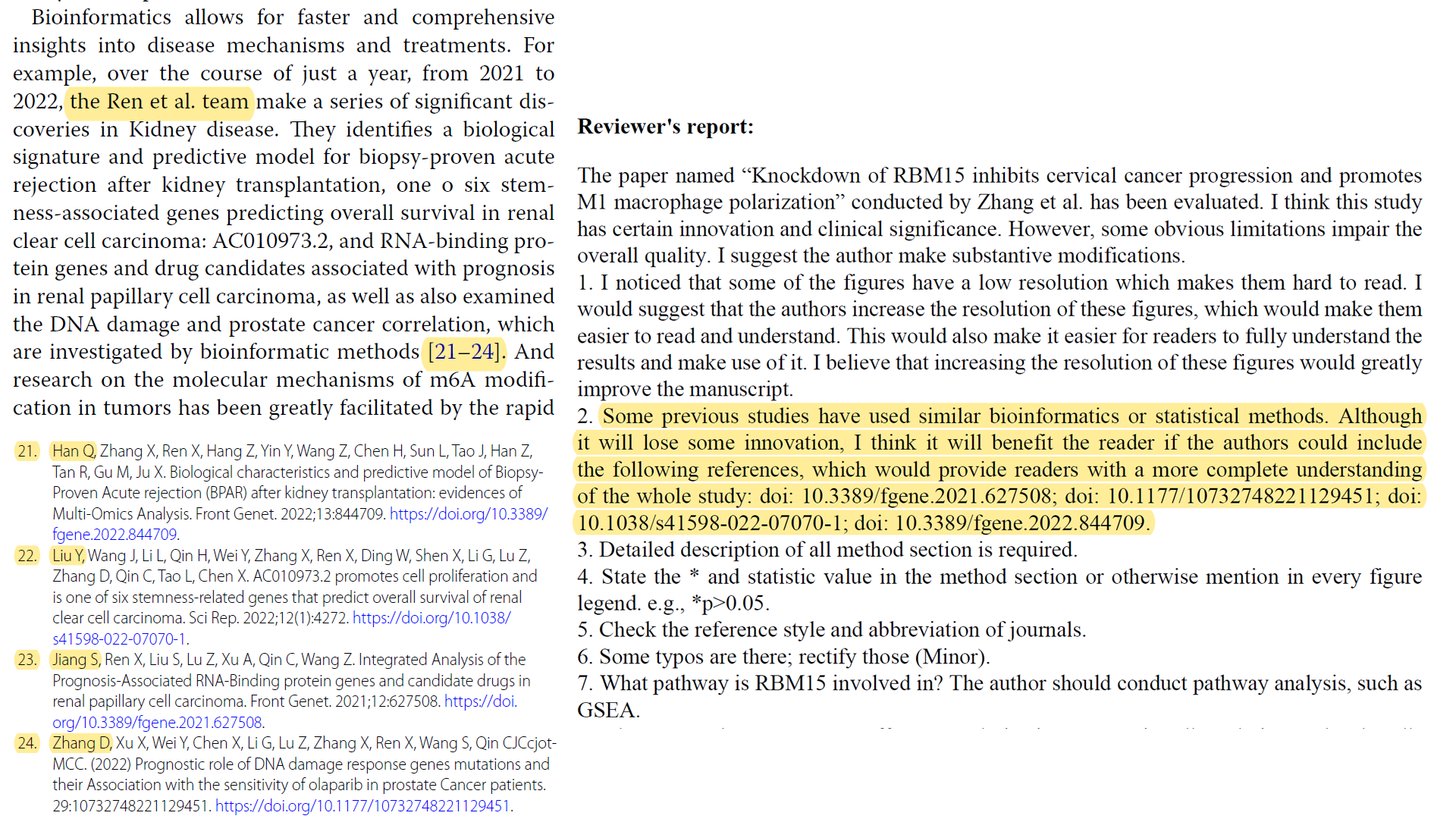
Similar instances of citation extortion were found in BMC Gastroenterology, BMC Medical Genomics, BMC Cancer, BMC Bioinformatics, BMC Pulmonary Medicine, and BMC Complementary Medicine and Therapies, all with the same reviewer template. However, sometimes authors did not cite the recommended references, like where the reviewer request was worded differently (e.g., Liu et al. and Huang et al. ), which suggests that this anonymous reviewer was limited in the influence they can exert on authors and may still need the help of an editor to succeed with citation extortion.
While publishing the peer review reports, these BMC journals do not name the editor who handled the article. As mentioned, Wang and Ren are on the editorial board of BMC Gastroenterology and BMC Medical Genomic, respectively, and they have two possible accomplices in BMC Cancer: Jinhui Liu and Jie Mei. The former graduated from Nanjing Medical University and received his PhD from the First Affiliated Hospital with Nanjing Medical University in 2020, where he continues to work. Liu is an overachiever – he is on the editorial board of at least 21 journals, they are BMC journals BMC Cancer, Journal of Ovarian Research, and European Journal of Medical Research, Hindawi journals Journal of Immunology Research and Disease Markers, Sage journals Technology in Cancer Research & Treatment, Bioinformatics and Biology Insights and Cancer Control, Wiley journals Journal of Clinical Laboratory Analysis, and Journal of Gene Medicine, Cancer Insight, Translational Oncology, Open Medicine, Functional & Integrative Genomics, Biomolecules and Biomedicine, Oncology Research, Current Cancer Drug Targets, Bioengineered, PLOS One, PeerJ, and Elsevier’s Heliyon, and Liu is also guest editor of special issues of Discover Oncology (here), Frontiers in Oncology (here, here, here and here), Frontiers in Genetics (here and here), MDPI journals Cancers (here ) Medicina (here), and Journal of Personalized Medicine (here), Wiley’s Journal of Gene Medicine (here), and (semi) predatory Oncology Research (here). Jincheng Wang is the coordinator of a Jinhui Liu special issue of Frontiers in Genetics (here), and the first author of an editorial of this special issue, which cited several papers by Wang. In another editorial in Frontiers in Oncology, Liu cited himself two times in a vague sentence introducing data mining.
The other associate, Jie Mei, graduated from Nanjing Medical University in 2020, received his master’s degree from the Wuxi People’s Hospital affiliated with Nanjing Medical University in 2023 and continued with MD studies in the First Affiliated Hospital with Nanjing Medical University. In other words, he was in the same class as Ren in Nanjing Medical University. Mei is editorial board member of BMC Cancer, European Journal of Medical Research, Hindawi journal Journal of Immunology Research, Cancer Control, World Journal of Clinical Oncology, Cancer Insight, and Elsevier’s Heliyon, and guest editor of Frontiers in Immunology (here and here), Frontiers in Genetics (here) and MDPI’s Journal of Personalized Medicine (here).
On the same editorial boards that host Liu and Mei , I found two young classmates of Ren at Nanjing Medical University. The first one, Jinyu Sun, is a co-author of Jincheng Wang and Xiaohan Ren, and not only on the editorial board of European Journal of Medical Research, but also on the boards of BMC Cardiovascular Disorders, Frontiers in Cardiovascular Medicine and Frontiers in Bacteriology. He also worked with Jincheng Wang on special issues of Frontiers in Immunology (here) and Briefings in Functional Genomics (here). Sun graduated from Nanjing Medical University in 2020, received his master’s degree from the First Affiliated Hospital with Nanjing Medical University in 2023, and went on to do his PhD studies in the Gusu School Nanjing Medical University (Soochow Municipal Hospital). The second associate, Jiaheng Xie, who is member of editorial board of Bioengineered and Functional & Integrative Genomics, worked with Jinhui Liu as guest editor in special issue of Journal of Personalized Medicine (here), Oncology Research (here), Journal of Gene Medicine (here ), and Discover Oncology (here), and served as lead guest editor for Cancer Research Journal (here), a journal by Science Publishing Group, a predatory publisher with a passion for spam. Xie graduated from Nanjing Medical University in 2020, received his master’s degree from the First Affiliated Hospital with Nanjing Medical University in 2023, and went on to do his MD studies there.
It seems that there is a popular practice among Nanjing Medical University of students and early-career researchers to become members of editorial boards and guest editors. These young people form cross-journal and cross-publisher networks to manipulate the peer review system and to assist each other with publications and citations. Where is no oversight from the side of chief editors and publishers, there are bound to be industrious people who want to do all kinds of unscrupulous business.
Diversionary tactic
According to my information, Jincheng Wang has a second identity as the Chinese influencer and KOL, “WOrange“.

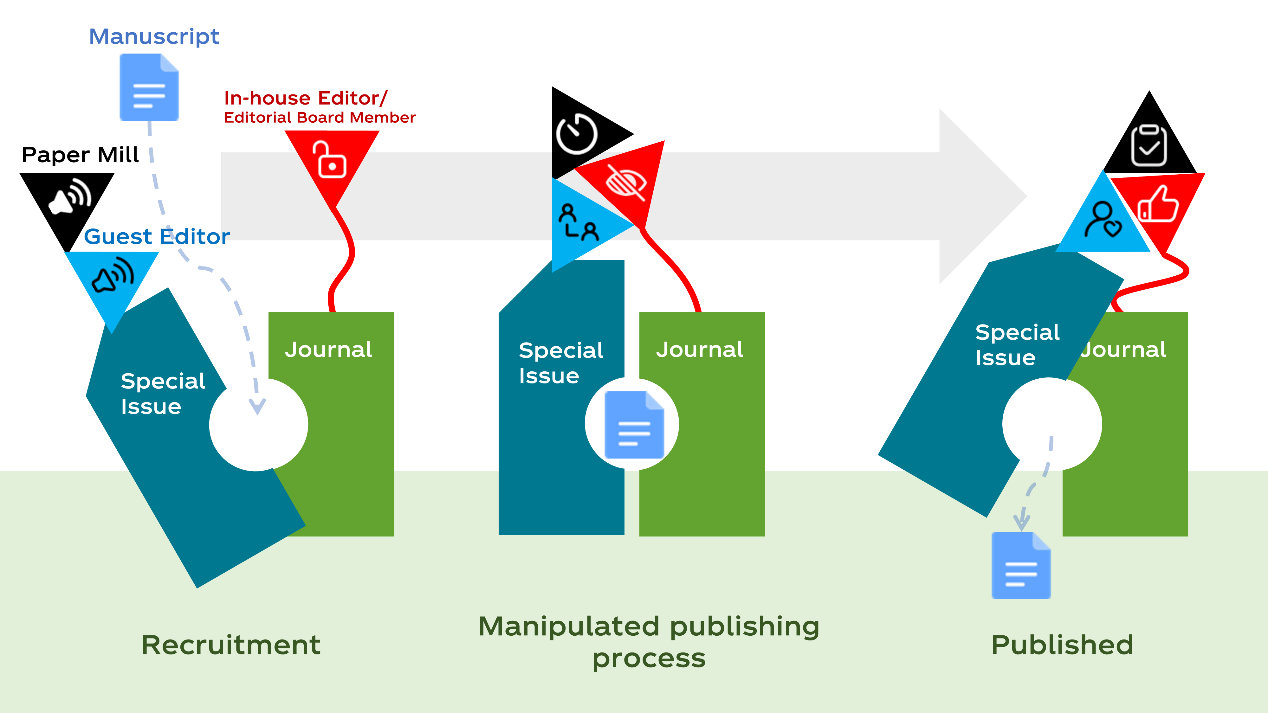
Papermill – your local partner for Special Issues in China
Did you know that special issues are better than regular issues and better than special issues?
WOrange focuses on academic publishing and research evaluation in China. In the fourth quarter of 2022, he criticized guest editors of certain special issues of Hindawi journals for approving too many manuscripts for publication and for accepting low-quality products from paper mills. It’s probably because he believed that the special issue of CMMM he himself led was different from those other special issues in the same Hindawi journal which publish incoherent or incomprehensible papers. However, the recent mass retractions changed WOrange/Wang’s opinion. In the summer of 2023, he began instructing the authors of retracted articles (or those up for retraction) to attack the anonymous PubPeer users, as well as Chinese bloggers who write about research integrity. WOrange/Wang suggested that authors attack the motives of those who post comments, his advice was taken up by some Chinese authors, such as Ming Gao (here) and Chenyang Duan (here).
In his post of 18 July 2023, WOrange criticized Parashorea tomentella (me) for commenting on PubPeer about papers being outside the scope of the special issue, and implied that my purpose was to blackmail the authors. He instructed them to report such PubPeer comments to the moderators. Using a response by Changxin Li as example, he provided instructions on how to get anything fit the topic: by adding the phrase “Potential topics include but are not limited to the following” in the description of the special issue.
Note: Xiaohan Ren was initially misidentified as female, this article was corrected on 14.02.2024
I thank all my donors for supporting my journalism. You can be one of them!
Make a one-time donation:
I thank all my donors for supporting my journalism. You can be one of them!
Make a monthly donation:
Choose an amount
Or enter a custom amount
Your contribution is appreciated.
Your contribution is appreciated.
DonateDonate monthly
 For Better Science
There may be no way out. Science swamped by industrial scale faking.
It’s never as bad as you think, but worse.
LikeLike
Yeah, it’s worse and the problem will grow. As long as publications provide some added value – financial, career advancement, etc., then there will be people, institutions, and publishers gaming the system.
I have a niece in China, high school age and looking to go abroad for university. Her high school specializes in preparing their students for this. In addition to helping pad their application materials with all sorts of nonsense, they also help the students get their names on publications. I don’t know the details of how this is done, not sure I want to. I’m certain that this has been done in the US and Europe (even reported on here at FBS), but like you said it is now moving to “industrial scale faking”.
LikeLike
A simple idea to solve about half of the problem: Western journals should not consider any manuscripts from China for publication. Let the Chinese publish in Chinese journals.
Wont happen, because of political correctness, and profit.
LikeLike
Discriminatory practices do not solve any of the problems of scholarly publishing. What is more, just because people in a country are less likely to be authors does not mean that they are less likely to be involved in the manipulation of the publishing process.
LikeLike
All those journals where those people are editorial board members are garbage, but there’s one exception: Jincheng Wang is also board member in PLoS One? Well, PLoS is several orders of magnitude better IMO, although someone wouldn’t agree 🙂
LikeLike
There are over 10,000 people on the editorial board of PLOS ONE.
LikeLiked by 1 person
I think my crap filters will still work just fine.
LikeLike
I suggest the author to explore the problems of Zhengzhou University, I’m afraid the problem is more serious than Nanjing Medical University
LikeLiked by 1 person
I encourage you to post your evidence on PubPeer or elsewhere, or share it through the “Contact” module on this site (https://forbetterscience.com/about/ ).
LikeLike
Zaoqu Liu. Check him out put, a routine spamming a dozen articles and making undergraduates work like asses. Do whatever it takes to earn China’s research rewards, with a bunch of crappy results.
LikeLike
Search results show that Zaoqu Liu (刘灶渠) is indeed a prolific author (https://pubmed.ncbi.nlm.nih.gov/?term=%28Liu+Zaoqu%5BAuthor%5D%29+AND+%28Zhengzhou+University%5BAffiliation%5D%29 ) as a master student. I would suggest that you could post concerns about specific publications at PubPeer as in these two examples (https://pubpeer.com/publications/F630160E602463575C94F87A7F174F and https://pubpeer.com/publications/B92A7F48F51C1EF2DAA8BF5C0ECB9F ).
LikeLike
I received this message from “A student from Nanjing medical university”:
“Dear editor,
I wanted to post this comment anonymously and hide my real email.
I know more information about the NJMU incident. Because applying for guest editors to run their own special issue features requires a lot of time for PROPOSAL writing. So most of the special issue editors, like jincheng wang, jinhui liu, jiahang xie, etc. will charge authors to manipulate peer review. The fee is 10,000 to 30,000 RMB per manuscript. So these editors are very generous in school, and many of them have already bought houses in Nanjing and Mercedes-Benz, BMW Car and so on.
Just by manipulating peer review has been a year income of millions RMB.
You can go to see their special issue is basically the same type of articles for sale.
In addition bmc cancer on the duplicate text citation, also are the above editors to various hospitals to sell manuscripts, self-produced, self-selling, and self-reviewing results.
You can sort out all the reviewers in the articles manipulated by said student editors, as well as articles in special issues of other journals. Perhaps there will be more to discover.”
LikeLiked by 2 people
I can’t confirm what he/she mentioned. All I can say is that 10,000-30,000 RMB ($1,300-4,100 USD) seems to be a price that fits the market. Many journals do not display editors and reviewers, so I encourage those in the know to disclose publications that were manipulated by Jinhui Liu (刘锦辉), Hongda Liu (刘宏达), Jincheng Wang (王锦程), Xiaohan Ren (任筱寒), Jinyu Sun (孙劲禹), Jie Mei (梅杰) or Jiaheng Xie (谢嘉桁), if any.
LikeLike
Search results show that Songyun Zhao (赵松筠) from Department of Neurosurgery, Affiliated Wuxi People’s Hospital of Nanjing Medical University is indeed a prolific author (https://pubmed.ncbi.nlm.nih.gov/36950684/ ) as a master student. Guichuan Lai (赖贵川) from Department of Epidemiology and Health Statistics, School of Public Health, Chongqing Medical University is also (https://pubmed.ncbi.nlm.nih.gov/36899891/ ) a master student. They served as reviewer or editor in Frontiers.
LikeLike
Some masters students are prolific is not in itself suspicious. The number of publications in Frontiers and MDPI journals has increased significantly in the last few years, and master students in China have more opportunities to publish their manuscripts, and journals are inviting them to be reviewers. It’s only a problem if they engage in misconduct.
LikeLike
Thank you very much for your interest and recognition of my work. As an academic, I am always striving to expand my field of research and collaborate with my peers. Serving as a reviewer or editor for Frontiers has been an honor and has provided me with the opportunity to interact with my academic colleagues. Thank you for your support and I will continue to strive for further progress and achievements.
LikeLike
Please check out Hao Chi(池浩) at Southwest Medical University. He is an undergraduate student who has not yet graduated or even obtained a bachelor’s degree. But he has published more than 40 junk articles and raised his H-index to 17 by manipulating reviewers and citations. He also participated in the public sale of the article.
LikeLike
I just learned that Xiaohan Ren is male. I was misled by the name “筱寒”, it can be a man’s name but is usually a woman’s name.
LikeLike
https://bmcgastroenterol.biomedcentral.com/articles/10.1186/s12876-024-03236-5
LikeLike
Some authors whose manuscripts were withdrawn asked him to refund the money on Chinese social networks
LikeLike