
There are papers which contain image duplications. There are papers which contain outrageous image duplications, which can only be explained by wilful manipulation and deceit. Then there are papers which are deliberately published twice, which also can constitute misconduct (COPE guidelines are somewhat unclear there).
In this case however, a paper containing outrageously manipulated duplicated images has been published 3 times, in three different journals, which happen to be also Open Access.
The authors are almost all from Malaysia, and not the same on these three publications Yet all three papers have same two corresponding authors:
Sekaran Muniandy, professor at the Department Of Molecular Medicine at the University of Malaya in Kuala Lumpur. He even used his institutional email address: sekaran@um.edu.my. The first and other corresponding author is apparently his PhD student, Nima Samie, who used a Gmail address: nimasamie@gmail.com.
These are the three papers, in the chronological order they were published:
Nima Samie, Batoul Sadat Haerian, Sekaran Muniandy, Anita Marlina, M. S. Kanthimathi, Norbani B. Abdullah, Gholamreza Ahmadian and Raja E. R. Aziddin
“Mechanism of Action of the Novel Nickel(II) Complex in Simultaneous Reactivation of the Apoptotic Signaling Networks Against Human Colon Cancer Cells”
Front. Pharmacol., 28 January 2016 | http://dx.doi.org/10.3389/fphar.2015.00313
Received: 19 November 2015; Accepted: 18 December 2015; Published: 28 January 2016.
Nima Samie1, Sekaran Muniandy, MS Kanthimathi, Batoul Sadat Haerian
“Mechanism of action of novel piperazine containing a toxicant against human liver cancer cells”
PeerJ 4:e1588, DOI 10.7717/peerj.1588
Published 2016-03-17, Accepted 2015-12-21, Received 2015-11-17
Nima Samie, Sekaran Muniandy, M. S. Kanthimathi, Batoul Sadat Haerian & Raja Elina Raja Azudin
“Novel piperazine core compound induces death in human liver cancer cells: possible pharmacological properties”
Scientific Reports 6, Article number: 24172 (2016) doi:10.1038/srep24172
Received: 01 October 2015, Accepted: 23 March 2016, Published online:13 April 2016
What exactly is wrong with these papers? Their figures are basically identical, the text was modified, apparently to avoid detection by anti-plagiarism software many publishers use these days (also the submissions happened close to each other for this purpose). Two papers deal with liver cancer, one with colon cancer, the figures themselves have been re-labelled and re-used. Figure 2 for example is quite representative. Each paper shows different cell lines, yet the images are exactly the same. Moreover, it is in fact the same image re-used, as even I, a non-specialist, can see. Cells were erased, and the image was rotated, to make it appear different.
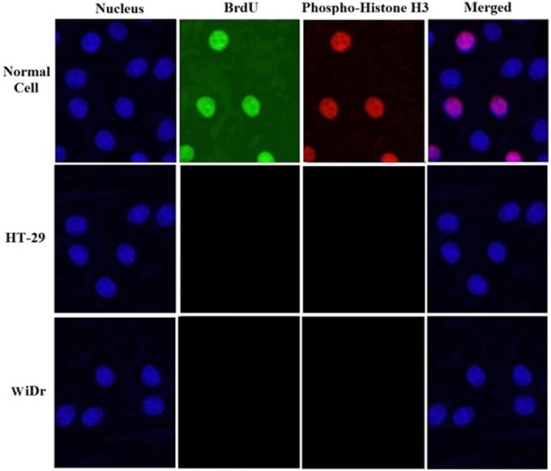


Figure 1, Scientific Reports
A “Concerned Scientist” commented on Scientific Reports website:
“There are serious problems with this paper.
Clearly several of the Figures have been created by copying and pasting various elements. For example, in Figure 5, despite purportedly showing three different types of cells, the cells in each frame are identical. In Figure 6, individual cells are copy and pasted multiple times. In Figure 7, the same data is shown in multiple panels. In Figure 4, images for different cell lines are impossibly similar.
The chemistry is equally problematic. The chemical structure of PCC shown in Supplementary figure 4 does not have the same mass as what is depicted in the mass spectrum (Supplementary figure 1). In addition, both the 1H NMR and the 13C NMR spectra are completely inconsistent with the chemical structure. The “Synthesis procedure” is entirely inadequate to describe the procedure for synthesizing PCC. What little description is present is not a possible chemical synthesis for the reported chemical structure of PCC. The molecular formula provided in this section, C20H20N2O2, matches neither the mass spectrum nor the structure reported in Supplementary figure 4.
I could go on. These are but a few of the problems that should have been easily caught with even the most cursory peer review.
This paper is full of errors, inconsistencies, and in my opinion outright fabrications”.
All three papers were peer reviewed. At PeerJ, a statement declares: “The author has chosen not to publish the full peer review history of this article”
Frontiers and Scientific Reports do not publish their peer review reports as a rule.
In any case, the peer review process seems to have failed in all three journals. And who knows, it may be in fact more than “just” three papers.
The quickest peer review happened at Frontiers in Pharmacology, namely less than one month (Scientific Reports took almost 5 months, PeerJ operates a post-publication peer review Correction thanks to reader comment: PeerJ operates a traditional peer review system, which took slightly over 1 month here). This Frontiers journal only recently had to retract a paper, apparently due to another incidence of failed peer review. The 2014 study “Water hyacinth: a possible alternative rate retarding natural polymer used in sustained release tablet design“, by Khatun, S., and Sutradhar, K. B. was retracted with the retraction note mentioning its “insufficient scientific quality”. The Editor-in-Chief, Dominique J. Dubois, professor at the Université Libre de Bruxelles, Belgium, did not reply to my older email where I asked for more details to that retraction. This is however hardly surprising, since Frontiers even blocked me on Twitter, due to my reporting.
Scientific Reports does not seem to have an Editor-in-Chief, but a specialised editorial board. The editor responsible for the cancer research area is Ronald DePinho, director of MD Anderson Cancer Center in Texas. DePinho is surely a specialist in image irregularities, a number of his own papers were discussed on PubPeer in this regard. He also saw no reason to investigate the problems in the publications by his MD Anderson colleague Raghu Kalluri, whose papers, namely those authored together with Sonia Melo, were found highly problematic by EMBO investigation. A certain multimillion dollar conflict of interest may have stood DePinho’s way.
Update 11.06.2016. Elisabeth Bik, microbiologist and image integrity specialist, has presented a detailed analysis of the data manipulations and duplications in the three papers (plus a published patent description noted by a reader here) on her website.
Update 15.06.2016. Malaysian daily The Star has reported on the case, as a reader commented below:
“PETALING JAYA: The Higher Education Ministry will investigate allegations that a group of researchers from Universiti Malaya’s (UM) Faculty Of Medcine falsified research data.
According to its minister Datuk Seri Idris Jusoh, he will personally look into the matter following wide-ranging postings on social media that questioned the integrity of the researchers, whose paper underwent three rounds of peer reviews.
“We do not compromise on such matters, and we’ll make sure action will be taken against them because we have to uphold the integrity of our education system,” he said on the sidelines of a memorandum signing ceremony between Sunway TES Centre for Accountancy Excellence, the Association of Chartered Certified Accountants (ACCA), and the ministry’s Polytechnic Education Department here yesterday.
When contacted by The Star, UM’s international and corporate relations director Dr Evelyn Khor said the university was aware of the incident and had formed an ad hoc committee to investigate the alleged wrongdoing.
“We do not condone fraudulent activities and appropriate actions will be taken against the researchers if any evidence of scientific misconduct is found,” she said”.
Update 17.06.2016. Another reader hattip: a very quick investigation found four researchers guilty and demands retraction of all four publications, according to The Star:
PETALING JAYA: A probe has revealed that the four researchers from Universiti Malaya (UM) had indeed falsified their research data.
UM vice-chancellor Prof Tan Sri Dr Mohd Amin Jalaludin said the findings from the investigation suggested that all four articles were prepared with a single set of data. A committee set up by the university to conduct an in-depth investigation into the allegations that the group had allegedly falsified research data found that there were duplication and/or manipulation of almost all the figures (images and graphs) within the original Scientific Reports paper and across three other papers.
“As UM adheres to a strict policy of integrity and ethical practices in research, the authors have been asked to retract all published articles in Scientific Reports, PeerJ and Recent Patents on Anti-Cancer Drug Discovery immediately,” he said in a statement.
In addition, Dr Mohd Amin said the author and co-authors have also been interviewed by the committee.
“As a research university, UM does not condone any form of research misconduct and allegations of malpractice in research are taken seriously by the university’s management,” he said.
Dr Mohd Amin said the committee consisted of senior members from the Faculty of Medicine. He said a complete report has been submitted to the university’s Research Integrity and Ethics Committee for further deliberation, including appropriate disciplinary action to be taken on the researchers. The committee, which was chaired by Faculty of Medicine dean Prof Dr Adeeba Kamarulzaman, said the university will be taking disciplinary action after investigations are completed. She believed this was the first time this had happened in the university.
Update 22.06.2016. Scientific Report now retracted the fraudulent paper, most likely other journals will follow suit soon:
“Following online criticisms of the published paper, an investigation at the journal has confirmed the manipulation and duplication of data and a level of image processing that is not compliant with the journal’s policies on image data integrity in figures 1–3, 6, 7, 10 and 12. Versions of figures 1–11 and large sections of the text had also previously been published1,2. All authors acknowledge these issues and agree to the retraction of the Article”.

 For Better Science
Pingback: Dr. Ong Kian Ming (王建民) | How serious is academic fraud in our universities?
My own Adobe Photoshop experience tells me it is possible totally to transform pictures if you have a wide knowledge of this program, where the detection of duplications, translocations, etc. will be impossible and the pictures will still look absolutely natural.
LikeLike
Eventually that generation of scientists from ‘before the Photoshop’ who used to develop manually the pictures and/or a true expert in cell biology/histology may notice the difference. This takes us to another level: do the actual young scientists have a real good foundation knowledge in cell biology/histology?
LikeLike
Pingback: Dr. Ong Kian Ming (王建民) | 我国大学的学术造假现象到底有多严重?
Pingback: Betapa seriuskah penipuan akademik di universiti kita? – Dr. Ong Kian Ming (王建民)
Pingback: Beall-listed Frontiers empire strikes back – For Better Science