
Spanish science transitioned from being a provincial swamp of ignorant nepotism under Franco’s fascist dictatorship to an elitist swamp of arrogant nepotism with a choke-hold on European and international research funds. Young researchers, who once returned from abroad to reform the country’s bogged-down scientific system, have grown into the provincial greedy power-clutching tyrants they have dethroned. Faculty jobs once given to family members, now go to loyal members of your scientific family. Another difference: the new science oligarchs are international and speak more languages than just the local Spanish dialect. Some are even foreigners, like the Italians Maria Pia Cosma, or the central character of this story, Andrea Cerutti. One bizarre relic which remained: the fundamentalist Catholic order Opus Dei still seems to have its hand in Spanish academia, as the recent affair around Carlos Lopez-Otin revealed (see this article and especially the comment section). In the 1980ies, one Spanish medical fraudster saved his career by joining Opus Dei, he even underwent exorcism to expel the devil which made him commit research misconduct. Who knows if this still happens.
Many countries have a problem with cheaters in science, but in Spain those cheaters are celebrated, awarded with highest honours and biggest public and industrial grants. Spanish media seems to know its place and applauds each award to a dishonest data manipulator as if nothing was out of order. Lopez-Otin is back from his Paris exile to the University of Oviedo now, he wrote a book about his Passion, and he will very likely soon get the Princess of Asturias Prize he craves so much.
The whole conspiracy farce around his 9 retractions, which culminated with an El Pais article showing Lopez-Otin with a 23-year-old progeria patient sitting on his lap wearing an Opus Dei crucifix, made one thing clear: any Spanish scientist opening their mouth about research integrity will be burnt at stake. Cancer and degenerative diseases are to be cured with massive investments into aggressive Photoshop fraud, Spanish elites of society have agreed.
Here are some other examples of the bizarre cult of scientific dishonesty in Spanish academia:
- Pura Munoz-Canoves keeps rising despite or rather because of the manipulated data she published. Her recent honours: Lilly Foundation Preclinical Award, and a €500k grant from La Caixa bank. This year, Munoz-Canoves is speaker at ISSCR 2019 conference in June 2019.
- Maria Pia Cosma, whose papers were spared any proper investigations because her former mentor and coauthor Kim Nasmyth is just too important, also received a €500k La Caixa grant last year. EU Commission trusts her research so much, it gave Cosma in 2016 €1 million, a quarter of the budget of the Horizon 2020 CellViewer project.
- Manel Esteller not only survived the fraud affair of his PhD student Sonia Melo undamaged, he was even recently appointed as director of Josep Carreras Leukaemia Institute. Melo herself has been whitewashed in Portugal and given a fresh grant from Astra Zeneca.
-
Antonio Garcia de Herreros, a colleague of Cerutti at IMIM in Barcelona, still receives funding money from the Spanish government, despite his massive PubPeer record and 4 retractions for fraud.
Recently, certain French and Spanish newspapers established that I am a German racist, a terrorist, and a harasser of women in science, further facts in that regard were extensively elaborated on Twitter.
In this regard, I will bring here a story about an Italian haematology and immunology researcher, Andrea Cerutti*, who holds transatlantic labs at Institut Hospital del Mar d’Investigacions Mèdiques (IMIM) in Barcelona, Spain, and at Icahn School of Medicine at Mount Sinai, New York, USA. Until recently, Cerutti used to swim in grant money, from 2011 to 2016 the Mount Sinai lab received from NIH $5 million for 4 projects, while the Barcelona lab frolicked from 2012 to 2017 in the €2.2 million ERC grant.
I was alerted to the Cerutti case by the pseudonymous image integrity sleuth Clare Francis, who found recent irregularities in Cerutti’s papers, next to the already impressive PubPeer record. Like this, in Sintes et al Nature Communications 2017: it shares gel bands with a four year older paper from Cerutti lab in New York, Romberg et al J Clinical Investigation 2013.
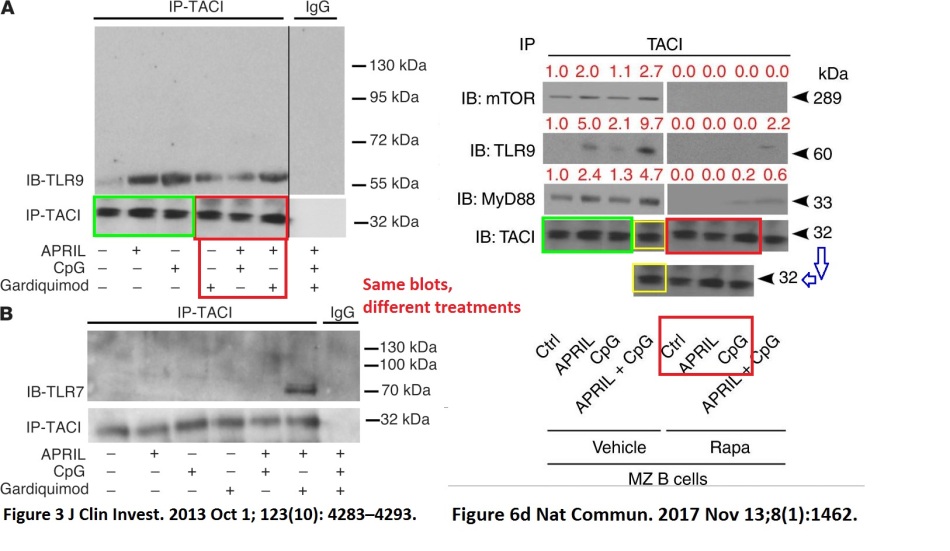
It is strange why same old blot from 2013 was rearranged so creatively in 2017, with same bands standing in for such diverse samples. Some might say, it was merely a loading control, but I personally feel those are kind of important and should not be faked. But again, others on Twitter proved me wrong, especially in this case.
In 2016, Cerutti had to correct a 10-year-old Qiao et al Nature Immunology 2006 paper, because of a palindromic gel, after evidence was posted on PubPeer:
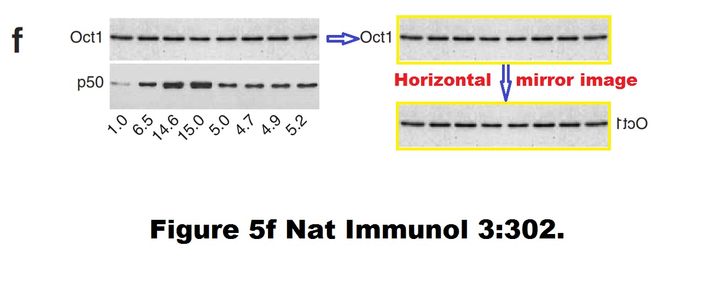
The correction from summer 2016 went:
“In the version of the article originally published, in the top immunoblot (loading control) in Figure 5f, the right half was incorrectly a mirror-image duplication of the left half. The correct immunoblot from a replicate experiment is now presented (along with the corresponding bottom immunoblot).”
How can that kind of mirroring happen by mistake? It can’t, but do you think the publisher Nature used the occasion to screen the paper for other Easter eggs? Apparently not, but others did and posted it on PubPeer, the problem with Figure 2b already in October 2016:
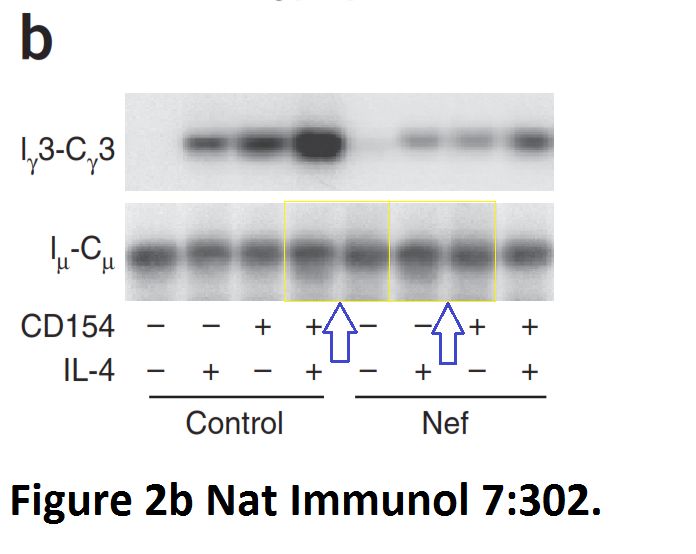
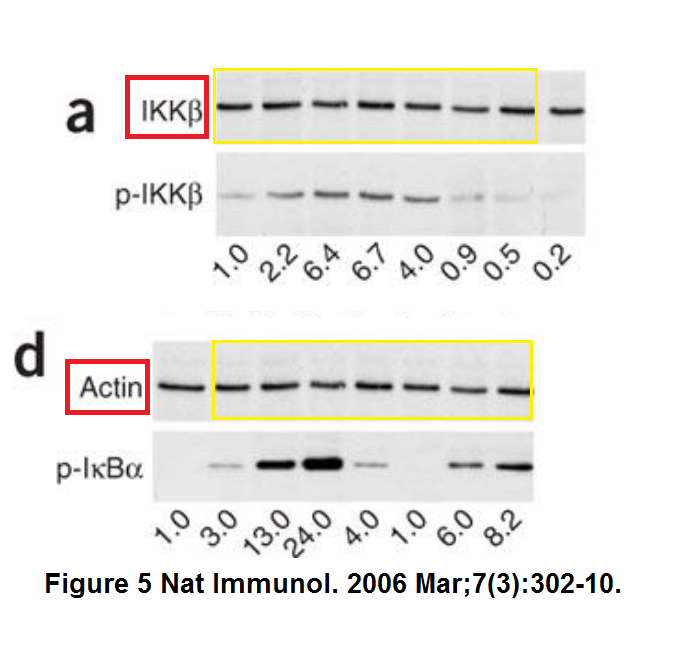
Did Nature Immunology do anything about this new evidence of manipulated gels? No, the case was apparently closed. Maybe the journal was so shocked by what Cerutti is capable of, they decided not to mess with that immunologist from Photoshop hell. Because Cerutti also published this: He et al, Nature Immunology 2010:


One interesting collaborator of Cerutti’s is the fellow immunologist Paolo Casali, a compatriot from Italy and Cerutti’s former mentor from their common time back at Weill Medical College of Cornell University. Cerutti used to work in Casali’s lab from 1997 till 2003 when the latter left Weill Cornell for California, and then for the University of Texas in San Antonio, USA, where Casali is now Chair of Department of Microbiology. Cerutti stayed at Weill Cornell till 2009, the year when, according to this CV, the Italian blot fabricator was granted tenure. For some reason, Cerutti instead buggered off to Mount Sinai in New York. During that period, Cerutti and Casali polluted scientific literature with some highly toxic material. For example, they honoured Nature Immunology with this interesting collage in Cerutti et al 2001:
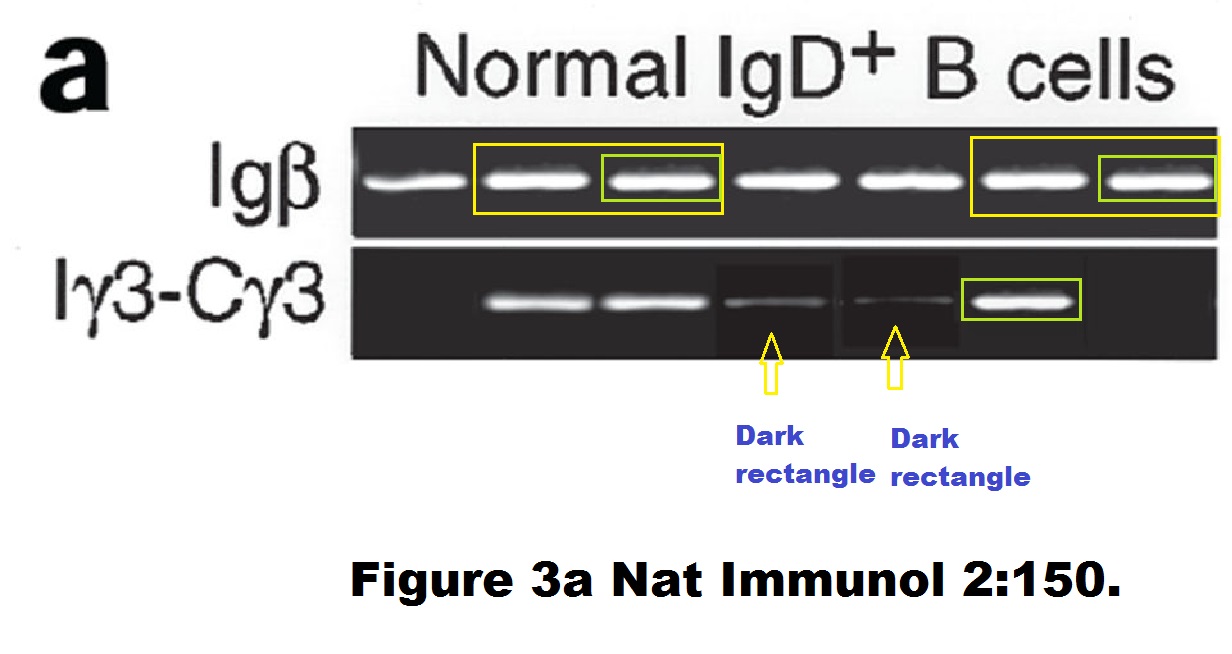
Not just that the pair of IgBeta bands are duplicated, one band makes an extra appearance in the gel below. It was obviously copy-pasted, just like its neighbours. The Italian couple published together also such Photoshop masterpieces like Zan et al J Immunology 2000 or Cerutti et al J Immunology 2002:
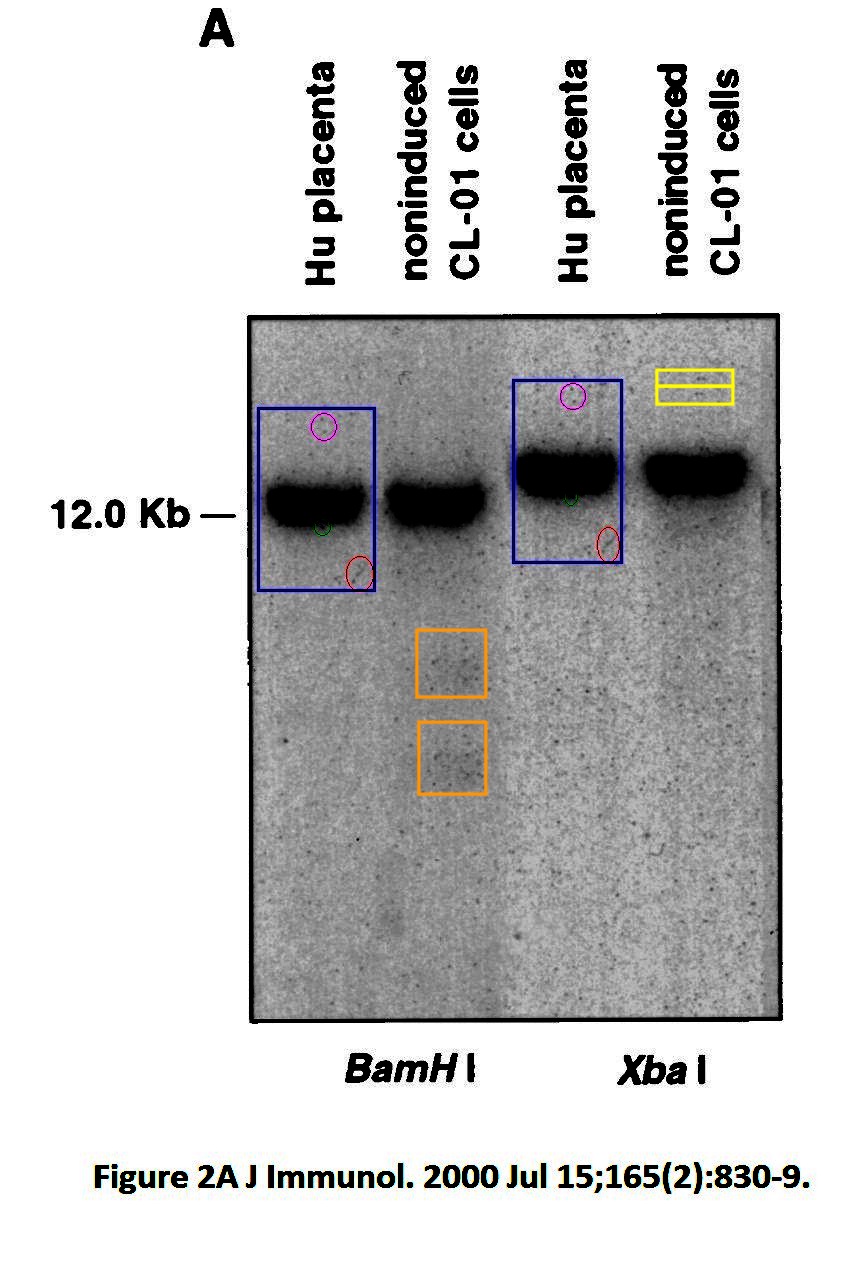
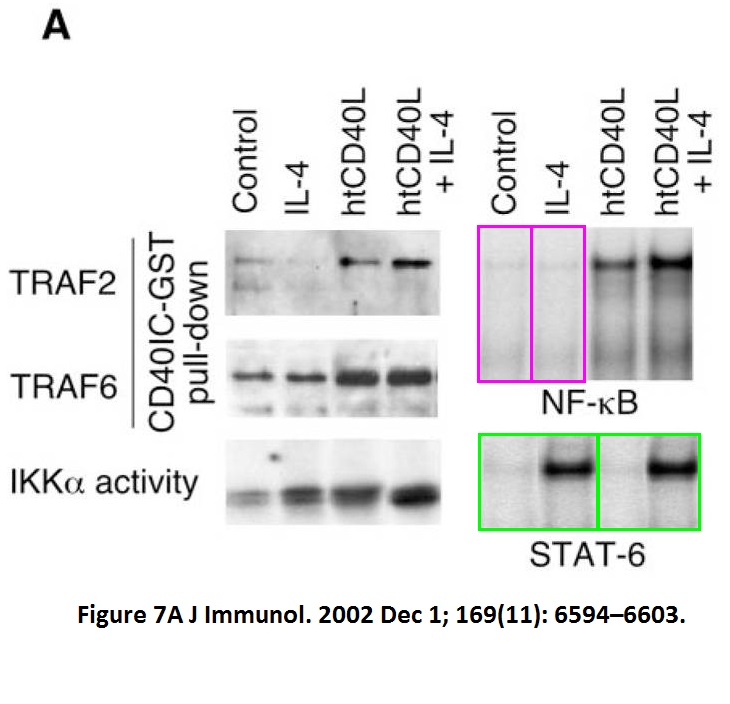
Or this Cerutti-Casali copro-duction, in the same journal, Litinskiy et al J Immunology 2002, with Cerutti as last author:
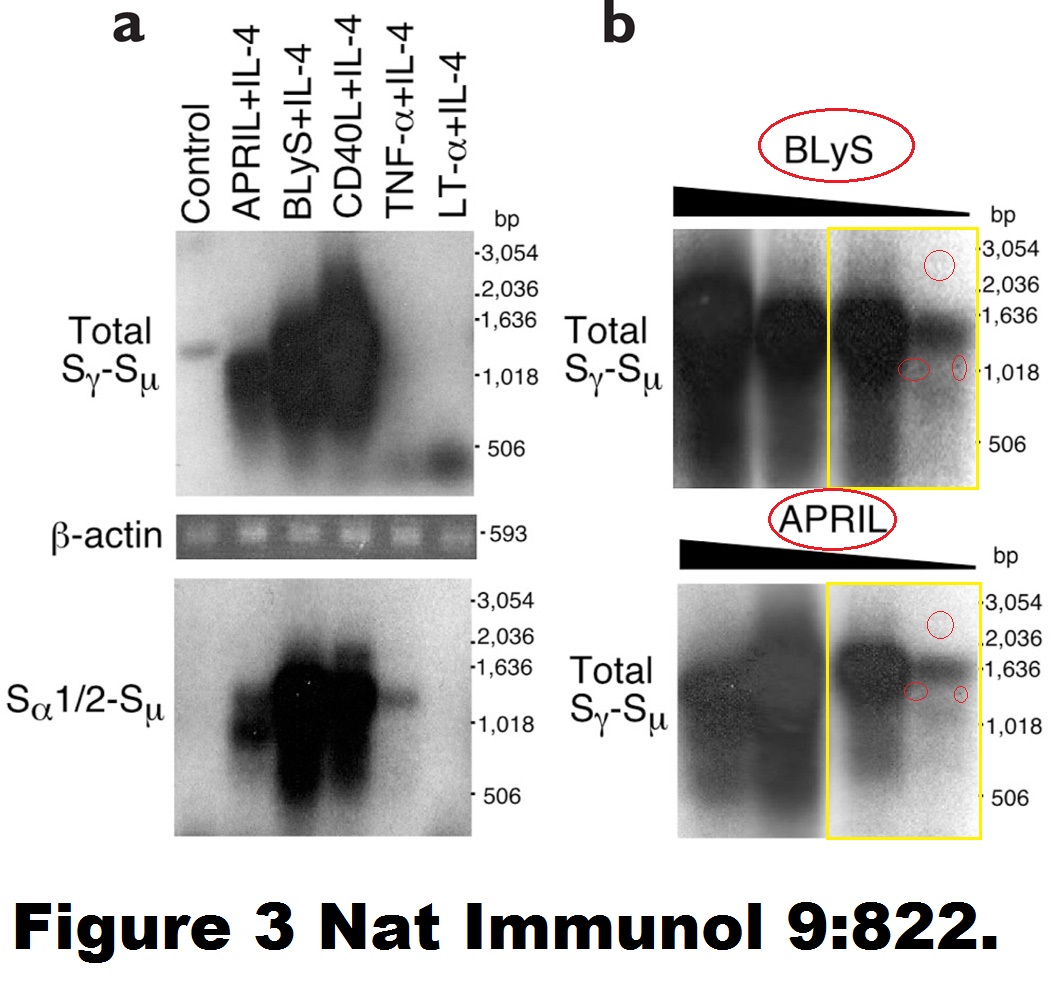

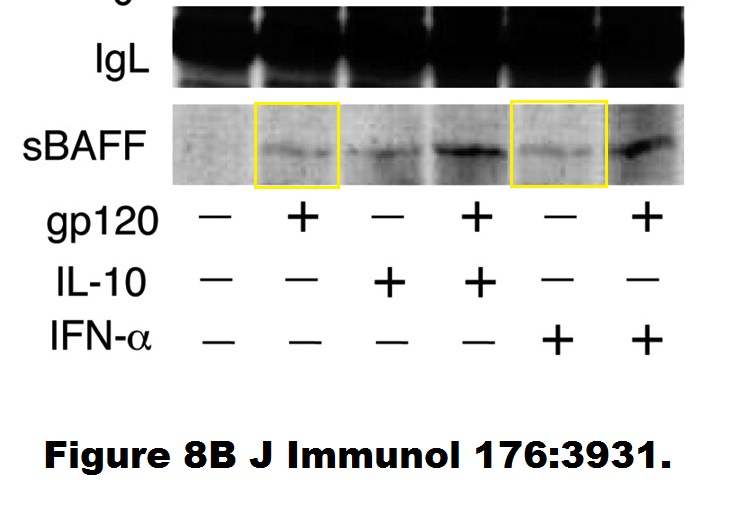
The poor Journal of Immunology, where Cerutti used to be associate editor until 2008, and which is published by The American Association of Immunologists of which Cerutti is a proud member. This appeared in He et al J Immunology 2004, last author Cerutti, just one of several manipulated figures in this paper:

Two years later, He et al J Immunology 2006, again from Cerutti lab in Cornell, and next to cloned gel bands there are also cloned FACS plots in that paper:
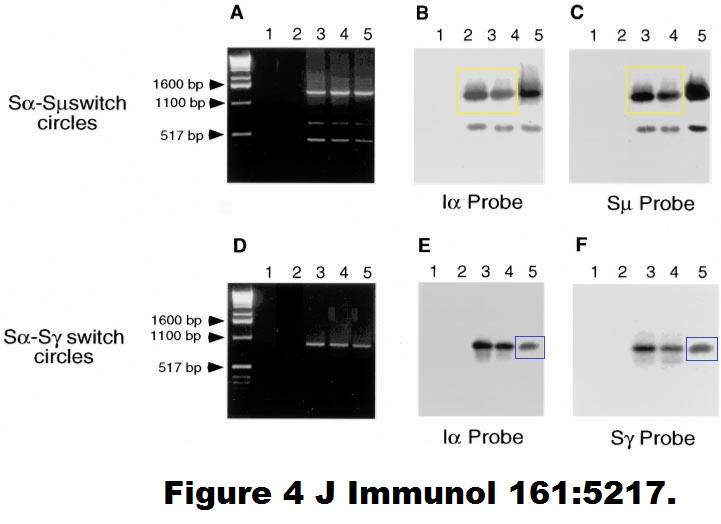
The following shows apparently how Cerutti and Casali started, back in 1998 there was not much Photoshop yet, you had to play glue, scissors, paper to get the right scientific result. A vintage artwork, from the olden times, Zan et al J Immunology 1998:
It is not like Cerutti stopped doing those naughty deeds once a successful academic career was fully established. It’s like with alcoholics, the temptation for recidivism is too strong and lurking everywhere. There are also these collaborative papers by Cerutti where same flow cytometry file appears twice. Examples are here, a paper from Cerutti’s collaborators at Karolinska Institutet in Stockholm, Sweden (Gutzeit et al J Immunology 2014) and at Icahn School of Medicine (Garcia-Carmona et al Frontiers in Immunology 2018). Duplicated flow cytometry (FACS) plots are labelled with colour squares.
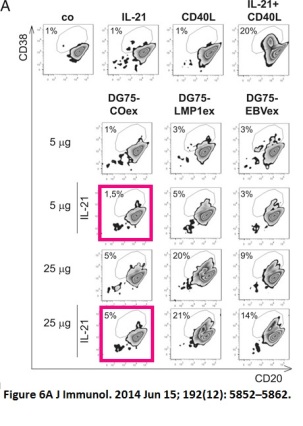

This might have been an honest mistake of oversight, but how come the quantified numbers are different? This means either the authors did it to obscure similarities, or they secretly changed measurement gates on each file to get the results they wanted (like Sonia Melo proudly admitted to having done). Neither constitutes good scientific practice. Cerutti actually published something similar with Casali before, guess where: Xu et al J Immunology 2008.

There is more material on PubPeer, but in Spain, its serves as a badge of honour, if anything.
*Andrea is a male name in Italy, but I don’t want to spoil the “harasser of women in STEM” story told about me online and offline. Also, I don’t want to miss the precious irony of Andrea Cerutti being possibly defended as a MeToo victim of harassment.
Donate!
If you are interested to support my work, you can leave here a small tip of $5. Or several of small tips, just increase the amount as you like (2x=€10; 5x=€25). Your generous patronage of my journalism will be most appreciated!
€5.00

 For Better Science
Fresh problematic data for Paolo Casali in Nature Immunology. PubPeer – HoxC4 binds to the promoter of the cytidine deaminase AID ge…
LikeLike
Fresh problematic data for Paolo Casali and Andrea Cerutti in another Nature Immunology paper. PubPeer – DCs induce CD40-independent immunoglobulin class switching t…
LikeLike
Fresh problematic data for Paolo Casali in a Nature Communications paper. PubPeer – Rad52 competes with Ku70/Ku86 for binding to S-region DSB en…
LikeLike
How to explain this Frontiers in Immunology data? PubPeer – Estrogen Reverses HDAC Inhibitor-Mediated Repression of and…
LikeLike
How to explain this Nature Communications data? PubPeer – B cell-intrinsic epigenetic modulation of antibody responses…
LikeLike
How to explain this Nature Communications data? PubPeer – Rad52 mediates class-switch DNA recombination to IgD
LikeLike
How unfortunate for the United States of America, and Americans. Paolo Casali is an the centre of this problematic paper. Exclusive: Publisher investigating DNA contamination paper that authors say CDC vaccine committee will consider – Retraction Watch
“Paolo Casali, editor-in-chief of Autoimmunity, did not respond to our request for comment. “
LikeLike
“One interesting collaborator of Cerutti’s is the fellow immunologist Paolo Casali, a compatriot from Italy and Cerutti’s former mentor from their common time back at Weill Medical College of Cornell University.”
12 December 2025 Editorial Expression of Concern for Paolo Casali’s Nat Immunol . 2009 May;10(5):540-50. doi: 10.1038/ni.1725. Epub 2009 Apr 12.
12 December 2025 Editorial Expression of Concern.
https://www.nature.com/articles/s41590-025-02379-1
Addendum to: Nature Immunology https://doi.org/10.1038/ni.1725, published online 12 April 2009.
The Editor would like to alert the readers that concerns have been raised regarding some of the data presented in this article, specifically:
Fig. 3a, top two plots appear to share highly similar datapoints;
Fig. 8c, Human 2E2 (nil) blot appears to show repetitive features in the ‘empty’ lanes;
Fig. 8c, Mouse spleen (nil) lanes 6 and 8 appear to have repetitive features;
Supplementary Fig. 2, IgG3 LPS and IgA LPS+TGF-β+IL-4+IL-5+anti-δ mAb-dextran plots appear highly similar.
The original data are no longer available due to the age of the article. Readers are therefore advised to interpret these date with caution.
Egest J. Pone agrees to this Editorial Expression of Concern. Seok-Rae Park does not agree to this Editorial Expression of Concern. Paolo Casali has not explicitly stated whether they agree to this Editorial Expression of Concern. The other authors have not responded to any correspondence from the Editor or Publisher about this Editorial Expression of Concern.
PubPeer – HoxC4 binds to the promoter of the cytidine deaminase AID ge…
LikeLike
Data in a 2000 J Immunol paper reappears in a 2002 Nature Immunology paper.
PubPeer – DCs induce CD40-independent immunoglobulin class switching t…
LikeLike
More problematic data comes to light in Immunity.
PubPeer – The translesion DNA polymerase zeta plays a major role in Ig…
LikeLike
Problematic data comes to light in a last century (1998) J Immunology paper.
PubPeer – CD40 ligand and appropriate cytokines induce switching to Ig…
LikeLike
More problematic data comes to light in a retracted 2001Nature Immunology paper.
PubPeer – Dysregulation of CD30+ T cells by leukemia impairs isotype s…
LikeLike
2000 J Immunology paper appears to have its own problems.
PubPeer – Engagement of CD153 (CD30 Ligand) by CD30+ T Cells Inhibits…
LikeLike
Problematic data comes to light in a 2002 Journal of Experimental Medicine paper.
PubPeer – Chronic lymphocytic leukemia B cells can undergo somatic hyp…
LikeLiked by 1 person
When I see the frequent problematic data by Andrea Cerutti they make me wonder how gormless the journals/editors/reviewers were, that applies to 20+ years ago, which were not the Stone Age. A constant refrain from the journals is that review system was not designed to spot fraud, as if not spotting the fraud is not the journals fault. The review system was designed to make money. Get people to review papers for free, then picket the money without responsibility.
LikeLike
Pocket the money.
LikeLike
09 February 2026 retraction for Cerutti and Casali in Nature Immunology.
Retraction Note: DCs induce CD40-independent immunoglobulin class switching through BLyS and APRIL | Nature Immunology
LikeLike