
Sholto David had a look at yet another Elsevier-published outlet: the Saudi Journal Of Biological Science, which is “the official publication of the Saudi Society for Biological Sciences and is published by King Saud University in collaboration with Elsevier and is edited by an international group of eminent researchers.” Now look what evidence of possession and sale of counterfeit science the Science Police has now secured!
Saudi Journal Of Biological Science: A Mecca for Bad Science
By Sholto David
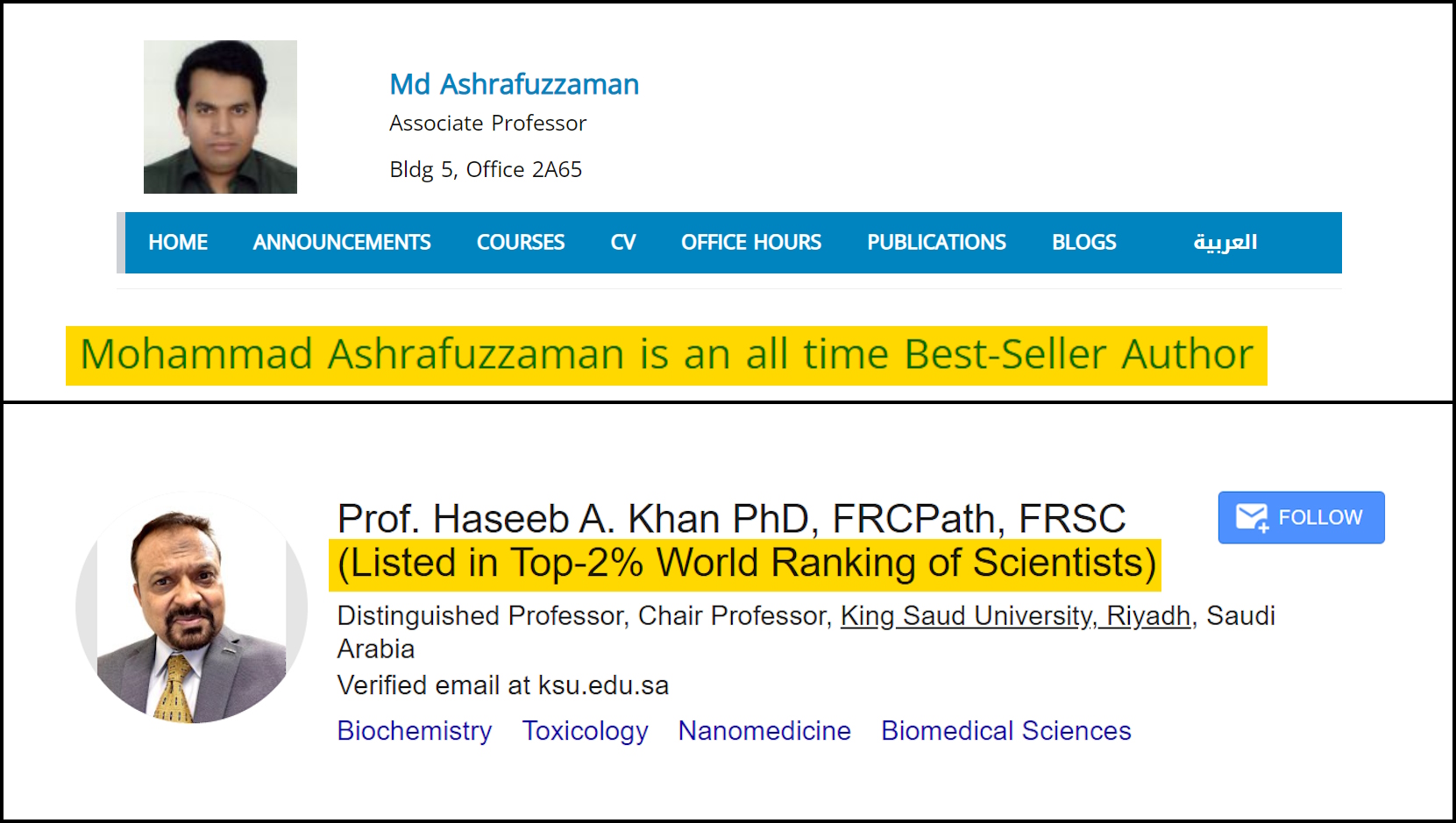
The Saudi Journal of Biological Sciences is published by King Saud University in collaboration with Elsevier. With an editorial board including an “all time best-seller author” and a “top 2% world ranking scientist”, as well as a bargain article processing charge of just $1350 this journal should be set up for success…
Unfortunately, over the last year or so I have left over 100 PubPeer comments pointing to a variety of different errors published by this journal; many others have contributed too. Some of these comments pertain to relatively innocuous image duplications. However, I keep returning to this journal because of its industrious output of silly forgeries and half-baked papers.
Authors who submit to this journal may expect to be well-acquainted with the clone tool in Photoshop. The following figure with numerous copied areas was published by one of King Saud’s own elite researchers.
Ammar Adnan Tuama, Arif Ahmed Mohammed Phytochemical screening and in vitro antibacterial and anticancer activities of the aqueous extract of Cucumis sativus Saudi Journal of Biological Sciences (2019) doi: 10.1016/j.sjbs.2018.07.012

With demand for such patchwork creations outstripping domestic supply, backup has been sought from Chinese authors with relevant expertise.
Hua-Wen Cheng, Jian-Guang He, Wen-Yan He Anticancer properties of towards ACHN human renal adenocarcinoma cells by inducing apoptosis Saudi Journal of Biological Sciences (2018) doi: 10.1016/j.sjbs.2017.03.004

Some efforts at cloning are, as ever, hard to explain… What was the need to copy and paste the cells below? The source images appear to be all different, so no substantial advantage seems to have been gained… Perhaps the authors simply enjoy it?
Zhaoyan Yu, Wei Xu, Haibo Wang Resveratrol treatment inhibits acute pharyngitis in the mice model through inhibition of PGE2/COX-2 expression Saudi Journal of Biological Sciences (2018) doi: 10.1016/j.sjbs.2017.05.005

A final example of enthusiastic deployment of the clone tool from researchers based in China.
Jianhua Zhao, Guanxun Cheng, Jing Liu Combination of intensity modulated radiotherapy followed treatment with p38 MAPK activation inhibitor inhibits the proliferation of MCF-7 breast cancer cells Saudi Journal of Biological Sciences (2018) doi: 10.1016/j.sjbs.2017.01.061

It is heartening to see that religious and geopolitical rivalries between Iran and Saudi Arabia do not interfere with their collaborative efforts in the publication of poor-quality science, a truly uniting endeavour.
K. Chehri, B. Salleh, T. Yli-Mattila, K.R.N. Reddy, S. Abbasi Molecular characterization of pathogenic Fusarium species in cucurbit plants from Kermanshah province Iran Saudi Journal of Biological Sciences (2011) doi: 10.1016/j.sjbs.2011.01.007

Smut Clyde described the below figure as “embarrassing for everyone”; each of the four panels contains duplicated elements, and in the bottom left corner the authors have abandoned a game of noughts and crosses (Tic-Tac-Toe). No one played any circles.
Dong-Yan Huang, Zhi-Rao Dai, Wei-Min Li, Rong-Guan Wang, Shi-Ming Yang Inhibition of EGF expression and NF-κB activity by treatment with quercetin leads to suppression of angiogenesis in nasopharyngeal carcinoma Saudi Journal of Biological Sciences (2018) doi: 10.1016/j.sjbs.2016.11.011

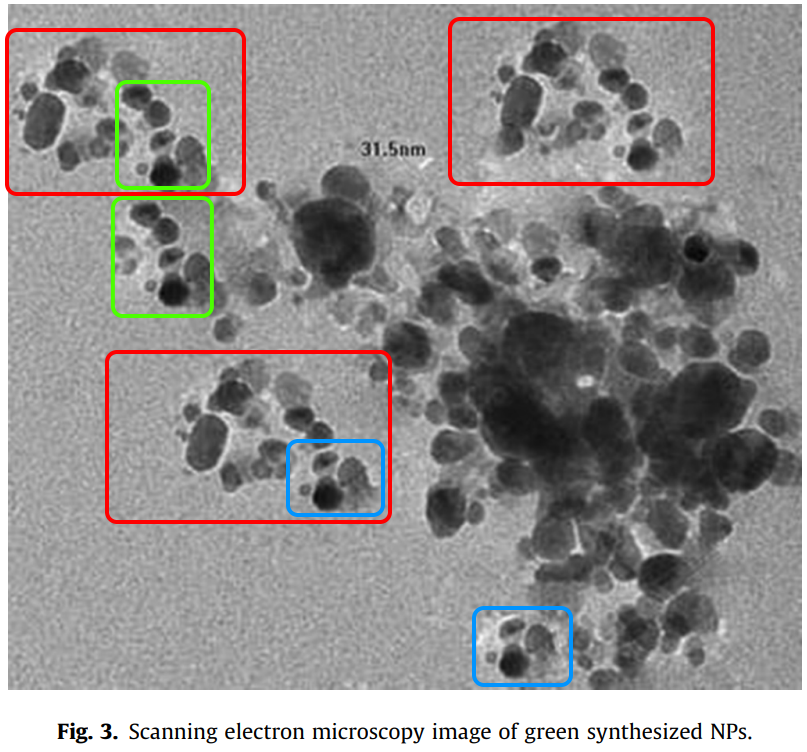
Of course, photoshopped SEM images are to be found in any journal with no self-respect. I live in fear for the day that authors finally locate the rotate tool in photoshop. It might not make these efforts much harder to spot, but it would make them far less amusing to look at.
A. Amala Lourthuraj, M. Masilamani Selvam, M. Saddam Hussain, Abdel-Wahab A. Abdel-Warith, Elsayed M.I. Younis, Nasser A. Al-Asgah Dye degradation, antimicrobial and larvicidal activity of silver nanoparticles biosynthesized from Cleistanthus collinus Saudi Journal of Biological Sciences (2020) doi: 10.1016/j.sjbs.2020.05.008
One of my favourite SEM images is below. The figure legend says it shows E. coli, which is known by most students of microbiology to be a rod-shaped bacterium, so it’s not obvious what the carnage in these three images is supposed to represent? Any SEM experts, feel free to enlighten me… A novel morphology?
Mohammad A. Alshuniaber, Rajapandiyan Krishnamoorthy , Wahida H. AlQhtani Antimicrobial activity of polyphenolic compounds from Spirulina against food-borne bacterial pathogens Saudi Journal of Biological Sciences (2021) doi: 10.1016/j.sjbs.2020.10.029

In the following SEM image, the authors did manage to procure an image of E. coli (which is a handy point of comparison to the above mess). Unfortunately, they were unsatisfied with the result and decided to attack it with the clone tool.
M. Amina, N.M. Al Musayeib, G.A. Al-Hamoud, A. Al-Dbass, A. El-Ansary, M.A. Ali Prospective of biosynthesized L.satiVum oil/PEG/Ag-MgO bionanocomposite film for its antibacterial and anticancer potential Saudi Journal of Biological Sciences (2021) doi: 10.1016/j.sjbs.2021.06.052

Another essential feather in the cap for any junk journal is animal torture experiments in the guise of “wound healing potential” studies, such experiments demand the creation of ghastly holes in rats followed by clumsy photography. One example shown here (day 14 is a narrower crop of day 12).
Pabba Shiva Krishna, S. Sudha, K. Ashok Reddy, Fahad A. Al-Dhabaan, Meher, R.S. Prakasham, M.A. Singara Charya Studies on wound healing potential of red pigment isolated from marine Bacterium Vibrio sp Saudi Journal of Biological Sciences (2019) doi: 10.1016/j.sjbs.2017.11.035

Elizabeth Bik contributed with further problematic duplications in Figure 4 of the same paper:

Unsatisfied with only microorganisms, materials, and animals, this journal is truly interdisciplinary in its approach to research misconduct and accepts forgeries in plant science too. In the below figure L1 and L3 are described as showing different experimental conditions, but in fact show the same plant, the angle is slightly different but some dark rectangles have been superimposed over L1 in an attempt to conceal its true identity.
Tan Quang Tu, Phutthakone Vaciaxa, Thu Thi Mai Lo, Nhung Hong Nguyen, Nhan Thi Thanh Pham, Quan Huu Nguyen, Phat Tien Do, Lan Thi Ngoc Nguyen, Yen Thi Hai Nguyen, Mau Hoang Chu GmDREB6, a soybean transcription factor, notably affects the transcription of the NtP5CS and NtCLC genes in transgenic tobacco under salt stress conditions Saudi Journal of Biological Sciences (2021) doi: 10.1016/j.sjbs.2021.08.018

When confronted with PubPeer comments, authors typically choose not to reply (naturally). About 90% of my comments are unanswered (I counted recently). Thankfully, authors occasionally do respond in the silliest way possible. In my comment below, I pointed to an area of similarity between cells which are labelled as different experimental conditions.
Mohamad S. AlSalhi, Kannan Elangovan, Amirtham Jacob A. Ranjitsingh, P. Murali, Sandhanasamy Devanesan Synthesis of silver nanoparticles using plant derived 4-N-methyl benzoic acid and evaluation of antimicrobial, antioxidant and antitumor activity Saudi Journal of Biological Sciences (2019) doi: 10.1016/j.sjbs.2019.04.001

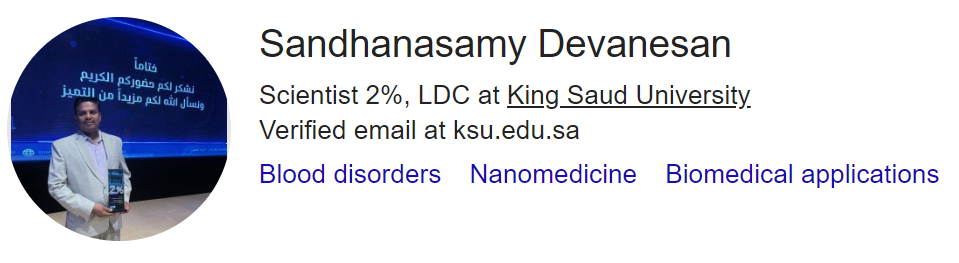
Sandhanasamy Devanesan (another “Scientist 2%” at King Saud University) responds:
“this is nit true in cytopathological view of the pointed out area .I HAVECHECKED UNDER HIGH MAGNIFICATION AND NOTED A A LOT OF CYRTOPATHOLOGICAL DIFFERNCES IN THAT AREAS…”
I stand corrected! I guess I need to increase my cyrtopathological understanding.
Some discussions border on surreal. The authors write in the following article that 101 pregnant rats “are given birth” to 101 newborn mice…
Mei Zhu , Xiaoqi Zhang Effect of IL-18 on intrauterine infection of HBV in mice on cell molecular level Saudi Journal of Biological Sciences (2020) doi: 10.1016/j.sjbs.2020.04.028
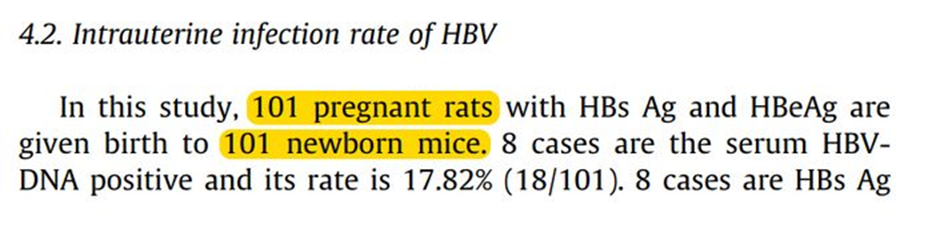
Chinese language does not have a distinct word for mice and rats, so some misunderstandings like this seem forgivable. The curious framing of this fairytale style occurrence (and especially the litter size) did make it seem worth exploring further…
Xiaoqi Zhang replied on PubPeer and doubled down:
“The objective of this study is to investigate the effect of IL-18 on intrauterine infection of HBV(Hepatitis B Virus) in mice(Offspring of pregnant rats) based on cellular and molecular level”.
So, is this a groundbreaking discovery? Or a troublingly ignorant author? The rest of the paper made about as much sense as the response. Supposedly, the rats gave birth to a litter size of one after a gestation period of 40 weeks?! Other PubPeer commenters (who I am inclined to believe) contributed further problems: HBV is unable to infect rodent hepatocytes nor can it transmit vertically in these animals. There is no way to collect 6 ml of blood from a mouse pup, which is typically <1 gm body weight… It seems likely that this paper was clumsily adapted from a human study into a paper about micerats, without accounting for much of anything, least of all biology.
But perhaps we should not be surprised by such basic ignorance, as contributors to this journal get their information from Wikipedia, how do we know? Because in this journal you can cite Wikipedia directly in the text!
Yunqi Luan, Yunpeng Luan, Youjie Zhao, Fei Xiong, Yanmei Li, Lili Liu, Yong Cao, Fei Dai Isorhamnetin in Tsoong blocks Hsp70 expression to promote apoptosis of colon cancer cells Saudi Journal of Biological Sciences (2019) doi: 10.1016/j.sjbs.2019.04.002

Most of the data in the above paper was also duplicated in another article, also in the Saudi Journal of Biological Sciences, although this time without the Wikipedia references.
Whilst I would never clown on authors for simple lapses in English, or even badly written papers, some of the writing in this journal is beyond the pale. I would challenge anyone to make head or tail of this excerpt:
Xin Lou, Ting Wang, Mingsan Miao, Ming Bai Fusen herbal tea influenced of spleen deficiency rats model Saudi Journal of Biological Sciences (2017) doi: 10.1016/j.sjbs.2017.11.014
“The main symptom is shortness of breath qi deficiency, fatigue, dizziness, diarrhea, loose stools, easy bleeding, bloody light, and even looking dirty white, spleen yang deficiency mainly in the stomach abdominal Leng Tong, greasy food cold will be abdominal pain, diarrhea, loose stool. Qi deficiency syndrome often due to eating disorders, frail, chronic illness caused by clinical manifestations of the organs function decline syndrome, trauma or disease for a long weary virtual lean, and see shortness of breath lazy words, pale, weary weakness, muscle wasting etc. Chinese medicine believes that ‘‘the spleen is the day after tomorrow”, spleen, stomach as the source of qi and blood, organs and meridians of the root, lifting of the air-hub for the body, but the body of important defense mechanism to resist evil.”
Perhaps it was produced by a poor translation algorithm, but I am reminded of the sentence under every article published online: “Peer review under responsibility of King Saud University.” So who peer reviewed the article?
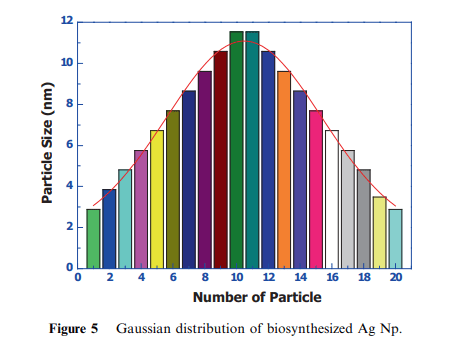
Nanoparticles need a small mention, of course. At first glance the distribution below looks suspiciously symmetrical, but otherwise might seem to be a reasonable histogram of particle size distribution. Until you read the labels on the axes. What is the sense in showing the “Number of Particle” on the x-axis and particle size on the y? A similarly muddled chart was also published by the same team.
Mohamed A. Yassin, Abd El-Rahim M.A. El-Samawaty, Turki M. Dawoud, Omar H. Abd-Elkader, Khalid S. Al Maary, Ashraf A. Hatamleh, Abdallah M. Elgorban Characterization and anti-Aspergillus flavus impact of nanoparticles synthesized by Penicillium citrinum Saudi Journal of Biological Sciences (2017) doi: 10.1016/j.sjbs.2016.10.004
With so much rubbish in the journal, you might expect the editors to be hard at work correcting and retracting, however this journal has published only ten corrigenda in its lifetime. Eight of these are related to administrative details such as author affiliations or funding sources, the other two are minor corrections to the description of figures. Only two articles have ever been retracted, one due to a data processing error (apparently to be later resubmitted, which makes me wonder why it wasn’t corrected instead?!). The other retraction was due to plagiarism. Amusingly, this second retraction notice is strongly worded for such a chaotic journal:
“This article represents a severe abuse of the scientific publishing system. The scientific community takes a very strong view on this matter and apologies are offered to readers of the journal that this was not detected during the submission process.”
One could argue that the Saudi Journal of Biological Sciences itself represents a “severe abuse of the scientific publishing system”. However, with the support of two of the world’s worst institutions (Elsevier AND the Saudi kleptocracy) I’m sure there will be no end in sight.
Interestingly, the acceptance rate for this journal is just 9%, apparently they reject 91% of submissions, so I wonder what exactly do they reject? Sound scientific papers perhaps?

 For Better Science
I wonder if someone at Clarivate Analytics would reads this excellent piece and give a thought to delisting this ridiculous journal, together with thousands more titles.
LikeLiked by 1 person
We live in hope? If Clarivate were to really clean up its listings, would some rival spring up and claim a bigger coverage, simply by listing more garbage? Publishing seems locked in a race to the bottom somehow. At least it is funny to observe (sometimes).
LikeLiked by 1 person
“If Clarivate were to really clean up its listings, would some rival spring up and claim a bigger coverage, simply by listing more garbage?”
Possible, but not probable. After all Clarivate has a name, and they are the organisation that supplies the impact factors. They are like Coca Cola: you can compete with them but will likely lose.
LikeLiked by 1 person
When I read articles like these, I am always amazed at how little effort and money is needed to advance in academia with fake ‘science’ and ‘gaming the system.’
One must truly be a morally inflexible, stubborn fool not to simply participate in it.
LikeLiked by 2 people
You need to add to your first sentence: “in bullshit institutions in bullshit countries.” Not so easy in the real scientific world, where we know who’s in the “BS Zone.”
LikeLike
US. Stanford (and previously Harvard). Ebrahim Mostafavi.
I agree, all signs of a bullshit institution in a bullshit country are there.
LikeLiked by 2 people
Yeah, I’m not sure I totally agree, with the assessment that all of this is happening in bullshit fields. See for example the chaos at QMUL in the UK.
LikeLike
If you check other saudi journals like journal of Saudi pharmaceutical society you will find the same issues. Infact I observed that one of the editor is a co-author in several articles which belongs to south Asia.
LikeLike
I agree, most of the journals associated with King Saud University seem quite full of rubbish. The Biological Sciences one has a lot of pictures, so it is easier to show that!
LikeLike
Dr.David “A MECCA FOR BAD SCIENCE”. This is a direct attack on Religious faith the people have with the holy place MECCA. PL. don’t drag religion to boost your vacubulary.The word hurts the faith of many . Further Scientific findings may vary from lab to lab according to the facilities. May be less developed country’s lab may not have good provisions. So avoid general comment about the university. If you are really interested for correction you can ask clarification from authors. If there is any mistake author will request the publishers to withdraw or request for erratum.ONE CANOT BE MASTER OF ALL .If the author admits the mistake and correction pl remove it. This act is an attack on individual image warrants judicial steps for personality damage. PL. DONT PUT THE AUTHOURS IMAGE .THIS IS TOO MUCH AND WITH AN AIM YTO TARNISH THE IMAGE OF A PARTICULAR RELIGION OWNED INSTITUTE. Kindly look into the papers published by other nations. Thank you
LikeLike
Calm down. You misguide your religious anger. Did you know Schneider is a Jew?
LikeLike
“This act is an attack on individual image warrants judicial steps for personality damage. PL. DONT PUT THE AUTHOURS IMAGE ”
This is a very strange interpretation of the religious image ban in Islam. By all interpretations, the ban extends to images of humans and animals, but not to images of cells, nanoparticles, or other inanimate objects, eg of a jar.
LikeLike
The joke is relevant because of the English idiom about Mecca. I would be sure to joke equally about all religions, so I wouldn’t worry about it.
It’s nothing to do with lab provisions, the images are being lazily duplicated and photoshopped.
I already asked for clarification by EVERY SINGLE AUTHOR on PubPeer. The journal and authors choose not to act, they deserve to be ridiculed like this.
Notice I also write about labs in the US and UK. Feel free to check out my other blog posts!
LikeLike
Can I know your specialization because your comments are funny. Its obvious that you make comments without understanding the topic and/or research hypothesis.
Could you please clarify your purpose from this article, where you just critisize papers published in highly reputable journals !!
I’d recommend you to review your qualification and ability to critisize such papers.
LikeLike
Show me yours, I’ll show you mine.
LikeLike
Please feel free to point out any errors in my blog post.
LikeLike
While I understand that “Mecca” is being used here as an English idiom to refer to a central or significant place, I can’t help but wonder why the author didn’t opt for something like the “Vatican of bad science” instead. It seems that the choice of “Mecca” might be more tied to the local culture and context, which in turn could unintentionally target a region or religion. If that’s the case, then it goes beyond just criticizing poor academic practices and veers into something more culturally specific.
I completely agree with the overall message about criticizing the worst academic practices and flawed science, but I think we should be cautious about the language we use. While “Mecca” might be a widely understood idiom in English, I believe there are better ways to make the point without invoking religious or regional symbols, even if it’s just meant to be an idiomatic expression.
LikeLiked by 1 person
Mecca is in Saudi Arabia, and as you acknowledge, this is a widely understood idiom in the English language. It’s also a joke. “Vatican of bad science” would have been a terrible way to title this blog because the Vatican is associated with the Roman Catholic religion, while the sponsor of the now defunct journal is King Saud university (KSU). Here is a quote from the president’s message on the KSU website:
“Welcome to KSU, the Kingdom of Saudi Arabia’s leading university in knowledge partnership. Since its establishment and under the patronage of the Custodian of the Two Holy Mosques, King Salman bin Abdulaziz, and His Crown Prince, His Royal Highness Prince Mohammed bin Salman bin Abdulaziz – may God protect them – our university has become the treasure trove of knowledge in the Middle East.”
Maybe if Saudi’s feel uncomfortable that idiotic “science” has been associated with their culture and religion, they could untangle these links, or stop doing silly science in the name of the Custodian of the Two Holy Mosques.
Sometimes pillorying religions, politicians, countries, and leaders is good in itself. If you found the joke offensive that’s good, it wasn’t “unintentional” to target the region or religion, I did that on purpose.
Some people find my writing offensive, but they think it is good to write about controversial things, I think this is a blind spot. Disagreeable people write offensive things.
LikeLike
Ah, how charming! A joke at the expense of an entire culture and religion, dressed up as wit—how very clever. But alas, the metaphor of “Mecca” as a symbol for bad science is as misguided as it is puerile. Yes, we all understand the idiom; it flutters about like a lazy parrot, repeating what’s fashionable, but here, it flaps its wings without grace or understanding. You have chosen to wield a sacred symbol as a weapon, invoking the name of Mecca—a place of profound reverence to millions—as though it were little more than a punchline. And for what, pray tell? To poke fun at a flawed academic journal? How utterly shallow.
While I initially thought this was an academic post, it seems someone here believes they possess the ultimate knowledge on everything. I prefer not to engage with such narrow, self-assured mentalities.
LikeLike
But thanks for the comment, I’m glad you thought the writing was worth responding to. Here’s a deal: if all the fake articles in KSU sponsored journals are retracted, I will ask Leonid if he is OK to change the title of this blog to “A Vatican for Bad Science” as you suggested.
LikeLiked by 1 person
Retracting fake articles is one thing, but how we critique cultures matters too. Using religious symbols as shortcuts only detracts from the actual problem. Let’s focus on the substance, not the sensationalism.
LikeLike
And yes, I’m not pro-Saudi, nor Saudi, and have no interest in defending any wrongdoing. I’ve lived in Saudi for many years and criticize what should be criticized, but I do so without resorting to religious symbols—of any religion—as crutches for my argument.
LikeLike
“A joke at the expense of an entire culture and religion” – A real student of comedy and free speech here. Best oil the chainsaw! Get a grip, my guy.
LikeLike